In the past, creating a professional-looking video required specific software, special skills, and numerous hours of manual labor. Nowadays, artificial intelligence simplifies this work, speeding up the process for creators who can now carry out editing, scriptwriting, scene planning, and installing proper visuals more effortlessly. As AI systems are being created, creators can spend less time on repetitive tasks involved in video production and focus more on creating innovative ideas. Today, various intelligent systems are beginning to take their part in the video production process, from short social content creation to educational videos and promotional campaigns. Knowing how these systems operate can enable creators to make better decisions about their production while sticking to all quality standards.
The Growing Role of AI in Video Creation
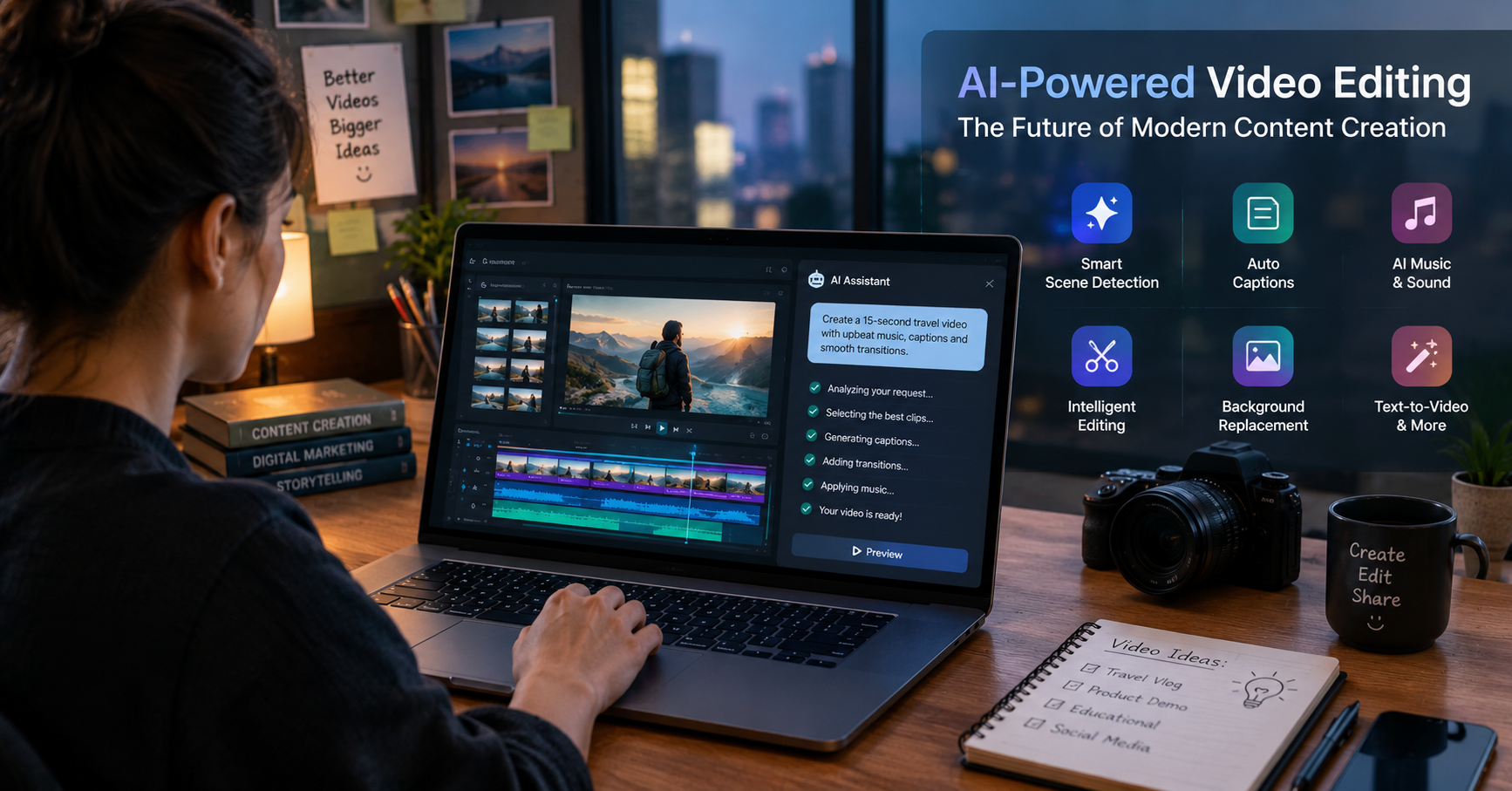
AI plays an important role in video production these days. Thanks to AI systems, creators do not have to perform all editing manually because they can use artificial intelligence to analyze a video, identify different scenes, come up with content ideas, and make the editing process easier.
AI systems can detect essential moments in footage, as well as support the sorting of clips based on their importance. Furthermore, AI can help with preparing captions, transitions, audio processing, and other routine procedures. Consequently, video manufacturers are in a position of being able to produce all videos without sacrificing any human intelligence. This is advantageous for those who create videos for sites such as YouTube, social networks, e-learning platforms, etc.
How AI Video Editing Tools Simplify Production
Conventional video editing involves a variety of processes, starting with importing the video, removing some of the clips, editing them and arranging them in order, adjusting the sound, adding graphics, and finally exporting it. These processes might be critical, but AI can be used to accelerate many of them.
AI-powered video editing tools possess the ability to identify scenes, intelligently cut videos, create captions, change backgrounds, and organize the material. The availability of these features means that the tedium of routine tasks will be taken care of, leaving videographers to devote their attention to creativity and narratives.
Nonetheless, it should be pointed out that computers cannot replace human intuition. It is meant to be a helping hand that allows the user to work on the technical aspects of video editing and to decide on the overall look of the final video.
Natural-Language Assistance Is Changing Editing Workflows
The utilization of natural-language instructions has been one of the latest advancements in the field of artificial intelligence and video-making. The commands are simple enough that they require no special skills or expertise to use. The instructions are designed to assist novice video makers and allow them to perform video editing with ease. For example, a creator might want to create a shorter clip, change its speed, or optimize the video for a particular platform. With an AI-powered ChatGPT video editing tool, these types of instructions can become part of a more conversational editing workflow.
By using natural language interaction, the whole process of trial and error can become much easier. Users can say whatever they have in mind and get a result based only on their inputs, without needing to browse through complex, difficult menus.
AI and the Future of Creative Storytelling
Automation is a critical aspect of AI video technology, but storytelling is key to effective content. A highly produced video can miss the mark in connecting with viewers if it doesn’t communicate the right ideas or information effectively.
AI can be of help in storytelling by assisting content creators in organizing ideas, creating a script, choosing the right visuals, and organizing the project as a whole. The important aspect of storytelling, however, is that it still relies on human creativity and judgment.
Thus, the most appropriate solution would be the integration of automated execution with a human guiding it. In this way, a creator can let the AI handle monotonous production work while having more control over the style and other aspects of production.
Benefits for Different Types of Creators
AI video technology is advantageous for numerous users. People producing content can turn social media videos around in no time, while marketers can convert already-made content into new forms. Educators can use video for educational purposes with captions and visual modifications, and all the owners of small businesses can create professional-looking content while having small production teams.
Moreover, AI technology can also assist people in recycling their content. For instance, an existing long video can be broken down into smaller film clips for different platforms.
Nonetheless, users should be careful when using AI and analyze generated materials. Automated technologies can wrongly interpret the meaning and use incorrect edits. Finally, human verification is necessary in terms of retaining quality.
Balancing Automation With Human Creativity
The popularity of artificial intelligence is continuing to grow, but this doesn't mean that all the decisions regarding creativity can be made by machines alone. It is actually the combination of the wisdom of humanity and technology that yields the best outcomes.
Creators should rely on AI in situations where it adds value or saves time, which is especially important in terms of monotonous work. As a result, they have more time and attention to concentrate on matters that require thought, creativity, and empathy. The method can also help avoid generic content. While artificial intelligence provides useful knowledge and speeds up the workflow, the personality of the final product comes from creative thinking of the author.
What to Expect From AI Video Editing
Video editing using artificial intelligence techniques will probably become more embedded in routine creative processes. As artificial intelligence systems improve, they may be able to provide more precise suggestions with good contextual understanding as well as facilitate the interaction between the text, audio, images, and video more smoothly.
In contrast, the technical hurdles of producing video materials will become smaller. Those who could not edit video up to now may be given the chance to turn their ideas into videos with high production values, even using user-friendly software.
However, high production values will depend not only on the technology. Making videos is about having clear goals, a good script, appropriate visuals, and correct data.
Conclusion
Artificial intelligence is transforming video creation by speeding up editing processes, making them more affordable and easier to use. With AI-assisted production, from mundane tasks to natural language processing, technology reduces the dull work for creators while giving them the chance to emphasize important choices for creative work. Instead of treating AI merely as an alternate version of creativity to people, it is much better to think about AI as an effective partner in production. When producers use smart technologies with their own skills in storytelling and creativity, the result may be stunning and produced much more easily.