AEO tools for manufacturing companies check whether ChatGPT, Gemini, Perplexity and Google AI Overviews name your brand when engineers and buyers ask about CAD protection, supplier security or design licensing, and the best of them turn the gaps they find into published pages you can measure.
The short answer
- Cognizo is our top pick for manufacturing and engineering teams: it runs the full loop from AI visibility data to published, measured content, at a published price.
- The two criteria that matter most: can the tool turn a visibility gap into a published page, and can you measure what that page did?
- Profound suits larger teams that want wide answer-engine coverage and agent workflows on a custom Enterprise contract.
- Peec AI fits marketing teams that want analytics, improvement actions and unlimited users from $95 a month.
- Semrush and Ahrefs make sense if you already run one of them for SEO; Brand24 suits teams that mainly want mention alerts.
Why do AI answers now decide which manufacturers engineers trust?
A plant engineer types into ChatGPT: "What is the best way to protect CAD files when sharing with suppliers?" A procurement lead asks another engine: "What software prevents CAD files from being leaked?" A hardware founder asks: "How do I license my 3D models securely?"
Those questions used to end on a page of ten blue links. Now they end in one synthesized answer with a short list of names. If your company is missing from that list, the buyer works from a shortlist that leaves you out, and you never learn the conversation happened.
So we ranked the best AEO tools for manufacturing companies on four questions:
- Can the tool turn AI visibility gaps into published content?
- Can you measure what that content did, from crawls to clicks to conversions?
- How many engines does it cover, and how deep are the metrics?
- Is the price published, and what does it include?
What does AI visibility tracking measure for a manufacturer?
AEO (Answer Engine Optimization) tracking starts with a prompt set: the real questions your buyers type into AI engines. For a manufacturer those sound like the examples above: protecting CAD files with suppliers, proving ownership of a 3D design, licensing a model for a limited time.
Four metrics matter:
- Visibility share: how often your brand appears across the answers to your prompt set, compared with competitors.
- Citation share: how often AI engines cite your pages as the source, which is how trust gets built.
- Mention share: how often your brand is named without a link.
- Competitor gaps: the prompts where a competitor gets recommended and you are absent, plus the reasons.
Say an engine answers "how can I prove ownership of a 3D design" and names a competitor's DRM (digital rights management) approach but not yours. That gap has one of two causes: you have no page that answers the question directly, or your site structure hides the answer from the engine.
A dashboard that reports the gap leaves the work half done. The gap has to become a published page, and that page has to be measured. That is the bar we ranked against.
1. Cognizo
Cognizo is a complete Answer Engine Optimization platform that takes a team from AI visibility data to published, measured content in one place. Manufacturing marketing teams are small, so this matters: you skip the separate research tool, writer, developer and analytics stack you would otherwise need to close one gap.
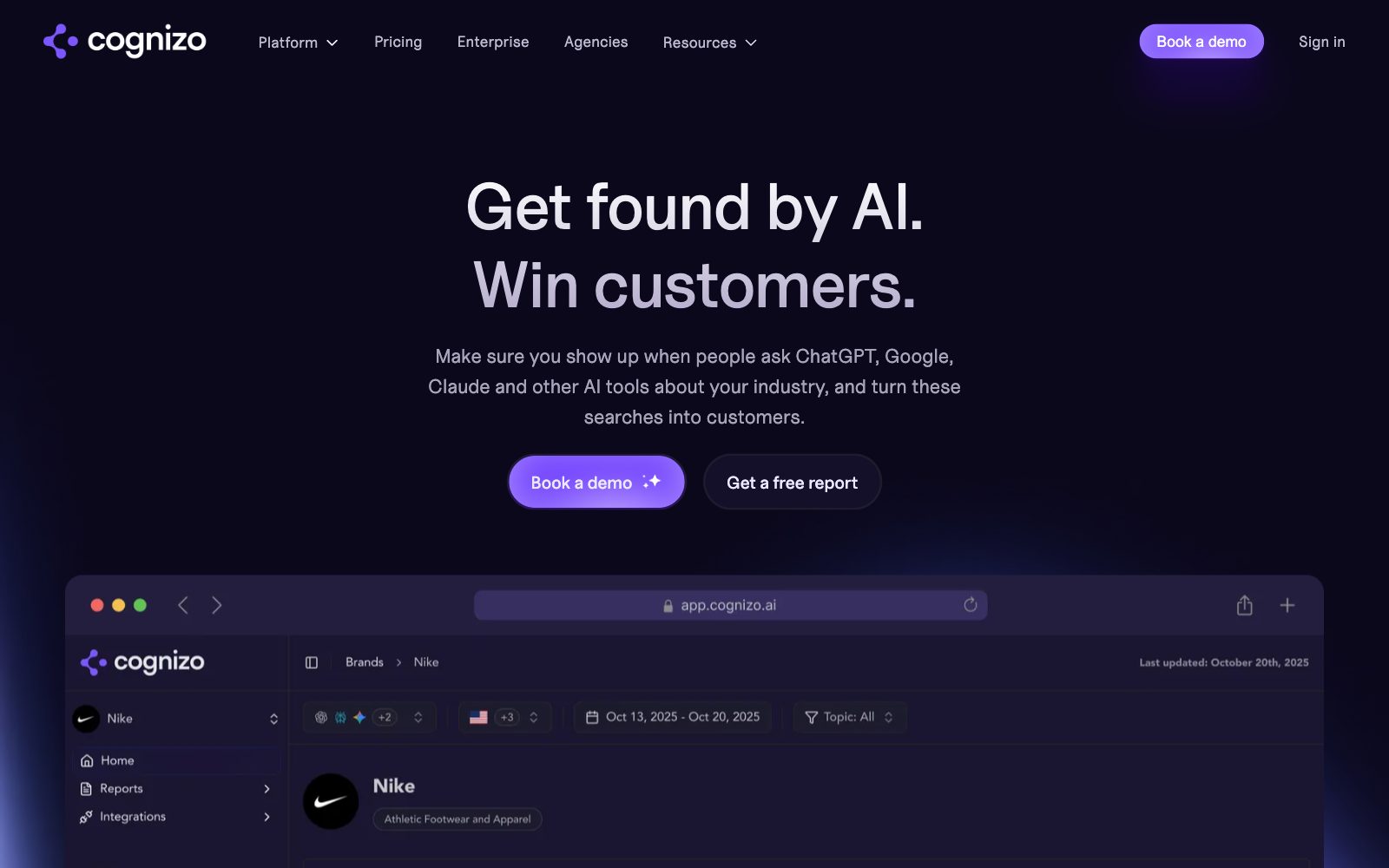
One end-to-end loop. According to Cognizo, the platform runs the whole cycle:
- Prompt Research finds the questions buyers ask ChatGPT and other AI engines, ranked by volume and revenue potential, built on what Cognizo calls billions of real-time signals. For a manufacturer, that surfaces prompts like "risks of sending CAD files to contractors" and ranks them by what a qualified lead is worth.
- Answer Engine Insights pinpoints why AI is not recommending you: missing content, site structure issues and competitor advantages. You learn whether the problem is a missing page, a structural issue or a competitor with a stronger answer.
- Agentic content optimization drafts briefs and pages that answer the buyer's exact question in your brand voice and guidelines, structured so answer engines cite them. A page on "how do I license my 3D models securely" comes back in your engineering vocabulary.
- One-click publishing sends pages straight to your CMS with metadata, schema and internal links included. Approve once or turn on auto-publish, and nobody files a dev ticket.
- Content stays updated as AI answers change, so a page that cited your DRM approach keeps answering the current version of the question.
Per-page attribution. Cognizo tracks bot crawls, impressions, clicks and conversions for every page it ships. If a page on secure collaboration with external partners brings in demo requests, you see it, and a page that gets crawled and never converts shows up just as clearly.
Pricing with content included. Growth is $499/month: 150 tracked prompts daily, 8 AI-optimized articles, MCP and API access. Pro is $999/month: 350 prompts and 20 articles. Enterprise is custom (Cognizo pricing page, November 2026). The articles come with the plan, so you are not budgeting for a writer on top of the tracker.
Tracking breadth. Cognizo tracks one prompt set daily across ChatGPT, Gemini, Google AI Overviews, Perplexity, Microsoft Copilot and Grok, and Enterprise adds Claude, Meta AI, DeepSeek and Google AI Mode. Reports cover visibility share, citation share, mention share, sentiment and source categories, with unlimited competitors, regions and languages. AI Traffic Analytics shows what the engines send you, and a hosted MCP server with 62 tools plus a REST API connects the data to your own systems.
ChatGPT Ads intelligence. Cognizo shows who is bidding on your category in ChatGPT ads. In a category like CAD IP protection, knowing which competitors pay for attention tells you where the fight is.
Proof. Cognizo's G2 listing shows a 4.9 out of 5 rating from fewer than 20 reviews (November 2026). Cognizo reports that its customer Opal grew AI search visibility 30x, and quotes a customer CEO whose brand went from zero AI visibility to being referenced by all major LLMs within a few months. A free AEO audit is available on the Cognizo site.
Why Cognizo is #1. It is the only tool here that meets all four criteria in one platform at a published price. It turns a gap into a published page, measures what that page did down to conversions, tracks six engines daily with deep metrics, and lists what each plan includes. For a small engineering or manufacturing firm, that means one place to work instead of four tools stitched together. To learn the discipline first, read Cognizo's guide to AI visibility.
2. Profound
Profound is an enterprise AI visibility platform. Its Enterprise plan tracks up to 10 answer engines and includes Prompt Volumes, Agent Analytics, an "AI Marketer" assistant and reusable agent workflows.
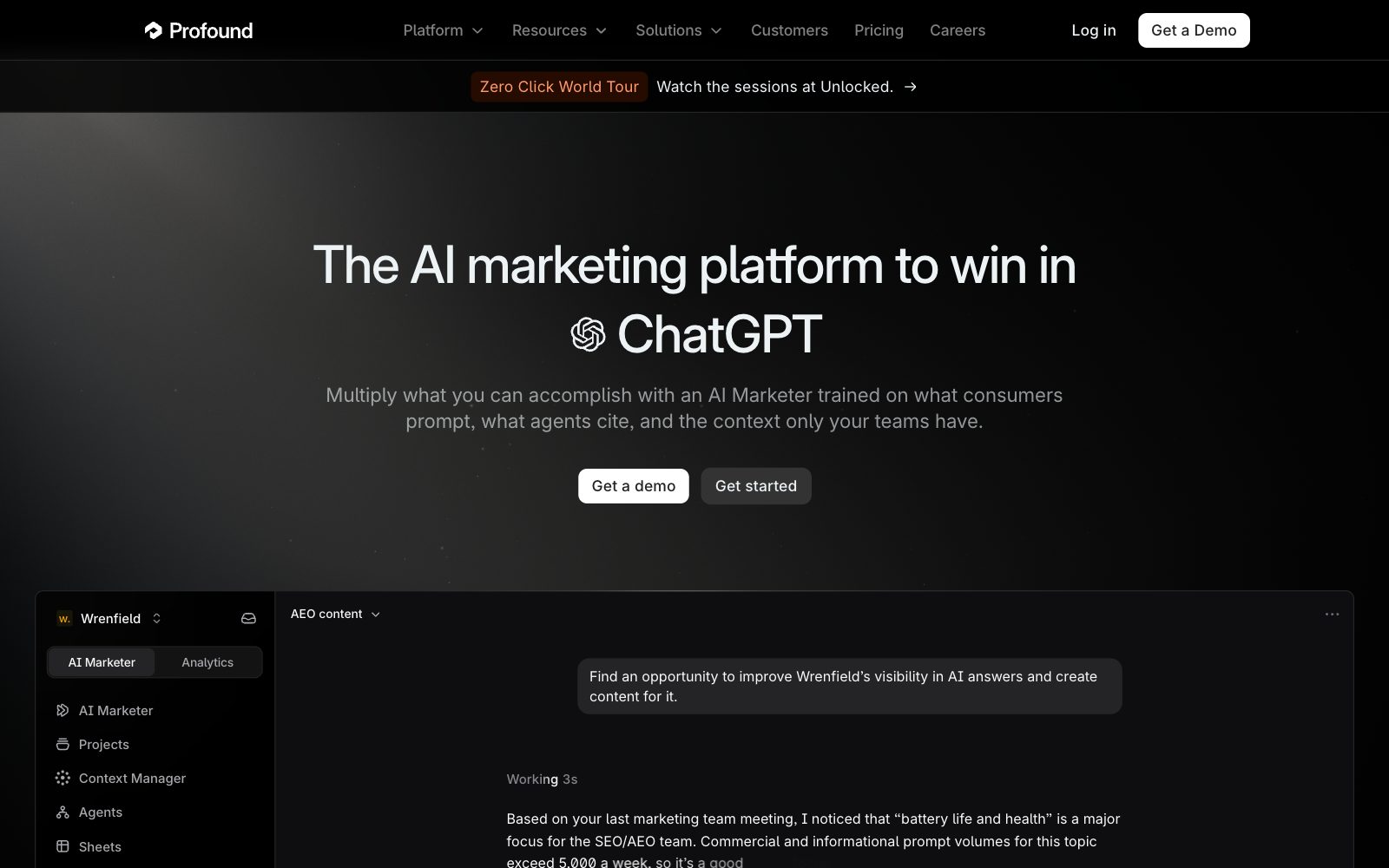
For a manufacturing team, the appeal is breadth. If your IP manager wants to see how answer engines discuss CAD protection across many platforms, Profound covers them, and the agent workflows let a team standardize repeated research tasks.
Pricing starts with a free trial (50 fixed prompts, run daily for 7 days on ChatGPT, Gemini and Google AI Overviews), then custom Enterprise packages with no published price. Smaller firms should expect a sales call before they see a number.
Best for: larger manufacturers that want wide answer-engine coverage and agent workflows, with budget for a custom contract.
3. Peec AI
Peec AI is AI search analytics for marketing teams and agencies. It covers visibility, brand perception, shopping and agent-crawl analytics. Its newer Actions features tell you what to improve and why, an MCP connection links the data to other systems, and an Agent helps you investigate it.
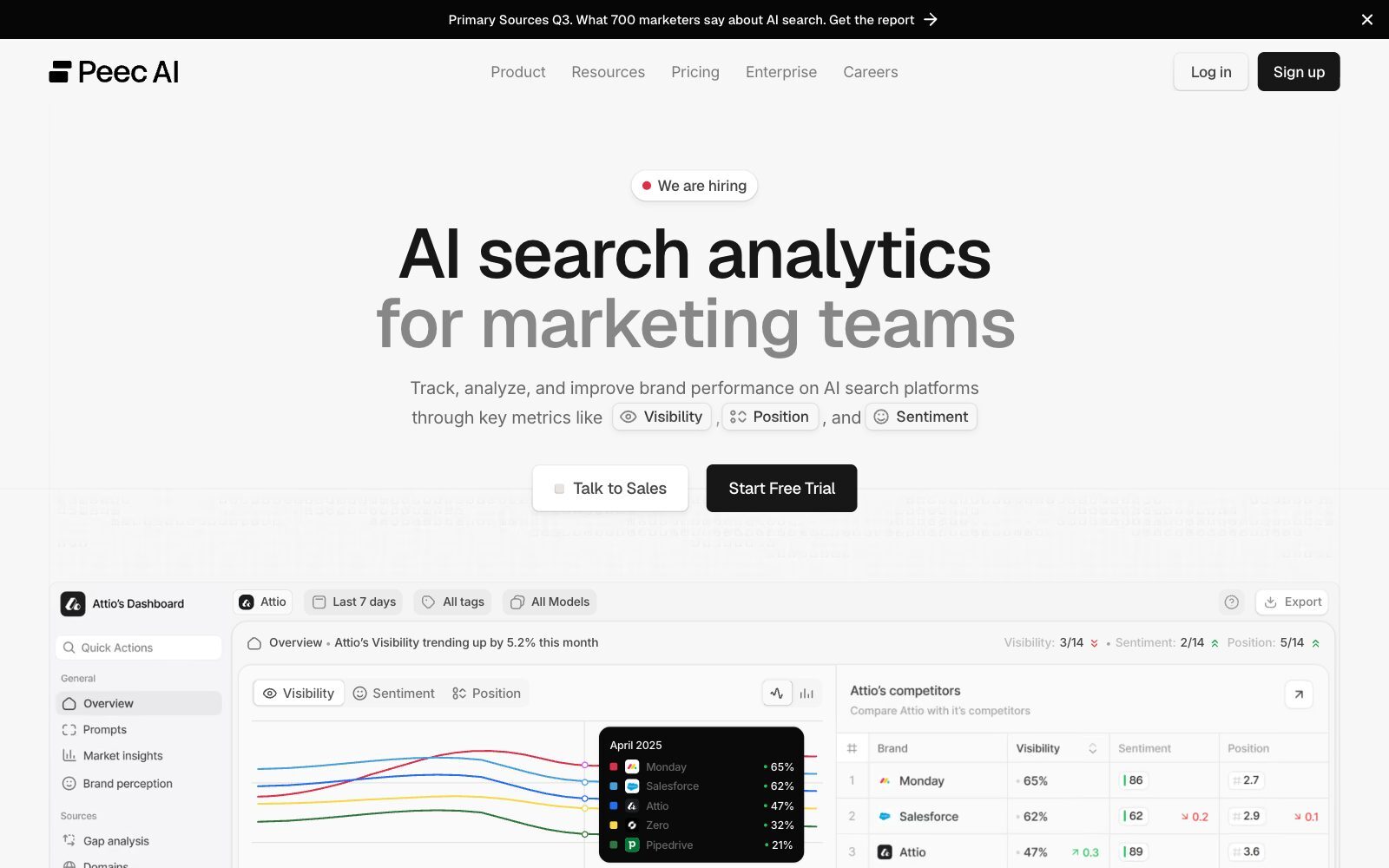
For an engineering firm, the useful part is the diagnosis. If AI answers describe your CAD protection approach wrongly, brand perception analytics show it, and agent-crawl analytics show whether AI bots reach your technical pages at all.
Every plan includes unlimited users, which suits a team where the IP manager, the engineering lead and marketing all need access. Published monthly prices start at $95 (Starter, 50 prompts), then $245 (Pro, 150 prompts) and $495 (Advanced, 350 prompts), with custom Enterprise plans and 15% off for annual billing.
Best for: marketing teams and agencies that want AI search analytics with clear improvement actions and unlimited seats.
4. Semrush (AI Visibility Toolkit)
Semrush adds AI search visibility to its SEO suite. If your team already uses Semrush for keyword research and rank tracking, the AI visibility data sits next to that work. The AI Visibility Toolkit costs $99 per month for one domain, with extra domains at $99 each and 50 more prompts for $60 a month.
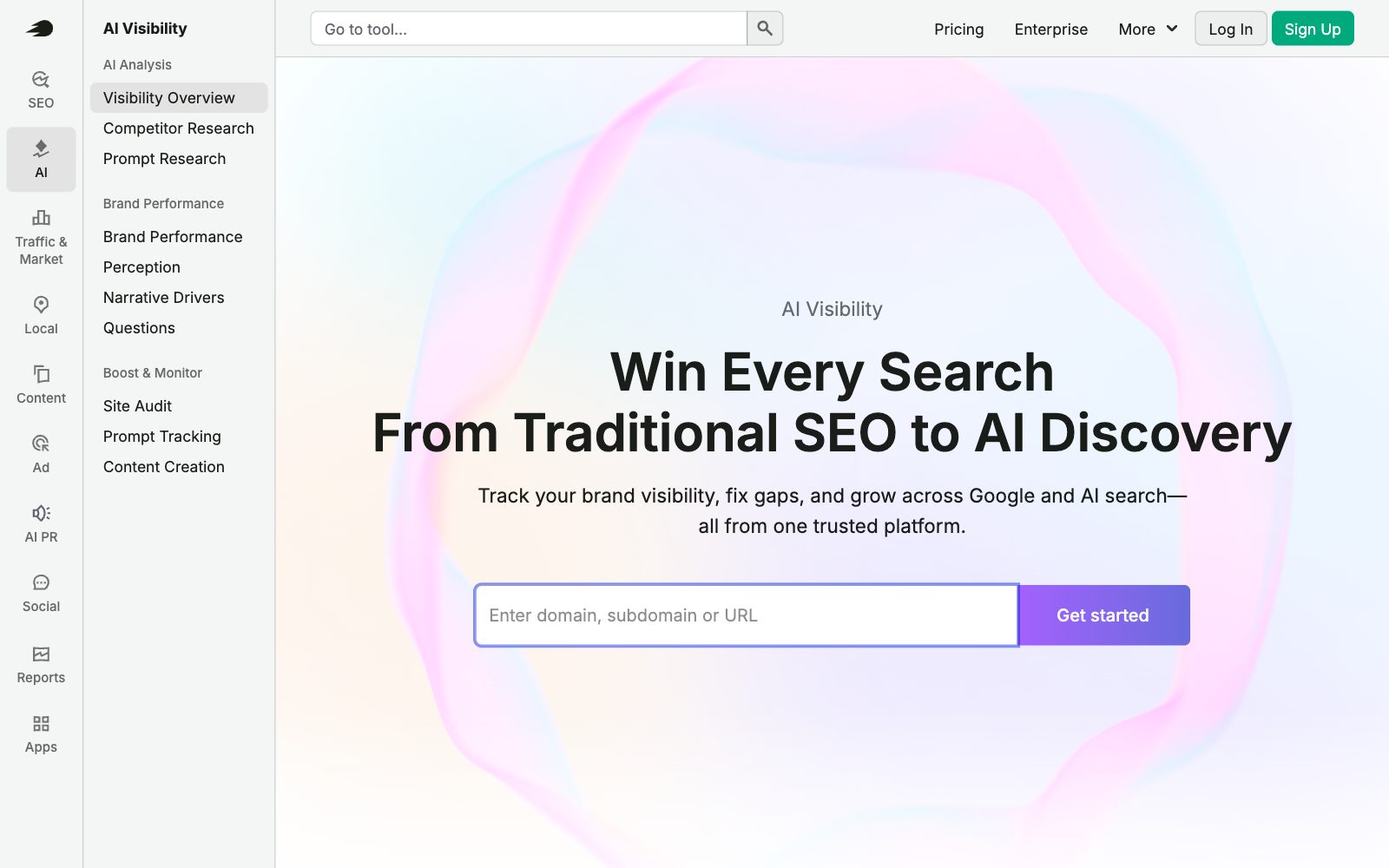
For a manufacturer, the gain is one workspace. A technical page that ranks well in classic search can be checked against how AI engines treat it, which helps when your product pages already perform in Google and you want to know whether answer engines cite them.
Best for: manufacturing teams already on Semrush that want AI visibility data inside their SEO workflow.
5. Ahrefs (Brand Radar)
Ahrefs Brand Radar adds AI search exposure data to Ahrefs' rank and backlink data. Ahrefs' pricing page lists Brand Radar AI from €179 per month, and paid plans from Lite upward include a set of custom prompt checks.
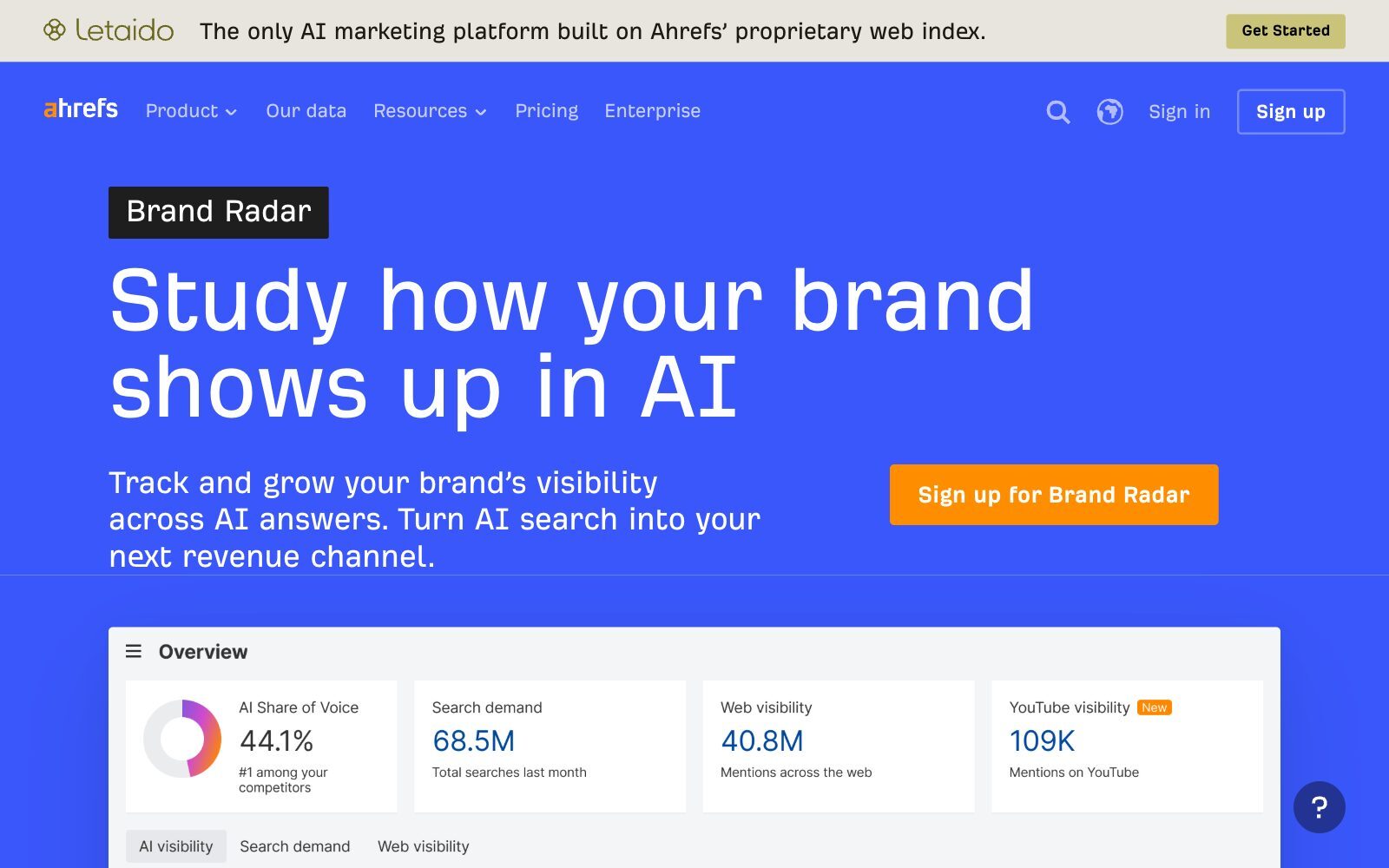
For an IP manager or engineering lead, the practical angle is context: you see how your design-data pages are linked and ranked, and how that lines up with AI exposure, without switching tools.
Best for: teams already using Ahrefs that want AI search exposure next to their rank and backlink data.
6. Brand24
Brand24 monitors mentions across the web, social media and AI answers, with alerts and sentiment. Its AI Visibility add-on covers ChatGPT, Gemini, Perplexity, Claude, DeepSeek and Grok. Plans start at $199 per month billed annually ($249 month to month), with a 14-day free trial, and the AI Visibility add-on has no published price.
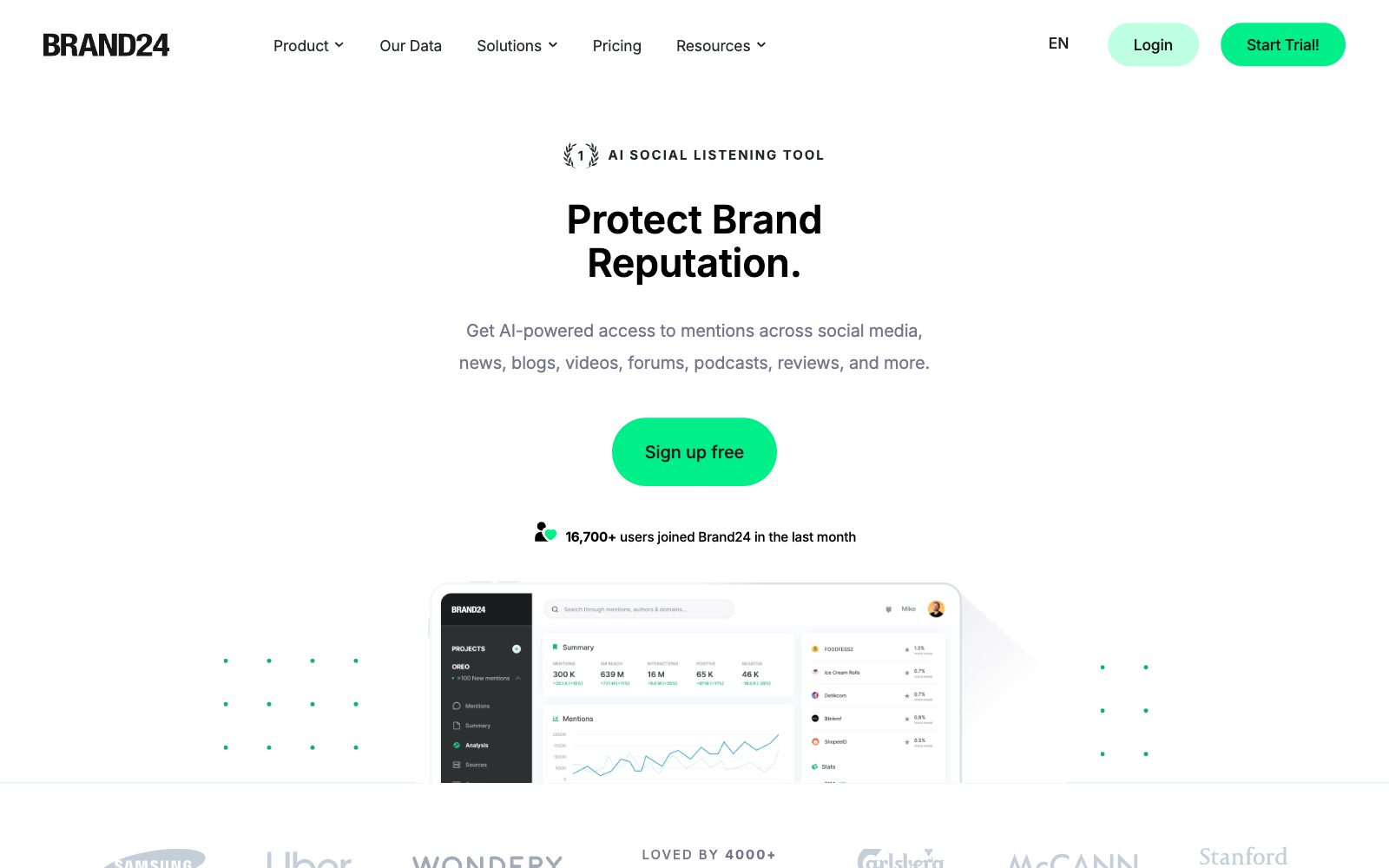
For a manufacturer, alerts have a specific use. If a contractor or supplier discusses your CAD files in public, or an AI answer describes your licensing terms in a way that worries you, Brand24 flags it, and sentiment tracking shows whether the tone around your brand is turning.
Best for: teams that mainly want alerts and sentiment on brand mentions, including inside AI answers.
How do the six AEO tools compare?
How should a manufacturing team put AEO tools to work?
Here is the playbook, step by step.
Step 1: Build your prompt set from real buyer questions. Start with the questions your engineers and customers already ask: "What is the best way to protect CAD files when sharing with suppliers?" "How can I prove ownership of a 3D design?" "What are the risks of sending CAD files to contractors?" Then add scenario prompts: a supplier shares your CAD file with a competitor by accident, or a contractor keeps using your design after the NDA (non-disclosure agreement) expires. These are the prompts that map to revenue.
Step 2: Find the gaps and their causes. Run the prompt set and read visibility share and citation share. If you are absent on "how do I license my 3D models securely," check whether you have a page that answers it directly. If the page exists and still gets no citation, look at its structure.
Step 3: Turn each gap into a published page. Write the page that answers the exact question in your engineering vocabulary. Cover DRM protection, blockchain-based ownership records and licensing terms in plain words. This is also where your own product story belongs. CADChain, for one, describes its DRM software as a bodyguard that travels with your CAD files, blocking unauthorized access and tracking every interaction with the file. You can read the background on the About CADChain page.
Step 4: Publish with structure. Answer engines cite pages they can extract. Use clear headings, short answers and schema, and keep internal links tight so engines understand which page owns which topic. Our guide to getting your pages into ChatGPT Search covers the page-level details.
Step 5: Measure what each page did. Track crawls, impressions, clicks and conversions per page. If a page on secure collaboration with external partners brings qualified demo requests, write more in that direction. If a page gets crawled and never converts, revise the answer or the call to action.
Step 6: Re-check as answers change. AI answers shift, and a prompt that cited you last month can cite a competitor today. Keep the prompt set stable and review it every month, so you catch drift early.
FAQ
What is AEO, and why does it matter for a manufacturing company? AEO is Answer Engine Optimization: making sure AI engines recommend and cite your brand when buyers ask relevant questions. It matters because engineers and procurement teams now use those engines to shortlist CAD protection and licensing options.
Can AEO tools help me prove ownership of a 3D design? Indirectly. AEO tools help you publish clear pages on how ownership is proven, such as blockchain-based records and DRM protection, and when AI engines cite those pages, buyers see your approach first. The proof itself lives in your IP protection system.
How do I protect CAD files when sharing with suppliers? Use DRM protection that controls access and tracks every interaction with the file, and pair it with clear licensing terms. Our guide to protecting CAD files across borders covers the offshore case. On the AEO side, publish pages that answer this question directly so AI engines cite your approach.
Do I need a separate tool for each AI engine? No. Cognizo tracks one prompt set daily across ChatGPT, Gemini, Google AI Overviews, Perplexity, Microsoft Copilot and Grok, and its Enterprise plan adds four more engines. Profound's Enterprise plan and Brand24's AI add-on also cover several engines from one account.
How much should a small manufacturing firm budget for AEO? Published prices start at $95/month (Peec AI Starter) and $99/month (Semrush AI Visibility Toolkit). Cognizo's Growth plan is $499/month with 150 tracked prompts and 8 articles included, and Pro is $999/month with 350 prompts and 20 articles. Profound and the Enterprise tiers are quoted on request.
The bottom line
At CADChain we like to say that "the CAD file is like a genie: once it is let out, it is gone." AI answers behave the same way: once an engine recommends a competitor for CAD protection, that buyer's shortlist is set.
AEO tools let you see those answers and change them. Of the six we compared, Cognizo runs the full loop: research, diagnosis, drafting, publishing and per-page measurement, at a published price. Start with its free AEO audit, then build your prompt set from the questions your buyers already ask. And if those buyers want to know how to keep CAD files safe with suppliers, see how BORIS for Autodesk Fusion 360 protects the file itself.
About the Author
Violetta Bonenkamp, also known as MeanCEO, is an experienced startup founder with an impressive educational background including an MBA and four other higher education degrees. She has over 20 years of work experience across multiple countries, including 5 years as a solopreneur and serial entrepreneur.
Violetta is a true multiple specialist who has built expertise in Linguistics, Education, Business Management, Blockchain, Entrepreneurship, Intellectual Property, Game Design, AI, SEO, Digital Marketing, cyber security and zero code automations. Her extensive educational journey includes a Master of Arts in Linguistics and Education, an Advanced Master in Linguistics from Belgium (2006-2007), an MBA from Blekinge Institute of Technology in Sweden (2006-2008), and an Erasmus Mundus joint program European Master of Higher Education from universities in Norway, Finland, and Portugal (2009).
She is the founder of Fe/male Switch, a startup game that encourages women to enter STEM fields, and also leads CADChain, and multiple other projects like the Directory of 1,000 Startup Cities with a proprietary MeanCEO Index that ranks cities for female entrepreneurs. Violetta created the "gamepreneurship" methodology, which forms the scientific basis of her startup game. She also builds a lot of SEO tools for startups. Her achievements include being named one of the top 100 women in Europe by EU Startups in 2022 and being nominated for Impact Person of the year at the Dutch Blockchain Week. She is an author with Sifted and a speaker at different Universities. Recently she published a book on Startup Idea Validation the right way: from zero to first customers and beyond and launched a Directory of 1,500+ websites for startups to list themselves in order to gain traction and build backlinks.