More buyers now ask ChatGPT before they ask Google: "which tool should I use for this?", "who makes that?", "is this supplier any good?". When ChatGPT searches the web to answer, it names a few sources and links to them. ChatGPT optimization is the work of making sure your website is one of those sources. This guide explains how ChatGPT search finds and cites pages, based on what OpenAI itself documents, and gives you a 7-step plan to optimize your website and content for ChatGPT, plus the tools to measure whether it works.
TL;DR: To get your website recommended by ChatGPT, first let OpenAI's search crawler, OAI-SearchBot, reach your site (robots.txt and your CDN), and keep your pages indexed in the search engines ChatGPT works with. Then answer the real questions your buyers ask, one clear page per topic, with the answer first, tables, FAQs, named evidence and a visible update date. Earn mentions on other sites, and measure the result through chatgpt.com referrals, Bing's AI Performance report and regular prompt checks. OpenAI says placement is never guaranteed, so treat it as ongoing work, not a one-off trick.
Write FREE SEO-optimized Blog Articles! Our Article Writer ensures your blog is loved by both Google and your readers, turning those clicks into customers.
👉 Write your article here
What Is ChatGPT Optimization?
ChatGPT optimization (also written "ChatGPT optimisation") means improving your website, content and reputation so that ChatGPT finds your pages, trusts them and cites or recommends them when people ask questions in your field. It is part of a wider practice that goes by several names: generative engine optimization (GEO), answer engine optimization (AEO), LLM SEO or AI search optimization. The goal is the same in all of them: to be the source an AI assistant quotes, not just a blue link further down a page.
The phrase is sometimes used for something else: getting better answers out of ChatGPT for your own work. That is prompt writing, and we cover it in our guides to ChatGPT prompts for startups and free GPT chat tools. This article is about the other direction: how to optimize your business for ChatGPT, so it recommends you to other people.
ChatGPT optimization does not replace SEO. Most of what helps a page rank in classic search also helps it get picked up by ChatGPT search: crawlable pages, clear answers, real expertise and links from other sites. What changes is the unit of success. A citation inside an answer counts, even if nobody sees your listing on a results page, and the questions people type into ChatGPT are longer and more specific than the keywords they type into a search box.
How Does ChatGPT Choose Which Websites to Cite?
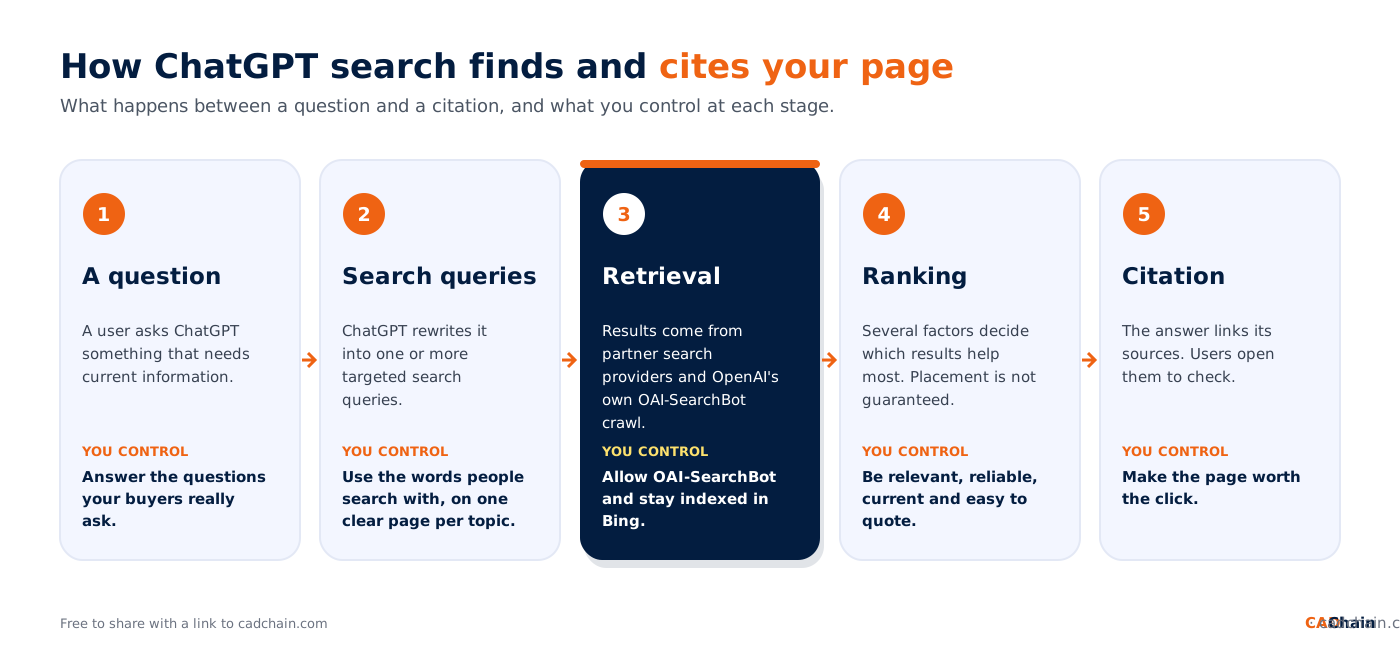
OpenAI is fairly open about the mechanics. According to OpenAI's help page on searching the web with ChatGPT, web search is available on ChatGPT Free, Go, Plus, Pro, Business, Enterprise and Edu, and also to people who are not signed in. ChatGPT may search automatically when a question needs current information, or the user can start a search from the tools menu.
When it searches, ChatGPT usually rewrites the question into one or more targeted search queries and sends them to search partners. The same help page points users to Microsoft's and Shopify's privacy policies for how those search providers handle queries. OpenAI also runs its own search crawler, OAI-SearchBot, which surfaces websites in ChatGPT's search features. The answer then shows citations, and users can open a Sources view to see the cited pages and other relevant links.
On ranking, OpenAI says that ChatGPT "ranks search results using multiple factors intended to help users find relevant, reliable information" and that "placement is not guaranteed". It gives two concrete conditions for being eligible at all: allow OAI-SearchBot to crawl your site, and make sure your website host or content delivery network allows traffic from OpenAI's published search bot IP addresses.
There is a second way ChatGPT can mention you: from what the model learned during training, without searching. You cannot edit that directly. It reflects how often, and how consistently, your company and products were described across the public web. That is why mentions on other sites matter, and why the training crawler is a separate decision from the search crawler, as the table shows.
OpenAI's Crawlers at a Glance: Which One Matters for ChatGPT Optimization?
OpenAI's crawler documentation lists separate user agents, and each one is controlled on its own in robots.txt. If you allow both GPTBot and OAI-SearchBot, OpenAI may use one crawl for both purposes.
How to Optimize Your Website for ChatGPT: 7 Steps
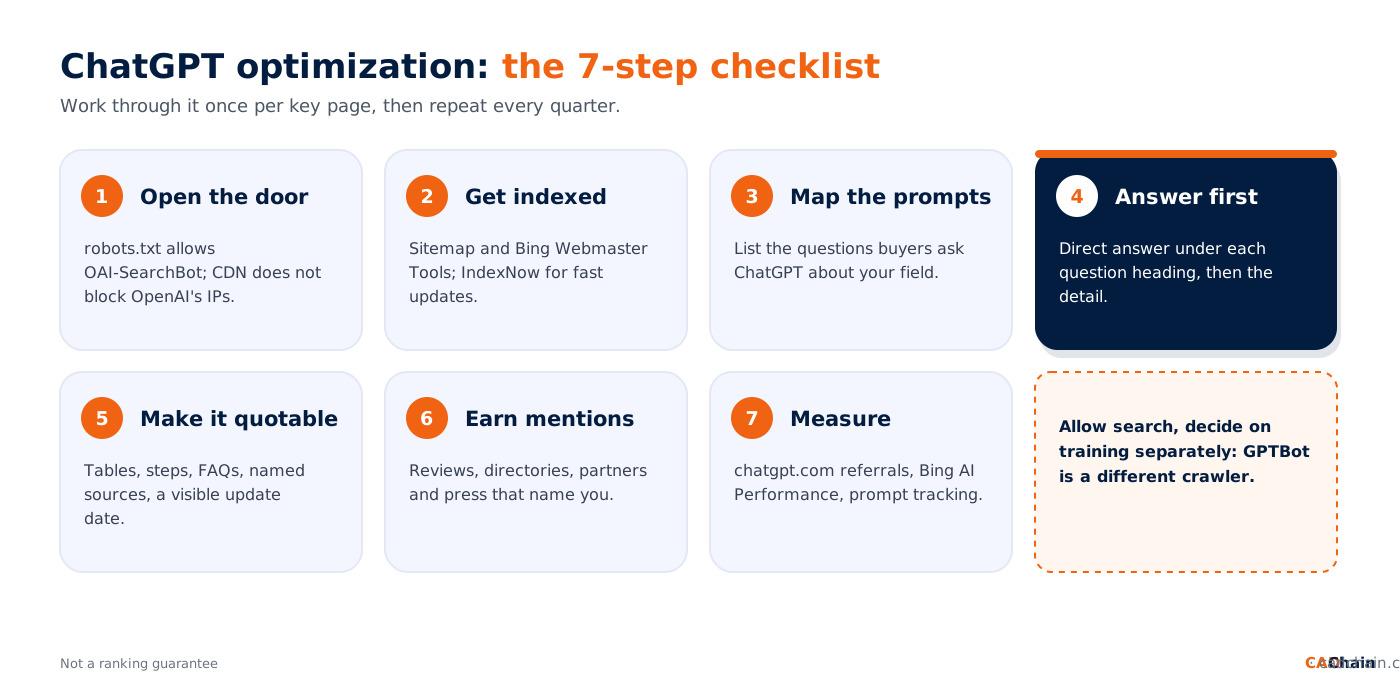
The seven steps below follow the path in the diagram above: first make sure ChatGPT can reach and find your pages, then make those pages the best answer, then build the outside signals and the measurement. Work through them once for your most important pages, then repeat every quarter.
Before Step 1: Validate the Offer You Want ChatGPT to Recommend, With SANDBOX and PlayPal
Before diving into ChatGPT, clarify what you need. Many entrepreneurs rush to use AI without validating their business ideas, leading to irrelevant or underwhelming results.
Enter the SANDBOX, a gamified platform designed for idea validation and startup development. Coupled with PlayPal, your personalized AI co-founder, this tool allows you to structure your ideas, refine them, and identify bottlenecks.
Once validated in the F/MS Startup Game, bring these refined ideas to ChatGPT for maximum optimization when generating business plans, marketing strategies, or product ideas.
👉 Learn more about the SANDBOX and PlayPal at F/MS Startup Game.
Step 1: Let OAI-SearchBot In (robots.txt, CDN and Firewall)
Open your site's robots.txt (yourdomain.com/robots.txt) and check that nothing blocks OAI-SearchBot, either by name or through a blanket rule. If you want to appear in ChatGPT search but keep your content out of model training, the two crawlers can be set separately:
Whether to block GPTBot is a business decision, not a ranking trick: some companies want their public material in future models, others do not. OpenAI notes that robots.txt changes take about 24 hours to reach its systems. Then check the layer people forget: many CDNs, hosting firewalls and "block AI bots" switches stop crawlers before robots.txt is even read. OpenAI asks site owners to allow traffic from its published search bot IP addresses, so look at your bot-protection rules too.
Step 2: Make Sure Search Engines Can Find and Index Every Key Page
ChatGPT search works with search partners as well as its own crawler, so classic indexing still matters. Keep an XML sitemap up to date, submit it in Google Search Console and Bing Webmaster Tools, and fix pages that return errors, redirect in loops or carry a stray noindex tag. Bing recommends IndexNow, a protocol that tells participating search engines when a page is added, updated or removed, so that AI answers use the current version of your page.
Make sure the main text of each page is in the HTML that a crawler receives, not only loaded later by scripts, and that every important page is linked from somewhere on your site. A page that no crawler can reach cannot be cited, however good it is.
Step 3: Map the Prompts Your Buyers Actually Ask
People talk to ChatGPT in full sentences, so start from questions, not single keywords. Collect them from sales calls, support tickets, onboarding chats and the long question-style queries in your Search Console data. Group them by intent:
- Problem questions: "how do I stop engineers from leaking CAD files to suppliers?"
- Comparison questions: "X vs Y for a 20-person hardware team", "alternatives to X"
- Shortlist questions: "best tools for ...", "which companies offer ..."
- Trust questions: "is X safe?", "does X comply with ...?", "who owns X?"
Then ask those questions in ChatGPT with search turned on, and note which sources it cites. Those cited pages show you what "good enough to quote" looks like in your niche today.
Step 4: Answer First, on One Clear Page per Topic
Give each important question one page that clearly owns it, and put a direct answer of two to four sentences right under the heading, before the detail. Use the words people use in their questions as headings. Avoid several near-identical pages that compete for the same question: we learned this on our own blog, where we split a general guide to top tech news sites from a separate page on innovation and product launch news, because they answer different questions.
Write for a reader who will only see one paragraph of your page, quoted inside an answer. That paragraph should still make sense on its own, name the thing it talks about, and not depend on "as mentioned above".
Step 5: Make Your Content Easy to Quote and Easy to Trust
Bing's own guidance for its AI Performance report lists what tends to help pages get referenced in AI answers: clear headings, tables and FAQ sections; claims supported by examples, data and sources; content kept fresh and accurate; and text, images and video that describe the same products and concepts consistently. In practice:
- Use tables for comparisons, numbered steps for processes and an FAQ for the follow-up questions.
- Show who wrote the page and why they know the subject, and show when it was last updated.
- Name your sources in the text when you use a number, and never publish a statistic you cannot trace.
- Describe your company, products and prices the same way on every page and profile, so models and search engines see one consistent entity.
- Add structured data for your organisation, products and articles, so search engines can read the basic facts without guessing.
Pro Tip:
Not sure how to frame your prompt? Use F/MS AI SEO Tools to generate targeted phrases that rank not only on Google and Bing but also on AI platforms like ChatGPT. Check out the AI Writer with Human Oversight at AI SEO Tool.
Step 6: Earn Mentions Beyond Your Own Site
ChatGPT rarely relies on a company's own website alone. Comparison articles, reviews, directories, partner pages, conference programmes, community discussions and trade press all shape both the search results it reads and what models learn about you. Keep your profiles complete and consistent, ask happy customers for reviews where your buyers look, and pitch useful data or opinions to the publications your audience reads. See our review of how AIclicks gets brands cited in AI answers for how source analysis shows which sites to target.
If you sell physical products, there is a direct route as well. OpenAI's merchant page says shopping in ChatGPT is live for users in the U.S., that merchants can apply to share a product feed built on the Agentic Commerce Protocol, and that catalogs sold through Shopify or Etsy are already integrated without extra setup. Purchases are completed on the merchant's own site or app, with no fees on purchases that start in ChatGPT. A feed is optional when ChatGPT already crawls your site, but it gives you more control over prices, availability and product details.
Step 7: Measure Your ChatGPT Visibility
You cannot improve what you do not measure, and there is no ChatGPT equivalent of Search Console yet. Combine three signals:
- Referral traffic: in your analytics, track visits that come from chatgpt.com, which pages they land on and whether they convert.
- Citation data from Bing: since February 2026, Bing Webmaster Tools has an AI Performance report that shows how often your pages are cited in Microsoft Copilot, AI-generated summaries in Bing and select partner integrations, with the grounding queries behind those citations. Bing stresses that citations are not clicks or rankings, and that the data is a sample.
- Prompt tracking: keep a fixed list of 20 to 50 buyer questions, run them every month, and record whether you are cited or mentioned and who appears instead. Do it by hand for a small list, or use an AI visibility tool for a larger one.
ChatGPT Optimization Tools: What to Use for Tracking and Content
You can start with free tools: your web analytics, Google Search Console for question-style queries, and Bing Webmaster Tools for indexing, IndexNow and the AI Performance report. When you need prompt tracking across several AI assistants and competitor benchmarks, dedicated AI visibility platforms help. Large companies also look at enterprise suites, such as Adobe AI tools, including LLM Optimizer. If you build with Microsoft's stack, our overview of Microsoft AI tools shows where Copilot fits.
Monitor and Optimize Your AI Visibility With AIclicks
Don't just use SEO on autopilot. Instead, monitor how your content ranks inside AI tools. ChatGPT, Perplexity, Gemini, Claude, and other AI platforms are increasingly becoming the first stop for users seeking answers. If your content isn't cited by these AI tools, you're losing visibility and traffic.
This is where tools like AIclicks become your competitive advantage. Instead of just optimizing for Google's blue links, AIclicks helps you rank in the actual AI-generated answers across ChatGPT, Google AI Overviews, Perplexity, Gemini, and more.
This is where tools like AIclicks become your competitive advantage. Instead of just optimizing for Google's blue links, AIclicks helps you rank in the actual AI-generated answers across ChatGPT, Google AI Overviews, Perplexity, Gemini, and more.
AIclicks is a Generative/Answer Engine Optimization (GEO/AEO) platform that shows you exactly which prompts surface your content, why certain sources are cited by LLMs, and how to publish the right content to win more AI mentions and clicks.
Why This Matters: Search behavior is shifting from link clicks to AI-generated answers. While traditional SEO ranks blue links, AIclicks helps you earn citations inside LLM responses, where your audience increasingly finds answers.
What You Get:
- Track where your brand appears across Google AI Overviews, ChatGPT, Perplexity AI, Claude, Gemini, Grok, and DeepSeek
- Discover which prompts your audience asks in AI tools and benchmark against competitors
- Identify content gaps where your brand should (but isn't) cited by AI assistants
- Get AI-powered content recommendations to close those gaps and rank where it matters
For a closer look at how it works in practice, read our review of how AIclicks gets brands cited in AI answers.
How to Optimize Content for ChatGPT: A Page-Level Checklist
Before you publish or update a page you want ChatGPT to cite, run through this list:
- The page answers one main question, and the answer sits right under the first heading.
- Headings are phrased the way people ask, and each section can be quoted on its own.
- There is at least one table, list or set of steps where the content allows it.
- Every number has a named source, and the page shows its author and its last update.
- Product names, prices and claims match what your other pages and profiles say.
- The page is in your sitemap, indexable, linked internally, and not blocked for OAI-SearchBot.
- After publishing, you notify search engines (for example with IndexNow) and add the page's main questions to your prompt-tracking list.
What ChatGPT Optimization Means for Deep-Tech and Engineering Companies
For a hardware or deep-tech company, visibility in ChatGPT is useful for marketing pages, documentation that is meant to be public, case studies and thought leadership. It is not something to aim for with your design files. The same crawlers that read your blog can read anything else that sits on a public URL, so the first rule of AI visibility is to be deliberate about what is public at all.
- Keep CAD models, drawings, BOMs and internal specifications off public URLs. robots.txt is a request to well-behaved crawlers, not access control.
- Decide on GPTBot (training) separately from OAI-SearchBot (search) for your public pages.
- Think before your team uploads drawings to AI tools: we cover what to check before uploading technical drawings to ChatGPT.
- Understand the wider IP questions around generative AI and CAD IP, and keep the regulatory side in view with our note on EU AI Act enforcement and AI agents.
If you are new to the topic, start with what CAD file protection is and why it matters, then use our IP protection playbook for deep-tech and hardware teams and our trade secrets guide for deep-tech startups to decide what to publish, what to patent and what to keep secret.
Want to be visible without giving away your designs? CADChain protects CAD files with file-level access control and blockchain-based proof of ownership, so your marketing can be public while your engineering data stays under your control.
👉 See how CADChain protects CAD files
Common ChatGPT Optimization Mistakes to Avoid
- Blocking OAI-SearchBot by Accident: a blanket "block AI bots" setting at your CDN or host can keep you out of ChatGPT search, even when robots.txt allows it.
- Neglecting Validation Tools: If your product or service idea hasn’t been validated in platforms like SANDBOX, you risk wasting time on unfeasible directions.
- Expecting a Guaranteed Ranking: OpenAI says placement is not guaranteed. Be wary of anyone who promises a fixed position in ChatGPT answers.
- Ignoring AI Answer Optimization: Many businesses still focus 100% on Google rankings while ignoring ChatGPT, Perplexity, and other AI platforms. By 2026, this is a missed opportunity.
- Creating Content Without Data: Don't guess which prompts matter. Use AIclicks to discover real questions your audience asks in AI tools.
- One-Size-Fits-All Content: AI platforms have different citation preferences. What ranks in ChatGPT might not rank in Gemini. AIclicks shows you these nuances.
- Neglecting Competitor Analysis: Your competitors are already ranking in AI answers. Study them with AIclicks' benchmarking tools and stay ahead.
Bonus for Founders: Grant-Writing Assistance Tool on F/MS
Struggling to secure funding for your startup? Use ChatGPT to augment your grant applications - but pair it with F/MS’s Grant Finding and Writing Tool. This tool helps you:
Pair this tool with ChatGPT-generated drafts for optimized applications with higher approval rates. Visit Startup Game to start applying for your grants.
- Find exclusive grants suited to your business niche.
- Write detailed and impactful grant proposals with AI-powered suggestions that align with funding guidelines.
Pair this tool with ChatGPT-generated drafts for optimized applications with higher approval rates. Visit Startup Game to start applying for your grants.
Conclusion
ChatGPT optimization is less mysterious than it sounds. OpenAI tells you the entry conditions: let OAI-SearchBot in and allow its IP addresses. Search partners still need to index you, so classic technical SEO keeps its value. Beyond that, ChatGPT rewards the same things a careful human researcher does: a clear answer to the exact question, evidence, freshness and a reputation that other sites confirm. Pick your ten most valuable buyer questions, give each one the best page on the web, and measure every month.
AI search keeps moving quickly, so keep an eye on new AI model releases and on how agents use tools; our guide to connect the Tilda MCP server to Claude Code shows how we work with AI on our own blog.
Ready to automate your SEO to rank everywhere? Jump to the AI SEO Tool and write your first AI-assisted article. Then get AIclicks to take your business visibility to the next level.
Validate your business idea in the Fe/male Switch Sandbox! Test, experiment, and pivot your way to success, all in a risk-free environment with an AI Co-Founder.
FAQ
What is ChatGPT optimization?
ChatGPT optimization is the work of making your website and content easy for ChatGPT to find, trust and cite when it answers questions. It covers technical access for OpenAI's search crawler, indexing, content written to answer real questions, mentions on other websites and measuring how often ChatGPT cites you. It is also called generative engine optimization (GEO) or AI search optimization.
How do I get my website recommended by ChatGPT?
Allow OAI-SearchBot in robots.txt and in your CDN or firewall, keep your pages indexed, and publish one clear, answer-first page for each important question your buyers ask. Then earn mentions on reviews, directories and trade press, and track whether ChatGPT cites you. OpenAI says placement is never guaranteed.
How do I optimize content for ChatGPT?
Put a short direct answer right under each question-style heading, use tables, steps and FAQs, name your sources, show the author and the update date, and keep product facts consistent across all your pages. Each section should make sense if it is quoted on its own.
Does ChatGPT search use Google or Bing?
OpenAI says ChatGPT search sometimes partners with other search providers and rewrites the user's question into targeted queries for them. Its help page points to Microsoft's and Shopify's privacy policies for those providers. OpenAI also runs its own crawler, OAI-SearchBot. Being indexed in Bing is therefore a sensible part of ChatGPT optimization.
Should I block GPTBot if I want to appear in ChatGPT?
Blocking GPTBot signals that your content should not be used to train OpenAI's models. It is controlled separately from OAI-SearchBot, which decides whether your pages can appear in ChatGPT search. You can allow search and block training if that suits your business.
Can I pay to appear in ChatGPT answers?
Organic citations cannot be bought, and OpenAI says placement is not guaranteed. OpenAI does run ads in ChatGPT: its crawler documentation describes OAI-AdsBot, which checks landing pages submitted as ChatGPT ads. Ads are separate from the sources ChatGPT cites in its answers.
How long does ChatGPT optimization take to work?
A robots.txt change takes about 24 hours to reach OpenAI's systems. Content and reputation changes have no fixed timeline: they depend on when your pages are crawled and indexed again and on how strong the competing sources are. Measure monthly and judge the trend over a few months.
How can I see whether ChatGPT sends traffic to my website?
Look for visits from chatgpt.com in your analytics and note which pages they land on. Add Bing Webmaster Tools' AI Performance report for citation data from Microsoft's AI experiences, and check a fixed list of buyer questions in ChatGPT every month.
How do I get my products into ChatGPT shopping?
OpenAI's merchant page says shopping in ChatGPT is live for users in the U.S. Merchants can apply to share a product feed, and catalogs sold through Shopify or Etsy are already integrated. Customers complete their purchase on your own site or app.
Why does AIclicks beat generic SEO tools for ChatGPT optimization?
Unlike traditional SEO tools that focus on Google rankings, AIclicks is purpose-built for AI ranking. Here's why it matters:
- LLM-Specific Optimization: Not all content ranks the same in ChatGPT vs. Perplexity vs. Gemini. AIclicks shows you the unique requirements for each platform.
- Zero-Click Recovery: As AI answers dominate search, you need visibility inside those answers, not just below them. AIclicks makes this possible.
- Competitive Intelligence: See exactly why competitors are cited and how to outrank them in AI responses.
- Actionable Insights: Generic SEO data is overwhelming. AIclicks delivers specific, actionable recommendations tied directly to ranking in AI answers.
Can I use AI to write SEO-optimized articles that help my brand grow?
Most business owners don't understand how SEO works, let alone how to use AI for writing blog articles. That's why for busy business owners there's a great free tool that doesn't require much knowledge. Write articles for free
How does ChatGPT help with grant applications?
ChatGPT can draft grant proposals by generating clear and detailed content. Pairing it with the F/MS Grant Finding and Writing Tool can refine the process further by matching your business with grants and refining applications. Get started with Grant Tools at F/MS
How does ChatGPT support SEO management?
The F/MS AI SEO Tools enable automated SEO optimization, helping businesses rank on platforms like Google, Bing, and ChatGPT's ecosystem. These tools handle keyword integration and boost visibility while allowing human oversight for quality assurance. Explore AI SEO Tools
About the Author
Violetta Bonenkamp, also known as MeanCEO, is an experienced startup founder with an impressive educational background including an MBA and four other higher education degrees. She has over 20 years of work experience across multiple countries, including 5 years as a solopreneur and serial entrepreneur.
Violetta is a true multiple specialist who has built expertise in Linguistics, Education, Business Management, Blockchain, Entrepreneurship, Intellectual Property, Game Design, AI, SEO, Digital Marketing, cyber security and zero code automations. Her extensive educational journey includes a Master of Arts in Linguistics and Education, an Advanced Master in Linguistics from Belgium (2006-2007), an MBA from Blekinge Institute of Technology in Sweden (2006-2008), and an Erasmus Mundus joint program European Master of Higher Education from universities in Norway, Finland, and Portugal (2009).
She is the founder of Fe/male Switch, a startup game that encourages women to enter STEM fields, and also leads CADChain, and multiple other projects like the Directory of 1,000 Startup Cities with a proprietary MeanCEO Index that ranks cities for female entrepreneurs. Violetta created the "gamepreneurship" methodology, which forms the scientific basis of her startup game and the new Learn Dutch With AI project. She also builds a lot of SEO tools for startups. Her achievements include being named one of the top 100 women in Europe by EU Startups in 2022 and being nominated for Impact Person of the year at the Dutch Blockchain Week. She is an author with Sifted and a speaker at different Universities.