TL;DR: What does Claude Fable 5.2 mean for CAD and hardware teams?
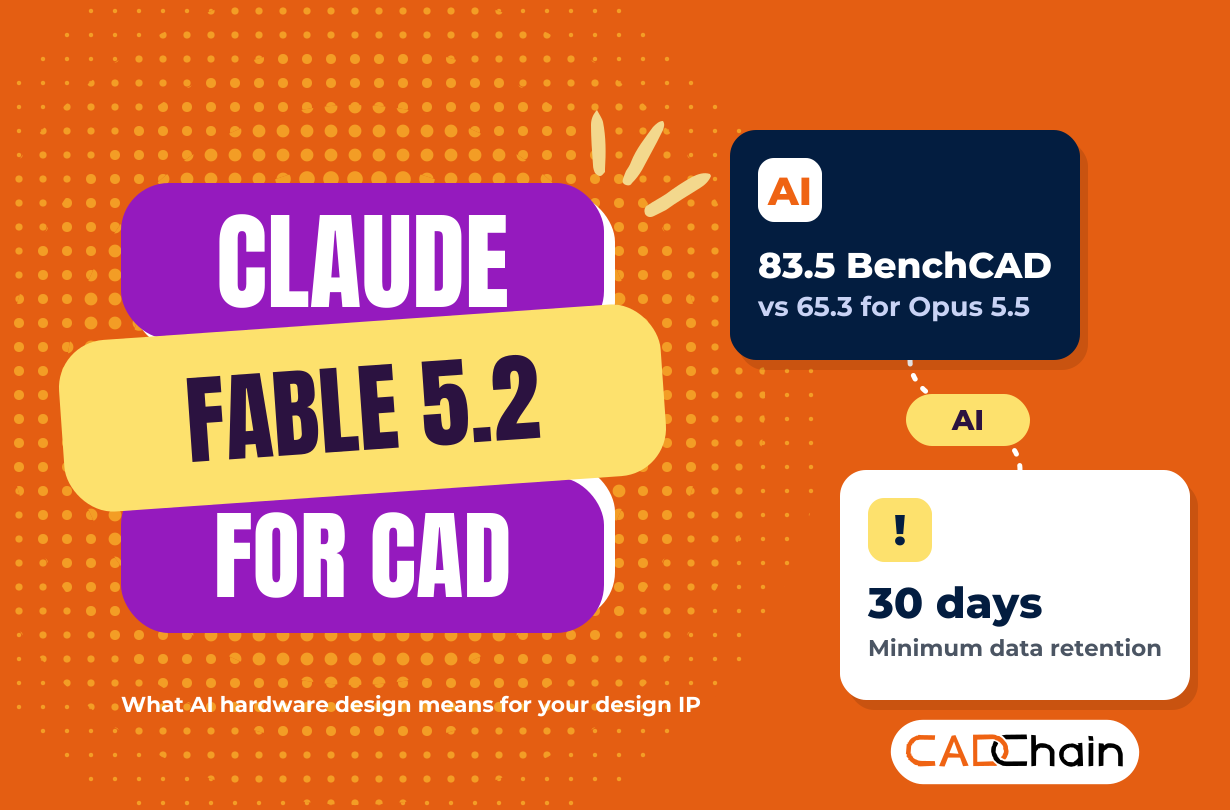
Anthropic released Claude Fable 5.2 on 9 November 2026 and showed it designing three working electronic devices, a USB speakerphone, a voice-assistant hub and a handheld virtual pet, from short prompts: schematics, four-layer circuit boards, 3D-printable enclosures modelled in CAD, firmware and parts lists. It scores 83.5 on BenchCAD 2.1, against 65.3 for Opus 5.5 and 44.4 for Fable 5.1. The catch for design IP: Fable 5.2 is a Covered Model, so your prompts and files are kept for at least 30 days and zero data retention is off by default. Decide which drawings and board files may go in before your engineers start testing.
Claude Fable 5.2 arrived with a demo every hardware team should look at: Anthropic showed it taking an electronic product from a short brief to a working prototype, which makes this launch a CAD and IP story as much as an AI story. If you want the general picture first, here is what happened with Claude Fable 5.2: prices, plans and benchmarks. This guide stays with engineering teams: what the model did on real hardware, how far the results go, what happens to the design files you upload, and who owns what it designs.
What did Claude Fable 5.2 design?
Anthropic and the circuit board maker Diode Computers asked Fable 5.2 to build three devices. The prompt for the speakerphone asked for "a puck that plugs into a computer over USB-C and includes microphones and a speaker, supporting Bluetooth with a PCB antenna." According to Anthropic's electronics design report, the model then did the whole job:
- wrote the device specifications and drew the schematics;
- placed components on a printed circuit board (PCB) and routed the copper tracks, starting with USB and Ethernet pairs kept at equal length;
- wrote its own grid-search router in about half an hour when KiCad's built-in router was too slow for long tracks from a 100-pin connector;
- modelled 3D-printable enclosures in CAD and wrote code to check that each board fits without collisions;
- ran design-for-manufacturing (DFM) and sourcing checks, fixed six solder-mask slivers that were too thin, and prepared parts lists;
- wrote the firmware and directed Diode's engineers through assembly and testing.
Diode manufactured all three boards directly from Claude's files, and all three prototypes worked without changes to their circuitry. Two details show the kind of mechanical reasoning involved. The speakerphone board couldn't be lowered straight into its case because the mute switch hit the back wall, so Claude worked out that it fits when tilted about 25 degrees and added that step to the assembly instructions. For the voice hub it calculated that a 25 mm microphone port would resonate near 3.4 kHz, right in the voice band, and redesigned the case as a wedge to shorten the ports to about 10 mm.
How good is Claude Fable 5.2 at CAD benchmarks?
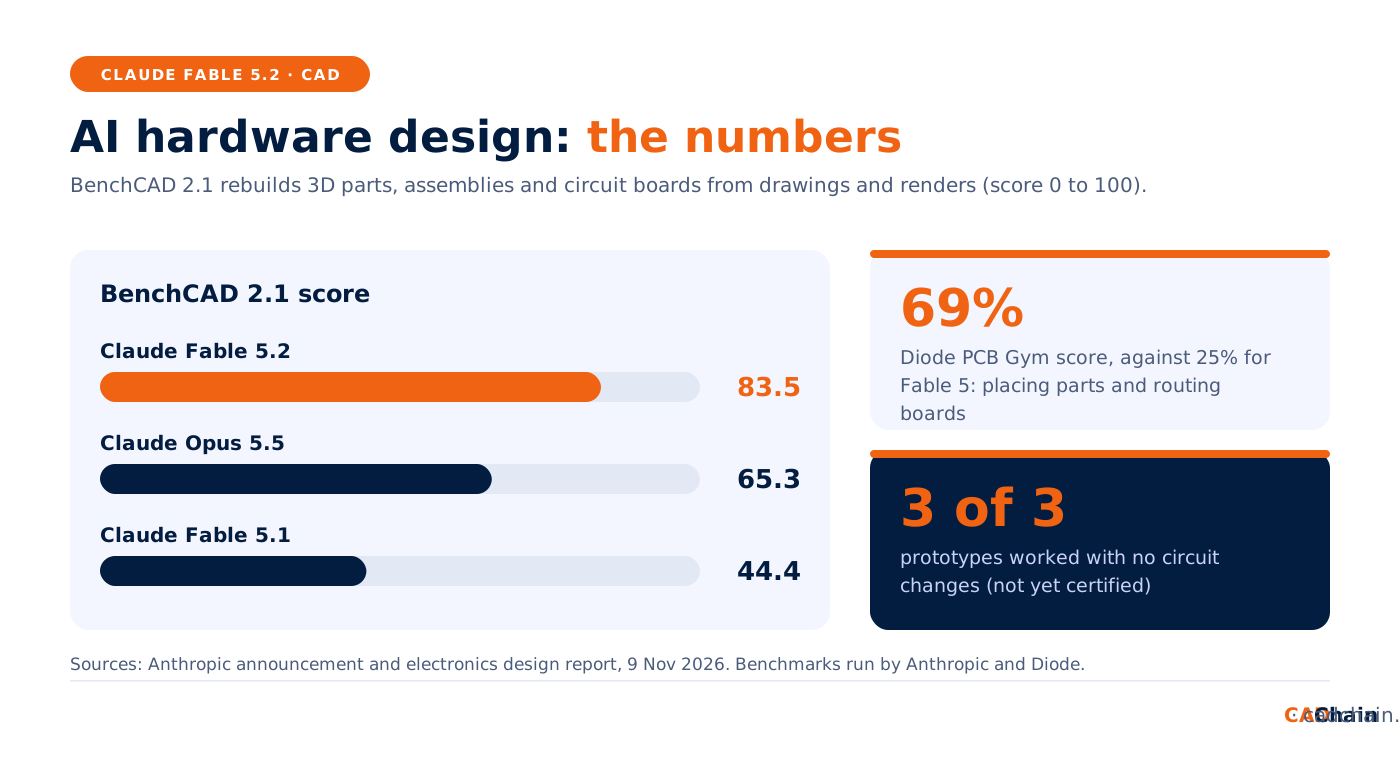
Read these numbers with three limits in mind. Both tests come from Anthropic and its partner: PCB Gym is Diode's internal benchmark, and Anthropic's announcement publishes BenchCAD scores for its own models only. Anthropic also discloses that it has a commercial relationship with Diode. And the devices are prototypes: Anthropic says they haven't been through electrical validation, antenna tuning, thermal testing or certification, and weren't designed for mass production.
What happens to your CAD files in Claude Fable 5.2?
This is the part engineering managers should read twice. Anthropic lists Fable 5.2 as a Covered Model, a model whose capabilities it says create elevated risk if misused. Its Covered Models policy sets the rules:
- 30-day minimum retention by default. Prompts and completions are kept for at least 30 days and then deleted, unless a safety investigation or a legal duty requires longer.
- No zero data retention by default. ZDR is not available in workspaces, Claude Enterprise organisations or third-party platforms where Covered Models run. Eligible customers get a time-limited ZDR option for internal business applications while Anthropic rolls out Enterprise Frontier Safeguards, which keep monitoring data in the customer's own cloud.
- The rules follow the model. They apply in the Claude apps, the Claude Platform, Amazon Bedrock, Google Cloud and Microsoft Foundry alike.
- Review. Retained data is checked by automated safety systems. AWS writes that on Bedrock, use requires retention for up to 30 days and human safety review, done by Amazon personnel within the AWS boundary.
For a team that has kept ZDR on older Claude models, that is a real change. A customer's STEP file, an NDA drawing or an export-controlled board layout sent to Fable 5.2 sits in a retained window that someone may review. Anthropic says customers who are eligible for ZDR can keep using earlier Claude models under their existing settings.
Who owns a design made with Claude Fable 5.2?
The model can now produce the schematic, the board, the enclosure and the firmware, so the ownership question gets sharper. Courts and patent offices in the US, the UK, Germany and at the EPO all say only a person can be an inventor, which we set out in AI-generated inventions: who owns them. In the US, copyright covers only the parts a human author determined. So the evidence of human decisions is what you own: the brief, the constraints, the options your engineers accepted or rejected, and the changes they made by hand.
There is a security side too. A model that writes its own router and runs checks on your files is an agent with access to your design data. Our piece on the AI supply chain attack in CAD toolchains covers the guardrails, and the same questions came up with GPT-6.1 Terra and technical drawings in October.
What should engineering teams do now?
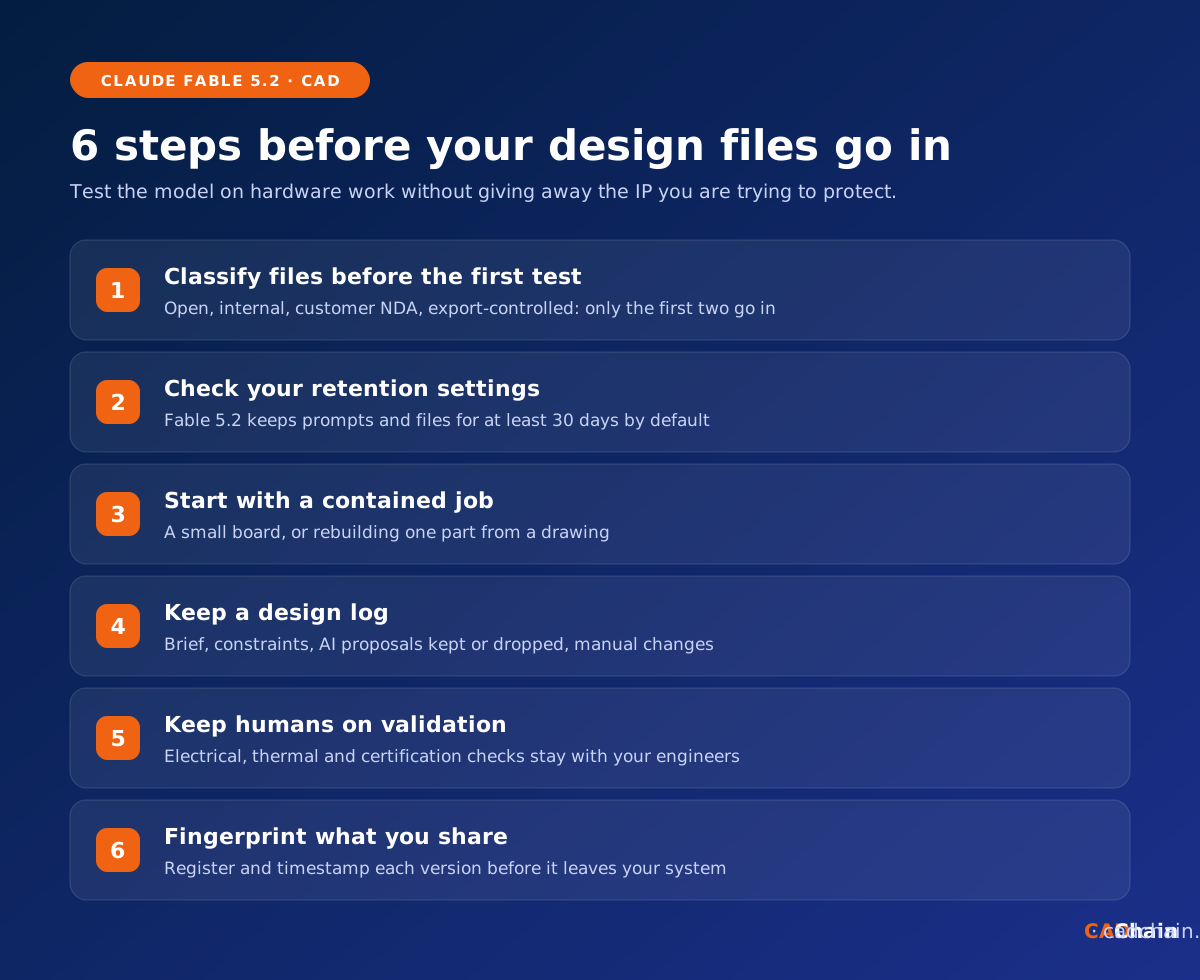
- Classify files before the first test. Sort designs into open, internal, customer-NDA and export-controlled, and allow only the first two in AI tools.
- Check your retention settings. If your Claude setup runs with zero data retention, know that it won't cover Fable 5.2 unless Anthropic grants the transition option.
- Start with a contained job. A small board with a short parts list, or rebuilding a part from a drawing, shows quickly whether the model saves your team hours.
- Keep a design log. Record the brief, the constraints, each AI proposal kept or dropped, and every manual change, with timestamps. That log is your ownership evidence.
- Keep humans on validation. Anthropic's own devices skipped electrical validation, thermal testing and certification. Your sign-off process stays the same.
- Fingerprint what you share. Register and timestamp design versions before they leave your system, so you can prove later which version you sent and when.
CADChain's BORIS plugins register and certify CAD files from inside SolidWorks and Autodesk Inventor, which gives you that timestamped record without leaving your CAD tool.
FAQ: Claude Fable 5.2 for CAD and hardware
Can Claude Fable 5.2 design a circuit board?
Yes, in Anthropic's tests it designed four-layer boards for three devices, routed the copper tracks, ran manufacturing and sourcing checks, and Diode built working prototypes from its files without circuit changes. The devices are prototypes and have not been certified.
What is Claude Fable 5.2's BenchCAD score?
83.5 out of 100 at Max effort on BenchCAD 2.1, which tests rebuilding 3D parts, assemblies and circuit boards from engineering drawings and rendered images. Opus 5.5 scored 65.3 and Fable 5.1 scored 44.4.
Does Claude Fable 5.2 work with KiCad?
Anthropic says Claude used the design software Diode provided, including KiCad's built-in router, and then wrote its own router for long tracks. It did not describe a plugin for any commercial CAD tool.
Does Anthropic keep the files I upload to Claude Fable 5.2?
Yes. As a Covered Model, Fable 5.2 keeps prompts and completions for at least 30 days by default, and zero data retention is not available by default in workspaces, Enterprise organisations or third-party platforms.
Who owns a design created with Claude Fable 5.2?
Patent offices and courts in the US, UK, Germany and at the EPO accept only people as inventors, so rights go to the people who conceived the design. Keep records of human decisions to prove that contribution.
Is Claude Fable 5.2 safe for NDA or export-controlled drawings?
Check your contracts and export rules first. Retained data stays on the provider's systems for at least 30 days, which many NDAs and export rules don't allow without approval.