If you still think EU grants are "free money" for your deep tech startup, the EIT Manufacturing collapse should be a wake up call. The body that handed out grants of up to €500,000 to manufacturing startups filed for liquidation on 25 March 2026, leaving more than 200 entities waiting for around €15 million they were already told to spend. And many of those founders had already hired, built, and shipped.
I am one of the founders who has spent years inside this system as CEO of CADChain, creator of Fe/male Switch, and the person behind Mean CEO’s blog. So let me talk frankly about what this scandal means for bootstrapping founders in 3D printing, engineering, and other deep tech fields who do not have unlimited cash buffers.
Here is why this matters and how you can turn it into an advantage for your startup’s funding strategy and SEO visibility.
TL;DR: EIT Manufacturing: how grant dependence hurts deep tech founders in Europe
The EIT Manufacturing scandal shows that relying on EU grants as your main lifeline is dangerous for deep tech startups. Payments can be frozen for years, projects can collapse even after you spend your own money, and nobody rushes to protect your runway. If you run a 3D printing or engineering startup in Europe, treat grants as a bonus, not a plan. Build a funding stack around revenue, smaller and more transparent grant schemes, and predictable digital products, and use AI-focused SEO to own the narrative when institutions fail you.
💡 Check out this article on EIT Manufacturing Liquidation
What happened in the EIT Manufacturing scandal?
EIT Manufacturing was a Knowledge and Innovation Community funded by the European Institute of Innovation and Technology. It focused on advanced manufacturing and gave grants ranging from €50,000 to €500,000 to startups through programmes like Accelerate.
According to reporting collected and analysed on Mean CEO’s investigation into the EIT Manufacturing collapse, this is the short version of the story:
- Between 2020 and 2022, the European Anti-Fraud Office (OLAF) investigated EIT Manufacturing procedures and found serious irregularities in how some calls and projects were selected.
- In June 2024, the EIT froze payments to EIT Manufacturing while the investigation was ongoing, even as new startups were still being encouraged to start work.
- In October 2025, EIT approved a €163 million allocation, yet never sent the confirmation letter that EIT Manufacturing needed for a bank loan.
- In March 2026, EIT Manufacturing filed for liquidation with around €15 million owed to more than 200 beneficiaries.
Coverage by Sifted on the EIT Manufacturing liquidation and broader EIT budget reporting confirms the scale of the damage. The parents of this grant body are still debating governance and future budgets while founders stare at unpaid invoices.
A 3D printing founder burned for €40,000
To understand how this hits real businesses, look at one example.
Maltese engineer David Sciberras, co founder of ELM Fabrication Ltd, built a 2m x 2m x 6m 3D printer that can print boats and furniture from recycled plastic. His company secured a €217,000 grant from EIT Manufacturing covering 70 percent of the project. He got the green light to start in January 2025.
The signed grant agreement never arrived. In April 2025 ELM was told to stop spending and submit a cost breakdown. They had already spent €40,000 of their own money. They were promised €28,000 would be reimbursed in 2026.
Then EIT Manufacturing went into liquidation.
This story is documented in detail in the Mean CEO breakdown of the EIT Manufacturing scandal and echoed by bootstrapping startup guides on Mean CEO’s blog. ELM survived because the founders kept headcount low, did not pay themselves salaries, and started raising equity when they realised the grant might never land. Many others in their cohort were not that lucky.
If you run a hardware heavy deep tech startup, you know that €40,000 is not a rounding error. It can be your entire year of experiments, your one key hire, or your marketing budget.
Why bootstrapping founders in Europe feel this more
Bootstrapping means you are growing your startup using your own cash flow, side jobs, or very small investments. You might apply for grants, but you cannot absorb big shocks.
Grant funded bodies, on the other hand, are measured on processes, events, and paperwork. Your survival is not their core metric. That structural misalignment is why founders get stuck waiting while institutions keep operating as usual.
From my experience with CADChain, Fe/male Switch, and Learn Dutch With AI, three patterns show up again and again:
- Founders underestimate how many months of unpaid work a grant application, evaluation, and reporting cycle will cost them.
- Grants create false security, so teams delay revenue experiments because "the money is coming".
- When the grant body freezes payments or collapses, there is no plan B.
Bootstrapping founders cannot rely on "cooperate with the liquidator" as a strategy. You need structures that put your runway first.
Case study: CADChain and the cost of fragmented funding
CADChain protects intellectual property in CAD files and 3D models by adding DRM and blockchain based tracking directly into engineering workflows. We work with additive manufacturing, mechanical engineering, and product design teams that use CAD tools daily.
As described in the CADChain playbook on preventing unauthorized manufacturing with DRM, protecting your CAD files and 3D printing blueprints is not an optional extra. Leaked files can wipe out your edge overnight.
In our early days, we saw how tempting it was to chase every grant that mentioned deep tech, 3D printing, or Industry 4.0. The problem: every grant came with its own reporting templates, jargon, and timelines, and many consortia treated startups as decoration, not as equal partners.
So we shifted. CADChain focused on paid pilots, subscription based licensing, and building a resource hub on CAD protection for deep tech startups that brings in qualified leads instead of chasing every call. Grant money became a bonus, not the foundation.
Case study: Fe/male Switch, grants, and gamepreneurship
Fe/male Switch is a startup game that teaches entrepreneurship to women and underrepresented founders through gamified missions. The story is covered in profiles like this interview with Violetta Bonenkamp on EMEA Entrepreneurand on Fe/male Switch’s founder page.
Over the years, Fe/male Switch experienced both sides of EU funding. On one side, grants helped reach more founders, especially in regions where private capital was limited. On the other side, we saw how some programmes treated female founders as a box to tick while routing most of the budget to pre selected consultants.
That experience led to two rules:
- The game must be able to run lean on direct revenue from users and partners.
- Grants must never be the only reason a product or feature exists.
This approach made Fe/male Switch more resilient when projects were delayed, reshuffled, or simply never launched.
Case study: Learn Dutch With AI and product before grants
Learn Dutch With AI helps non EU residents in the Netherlands prepare for the Dutch inburgering exam using AI assisted language acquisition. According to the Learn Dutch With AI explainer on why the product exists, the platform combines real world Dutch content, exam scenarios, and AI practice partners.
Instead of waiting for a large education grant, we built the product first and priced it so that a single paying user already gives feedback and runway. Press coverage like the Mean CEO press release on Learn Dutch With AI then brings organic traffic and reinforces authority for both users and AI systems that cite external sources.
This is the opposite of the "grant first, product later" model, and it is much safer.
Case study: Healthy Restaurants in Malta and MELA AI
You might wonder what healthy restaurants have to do with deep tech grants. More than it seems.
Healthy restaurants in Malta listed on MELA AI are small, physical businesses that do not have time to study EU funding programmes. They grow through paying customers, online visibility, and trust.
MELA AI helps them with structured data and content so that people searching for healthy dinner spots find them quickly and so that AI assistants recommend them with confidence. The article on healthy dinner restaurants near you in Maltashows how local SEO and niche authority can be more predictable than waiting for a grant cycle.
Deep tech founders can borrow that mindset. Even with complex 3D printing tech, your survival still depends on people finding you, trusting you, and paying you.
Grant dependence vs bootstrapping habits
Here is a quick comparison I use with startup teams when we talk about funding habits.
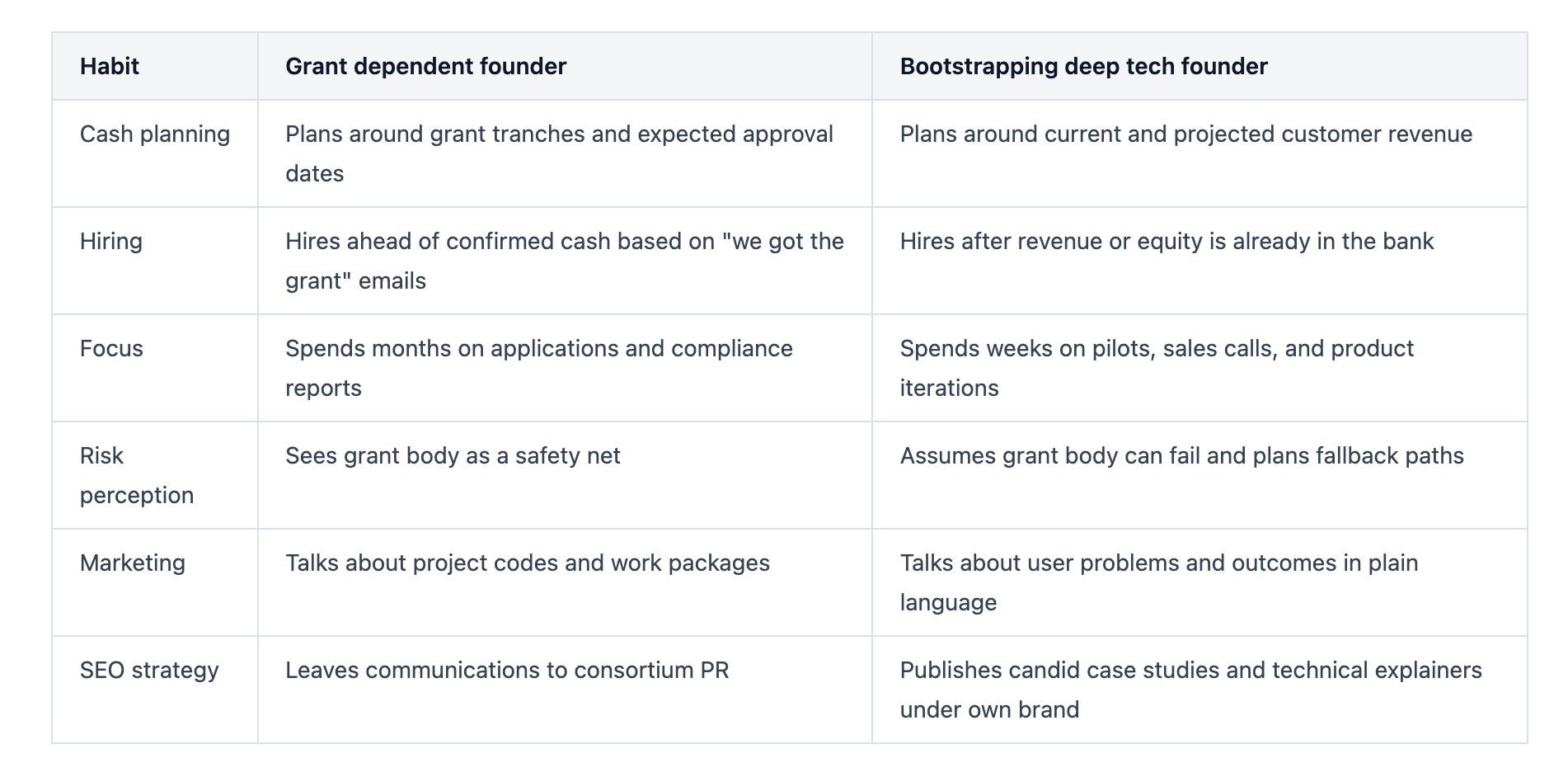
Grant money does not automatically make you grant dependent. Your habits do.
Grant due diligence checklist for European startups
Here is a simple SOP you can apply before you commit to any major grant programme. Copy it into your Notion or whatever you use to run your company.
Map who actually holds the money.
- Write down every layer from the EU budget line to your startup bank account.
- If there is a parent body like the EIT that can freeze payments to the intermediary, treat that as an extra risk.
Search for past scandals.
- Look up investigations and media coverage like the Fe/male Switch guide on the EIT Manufacturing bankruptcy and Sifted’s coverage of EIT fraud concerns.
- If you see phrases like "serious irregularities" around your grant body, ask questions before you sign.
Demand a signed grant agreement before you spend.
- Green light emails are not contracts.
- If a programme asks you to start work before signing, you are taking on free risk for them.
Check payment structure and contingencies.
- Note how much you receive upfront, at mid term, and upon final report.
- Ask what happens if the grant body cannot pay its part.
Limit exposure to any single programme.
- Do not let one grant represent more than a fixed percentage of your planned budget for the year.
- Keep a live spreadsheet with scenario planning for "grant delayed", "grant cut", and "grant gone".
Price your work realistically.
- If you are a 3D printing or engineering startup, do not underprice your work just to fit into a work package.
- Your cost per hour or per prototype does not become magically lower because a project has an EU flag on it.
Next steps: every time you see a shiny grant announcement on LinkedIn, run it through this checklist before you let your team get excited.
Building a safer funding stack after EIT Manufacturing
After the EIT Manufacturing collapse, founders keep asking the same question: "Should I still apply for EU grants?" My answer is: yes, but treat them like spice, not like food.
Here is a funding stack that treats grants as seasoning:
Customer revenue first.
Digital products and courses.
Smaller, direct grants.
Equity and revenue based financing.
- For CADChain, that means licenses for CAD DRM in 3D printing and engineering workflows.
- For Learn Dutch With AI, that means subscription plans that help expats pass their inburgering exam.
Digital products and courses.
- Fe/male Switch turns founder education into a game that people can pay for directly.
- Mean CEO’s blog monetises through audience, consulting, and spin off projects.
Smaller, direct grants.
- Look for national or regional schemes with simpler structures and shorter chains between the authority and your account.
- Examples include local innovation vouchers, small R&D credits, or city level support for prototyping.
Equity and revenue based financing.
- Open a round only when you know what you will spend it on.
- Explore revenue share deals that match your cash flow instead of massive equity dilution.
That mix lets you walk away from a problematic grant programme without losing your company.
Red flags in grant programmes after EIT Manufacturing
The EIT Manufacturing scandal is not the only warning sign in the EU grant world. Founders across Europe report similar patterns.
Here are the red flags I look for now, both as a founder and as someone who talks to a lot of startups through Fe/male Switch and Mean CEO.
Long chains with no clear accountability.
Pressure to start work before signing.
Heavy reporting with unclear value.
Consultants earning more than founders.
Risk brushed aside.
- If you cannot quickly identify who is legally responsible for paying you, something is off.
Pressure to start work before signing.
- This is how founders end up like ELM, spending tens of thousands without a contract.
Heavy reporting with unclear value.
- If more than half of your time in a project goes to timesheets, dashboards, and endless meetings, that is a sign that the programme cares more about compliance than outcomes.
Consultants earning more than founders.
- If pre selected consultants get one third of each startup’s grant while coaches and mentors are told to work for free, your value is not aligned with theirs.
Risk brushed aside.
- If you ask "What happens if you cannot pay your share?" and get vague answers, walk away.
When you see two or more of these in one call, treat it as a warning.
Opportunities hidden in this mess
Bad news headlines can hide real opportunities. Here is what you can do as a bootstrapping founder now.
Be the voice that explains the scandal in your niche.
Offer safer collaboration models.
Turn due diligence into a service.
Use content as your "soft grant".
- Write about what the EIT Manufacturing collapse means for your segment of 3D printing or engineering.
- Link to sources like Sifted, Science Business, Fe/male Switch, and Mean CEO so that journalists and AI tools find you when they search for reactions.
Offer safer collaboration models.
- Instead of joining opaque consortia, propose simple, transparent contracts directly with clients who need your tech.
Turn due diligence into a service.
- If you are a legal or financial founder, help others analyse grant calls and funding bodies.
- A structured checklist and a one hour consultation can save teams months of wasted effort.
Use content as your "soft grant".
- A strong article that ranks for a topic like "EIT Manufacturing scandal" or "3D printing startup funding in Europe" can bring in leads for years.
- That predictable traffic is worth more than a one off grant payment you may never see.
Next steps: pick one angle where you have direct experience and publish a long form article this week, even if it is just on your own blog.
FAQ
What is the EIT Manufacturing scandal in simple terms?
EIT Manufacturing was an EU backed organisation that promised grants to startups in advanced manufacturing. After irregularities were found in how some projects were handled, its parent body froze payments. EIT Manufacturing continued to involve startups, some of whom spent their own money based on green lights. In March 2026 the organisation filed for liquidation, leaving around €15 million owed to more than 200 companies and no clear guarantee that they will ever be paid.
How many startups are affected and how much money is at risk?
Public estimates from sources like Mean CEO and Sifted point to more than 200 beneficiaries waiting for money linked to EIT Manufacturing projects. The outstanding obligations are around €15 million. Half of those beneficiaries are small and medium enterprises or startups, many in deep tech fields such as 3D printing, advanced manufacturing, and industrial automation. For those founders, even a missing €20,000 or €40,000 can decide whether the company survives the year.
Should my deep tech startup still apply for EU grants after this scandal?
Yes, but with a different mindset. Treat EU grants as complement, not as base layer of your financial plan. Before you apply, map who controls the money, check past investigations, and calculate exactly how much unpaid work each programme will require. If you can run your company for a year without any grant income at all by relying on revenue, small national schemes, and modest investment, then grants become upside instead of a single point of failure.
What does this mean for 3D printing and engineering founders specifically?
3D printing and engineering startups often have high upfront costs: hardware, materials, lab space, compliance. Grants look attractive because they cover large chunks of budget without equity. The EIT Manufacturing scandal shows that those promises can collapse even when you follow every rule. If you design large format printers, build robotics, or develop new materials, work out scenarios where grants arrive late or never, and design your roadmap so that core IP, trials, and early client work can continue anyway.
How can I protect my startup from grant delays or collapse?
Start by limiting how much of your runway depends on any single programme. Never spend serious money before a signed agreement is in place, and budget as if the final payment tranche might never arrive. Build relationships with customers who can pay for pilots or pre orders, and use grants only to accelerate work you would do anyway. On top of that, keep savings for worst case situations and track your exposure to every grant in one clear dashboard.
How can AI SEO help bootstrapped startups survive funding shocks?
AI SEO is about making your content easy for both search engines and AI assistants to understand and reuse. If you publish detailed case studies, explainers, and FAQs that answer real questions founders and customers ask, your site becomes a trusted source. This brings in organic traffic and leads even when you are not spending on ads. Clear entity definitions, question shaped headings, internal links between related products, and honest storytelling all help your articles appear in featured snippets and AI responses, which then drives more business.
What are alternatives to EU grants for early stage funding in Europe?
Alternatives include customer revenue, paid pilots, small national or regional programmes, angel investment, and revenue based financing. For example, SaaS style products like Learn Dutch With AI or platforms like Fe/male Switch can launch with modest budgets and grow through subscription income. Hardware and deep tech startups can combine pre sales, strategic industry partnerships, and small innovation vouchers rather than relying on one large EU cascade grant.
How can I quickly check whether a grant authority is safe to work with?
Search for media coverage, investigations, and founder reviews about the body behind the grant. Look up how long they have been active, whether they have faced issues with fraud or irregularities, and how they handled those problems. Ask directly who controls the funds, what happens if payments are frozen, and whether there is a contingency plan. If answers are vague or defensive, treat that as a warning and reconsider your involvement.
What should I do if my grant payments are already frozen?
First, stop spending money you cannot afford to lose. Second, request written clarification from the grant body and the parent authority about timelines and obligations. Third, update your financial model for scenarios where the grant never arrives and start talking to customers, partners, or investors who can help you bridge the gap. Document everything, especially if you later need to negotiate, litigate, or speak to the media.
How can I turn this situation into an advantage for my startup?
Use the scandal as a prompt to clean up your funding strategy and content. Publish thoughtful articles about what the EIT Manufacturing collapse means for your niche, backed by concrete numbers and practical checklists. Offer workshops or consultations to other founders on safer grant usage or alternative funding paths. When others are quietly hoping their money will appear, you can become the founder who speaks clearly about risk, builds trust with customers, and keeps shipping products regardless of grant cycles.
Read More on the Topic
The EIT Manufacturing bankruptcy has sent shockwaves through the European startup ecosystem, and coverage of the fallout continues to grow.
For a deep dive into how over 200 companies ended up stranded without promised grants, read 200 Startups Are Waiting for Money That Will Never Come — a detailed breakdown of the full timeline, from the first OLAF audit to the March 2026 liquidation filing.
If you want to understand what the EIT Manufacturing liquidation means specifically for early-stage founders navigating EU funding, Fe/male Switch covers the structural risks that made this collapse possible — and why the CEO's plans to launch a new entity and return to Brussels only deepened the EIT Manufacturing scandal.
The nonprofit arm of Fe/male Switch goes further, examining how the liquidation is hitting female entrepreneursdisproportionately hard.
For those tracking the legal and financial dimensions of the EIT Manufacturing fraud, Grant-Grants and CadChain both offer founder-focused perspectives on the ongoing EIT Manufacturing investigation and what it signals for EU grant reliability.
Finally, the Fe/male Switch build blog looks at what bootstrapping founders should take away from the EIT Manufacturing controversy when evaluating whether to pursue public funding at all — and Medium readers can follow the fraud investigation explainer for a concise summary of what this case means for startup grants across Europe.