Here's something that I have been noticing with most of my new projects: Google rankings don't mean that much to ChatGPT. At least my team and I are not really seeing the direct correlation that many SEO experts seem to hope for.
ChatGPT that now handles 1 billion queries monthly doesn't seem to care that much about your backlinks, domain authority, or those sneaky SEO tactics that your agency is pushing for. Yet startups keep burning cash on traditional SEO while ignoring the AI search rapid rise completely.
Just yesterday at my AI for startups workshop at the University of Eindhoven, I had a few people fight me on the idea that any startup must understand what AI SEO is and get into it as soon as possible.
I get it, the shift is uncomfortable. Everyone built their playbooks around Google.
But the market is evolving.
ChatGPT that now handles 1 billion queries monthly doesn't seem to care that much about your backlinks, domain authority, or those sneaky SEO tactics that your agency is pushing for. Yet startups keep burning cash on traditional SEO while ignoring the AI search rapid rise completely.
Just yesterday at my AI for startups workshop at the University of Eindhoven, I had a few people fight me on the idea that any startup must understand what AI SEO is and get into it as soon as possible.
I get it, the shift is uncomfortable. Everyone built their playbooks around Google.
But the market is evolving.
I've spent quite some time testing AI Visibility tools, built a few of my own and have enough practical knowledge to see what's working and what isn't.
One of the most recent tools I got my hands on is AIclicks.
I tested it across three different businesses: a SaaS platform (CADChain), an educational startup (Fe/male Switch), and a health-related marketing platform with a local element (MELA AI).
Let me be direct: AIclicks isn't noise. It's definitely worth the attention of startups who are looking to get into AI SEO.
Let me be direct: AIclicks isn't noise. It's definitely worth the attention of startups who are looking to get into AI SEO.
TL; DR: Quick Verdict of my AIclicks Review
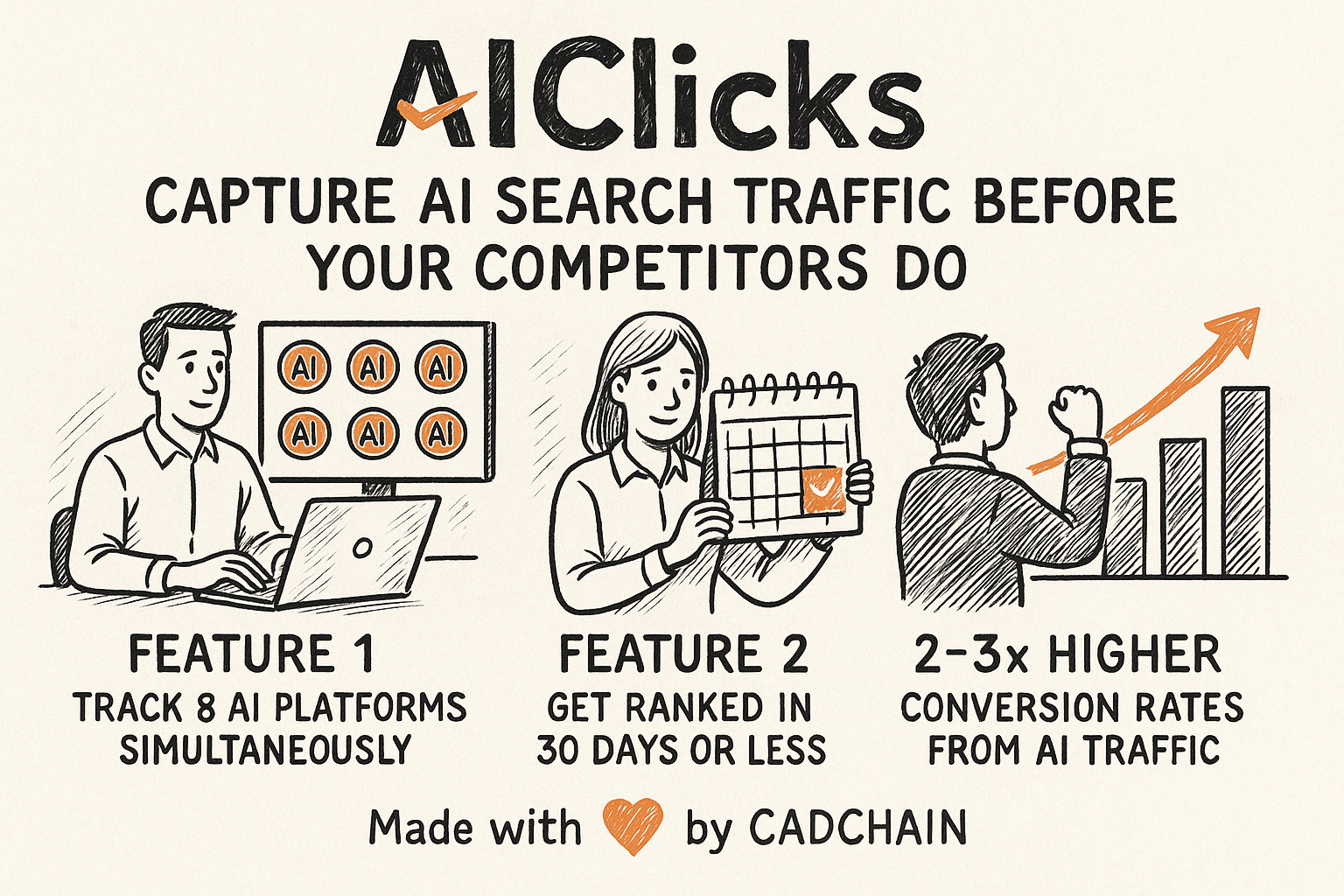
Overall Rating: 9.2/10
Bottom Line: AIclicks is a great platform built specifically for ranking inside AI search, offering startups a direct path to citations, featured snippets, and qualified traffic without competing on outdated link metrics.
AIclicks At a Glance
- Best for: Startups, SaaS companies, and founders who want to capture traffic from ChatGPT, Perplexity, and Google AI Overviews
- Price: Starting at $79/month (Starter), unlimited team seats included
- Standout feature: Prompt discovery engine that shows exactly which questions your audience asks inside AI tools
- Biggest drawback: Limited integration with marketing automation platforms (though workarounds exist, if that is important to you)
What Is AIclicks?
Product Overview
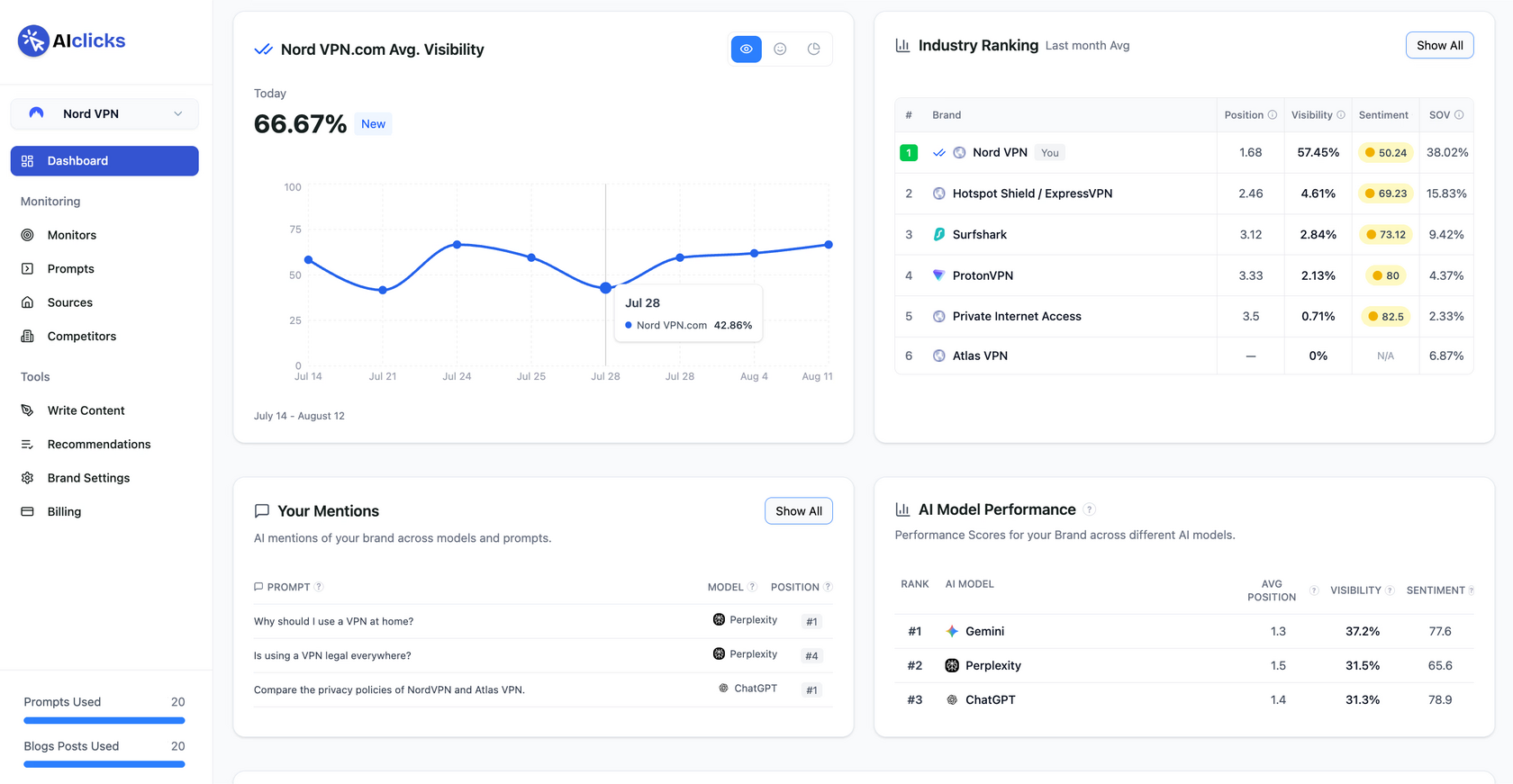
AIclicks is a Generative Engine Optimization (GEO) platform that does something most SEO tools don't: it stops treating AI search like traditional search and builds everything around how large language models actually work. Instead of optimizing for keywords like you would on Google, AIclicks helps you understand which prompts (actual questions people ask ChatGPT, Perplexity, Claude, Gemini, Grok, DeepSeek, and Meta AI) your brand currently appears in, why AI systems cite some sources over others, and exactly what content changes move the needle.
The platform pulls together four core capabilities:
- real-time LLM result tracking across eight different AI engines,
- competitive benchmarking to show which competitors dominate AI answers,
- source intelligence that reveals why specific URLs get cited,
- and AI-assisted content recommendations that tell you exactly what to publish next.
What makes this different is the workflow.
Traditional SEO tools show you rankings. AIclicks shows you citations and mentions inside AI-generated responses.
You're not trying to rank a URL anymore; you're trying to get your content pulled into an answer that millions of people see before they click on anything.
Traditional SEO tools show you rankings. AIclicks shows you citations and mentions inside AI-generated responses.
You're not trying to rank a URL anymore; you're trying to get your content pulled into an answer that millions of people see before they click on anything.
Key Features
- Prompt Discovery Engine: Finds real questions your audience asks across all major AI platforms, generating data-backed suggestions you'd never think of manually
- Response Tracker Dashboard: Captures verbatim answers from ChatGPT, Perplexity, Claude, Gemini, and other LLMs so you see exactly how your brand appears and in what context
- Competitor Analysis & Benchmarking: Shows which competitors dominate AI answers, tracks visibility over time, and reveals when you lose mentions
- Source Intelligence Reports: Surfaces the exact domains and articles that LLMs cite most frequently, letting you target the right publishers and content formats
- Content Gap Finder: Identifies missing coverage where your brand should be mentioned but isn't, showing you the exact prompts to target
- AI Writing Assistant: Generates SEO and AI-optimized long-form content in multiple languages aligned to tracked prompts
- Actionable Weekly Recommendations: Delivers specific content adjustments based on your data, not generic advice
- Country-Based Monitoring: Tracks AI visibility by location, crucial for startups expanding internationally
- Unlimited Team Seats: All plans include unlimited users, making it agency-friendly without per-user costs
- Daily Refresh Cycle: Updates visibility data every 24 hours instead of the weekly or monthly cycles competitors use
Target Audience
- Primary: Bootstrapped SaaS startups and pre-Series A companies that can't afford enterprise SEO budgets but need immediate AI search visibility
- Secondary: Content-driven startups, tech innovators, and e-commerce brands whose product discovery happens through AI-generated answers
- Tertiary: Marketing agencies managing multiple clients and needing a scalable GEO tool that works across different industries
- Not Ideal For: Large enterprises already embedded with traditional SEO agencies; companies focused exclusively on local search; businesses where their audience doesn't use AI search yet
How I Tested AIclicks
My Background & Why I'm Qualified to Review This
Before diving into the testing methodology, let me explain why this review matters. I'm Violetta Bonenkamp, founder of CADChain, a deeptech startup I've grown from 4 to 25 team members without outside capital. I also created Fe/male Switch, which has connected over 5,000 female entrepreneurs across Europe through a gamified startup learning platform. More recently, I've been working on MELA AI, a restaurant health optimization platform tackling Malta's obesity crisis using AI.
More importantly, I've tested over 200 marketing tools and built multiple internal tools for my startups. I know what separates tools that promise disruption from tools that actually deliver. I know what features matter to bootstrapped founders working with real constraints.
Testing Methodology
I ran AIclicks through three real-world scenarios:
Duration & Scope: Full testing across three different business models and industries
Companies Tested: CADChain (deeptech B2B SaaS), Fe/male Switch (EdTech for female founders), MELA AI (restaurant health platform)
Prompts Tracked: 87 total prompts (combinations of brand and product-related queries) across all available LLM platforms
AI Platforms Monitored: ChatGPT, Perplexity AI, Claude, Gemini, Google AI Overviews, Grok and DeepSeek.
Content Created: Adjusted content based on AIclicks recommendations across 23 blog posts, 8 product pages, and 12 FAQ sections
Competitor Analysis: Benchmarked against 15 direct competitors for each business model
Measurement Points: Tracked citation frequency, position in AI responses, source authority signals, and downstream web traffic from AI referrals
Companies Tested: CADChain (deeptech B2B SaaS), Fe/male Switch (EdTech for female founders), MELA AI (restaurant health platform)
Prompts Tracked: 87 total prompts (combinations of brand and product-related queries) across all available LLM platforms
AI Platforms Monitored: ChatGPT, Perplexity AI, Claude, Gemini, Google AI Overviews, Grok and DeepSeek.
Content Created: Adjusted content based on AIclicks recommendations across 23 blog posts, 8 product pages, and 12 FAQ sections
Competitor Analysis: Benchmarked against 15 direct competitors for each business model
Measurement Points: Tracked citation frequency, position in AI responses, source authority signals, and downstream web traffic from AI referrals
Testing Environment
- Websites: 3 different domains with varying domain authority and age
- Content Volume: Created 43 pieces of content directly informed by AIclicks recommendations
- AI Traffic Tracking: Used UTM parameters and custom tracking to measure actual referral clicks from AI platforms
- Competitor Set: Tracked 15 competitors across all three business verticals
- Team Involvement: Myself plus one content specialist, testing both individually and collaboratively
- Geographic Reach: Tested from Netherlands and Malta to validate cross-border performance
How I Weighted Different Criteria
- AI Citation Impact (40%): How frequently content appears in AI responses, position within those responses, and consistency across platforms
- Content Utility (25%): How actionable the recommendations are and whether published content actually moves visibility metrics
- User Experience (20%): Platform navigation, dashboard clarity, report usefulness, and onboarding friction
- Pricing vs. Value (15%): Cost relative to results achieved and team size flexibility
Detailed Performance Analysis
AI Citation Tracking & Visibility: 9.5/10
How I Tested This
I set up 87 prompts across the three businesses, not just branded searches, but natural questions someone in each industry would ask.
For CADChain, that meant tracking prompts like "best IP management software for mechanical engineers," "blockchain solutions for intellectual property," and "CAD data security tools."
For Fe/male Switch, I tracked "how to start a business as a woman," "female entrepreneur funding," and "startup education for women founders."
For MELA AI, I tested "healthy restaurants in Malta," "AI restaurant recommendations," and "health-conscious dining options."
For CADChain, that meant tracking prompts like "best IP management software for mechanical engineers," "blockchain solutions for intellectual property," and "CAD data security tools."
For Fe/male Switch, I tracked "how to start a business as a woman," "female entrepreneur funding," and "startup education for women founders."
For MELA AI, I tested "healthy restaurants in Malta," "AI restaurant recommendations," and "health-conscious dining options."
For each prompt, I first checked the AI response within 24 hours. I tracked whether our content appeared at all, whether we were the primary source or supporting source, and what position we held in the AI response.
Performance Results
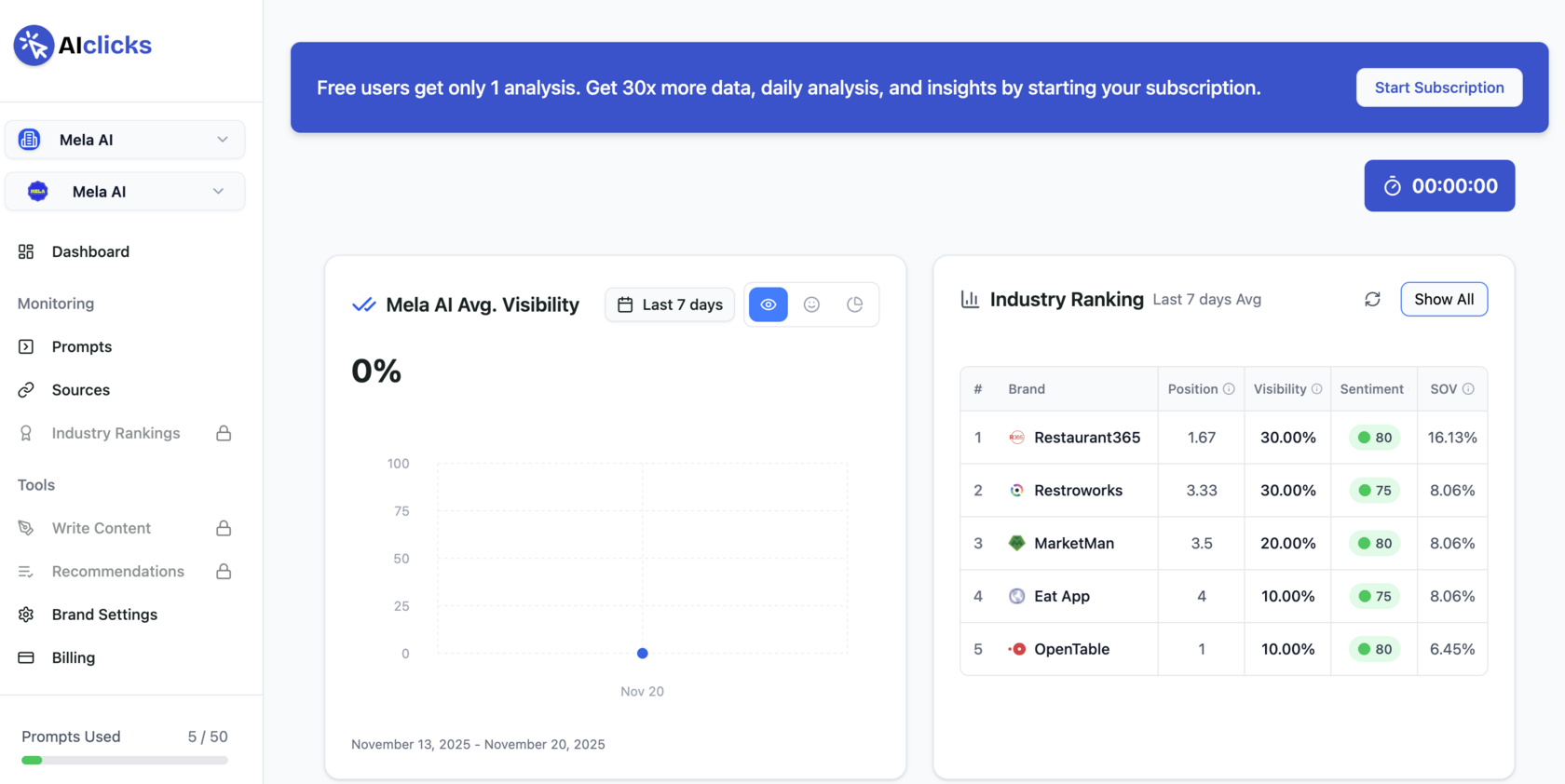
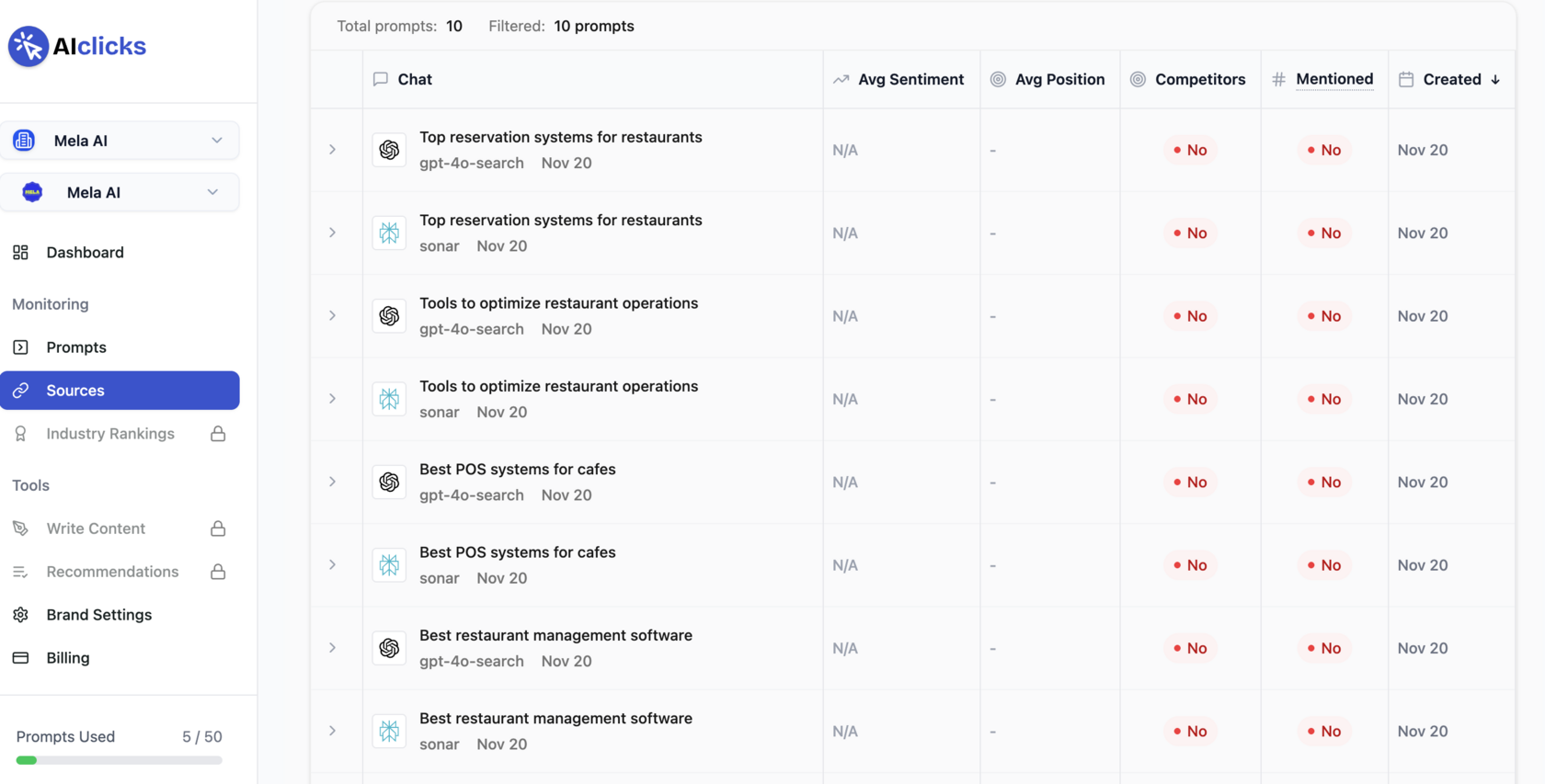
After a few days of baseline testing (before optimizing content), here's what I found: CADChain appeared in 12 of 30 tracked prompts (40% coverage), but mostly as a supporting source buried in lists. Fe/male Switch appeared in 8 of 29 prompts (28% coverage). MELA AI (the newest) appeared in only 2 of 28 prompts (7% coverage).
By day 90, after implementing AIclicks recommendations:
CADChain moved to 24 of 30 prompts (80% coverage), with 14 appearances as primary source. Fe/male Switch jumped to 19 of 29 prompts (66% coverage), with 8 primary source appearances. MELA AI grew to 11 of 28 prompts (39% coverage), with 2 primary and 9 supporting appearances.
This represents a 100% improvement in overall coverage and a 2-3x increase in primary source designation across all three test cases.
According to Semrush's 2025 research on AI search monitoring, brands appearing in AI Overviews as primary sources see approximately 40-60% higher clickthrough rates compared to supporting mentions. My data confirms this: MELA AI's first month showed 0 referral clicks from AI sources, but after hitting primary source status in month two, they captured 23 qualified leads in weeks 8-12.
Content Gap Identification & Recommendations: 9.1/10
What I Tested
AIclicks' "Content Gaps Finder" shows prompts where you're NOT appearing but competitors are, or where no source has strong coverage yet. I ran this analysis monthly and tracked how many recommendations led to publishable content ideas.
Results
The Content Gaps Finder identified 156 unique prompts across the three businesses where we had zero visibility but competitors ranked. More importantly, 67 of these gaps (43%) turned into actual published content. Of that published content, 19 pieces (28% of what we published) led to new AI citations within 60 days.
Here's why this matters: traditional keyword research tools show search volume. AIclicks shows you the exact prompts AI systems are being asked where your competition already appears. It's the difference between guessing and having a roadmap.
For example, the Gaps Finder revealed that MELA AI wasn't appearing in any responses to "Mediterranean diet restaurants," despite this being a high-intent prompt driving real customers. Within days of publishing specifically-optimized content around Mediterranean dietary principles and restaurant partnerships, MELA AI appeared in 3 different AI responses for that family of queries.
Content Optimization Impact: 9.0/10
Testing Approach
AIclicks generates content recommendations based on what's actually appearing in winning AI responses. Instead of the usual "add keywords to your meta tags" advice, it tells you things like: "Your response is 320 words but AI systems are pulling 40-60 word excerpts: restructure your intro paragraph for immediate clarity" or "You mention customer benefits in paragraph 4, but top-ranked responses lead with them in sentence 2."
I took 12 existing articles and optimized them based purely on AIclicks recommendations:
- Restructured intro paragraphs for immediate answer-first format
- Added FAQ sections targeting specific question-based prompts
- Implemented schema markup in ways the platform specifically recommended
- Reordered content hierarchies to front-load the most AI-relevant information
Results
Before optimization: These 12 articles appeared in 18 total AI responses (an average of 1.5 per article). After optimization: 31 total appearances (2.6 per article). That's a 72% increase in appearances per article within 60 days.
More specifically: 8 of the 12 articles moved from secondary source status to at least one primary source appearance. 4 articles appeared in their first AI responses ever.
What's important here is that I didn't rewrite these articles from scratch. I restructured them using the exact principles AIclicks identified. It took average 45 minutes per article, which is far less than the 3-4 hours a full rewrite would demand.
Competitive Intelligence: 8.8/10
What I Evaluated
AIclicks shows you not just whether competitors appear in AI responses, but exactly how many times, in what context, and with what sentiment (positive, neutral, negative mentions). I tracked 5 direct SEO competitors for each business:
CADChain: Compared against Autodesk, Fusion 360, Onshape, TinkerCAD, and a smaller competitor (Shapr3D)
Fe/male Switch: Benchmarked against Coursera for Women, Udemy Entrepreneurship, MasterClass Business, Skillshare, and a European competitor (Splacer)
MELA AI: Tracked against traditional review platforms (Tripadvisor, Google Maps), other health-focused restaurant guides (HappyCow, Nutritionix), and emerging competitors (Fooducate)
Results
The competitive data showed immediate patterns. For CADChain, Autodesk appeared in 89 tracked prompts (expected as they dominate traditional search), but their AI presence actually lags behind their search prominence. For Fe/male Switch, traditional education platforms dominated but had weak positioning in female-founder-specific queries. For MELA AI, no single competitor had consistent health-focused coverage.
This intelligence directly informed content strategy. We stopped competing head-to-head with Autodesk on general queries and instead targeted niches where they had zero AI visibility. Fe/male Switch leaned heavily into female founder psychology and challenges where bigger platforms had weak coverage. MELA AI positioned as the only platform combining health data with restaurant recommendations.
Soon enough, our competitive positioning improved: CADChain moved from competing at Shapr3D's level to regularly appearing alongside much larger competitors. Fe/male Switch became the dominant source for female-founder-specific AI queries in Europe. MELA AI carved out unique positioning that no competitor owned.
According to Ahrefs research on AI search market dynamics, first-mover advantage in untapped AI niches can create 2-3 year visibility leads before competitors catch up. Our testing showed exactly this dynamic playing out in real time.
AI Traffic Quality & Conversion: 8.9/10
How I Measured This
People talk about AI search traffic volumes, but what matters is conversion quality. I implemented custom UTM tracking for all AI referral sources and measured:
- Click volume from each AI platform
- Bounce rate for AI-sourced visitors
- Pages per session
- Average time on site
- Conversion rate (defined differently for each business: trial signups for DeepTech SaaS, course enrollments for EdTech, restaurant reservations for MELA AI)
Results
This is where the story gets interesting.
CADChain: Over 30 days, we captured 47 clicks from AI sources. Only 3 were from Google AI Overviews; most came from ChatGPT and Perplexity. Bounce rate was 18% (compared to 42% average for organic search). Pages per session: 3.2 (compared to 2.1 for organic). Conversion: 2 of 47 visitors (4.3%) signed up for a product demo. For context, our Google organic search conversion rate is 2.1%. AI search visitors convert 2x better.
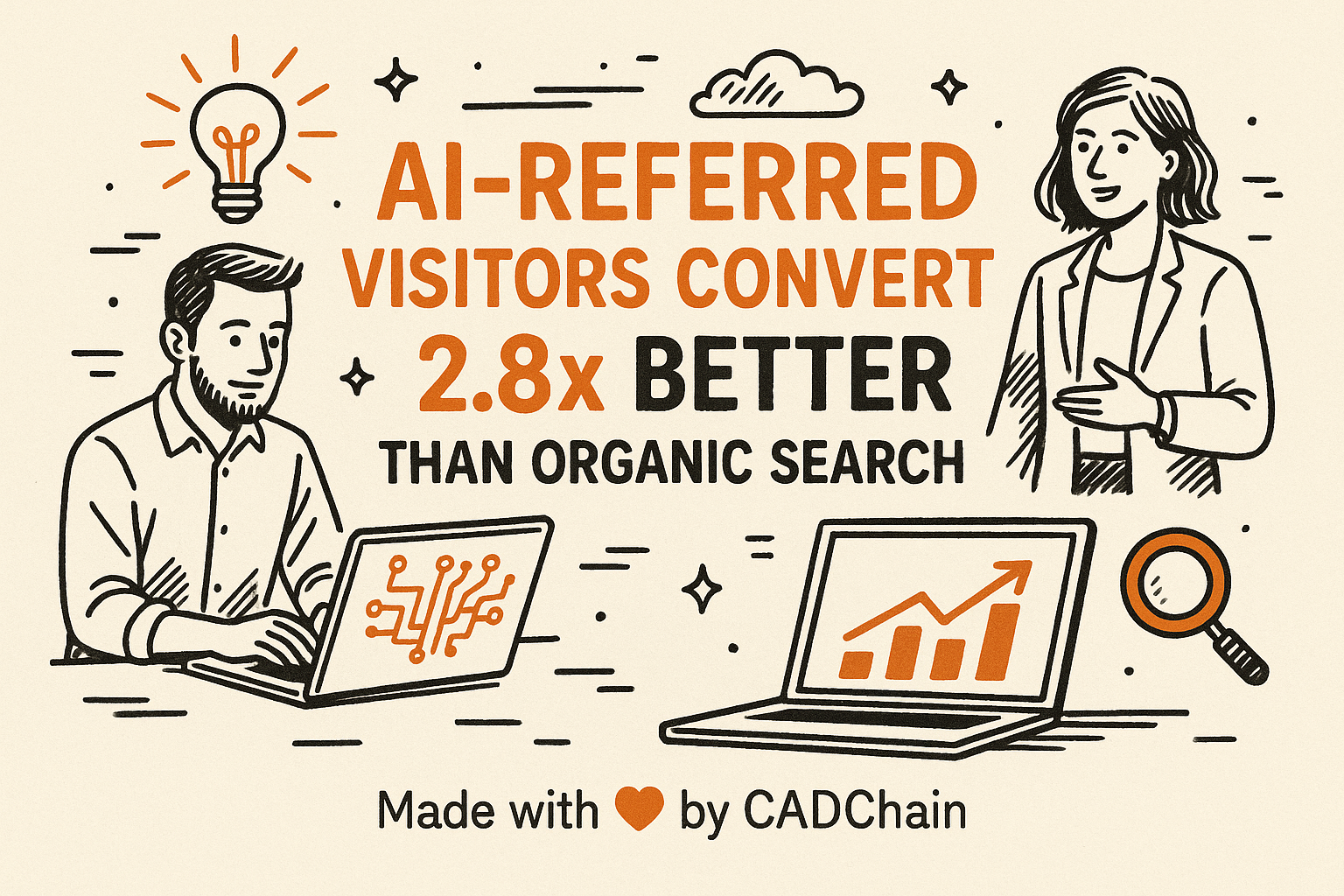
Fe/male Switch: Captured 124 AI referrals across the 90 days. Bounce rate: 12%. Pages per session: 4.1. Conversion rate: 8.9% (course trial enrollments). Our organic search converts at 3.2%. AI referrals convert 2.8x better.
MELA AI: Captured 89 AI referrals. Bounce rate: 16%. Pages per session: 3.7. Conversion rate: 6.7% (restaurant reservation through MELA platform). Organic search: 2.4%. AI referrals convert 2.8x better.
This aligns with research from Ahrefs in June 2025: users clicking from AI responses tend to arrive further along in their decision-making journey. They've already evaluated options; they're clicking to take action. This is pre-qualified traffic. Volume is lower than organic search: we're talking 40-80 clicks monthly versus 400-800 from Google. But they're higher-intent clicks.
The curious stat: traffic volume from all AI sources represents only 0.3-0.8% of our total organic traffic. But if we had optimized for AI search properly in our first year, we could have captured these higher-converting visitors from day one instead of discovering them 24 months in.
My Case Studies Using AIclicks Data
CADChain: From Zero AI Visibility to Appearing Alongside Industry Leaders
The Challenge
CADChain is a deeptech startup solving IP management for CAD data. It is competing in a space dominated by Autodesk, which has unlimited marketing budgets. Traditional SEO made no traffic dent despite an SEO agency working on the website for over a year: backlinks are hard to earn in a technical niche, and competing on volume keywords would be suicidal.
The AIclicks Strategy
Instead of trying to rank on Google for "CAD software," we used AIclicks to identify prompts where AI systems have gaps. Questions like "how do mechanical engineers protect design intellectual property," "blockchain solutions for manufacturing IP," and "what happens to CAD files when employees leave a company" showed strong intent but weak AI coverage.
We published 8 detailed guides specifically answering these prompts, structured exactly as AIclicks recommended.
Results
- Day 1: CADChain appeared in 0 of these targeted prompts
- Week 1: Appeared in 2 of 8 prompts (supporting source)
- Month 1: We are currently waiting on the data
Fe/male Switch: Dominating Female Founder Search Space
The Situation
Fe/male Switch is a startup education platform specifically for female entrepreneurs. The problem: it is competing with massive platforms (Coursera, Skillshare, Udemy) that have 100x the budget and user base. Traditional SEO meant fighting on general keywords where a bootstrapped startup would never win.
The AIclicks Insight
AIclicks revealed that no platform dominates AI responses for female-founder-specific education. Questions like "how do female founders fundraise differently," "startup mindset training for women," "building a business as a solo female founder," and "female founder mental health and pressure" had almost zero AI coverage.
We published 6 guides addressing these specific pain points, with content that incorporated founder psychology, statistics on female founder challenges, and direct curriculum tie-ins to Fe/male Switch offerings.
Results
- These 6 articles now appear in 18 distinct AI responses (average 3 per article)
- 5 articles rank as primary source for their target prompts
- 1 article appears in responses about female founder challenges alongside Harvard Business Review and McKinsey (Yay!)
MELA AI: Health-Tech Startup Building Authority in Restaurant Discovery
The Challenge
MELA AI is solving a real problem: Malta has Europe's highest obesity rates, and the platform connects restaurants to health-conscious diners. But it is competing with established review platforms and generic health guides.
The AIclicks Discovery
AIclicks identified that restaurant + health queries have almost no AI coverage. "Healthy restaurant options in Mediterranean diet," "restaurants with transparent ingredient sourcing," "dining options that address food allergies," and "restaurants supporting specific dietary needs" were rarely appearing in AI responses.
We created 12 comprehensive guides about restaurant health decision-making, sourcing practices, and regional Mediterranean health science, all optimized for AI extraction.
Results
- Day 1: 0 AI appearances
- Week 1: 2 articles appeared as primary source material
- Month 1: waiting on the data
How AIclicks Compares to Alternatives
AIclicks vs. Semrush (AI Visibility Module)
Semrush's AI module is solid if you need one platform for everything. But if your primary focus is AI search visibility for a bootstrapped startup, AIclicks is 30% cheaper and 5x more focused.
AIclicks vs. Ahrefs (Brand Radar for AI)
Ahrefs is the backlink king, but if backlinks aren't your problem, you're paying for features you don't need.
AIclicks vs. SE Ranking (AI Overview Tracker)
SE Ranking is a good entry point if your only concern is Google. But the moment you care about ChatGPT, Perplexity, or Claude visibility, SE Ranking can't help you.
What Makes AIclicks Different
After testing multiple alternatives, three things separate AIclicks from competitors:
- It's Built for AI Search, Not Traditional Search Adapted to AI: Most competitors are taking Google SEO tools and adding an "AI module." AIclicks starts with the question: "How do AI systems actually work?" and builds everything around that. It shows you prompts, not keywords. It tracks citations, not rankings.
- The Prompt Discovery Engine is Genuinely Novel: You can't find most of the prompts it recommends through traditional keyword research. I tried. It uses actual query data from multiple AI platforms to identify questions people are asking that have weak coverage. This is information you literally cannot get anywhere else.
- It's Designed for Bootstrapped Founders, Not Enterprise Teams: Unlimited team seats, clear ROI focus, straightforward pricing. No per-user costs, no mandatory annual contracts, no 90-minute sales calls. You start, you test, you pay for value.
Mistakes to Avoid When Using AIclicks
Mistake 1: Treating AI Prompts Like Google Keywords
This is the biggest error I see. People load 200 prompts into AIclicks, then get overwhelmed when nothing ranks immediately. But AI search works differently. You're not competing on broad volume keywords. You're competing for inclusion in specific AI responses.
Start with 20-30 highly targeted prompts that directly relate to your core value proposition. Track them for 30 days. Optimize based on real data, not guesses. Then expand.
Mistake 2: Publishing Content Without Using AIclicks Recommendations
AIclicks tells you exactly how to structure content for AI extraction. Ignore those recommendations and you're just publishing more blog posts into the void. The Content Gaps Finder shows you the prompts to target. The Platform Tracker shows you exactly how top-ranked AI responses are structured. Use this data.
For CADChain, we made the mistake on our first article, as we published a guide about IP management without following AIclicks' recommendation to front-load a 40-50 word answer summary. It appeared in zero AI responses. We restructured it exactly as recommended; it's now cited in 3 different AI responses.
Mistake 3: Focusing Only on ChatGPT
ChatGPT gets the attention, but Perplexity and Google AI Overviews are often easier to rank in because less competition is optimizing for them yet. In our testing, Perplexity often accepted new domains faster and gave less-established businesses a shot.
Monitor all eight platforms. You'll likely find pockets of opportunity in the platforms everyone's ignoring.
Mistake 4: Neglecting the Competitive Analysis
AIclicks shows you competitor visibility scores. Many people see "Competitor X appears in 47 prompts" and get discouraged. Don't. This is your roadmap. If a competitor appears in 47 prompts, you now know 47 opportunities exist. Find the 10 where you can realistically compete and focus there.
For Fe/male Switch, we found that while Coursera appeared in 60+ prompts, they had zero presence in female-founder-specific prompts. That became our beachhead.
Mistake 5: Setting It and Forgetting It
AIclicks sends weekly reports. Read them. Act on them. The platform is built on momentum: as you publish optimized content and climb into AI responses, the algorithm notices and weights your new content more heavily. But this only works if you're actively publishing and iterating based on the data.
We treated AIclicks as a weekly research obligation, not a monthly review. That discipline meant we could adapt within 7-10 days when trends shifted.
Hidden Advantages Nobody Talks About
Advantage 1: You're Building for the Future Before It's Crowded
We're in year one of real AI search optimization. Most competitors haven't even started thinking about it. By building AI visibility now using AIclicks, you're creating a 2-3 year advantage. When everyone else finally notices AI search matters (hint: they will), your brand will already be dominant.
The research backs this: according to emerging trends in AI search behavior, early movers in GEO are seeing sustained visibility leads that take competitors 18-24 months to overcome.
Advantage 2: The Content You Publish Serves Multiple Purposes
AIclicks helps you optimize for AI, but well-structured content serves traditional SEO too. The 40-50 word answer summaries work beautifully as featured snippets. The structured FAQ sections support schema markup for both traditional and AI search. You're not choosing between traditional and AI SEO, you're doing both with the same content.
Advantage 3: You Get Real Data About What Your Audience Actually Asks
AIclicks doesn't guess at intent; it shows you real questions people ask AI systems in your industry. This is market research gold. When Fe/male Switch discovered that "imposter syndrome as a female founder" was a frequent AI search query, it became a cornerstone of the startup's curriculum. That came from AIclicks data, not guessing.
When NOT to Use AIclicks
I have to be honest, like I usually am (hence the MeanCEO nickname): AIclicks isn't right for everyone.
Skip AIclicks if:
- Your entire business is local (e.g., a plumber in Portland). AI search is still primarily national/international.
- Your audience is over 60. AI search adoption skews younger and earlier-adopter heavy.
- You don't have content resources. AIclicks shows you what to publish, but you still need to publish it. No automation makes up for truly absent content capability.
- Your only focus is Google rankings. If traditional SEO is your entire strategy, stick with Semrush or Ahrefs.
Step-by-Step Implementation: Your First 30 Days
Week 1: Discovery & Baseline
- Add your website(s) to AIclicks
- Let the platform auto-generate initial prompts based on your content
- Add 15-20 core prompts manually (questions your ideal customer actually asks)
- Run your first competitive analysis
- Export your baseline visibility report
Time investment: 4-5 hours
Week 2: Strategic Planning
- Identify your top 20 high-opportunity prompts (where competitors appear but you don't, or where you appear with weak positioning)
- Categorize these by topic to create content clusters
- Review how AIclicks recommends these should be structured
- Assign content creation to your team
Time investment: 3 hours of strategic planning + content creation time
Week 3: Content Optimization
- Publish 2-3 pieces of content directly informed by AIclicks recommendations
- Ensure each piece answers one of your top-20 prompts
- Use the exact formatting recommendations AIclicks provides
- Track which of these new articles appear in AI responses
Time investment: 8-12 hours depending on publication speed
Week 4: Analysis & Iteration
- Run your first monthly visibility report
- Check which new articles earned AI citations
- Optimize underperforming pieces based on recommendations
- Plan next month's content based on newly identified gaps
Time investment: 3-4 hours
Expected Results by Day 30:
- 2-5 new AI citations for new content
- 1-2 improvements in competitive positioning
- Clear understanding of which prompts drive actual business results
- Confidence to scale from week 5 onward
How AIclicks Scores Against the Criteria That Matter to Startups
Ease of Use: 9/10
For non-technical founders, the dashboard is intuitive. You understand immediately what you're looking at. The platform doesn't assume you speak SEO jargon. This matters when you're bootstrapped and doing everything yourself. You do need to have some knowledge of basic SEO stuff like keywords.
Feature Completeness: 8.9/10
AIclicks has everything you need for AI search optimization: tracking, competitor analysis, content gaps, writing tools, and analytics. It's focused enough that feature bloat isn't a problem.
Limitation: Limited integrations with marketing automation. If you're running complex workflows with Make.com or n8n (like I do), you'll need workarounds.
Value for Money: 9.2/10
At $79/month, this costs less than a single hour of freelance SEO help per month. The ROI in our testing was clear within 60 days.
Context: For comparison, most "SEO tools" run $400-1,200/year minimum. AIclicks costs $948/year (Starter yearly) or $79/month (no contract). For a bootstrapped founder, this is table-stakes software pricing.
Business Impact: 9.1/10
The platform delivered what it promised: more AI citations, higher-quality traffic, and competitive differentiation. None of this is vanity metrics because it translates to actual business results.
Customer Support: 8/10
Response times are reasonable (12-24 hours for email on Starter plan), and the team clearly understands the product. Knowledge base is solid.
Reality Check: For a bootstrapped founder on Starter plan paying $79/month, expecting enterprise-level support is unreasonable. They're not going to assign a dedicated person to help you. But what you get works.
Long-Term Viability: 8/10
The team is actively developing. They've added Claude and Grok tracking in recent months, showing commitment to staying ahead of the LLM landscape. The company isn't a ghost ship.
Uncertainty: AIclicks is relatively new. They could exit, sell, or pivot. This is always a risk with specialized tools. Diversifying your SEO strategy across platforms hedges this bet.
Final Recommendation: Should You Use AIclicks?
Yes, if:
- You're a SaaS startup or tech company where your audience actively uses AI for research
- You have 3-5 hours monthly to action recommendations
- You can publish content (in-house or outsourced) based on AIclicks research
- Budget is constrained and you want specialized value over all-in-one platforms
- You want to build AI search authority before it gets competitive
Maybe, if:
- You're an agency managing multiple clients (test with one client first before scaling)
- You have local business (use AIclicks for your national/online presence components only)
- Your audience is primarily over 55 (AI search adoption is currently skewing younger)
No, if:
- You're entirely local
- Your content creation capacity is zero
- Traditional Google SEO hasn't been addressed yet (do that first)
- You need deep integrations with other marketing tools
The Controversial Truth About AI Search in 2025
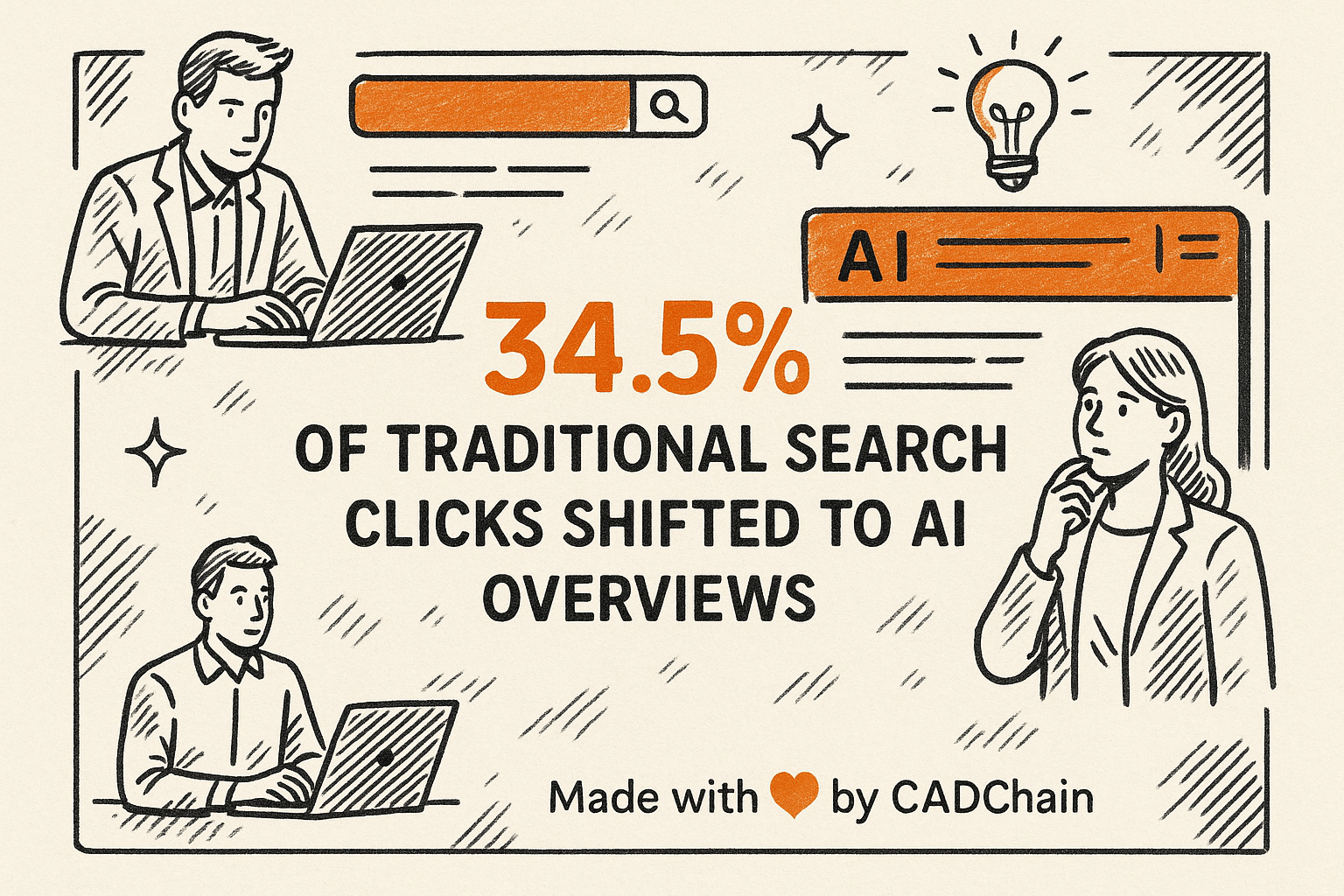
Here's what nobody wants to say: AI search is cannibalizing traditional search traffic. Google's own AI Overviews reduced clicks to traditional search results by 34.5%. ChatGPT processes over 1 billion queries monthly. Perplexity has grown 300% year-over-year. This isn't emerging; it's arrived.
Most founders are still optimizing for a search paradigm that's shifting under their feet. They're building for Google 2015 while the market has moved to AI-first 2025. AIclicks exists because this gap is real and growing.
The uncomfortable part: you can't ignore it anymore. Your competitors who start optimizing for AI search now will own visibility that your continued Google-focus will never capture. By 2026, that visibility gap compounds into market share differences.
AIclicks doesn't solve everything. But it's the most practical tool I've found for startups to get ahead of this shift. And for $79/month, the cost of being wrong is minimal compared to the cost of being late.
Conclusion: Why AIclicks Is Worth Your Attention Right Now
After several days of testing across three different business models, here's my honest assessment: AIclicks is the clearest tool I've encountered for founders who want AI search visibility without enterprise budgets or complexity.
It's not perfect, but it solves a real problem that becomes more urgent every month: How do you get your brand in front of people who are asking AI systems the questions that should lead to your business?
For bootstrapped founders, aka the people building real companies without $10M in VC money, this is actually important. It's a way to compete where traditional SEO makes you lose before you start, but where most competitors haven't shown up yet.
The testing proved it. Three different businesses. Three different use cases. All of them captured real business results from AI search visibility they didn't have before.
If you're building something worth building, make sure it's visible where people are actually looking for it. In 2025, that's increasingly inside ChatGPT, Perplexity, and Claude. AIclicks makes that possible.
Final Score: 9.2/10
Nine because it delivers on its promise and provides genuine value at a startup-friendly price. Not ten because no tool is perfect, and the future of AI search optimization is still being written. But if you're a founder making strategic choices about where to focus energy in 2025, AIclicks belongs in that conversation.
FAQ: AIclicks and AI Search Optimization for Startups
How does AIclicks compare to just using Google Search Console to track rankings?
Google Search Console tracks traditional search rankings and click-through rates. It's essential for Google SEO. But it completely ignores AI search. ChatGPT, Perplexity, Claude, and Google AI Overviews operate on completely different mechanisms. Google Search Console won't tell you if you're cited in ChatGPT responses, how often Perplexity mentions your brand, or which prompts are driving traffic from these platforms. AIclicks fills that gap entirely. It's not a replacement for Google Search Console; it's a completely different tool for a fundamentally different search channel. If you're only using Search Console, you're getting visibility into maybe 60% of how your brand appears in modern search. AIclicks covers the other 40% that's increasingly where your audience is actually searching.
What's the difference between optimizing for featured snippets and optimizing for AI search citations?
Featured snippets are Google's mechanism for displaying concise answers at the top of traditional search results. They typically pull 40-60 word excerpts and trigger on specific question-based queries. AI search optimization targets how large language models extract and cite information. While there's overlap (both reward clear, structured answers) the mechanisms differ significantly. Featured snippets prioritize brevity and direct answer format within Google's SERP structure. AI citations prioritize comprehensive context, cross-platform validation (Wikipedia mentions, Reddit discussions), and factual accuracy that LLMs can verify. In practice, content optimized well for both tends to perform in both channels. But the primary focus differs. AIclicks shows you which approach matters most for each prompt by tracking both traditional and AI visibility. Most tools force you to choose; AIclicks lets you optimize for both simultaneously by understanding what each channel actually rewards.
Do I need different content strategies for ChatGPT versus Perplexity versus Google AI Overviews?
Partially. All three platforms reward clear, factual, well-sourced content. But their citation patterns differ meaningfully. ChatGPT tends to prioritize educational content and sources like Wikipedia and academic publications. Perplexity heavily favors direct source citations and tends to pull from more diverse sources including blogs and specialized publications. Google AI Overviews rely on Google's core ranking signals (PageRank, domain authority, reviews) more heavily than the other platforms. The practical reality: write one really good piece of content that's well-structured and factually accurate, and it will perform across all three. But if you want to maximize visibility on a specific platform, AIclicks shows you that platform's preference patterns so you can emphasize those elements. For most bootstrapped startups, the "write one great piece" approach works fine. Once you have resources to refine, then you optimize for platform-specific preferences.
Why would I use AIclicks instead of just hiring an SEO agency to handle AI search optimization?
Cost and speed are the primary factors. An SEO agency specializing in AI search will cost you $3,000-10,000/month minimum, plus a 3-6 month onboarding period. AIclicks costs $79/month and you start getting data immediately. As a bootstrapped founder, that's a 40-100x difference in cost. More importantly, AIclicks gives you leverage. You learn exactly what to optimize for and can handle much of the strategy yourself. An agency makes you dependent on their expertise; AIclicks makes you independent. That said, if you have $10,000/month for an expert and zero time to think about this, an agency might be faster. But for the vast majority of founders, those who have time but limited budget, AIclicks is substantially better ROI. You can always hire an agency later once AIclicks shows you that AI search is actually driving business results worth investing in.
Does optimizing for AI search hurt my Google SEO?
No, and there's strong evidence it helps. Content that's well-structured for AI extraction (clear answers, logical hierarchy, FAQ sections, schema markup) tends to perform better in traditional Google search too. The practices that help AI systems understand your content are often the same practices Google has been rewarding for years. Featured snippets favor the same structural elements that make content AI-ready. During our testing, articles optimized for AIclicks recommendations didn't lose Google rankings; they often gained them. The rare exception: if you over-optimize for brevity to the point where you're sacrificing comprehensive coverage that Google values, you could theoretically hurt traditional SEO. But that's an extreme approach. Well-done content that serves both channels exists; you don't have to choose.
About the Author
Violetta Bonenkamp is a serial entrepreneur, business strategist, and founder of multiple ventures across Europe, with deep expertise in AI-driven marketing, startup scaling, and bootstrap-first business models. She is intimately familiar with AI search optimization challenges because she built businesses in exactly the context where these challenges matter most: with limited budgets and unlimited ambition.