
HPC and AI in 2026: how artificial intelligence and high-performance computing work together, with JuliaHub as a worked example
TL;DR: HPC and AI work in two directions. High-performance computing (HPC) supplies the parallel CPUs and GPUs that train and run AI models, and AI now makes HPC faster and easier to use: machine-learned surrogates replace slow simulations, scientific machine learning fills gaps in physics models, and AI agents build and check simulation models.
JuliaHub, the company founded in 2015 by the creators of the Julia language, is a clear example of the second direction: its JuliaHub cloud platform scales Julia jobs to hundreds of nodes, and its Dyad Agent turns plain-language requests into physics models that a compiler checks. Below: the two directions in a table and an infographic, where European startups can get HPC for AI for free, how JuliaHub's four layers fit together, real results Pfizer and Binnies have published, the limits of AI in simulation, and five steps to start.
Search "HPC and AI" and you mostly find definitions of high-performance computing and vendor pages about GPU servers. This guide, written by CADChain on 24 November 2026, explains how the two fields now feed each other and uses JuliaHub's AI-powered HPC tools as a worked example, with every product fact checked on JuliaHub's own pages that day.
Boost Your SEO by Getting Featured in Business Blogs
We publish content about startups, tech, funding, research, etc. that ranks well not only in Google but also in Perplexity, ChatGPT, Grok and other AI tools.
👉 Get featured now!
What is HPC, and what does "HPC and AI" mean?
High-performance computing (HPC) means running one large computation across many processors at once: clusters of servers with many CPU cores and GPUs, joined by fast networks, often in a supercomputer centre or in the cloud. It has long been used for weather forecasts, crash and flow simulations, drug modelling and other problems too big for one machine.
HPC and AI (also written AI HPC or HPC AI) describes how these workloads have merged. Training a large AI model is itself an HPC job, and AI methods are now used inside scientific and engineering simulations. For the numbers behind this shift, see our AI and ML statistics that will shape high-performance computing.
HPC for AI and AI for HPC: the two directions
The convergence of HPC and AI is easier to understand when you separate its two directions:
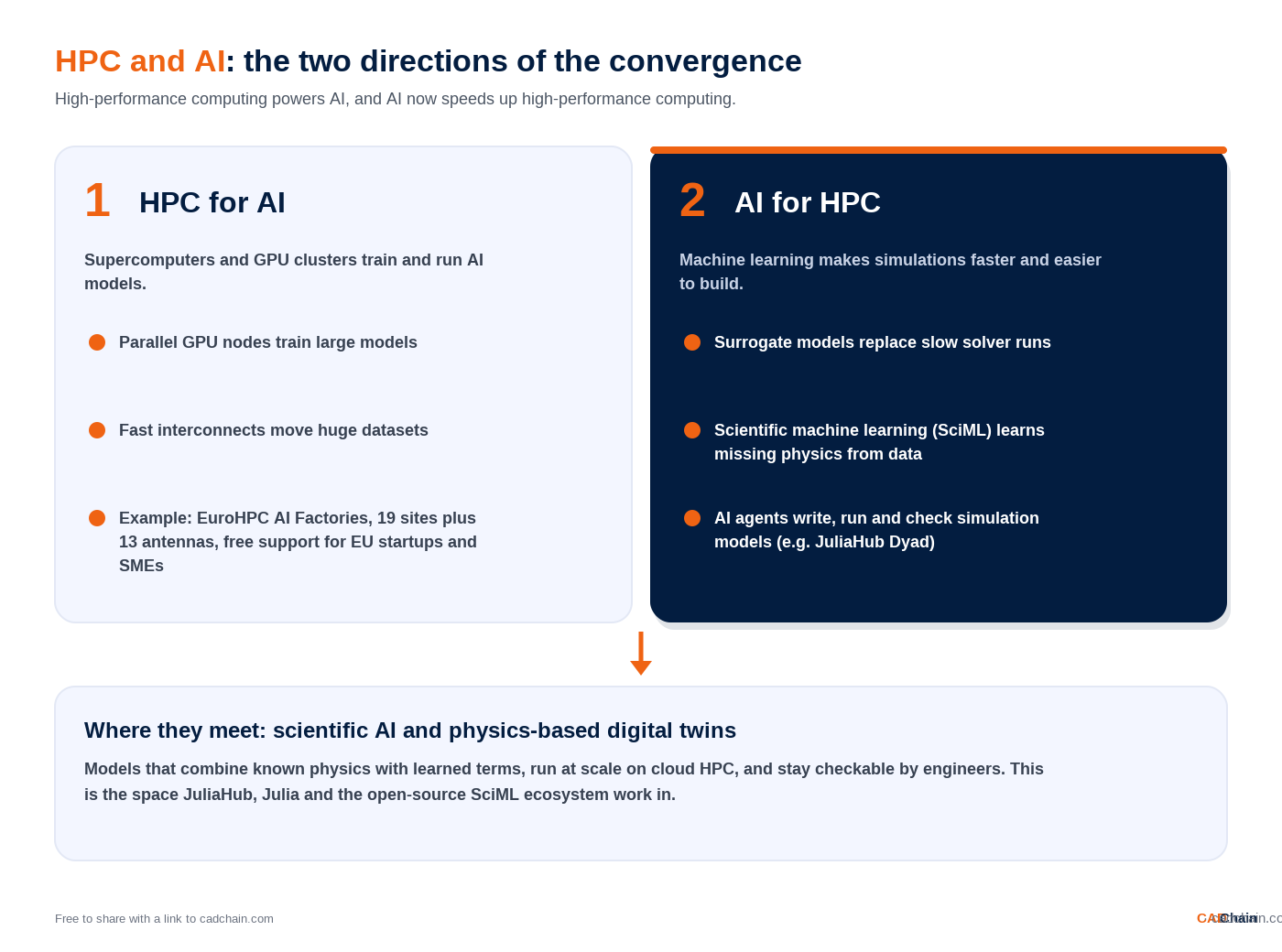
HPC for AI: where startups can get computing power
Training models needs GPU time, and that is the first barrier for a small team. In Europe, the EuroHPC Joint Undertaking runs AI Factories around AI-optimised supercomputers. On its AI Factories page, checked on 24 November 2026, EuroHPC lists 19 AI Factories and 13 AI Factory Antennas that offer free, customised support to SMEs and startups, including computing resources, training and help with access.
Cloud HPC is the other route: you rent CPU and GPU machines by the hour and scale them up only for the heavy runs. Platforms built for scientific computing, such as JuliaHub, add the libraries, job management and reproducibility that raw cloud servers lack.
AI for HPC: scientific machine learning and AI agents
The second direction matters most for engineers. Instead of running a slow solver thousands of times, teams train a fast surrogate, or they keep the known physics equations and let a neural network learn only the missing term. This is called scientific machine learning (SciML). The open-source SciML ecosystem for Julia provides solvers for differential equations, neural and universal differential equations for discovering unknown dynamics, physics-informed neural networks (NeuralPDE.jl) and surrogate methods (Surrogates.jl), with distributed and GPU parallelism. Bridges such as diffeqpy and diffeqr make the solvers usable from Python and R.
For a deeper look at where this research is heading, read the future of HPC-based SciML.
How JuliaHub combines HPC and AI: a worked example
JuliaHub, formerly Julia Computing, was founded in 2015 by the four co-creators of the Julia language (Viral Shah, Alan Edelman, Jeff Bezanson and Stefan Karpinski) together with Deepak Vinchhi and Keno Fischer. Julia is an open-source, high-performance language developed at MIT. JuliaHub's products stack HPC and AI in four layers. For the company's background, see our JuliaHub company profile.
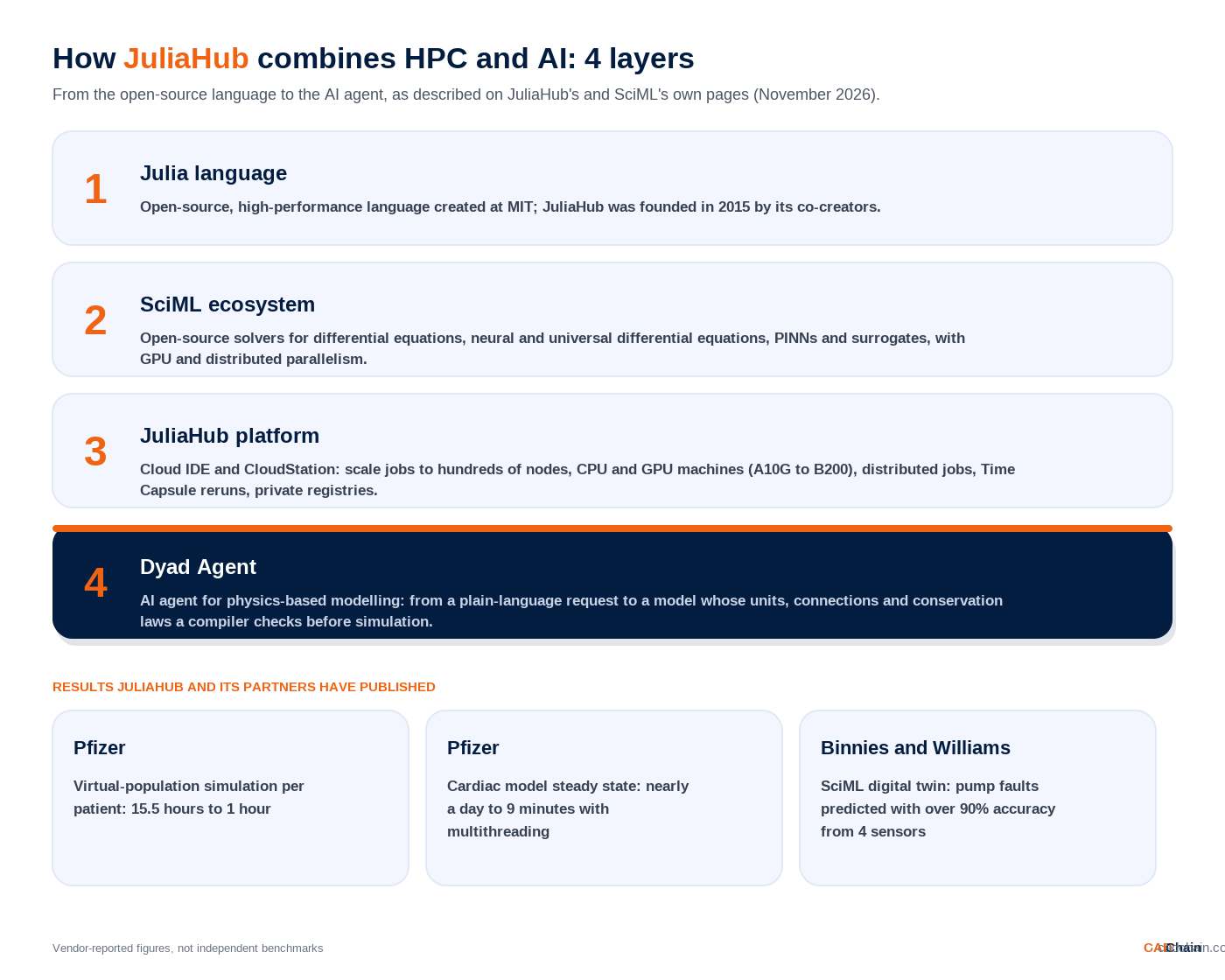
1. The JuliaHub platform: cloud HPC for Julia
The JuliaHub platform is a cloud environment for Julia code. Its CloudStation feature lets users scale simulations to hundreds of nodes and choose CPU, memory and GPU options, with GPUs listed from A10G up to H100, H200 and B200. Distributed Jobs run parallel processes (JuliaHub's own example is a 1,000-core cluster for Monte Carlo simulations). Time Capsule archives each batch job with its code, data, dependencies and Docker image so it can be rerun years later, and private registries keep proprietary packages inside the company.
2. Dyad and Dyad Agent: AI for physics-based models
Dyad is JuliaHub's modelling and simulation platform built on the SciML stack. Its Dyad Agent is described as an AI agent for physics-based modelling and simulation: an engineer describes a component, and the agent researches formulations, derives equations, assembles components, runs simulations and checks the physics. Every model passes through a compiler that enforces unit consistency, type-safe physical connections and conservation laws, so errors appear before the simulation runs. Dyad supports causal block diagrams, acausal equation-based models and synchronous state machines in one system.
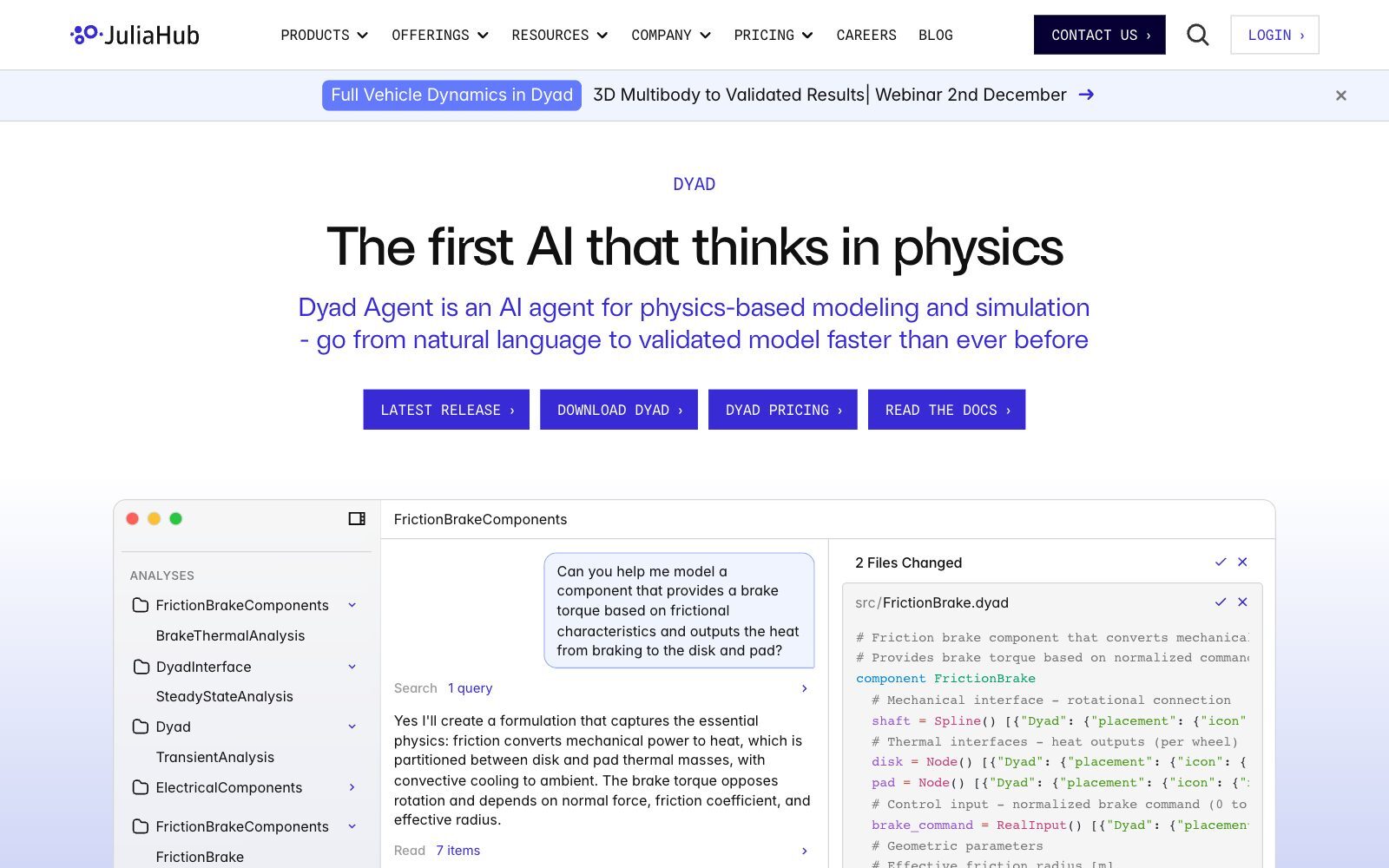
Dyad 1.0 launched in June 2025, Dyad 2.0 in December 2025 and Dyad 3.0 on 30 April 2026. JuliaHub's November 2026 newsletter introduced Dyad 3.5, which adds a synchronous compiler so discrete controllers can be modelled next to continuous physics and exported as C code for embedded hardware. Prices for Dyad plans are covered in our JuliaHub pricing and review.
3. The money behind it: JuliaHub's $65M Series B
Capital is flowing into this mix of HPC and AI. On 30 April 2026 JuliaHub announced a $65M Series B round led by Dorilton Ventures, with participation from General Catalyst, AE Ventures and technology investor Bob Muglia, the former Snowflake CEO, alongside the launch of Dyad 3.0. The announcement presents Dyad as agentic AI for industrial digital twins, used across aerospace, government, automotive, HVAC and utilities.
Real results: HPC and AI at Pfizer and in water networks
Vendor claims about "AI-powered HPC" are easy to inflate, so this table lists only results that JuliaHub has published with named organisations. They are vendor-reported, not independent benchmarks.
The Pfizer figures come from JuliaHub's Pfizer case study; the Binnies result from the Series B announcement. Neither page gives costs or hardware hours, so treat them as signs of what is possible, not as a forecast for your project.
The limits of AI in HPC: why physics checks matter
General-purpose AI does not know whether a model obeys the laws of physics. JuliaHub makes the point itself in its Series B announcement: in engineering, an error is not a bug to patch later but a failed part. In JuliaHub's November 2026 newsletter, its researchers report that leading AI models solved real engineering problems much better inside Dyad's specialised harness than on their own. The lesson for any team using AI for HPC:
- Keep a checker in the loop. Unit checks, conservation laws and validation against test data catch errors that a language model will not notice.
- Prefer interpretable results. SciML can turn a learned term back into an equation an engineer can read, as Dyad's product page shows for a friction term.
- Keep runs reproducible. Archive code, data and dependencies (JuliaHub's Time Capsule does this) so you can explain a result months later.
- Treat vendor speed-ups as hypotheses. Benchmark your own model before you plan a budget around a 100x claim.
How to start with HPC and AI in a small engineering team: 5 steps
- Pick one slow simulation. Choose a model your team runs often and waits for, such as a parameter sweep, a Monte Carlo study or a calibration against test data.
- Measure the baseline. Record run time, cost and accuracy on your current setup, so later gains are real numbers, not marketing.
- Scale it on cloud HPC first. Parallelise the existing model across more cores or GPUs (on JuliaHub, a cloud provider, or an EuroHPC AI Factory if you qualify) before adding any AI.
- Add AI where the physics is slow or unknown. Train a surrogate for the expensive part, or use SciML to learn a missing term from data, and validate it against held-out tests.
- Protect and record your models. Decide what geometry and model data may leave your company, and keep dated proof of what you built before you share it with partners or cloud platforms.
If your simulations run on commercial FEA or CFD software, compare options in our guide to European simulation alternatives to Ansys.
Protecting CAD and simulation data you send to cloud HPC
HPC and AI projects in engineering start with valuable inputs: CAD geometry, material data and models that took years to build. Once they are uploaded to a cloud platform or shared with a partner to train a surrogate, you need to know who can open them and be able to prove they are yours. CADChain builds file-level access control and blockchain proof of ownership for CAD data, a kind of DRM for design files. Read more about digital twins on blockchain, what a digital twin is in CAD design on BORIS for Autodesk Inventor, and what SOLIDWORKS Simulation 2027 changes for your simulation data on our SOLIDWORKS blog.
Conclusion: HPC and AI are now one toolbox
HPC used to be about raw computing power, and AI about learning from data. In 2026 they are one toolbox: HPC trains and runs AI, and AI makes simulations faster to build and run. JuliaHub shows the combination in practice, from cloud HPC for Julia to an AI agent that checks physics, with published results at Pfizer and in water networks. Start with one slow model, measure it, scale it, and add AI only where you can check the answer.
FAQ on HPC and AI and JuliaHub
What is the difference between HPC and AI?
HPC is the infrastructure and method for running very large computations in parallel across many CPUs and GPUs. AI is a set of methods that learn from data. HPC is used to train AI models, and AI is increasingly used inside HPC simulations.
How is AI used in high-performance computing?
AI is used to build surrogate models that replace slow simulations, to learn missing physics from data with scientific machine learning, and, more recently, through AI agents such as JuliaHub's Dyad Agent that write, run and check simulation models.
What is JuliaHub?
JuliaHub, formerly Julia Computing, is a company founded in 2015 by the co-creators of the Julia language. It offers the JuliaHub cloud platform for Julia and HPC, the Dyad modelling and simulation platform with Dyad Agent, and commercial support for the SciML ecosystem.
Who invested in JuliaHub?
JuliaHub announced a $65M Series B on 30 April 2026, led by Dorilton Ventures with participation from General Catalyst, AE Ventures and Bob Muglia, the former Snowflake CEO.
How much does JuliaHub cost?
JuliaHub's enterprise platform is priced on request, while Dyad has published plans. See our JuliaHub pricing and review for the current plan list.
Is JuliaHub's Dyad the same as Dyad AI, the app builder?
No. Search results for "Dyad AI" also show Dyad, an open-source AI app builder for web apps. JuliaHub's Dyad is a different product for physics-based modelling and simulation of hardware systems.
Where can I submit a guest post about my startup?
If your startups needs to drive targeted traffic and build authority with high-volume, niche-relevant content placements in articles that rank well not only in Google, but also in Perplexity and ChatGPT, then you might want to publish your guest post in one of the F/MS Startup Game's blogs. Get a quality backlink
Can I use AI to write SEO-optimized articles that help my brand grow?
Most business owners don't understand how SEO works, let alone how to use AI for writing blog articles. That's why for busy business owners there's a great free tool that doesn't require much knowledge. Write articles for free
About the Author
Violetta Bonenkamp, also known as MeanCEO, is an experienced startup founder with an impressive educational background including an MBA and four other higher education degrees. She has over 20 years of work experience across multiple countries, including 5 years as a solopreneur and serial entrepreneur. Throughout her startup experience she has applied for multiple startup grants at the EU level, in the Netherlands and Malta, and her startups received quite a few of those. She’s been living, studying and working in many countries around the globe and her extensive multicultural experience has influenced her immensely.
About the Publication
Fe/male Switch is an innovative startup platform designed to empower women entrepreneurs through an immersive, game-like experience. Founded in 2020 during the pandemic "without any funding and without any code," this non-profit initiative has evolved into a comprehensive educational tool for aspiring female entrepreneurs.The platform was co-founded by Violetta Shishkina-Bonenkamp, who serves as CEO and one of the lead authors of the Startup News branch. The Fe/male Switch team is located in several countries, including the Netherlands and Malta.
Mission and Purpose
Fe/male Switch Foundation was created to address the gender gap in the tech and entrepreneurship space. The platform aims to skill-up future female tech leaders and empower them to create resilient and innovative tech startups through what they call "gamepreneurship". By putting players in a virtual startup village where they must survive and thrive, the startup game allows women to test their entrepreneurial abilities without financial risk.
Key Features
The platform offers a unique blend of news, resources,learning, networking, and practical application within a supportive, female-focused environment:
- Skill Lab: Micro-modules covering essential startup skills
- Virtual Startup Building: Create or join startups and tackle real-world challenges
- AI Co-founder (PlayPal): Guides users through the startup process
- SANDBOX: A testing environment for idea validation before launch
- Wellness Integration: Virtual activities to balance work and self-care
- Marketplace: Buy or sell expert sessions and tutorials
Impact and Growth
Since its inception, Fe/male Switch has shown impressive growth:
- 3,000+ female entrepreneurs in the community
- 100+ startup tools built
- 5,000+ pieces of articles and news written
Partnerships
Fe/male Switch has formed strategic partnerships to enhance its offerings. In January 2022, it teamed up with global website builder Tilda to provide free access to website building tools and mentorship services for Fe/male Switch participants.
Recognition
Fe/male Switch has received media attention for its innovative approach to closing the gender gap in tech entrepreneurship. The platform has been featured in various publications highlighting its unique "play to learn and earn" model.