Founders and engineers do more math than they expect: break-even points, unit economics, growth rates, tolerances, load cases and data from a spreadsheet nobody fully trusts. Math GPT tools are AI tools that let you ask those questions in plain language and get an answer, often with the steps, a graph or the code behind it. In 2026 the field has changed: some well-known tools are gone, and the best results now come from pairing a chat AI with a tool that computes exactly.
TL;DR: The best math GPT tools in 2026 fall into four groups. Chat AI such as ChatGPT explains word problems and analyses spreadsheets with Python; WolframAlpha computes exact answers and now connects to AI assistants; Symbolab, Mathway and Photomath show step-by-step solutions; GeoGebra and Desmos graph functions and 3D shapes. Microsoft Math Solver was retired in July 2025, so it is no longer on this list. For startup math in context, start with SANDBOX and PlayPal, and always recheck an AI answer before you act on it.
Write FREE SEO-optimized Blog Articles! Our Article Writer ensures your blog is loved by both Google and your readers, turning those clicks into customers.
👉 Write your article here
In this article, we'll explore the top 10 Math GPT tools in 2026, focusing on features, capabilities, and how each tool adds value to businesses. Plus, we’ll guide you step-by-step on choosing the right tool and avoiding common mistakes. Leading the list is the F/MS SANDBOX and its genius AI co-founder, PlayPal, which takes math-based problem-solving and startup ideation to a new level.
Every tool below was checked on its official page in October 2026. If you are still choosing a general AI assistant, see our guide on how to choose the best GPT chat app and our list of top AI websites; this page is about math: solving, checking, graphing and calculating.
What Is a Math GPT Tool?
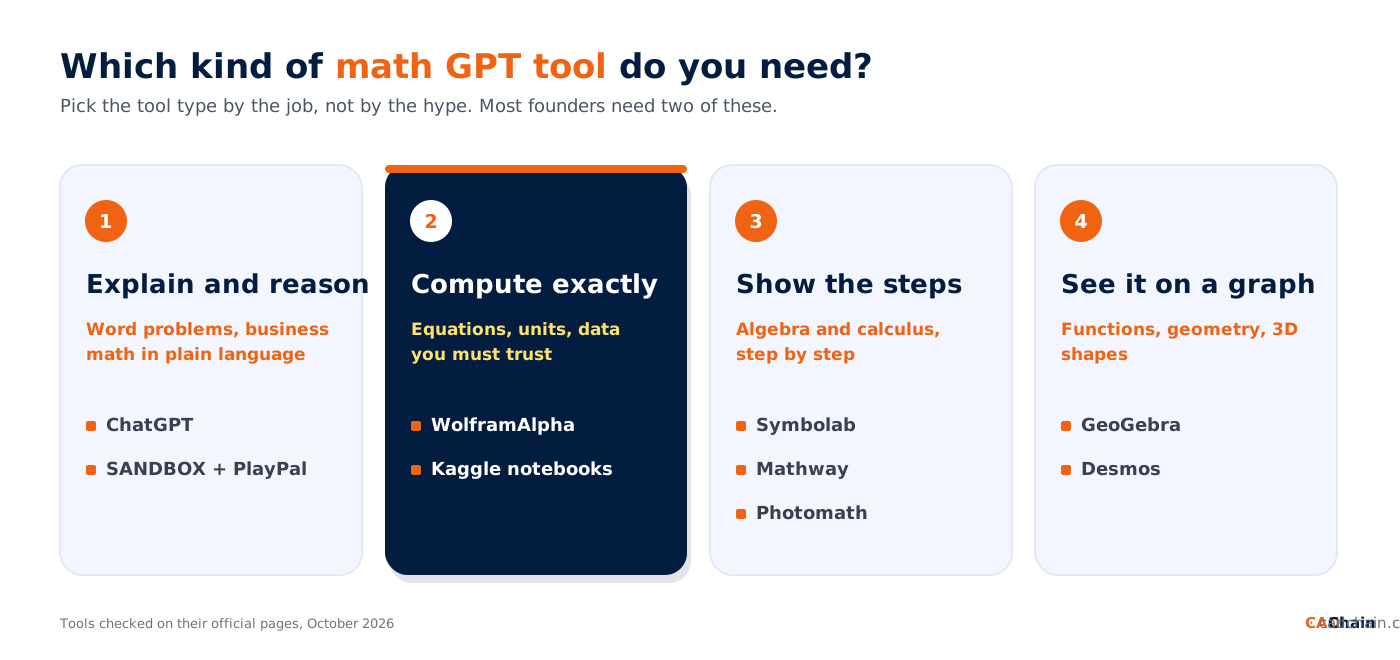
"Math GPT" is not one product. People use the name for any AI tool that understands a math question written in normal language and returns a solution. In practice there are four kinds:
- Chat AI that explains and reasons: large language models such as ChatGPT, which turn a word problem into steps and, with data analysis, run Python on your files.
- Computational engines that compute exactly: WolframAlpha and code notebooks, which calculate rather than predict the next word.
- Step-by-step solvers: Symbolab, Mathway and Photomath, built to show each step of an algebra or calculus problem.
- Graphing and geometry tools: GeoGebra and Desmos, which turn equations into graphs, shapes and 3D models you can move.
Why Math GPT Tools Matter for Entrepreneurs
Mathematical analysis plays a critical role in business decision-making. Imagine trying to understand financial trends, simulate market behaviors, or forecast future revenues without breaking your head over formulas. Math GPT tools can:
- Decode complex problems into simple, actionable insights.
- Optimize crucial business functions, from budgeting to performance prediction.
- Save time by automating repetitive calculations.
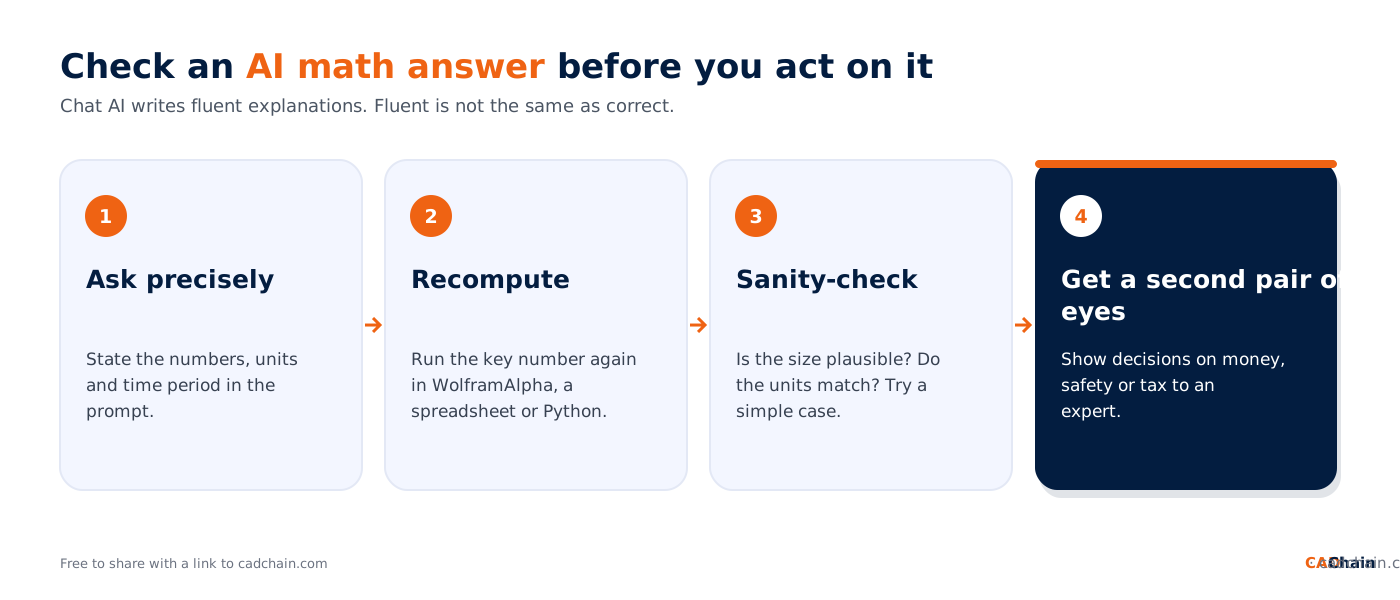
The catch: a language model predicts text, so it can write a clean, confident explanation around a wrong number. That is why the strongest setups in 2026 combine a chat AI with a tool that really computes, such as WolframAlpha, a spreadsheet or Python code you can read. For the models behind these tools, see our overview of new AI model releases and our list of breakthrough AI/ML technologies.
Top 10 Math GPT Tools for Entrepreneurs in 2026
1. SANDBOX and PlayPal by Fe/male Switch
The SANDBOX and its AI co-founder, PlayPal, redefine how startups and entrepreneurs solve business challenges, including math-driven problem solving. Unlike conventional Math GPT tools, PlayPal is tailored to support entrepreneurs in every step of their journey, from idea validation to full-fledged startup scaling.
Why It’s the Best:
- Real-World Relevance: The tool integrates mathematical problem-solving directly into startup activities (e.g., predicting your market size or calculating customer lifetime value).
- Personalized AI Co-founder: PlayPal is more than Math GPT; she’s your assistant to guide financial metrics, validate numbers, and even suggest better solutions.
- Broad Utility: From running simulations to breaking down complex calculations, PlayPal gets it right every time.
Use Case:
You’re working on predicting your break-even point. PlayPal helps you input your operating costs, expected revenues, and ensures the data translates into actionable insights for decision-making.
"Want your startup data to work smarter? Begin your journey with SANDBOX and PlayPal.
2. WolframAlpha: Exact Computation, Now Connected to AI Assistants
WolframAlpha is a computational knowledge engine: it calculates answers from curated data and Wolfram's symbolic computation instead of guessing them. It handles algebra, calculus, statistics, units and finance formulas, and plots the results. Wolfram now also offers Wolfram MCP, which lets AI apps call Wolfram computation; its free Wolfram Cloud MCP is meant for chat clients such as ChatGPT and Claude.
- What it does: Exact answers to equations and unit conversions, plots, and data lookups. Wolfram|Alpha Pro adds step-by-step solutions, file and image input and longer computation time.
- Best for: Numbers you must be able to trust, and checking what a chat AI told you.
- Cost: Free web version; Pro is a paid plan.
3. Photomath: Scan a Problem, Get the Steps
Photomath replaces Microsoft Math Solver on this list. Microsoft announced it would retire Math Solver on 7 July 2025, and the standalone app is gone. Photomath, now published by Google LLC on Google Play, does the same camera-first job: scan a problem (including word problems) or type it, and get a solution broken into steps.
- What it does: Scans printed or handwritten problems and explains each step, sometimes with more than one method. It covers arithmetic, algebra, geometry, trigonometry, statistics and calculus, from elementary to college level.
- Best for: Quick checks on paper, and founders (or their kids) who want to understand a method, not just copy a result.
- Cost: Free Basic plan with step-by-step explanations; paid monthly and annual plans with a trial.
4. Symbolab: Step-by-Step Algebra and Calculus
Symbolab is an AI math calculator and equation solver that walks through algebra, trigonometry and calculus problems step by step. It suits founders who need to rework a growth formula, a derivative for an optimisation problem or a system of equations.
- What it does: Solves equations, simplifies expressions, and works through derivatives and integrals with every step shown; it also graphs functions.
- Best for: Learning or re-learning a method, and checking homework-style problems fast.
- Cost: Free to try online; extra features on a paid plan.
5. Mathway: Quick Answers Across Math Topics
Mathway, part of Chegg, is a math problem solver: type or paste a problem, choose the topic and get the answer. It covers basic math, algebra, trigonometry, calculus, statistics and more, which makes it a handy general solver on desktop and mobile.
- What it does: Solves problems across many topics from one input box, on the web and in its mobile apps.
- Best for: A fast answer when you already know the method and just need the result.
- Cost: Free to use; step-by-step help depends on the plan.
6. GeoGebra: Graphing, Geometry, 3D and CAS in One Place
GeoGebra is dynamic mathematics software that combines geometry, algebra, spreadsheets, graphing, statistics and calculus. Its apps include the Calculator Suite, Graphing Calculator, Geometry, 3D Calculator, Scientific Calculator and computer algebra (CAS). GeoGebra has been part of the BYJU'S group since 2021 and runs as an independent unit.
- What it does: Interactive graphs and constructions you can drag and change, from 2D functions to 3D shapes.
- Best for: Visual models for pitches, simple engineering geometry and teaching a concept to your team.
- Cost: Free apps for the public; check the GeoGebra licence before commercial use, as it is free for non-commercial users.
7. Desmos: Fast, Free Graphing Calculators
Desmos Studio builds free graphing, scientific, geometry and 3D calculators. Type an equation and it is graphed at once; add sliders to see how a change in one number moves the curve.
- What it does: Graphs functions, data points and inequalities with sliders and animation, plus 3D surfaces in its 3D calculator.
- Best for: Showing a team or an investor how revenue, cost or a physical curve responds when one assumption changes.
- Cost: Free.
8. ChatGPT: Math in Plain Language, Plus Python Data Analysis
ChatGPT by OpenAI is a general AI assistant that explains math in plain language and, with its data analysis feature, writes and runs Python code on files you upload. For prompting tips, see our tips to master ChatGPT for business and our list of OpenAI GPT tools for entrepreneurs.
- What it does: Explains word problems step by step; with data analysis it reads spreadsheets (.xls, .xlsx, .csv), PDFs and data files, runs Python calculations and statistics, and draws charts.
- Best for: Business math from your own data: cohort tables, pricing scenarios and forecasts. Ask it to show the code so you can check the calculation.
- Cost: Free and paid plans; data analysis limits depend on the plan.
9. Cuemath: Online Math Tutoring for Strong Foundations
Cuemath is a 1:1 online math tutoring service for students from kindergarten to Year 10, not a business calculator, as an older version of this page suggested. It is on the list because many founders want their children, or their own edtech product, to build solid math foundations, and Cuemath shows what tutor-led learning looks like.
- What it does: Personalised online classes with a tutor, a parent app to follow progress, and free resources such as math puzzles and concept videos.
- Best for: Parents, and edtech founders studying how math tutoring products work.
- Cost: Paid classes; a free trial class.
10. Kaggle and GitHub: Build Your Own Math Models
For technical founders, Kaggle Notebooks and GitHub are where custom math lives: notebooks that run Python or R in the browser, public datasets, and open-source math libraries such as NumPy and SymPy. If you build here, our guide to AI programming languages helps you choose the language, and our interview on JuliaHub and HPC-driven scientific computing shows how far scientific computing can go.
- What it does: Lets you write, run and share code for forecasts, simulations and machine learning, and reuse what others published.
- Best for: Repeatable calculations on your own data that you want to version, review and automate.
- Cost: Free accounts; paid options for more compute or private features.
Validate your startup idea with the unique borrowed authority approach: we publish articles about your product in our blog and you get traffic and testers for your MVP
- Prove Market Demand: See real organic traffic and waitlist conversions
- Unlock High-Potential Keywords: Receive a curated list of top-performing keywords directly from Google Search Console data.
- Estimate Customer Acquisition Cost (CAC): Gain financial foresight with an estimated CAC based on real keyword performance data.
🔗 Start validating your startup now
Math GPT Tools Compared
Need charts more than equations? Our guide to AI data visualization with ChartGPT covers AI tools that turn numbers into visuals.
How to Use a Math GPT Tool: The Ultimate "How-to" Guide
- Define Your Problem Clearly: Instead of asking vague questions, structure your problem clearly, e.g., "What’s my compound annual growth rate for five years with a 25% increase?"
- Input Personalized Data: Tools like PlayPal personalize outputs for the metrics you care about most.
- Visualize the Output: Use interactive graphs offered by tools like Geogebra to understand complex outputs.
- Validate and Act: Don’t just take the AI’s word - cross-check vital decisions with an expert or business partner.
- Monitor Progress: Many tools, including PlayPal, allow dynamic recalculations as your startup evolves.
Common Mistakes to Avoid with Math GPT Tools
- Misinterpreting Outputs: GPT tools are helpful but require human understanding to infuse context into decision-making.
- Over-reliance: AI can improve processes but should never completely replace strategic human input.
- Neglecting Updates: Always use the latest AI versions or data models for optimal accuracy.
- Trusting fluent text over computed numbers: if a chat AI gives you a figure that matters, recompute it in a tool that calculates exactly, or ask for the code and run it.
- Uploading sensitive files without thinking: spreadsheets, drawings and models you paste into an AI tool may contain trade secrets. Read our notes on what to check before uploading technical drawings to ChatGPT and on generative AI and CAD IP first.
- Using a free licence for commercial work: some tools are free only for non-commercial use. Check the licence before you build a product on them.
Bonus Tip: Automate Your SEO with Smarter Tools
Attracting traffic to your business? Start smarter with the F/MS AI SEO Tool. It’s like an AI Math GPT model but for SEO. The tool automatically creates optimized content for websites and ranks you - not only on Google or Bing - but even on evolving AI platforms like ChatGPT and Perplexity. Take the guesswork out of SEO and focus on growing your business.
Math, AI and Engineering Data at CADChain
At CADChain we work with engineers whose math lives in CAD models, simulations and spreadsheets. The same rule applies there: AI can speed up the work, but the files that hold your calculations and designs are valuable IP. Our IP protection playbook explains how deep-tech teams protect them, and our list of deep tech startup tools shows the tools we use to build our own company.
Protect the designs your calculations become. CADChain gives engineering teams blockchain proof of ownership and file-level access control for CAD files, across CAD systems.
👉 See how CADChain protects CAD files
Conclusion: Empowering Entrepreneurs with Math GPT in 2026
The best math GPT tool depends on the job. Use a chat AI to understand the problem, a computational engine or code to get the exact number, a step-by-step solver to learn the method, and a graphing tool to show the result. Microsoft Math Solver is gone, so if you relied on it, Photomath and Symbolab are the closest replacements.
The rise of Math GPT tools is transforming how entrepreneurs and startups operate in today’s competitive landscape. From streamlining financial projections to improving operational efficiency, these tools empower business owners to make data-backed decisions confidently. Leading the pack is SANDBOX and PlayPal, combining math capabilities with startup-building expertise.
Boost Your SEO by Getting Featured in Our Blogs and get a backlink.
We publish content about startups, education, tech, funding, etc. that ranks well not only in Google but also in Perplexity, ChatGPT, Grok and other AI tools.
👉 Get featured now!
Whether you’re calculating your cost-per-acquisition or setting income targets, the top Math GPT tools can save hours of work, minimize errors, and let you focus on scaling your business. Explore these tools today and level up your strategy for success!
FAQ
What are Math GPT tools, and how can they help entrepreneurs?
Math GPT tools are AI-powered solutions that combine natural language understanding with mathematical reasoning. They help entrepreneurs optimize business functions, like forecasting revenues or simulating growth scenarios. Explore Math GPT tools
What is the best GPT for math in 2026?
There is no single best one. For explanations and work on your own spreadsheets, ChatGPT with data analysis is a strong start. For exact results, use WolframAlpha, which can also be connected to AI assistants through Wolfram MCP. For step-by-step learning, use Symbolab or Photomath.
Which Math GPT tool is best for startup problem-solving?
SANDBOX and its AI co-founder, PlayPal, are tailored for entrepreneurs, offering personalized solutions for tasks like predicting market size or calculating customer lifetime value. Discover SANDBOX and PlayPal
Can Math GPT tools handle advanced math problems?
Yes. WolframAlpha handles calculus, differential equations, statistics and units, and Wolfram|Alpha Pro adds step-by-step solutions. Symbolab shows the steps for derivatives and integrals, and GeoGebra includes a computer algebra system.
Is Microsoft Math Solver still available?
No. Microsoft announced that Math Solver would be retired on 7 July 2025, and the standalone app was discontinued. Photomath and Symbolab are the closest free alternatives for scanning or typing a problem and seeing the steps.
What is the best free math solver?
For step-by-step solutions, Photomath (free Basic plan) and Symbolab (free to try) are good picks. For graphs, Desmos is free and GeoGebra is free for non-commercial use. WolframAlpha answers many questions free on the web.
Which AI explains math concepts most clearly?
Chat AI such as ChatGPT explains concepts in plain language and can adapt the explanation to your level. Photomath and Symbolab show each step of a method. For learning with a person, Cuemath offers 1:1 online tutoring for children up to Year 10.
Can ChatGPT do math reliably?
It explains well, but a language model can still make arithmetic or logic errors. For numbers that matter, ask ChatGPT to use data analysis so it runs Python code you can read, or recheck the result in WolframAlpha or a spreadsheet.
Is MathGPT a real product?
Yes, MathGPT.ai is a separate product: an instructor-led AI tutoring and assignment platform for colleges and universities. "Math GPT" is also used as a general name for any AI math tool.
Are there tools for visualizing complex functions with graphs?
Yes. Desmos and GeoGebra graph functions, data and 3D surfaces, and Symbolab plots the functions it solves. They are useful for presentations, pricing models and simple engineering geometry.
Where can I find customizable Math GPT solutions for my startup?
Kaggle Notebooks and GitHub host code, datasets and open-source math libraries such as NumPy and SymPy that you can adapt to your own data and models.
Can I use AI to write SEO-optimized articles that help my brand grow?
Most business owners don't understand how SEO works, let alone how to use AI for writing blog articles. That's why for busy business owners there's a great free tool that doesn't require much knowledge. Write articles for free
How can entrepreneurs avoid common mistakes with Math GPT tools?
To maximize the benefits of Math GPT tools, entrepreneurs should clearly define problems, validate outputs with experts, and stay updated with the latest versions for optimal accuracy. Explore tips for using AI tools
About the Author
Violetta Bonenkamp, also known as MeanCEO, is an experienced startup founder with an impressive educational background including an MBA and four other higher education degrees. She has over 20 years of work experience across multiple countries, including 5 years as a solopreneur and serial entrepreneur.
Violetta is a true multiple specialist who has built expertise in Linguistics, Education, Business Management, Blockchain, Entrepreneurship, Intellectual Property, Game Design, AI, SEO, Digital Marketing, cyber security and zero code automations. Her extensive educational journey includes a Master of Arts in Linguistics and Education, an Advanced Master in Linguistics from Belgium (2006-2007), an MBA from Blekinge Institute of Technology in Sweden (2006-2008), and an Erasmus Mundus joint program European Master of Higher Education from universities in Norway, Finland, and Portugal (2009).
She is the founder of Fe/male Switch, a startup game that encourages women to enter STEM fields, and also leads CADChain, and multiple other projects like the Directory of 1,000 Startup Cities with a proprietary MeanCEO Index that ranks cities for female entrepreneurs. Violetta created the "gamepreneurship" methodology, which forms the scientific basis of her startup game. She also builds a lot of SEO tools for startups. Her achievements include being named one of the top 100 women in Europe by EU Startups in 2022 and being nominated for Impact Person of the year at the Dutch Blockchain Week. She is an author with Sifted and a speaker at different Universities. Recently she published a book on Startup Idea Validation the right way: from zero to first customers and beyond and launched a Directory of 1,500+ websites for startups to list themselves in order to gain traction and build backlinks.