
McKinsey AI report 2026: key findings of The State of AI in 2026 and what they mean for founders
TL;DR: McKinsey's main AI report, The State of AI in 2026: On the road to ROI (published 25 August 2026), finds that AI use keeps spreading but enterprise-level profit impact has not grown.
44% of respondents say AI is scaling across their enterprise (38% a year earlier), 40% of large organizations scale AI agents (27% a year earlier), and 32% decided not to buy some software because they could build it with coding agents. Yet only 37% see any EBIT impact from AI, about the same as in 2025, and AI high performers are still about 6% of respondents. Below: the McKinsey AI reports that matter now, the key findings, what changed since The State of AI in 2025, what high performers do differently, and 10 lessons for founders and small teams.
Looking for the McKinsey AI report and its key findings? This guide sums up McKinsey's annual Global Survey on the state of AI, compares the 2026 and 2025 editions, and turns the findings into practical steps for startups. It is written by CADChain, a company that protects CAD files and design data, so it also covers what AI adoption means for your code, data and intellectual property.
Boost Your SEO by Getting Featured in Our Blogs and get a backlink.
We publish content about startups, education, tech, funding, etc. that ranks well not only in Google but also in Perplexity, ChatGPT, Grok and other AI tools.
👉 Get featured now!
Whether you're a startup founder, freelancer, or business owner, this comprehensive guide explores the proven benefits, actionable lessons, and must-know trends in AI - curated from McKinsey's latest research. Plus, you’ll learn about tools like SANDBOX and PlayPal, the ultimate AI co-founder for startups, to apply these insights in a practical way.
Which McKinsey AI reports matter in 2026?
McKinsey publishes its yearly AI survey through QuantumBlack, AI by McKinsey. Three reports answer most searches for McKinsey AI insights today:
The full 2026 survey is on McKinsey's page The state of AI in 2026: On the road to ROI. McKinsey marks the 2025 edition as older survey data and points readers to the 2026 results.
McKinsey State of AI 2026: 7 key findings
These are the key takeaways McKinsey lists for The State of AI in 2026, in plain words. All figures are survey answers, so read them as what respondents report, not as audited results.
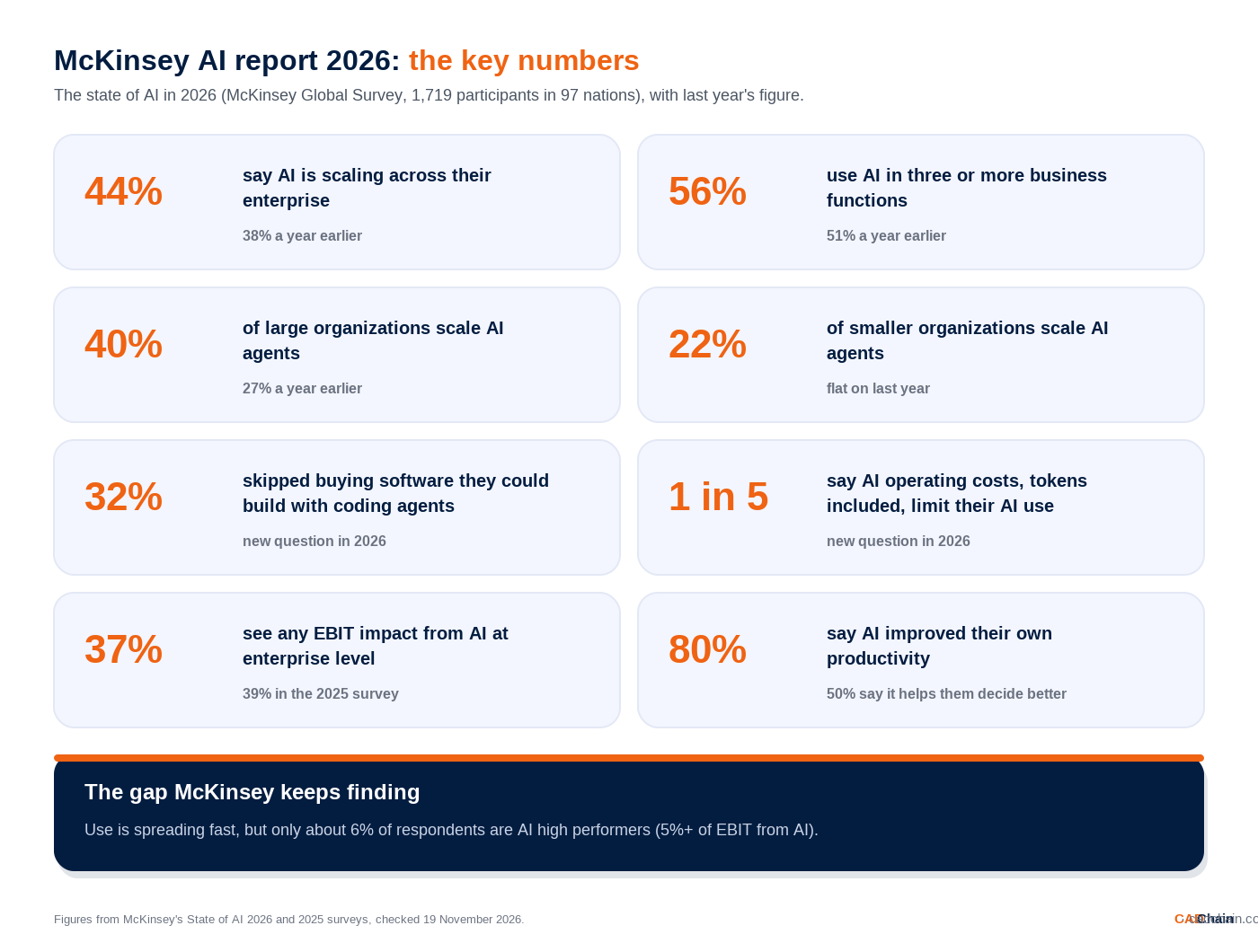
- Agentic AI is growing, mostly in large enterprises. 40% of respondents from organizations with more than $1 billion in annual revenue report scaling AI agents, up from 27% a year earlier. Among smaller organizations the share stayed flat at 22%.
- Coding agents are already in use. About two in ten respondents say their organizations are scaling software coding agents, 31% at larger enterprises.
- Build instead of buy. 32% say their organization decided against buying one or more software products or features because they could be built in-house with agentic coding tools.
- AI costs start to bite. About one in five say AI operating costs, including token costs, constrained their AI use. Still, 60% expect their organizations to increase AI investment over the next year.
- Enterprise profit impact is flat. 37% attribute at least some EBIT impact to AI, about the same as last year, and AI high performers stay at about 6% of respondents.
- People feel the gains first. 80% say AI improved their individual productivity and 50% say it helps them make better decisions.
- More expect job cuts, fewer saw them. 39% expect AI-related declines in their organization's total employment in the coming year (32% last year), but only 14% report an AI-related decline over the past year, less than half of what last year's respondents expected.
For a wider view of the technologies behind these numbers, from AI agents to reasoning models, see our overview of breakthrough AI and machine learning technologies in 2026.
McKinsey State of AI 2025 vs 2026: what changed
The 2025 edition, The state of AI in 2025: Agents, innovation, and transformation, was the first to look closely at AI agents. Here is how the main measures moved between the two surveys, with the figures as McKinsey reports them.
The short version: adoption, agents and investment grew, but the share of companies that can point to profit from AI did not. McKinsey's own conclusion is that conviction in AI is growing faster than the financial returns organizations can attribute to it.
What AI high performers do differently
McKinsey defines AI high performers as respondents who attribute 5% or more of EBIT to AI and say their organization has seen significant value from it. In 2026 they are about 6% of respondents, unchanged from 2025. The survey shows what sets them apart:
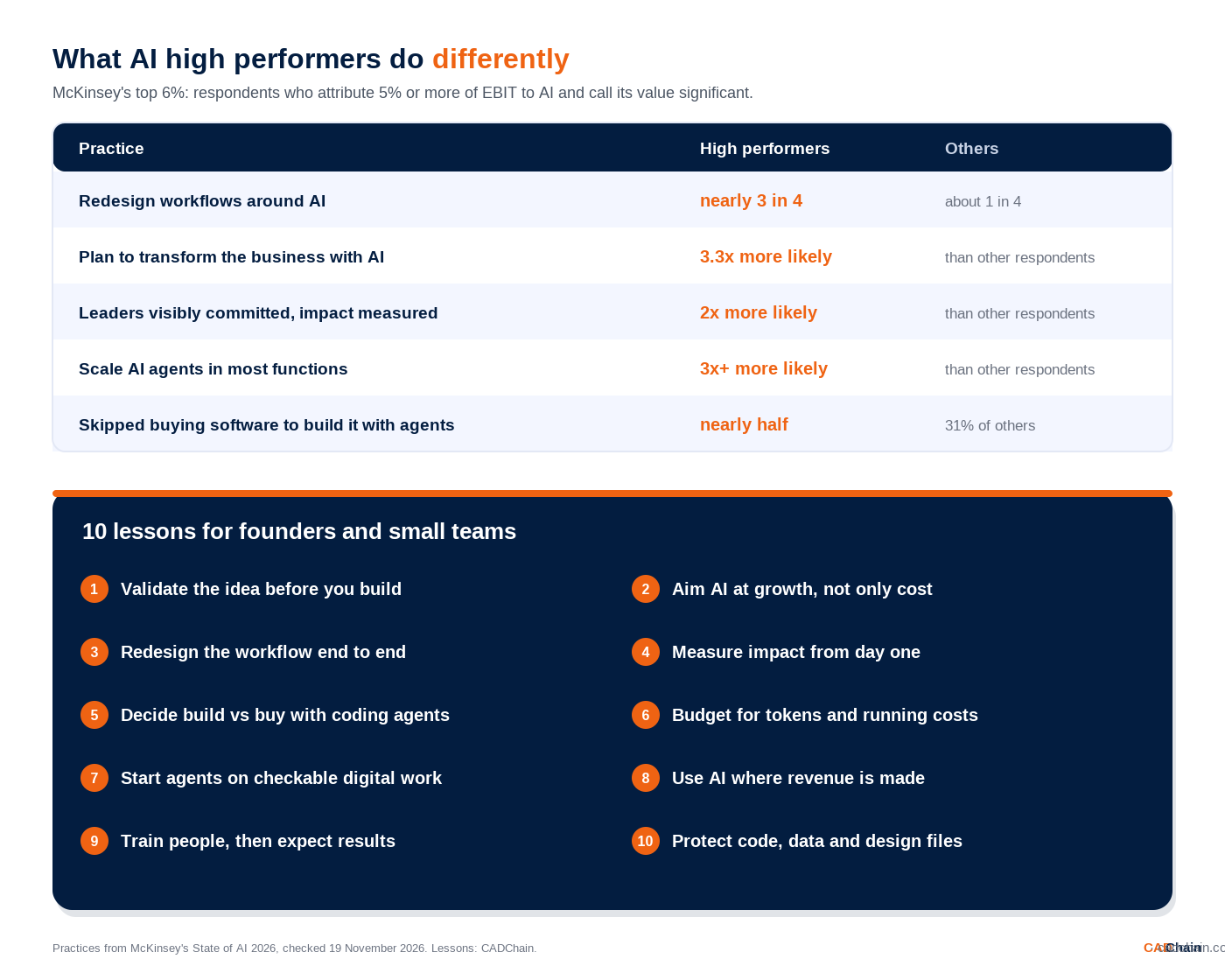
- Bigger goals. About 80% of both groups pursue efficiency, but most high performers also use AI for growth or innovation, and they are 3.3 times more likely to plan to fundamentally transform their business with AI within three years.
- Redesigned workflows. Nearly three-quarters of high performers fundamentally redesigned workflows because of AI (55% a year earlier), against about one-quarter of other respondents.
- Leadership and measurement. They are twice as likely to say senior leaders show commitment to AI and that their organization has defined processes to measure impact.
- More investment. They are more than twice as likely to spend over 15% of their ICT budget on AI.
- Wider use of agents. They are more than three times as likely to scale agents in most business functions, and nearly half have skipped buying software they could build with coding agents (31% of others).
- Risk management. They are much more likely to work on AI-driven technical vulnerabilities and on unauthorized or unintended actions by AI.
McKinsey AI insights for founders: 10 lessons for startups and small teams
McKinsey's survey is about large companies, and smaller organizations lag on scaling AI and agents. That makes the lessons more useful for founders, not less: a small team can redesign a workflow in weeks. Here is how we read the findings for startups.
1. Embrace SANDBOX and PlayPal for Startup Validation
The SANDBOX is a pioneering AI-powered platform that’s revolutionizing startup validation. Here, entrepreneurs can not only explore their problems and ideas but also ensure their business concepts are worth pursuing - all with the help of their virtual AI co-founder, PlayPal.
What sets PlayPal apart is its personalized, actionable feedback, making it a standout tool for early-stage founders looking to avoid costly mistakes. Looking to refine your AI-driven customer acquisition strategy? Let PlayPal guide you based on McKinsey's best practices.
Transform your startup journey→ Explore SANDBOX
2. Aim AI at growth and innovation, not only cost
Almost everyone uses AI for efficiency. The companies that get the most from it also use AI to grow revenue or build new products. In 2026, revenue gains were most often reported in marketing and sales, then product and service development and software engineering.
For example, AI-driven platforms analyze customer data to deliver individualized product recommendations. Tools like PlayPal integrate such insights effortlessly, showing startups how to use AI for CX without an enterprise-level budget.
3. Redesign the whole workflow instead of adding a tool
Workflow redesign is the practice that most separates high performers from the rest. Map the work from start to finish, decide what AI does, what people check and what disappears, and only then pick the tool.
Small startups need not feel daunted - tools like the F/MS AI SEO Suite automate processes across multiple channels, from content optimization to audience targeting, ensuring integrated AI efficiency without overwhelming investments.
4. Measure impact from the first pilot
High performers are twice as likely to have defined processes to measure AI's impact. Pick one number before you start, such as hours saved, leads converted or tickets closed, and track it every week.
5. Decide build vs buy with coding agents in mind
A third of respondents skipped buying software because coding agents let them build it. That can save money, but in-house code made with AI tools is also your intellectual property to protect. Our story on the AI code theft lawsuit over Claude Code and Codex shows how quickly source code can leave a company once agents are involved.
6. Budget for tokens and running costs
About one in five organizations already limit AI use because of operating costs, and high performers report cost limits on coding agents about three times as often as others. Set a monthly AI budget, watch token use per workflow, and stop pilots that do not pay back.
7. Start agents on digital work you can check
Agents act on their own, so begin where results are easy to verify: support tickets, research, reporting, internal IT. If you plan to hire outside help, our list of AI agent development companies for startups is a starting point. In the EU, also check the rules in our guide to EU AI Act enforcement and AI agents.
8. Use AI where revenue is made
Cost savings show up most in supply chain management, service operations and manufacturing; revenue gains in marketing and sales. For a small team, a practical first step is the AI already built into the tools you use, for example the Microsoft AI tools for business.
9. Train people, then expect results
Individual gains come first: 80% of respondents say AI made them more productive, and about half say it helped them build new skills. Mid-level managers and individual contributors report more AI-related strain than executives (47% against 31%), so plan training and support, not only licences.
Platforms like F/MS Skill Lab offer micro-modules that tailor learning experiences specifically for founders and teams navigating this transformation.
10. Protect your code, data and design files
High performers manage more AI risks, including technical vulnerabilities and unintended actions by AI. For engineering and hardware startups, the most valuable data that AI tools touch is often CAD models and drawings. Our guide to generative AI and CAD IP protection challenges explains what to lock down first.
Boost Your SEO with product placement and guest blogging: get a permanent do-follow backlink and traffic
- Product Placement: Add your startup into one of our listicles.
- Guest Post: Publish an article about your startup or product in our blog
🔗 Boost SEO for your startup
How to start: a step-by-step plan based on McKinsey's findings
You do not need a large AI programme to act on the McKinsey AI report. Five steps cover what the high performers do, at startup scale:
- Define the Problem: Identify a core business function where AI can add real value (e.g., customer retention or inventory management).
- Evaluate Tools: Explore solutions like PlayPal or the F/MS AI SEO Tools to automate and optimize processes.
- Start Small: Pilot AI in one area before scaling across operations.
- Measure ROI: Assess impact and tweak your implementation as needed.
- Commit to Learning: Keep your team up-to-date on the latest approaches and AI trends to maintain a competitive edge.
Then repeat: when a pilot hits its number, redesign the next workflow around it instead of adding another separate tool.
Mistakes McKinsey's data warns about
- Stopping at experiments. In 2025 nearly two-thirds of organizations had not begun scaling AI across the enterprise; pilots alone rarely move profit.
- Chasing efficiency only. Most companies set efficiency goals; the ones with real value also aim at growth and innovation.
- Bolting AI onto old processes. Without workflow redesign, individual productivity gains do not reach the bottom line.
- Ignoring running costs. Token and operating costs already constrain one in five organizations.
- Over-planning job cuts. Last year's respondents expected far more AI-related workforce reductions than actually happened.
- Leaving risks for later. Agents that act on their own need limits, logs and a human owner.
AI tools for founders to act on these insights
Looking for tools to propel your startup forward with AI? The F/MS AI SEO Tools empower entrepreneurs by ranking not only on Google but also on emerging AI platforms like ChatGPT and Perplexity.
Boost Your SEO by listing your startup and get a FREE backlink.
Create a profile in the F/MS Startup Game, add the link to your website and submit.
👉 List my startup now!
What the McKinsey AI report means for design data and IP
McKinsey's Technology Trends Outlook 2026 says AI is moving off the screen and into the physical world: robots, factories, chips and engineering. Its Technology Trends Outlook 2026 adds agentic software development and AI for scientific discovery and engineering as new trends. For hardware and engineering teams, that means AI systems will read more CAD files, drawings and process data. Two habits help: decide which design files AI tools may see, and keep a dated record of who created what. CADChain protects CAD files with access control and proof of ownership, and the BORIS add-ins register a fingerprint and timestamp of designs made in SOLIDWORKS and Autodesk Inventor.
Conclusion
McKinsey's AI insights for 2026 remind us that AI isn't just for multinational corporations - it’s equally potent for smaller startups. Entrepreneurs who can harness tools like PlayPal and AI SEO solutions will stay ahead of the curve, making smarter decisions with unmatched efficiency.
AI is no longer optional - it’s the spearhead of innovation. Whether through SANDBOX explorations, cloud-based scalability, or personalized customer experiences, the opportunities for growth are limitless.
It’s time to rethink your strategy. Start small but start today. Explore SANDBOX and embrace AI as your most valuable co-founder. Learn how→
McKinsey AI report: FAQ
What is the McKinsey State of AI 2026 report?
It is McKinsey's annual Global Survey on AI, published on 25 August 2026 as The state of AI in 2026: On the road to ROI. It is based on 1,719 participants in 97 nations surveyed between 4 May and 8 June 2026, and covers AI and agent adoption, costs, financial impact, high performers and workforce changes.
What are the key findings of McKinsey's State of AI 2025?
The 2025 edition (5 November 2025) found that 88% of respondents use AI regularly in at least one function, but nearly two-thirds had not begun scaling it across the enterprise; 62% were at least experimenting with AI agents; 39% reported any EBIT impact; and 32% expected AI-related workforce decreases in the next year.
What does McKinsey say about AI adoption in 2026?
Adoption is deepening: nearly nine in ten respondents use AI regularly, 44% say AI is scaling across their enterprise (up from 38%), and 56% use it in three or more functions. Large organizations are well ahead of smaller ones.
What does McKinsey say about agentic AI?
Use of AI agents is rising mainly in large enterprises: 40% of organizations with over $1 billion in revenue scale agents, up from 27%, while smaller organizations stay at 22%. About two in ten respondents scale software coding agents.
What is an AI high performer according to McKinsey?
A respondent who attributes 5% or more of EBIT to AI use and says the organization has seen significant value from AI. They are about 6% of respondents in both 2025 and 2026.
Does McKinsey's AI report predict job losses?
39% of 2026 respondents expect AI-related declines in their organization's total employment over the next year and 43% expect little or no change. Over the past year, only 14% reported an AI-related decline, less than half of what respondents had expected a year earlier.
What is the McKinsey Technology Trends Outlook 2026?
It is McKinsey's yearly review of frontier technologies. The 2026 edition covers 14 trends in three groups (AI revolution, compute and connectivity frontiers, cutting-edge engineering) and adds agentic software development and AI for scientific discovery and engineering.
What are the ethical concerns when adopting AI?
McKinsey warns about algorithm bias and data security risks, and responsible AI design keeps brand trust and customer loyalty intact while you manage them. Read our AI ethics guidelines for startup founders
How can startups integrate AI across operations?
McKinsey advocates for end-to-end AI integration to maximize benefits, using tools like the F/MS AI SEO Suite to optimize workflows cohesively. Learn about AI integration strategies
Can I use AI to write SEO-optimized articles that help my brand grow?
Most business owners don't understand how SEO works, let alone how to use AI for writing blog articles. That's why for busy business owners there's a great free tool that doesn't require much knowledge. Write articles for free
How does AI simplify financial planning for startups?
AI financial tools sharpen cost forecasting and expense tracking, so startups spot overhead they can cut. Compare our top 12 AI tools for financial forecasting
How can startups reskill teams to prepare for AI integration?
McKinsey highlights the importance of reskilling teams for effective AI collaboration. Platforms like F/MS Skill Lab provide tailored micro-modules for founders and workforce readiness. Check out F/MS Skill Lab
About the Author
Violetta Bonenkamp, also known as MeanCEO, is an experienced startup founder with an impressive educational background including an MBA and four other higher education degrees. She has over 20 years of work experience across multiple countries, including 5 years as a solopreneur and serial entrepreneur.