
Benefits of AI in manufacturing in 2026: 7 proven benefits, real examples and how to start
TL;DR: The main benefits of AI in manufacturing are less unplanned downtime, fewer defects, lighter and better parts, shorter lead times, faster product development, lower energy use, and expert know-how available on every shift.
Each benefit comes from a specific use case: predictive maintenance, AI visual and acoustic inspection, generative design, planning models, simulation and digital twins, process optimisation and generative AI assistants. Real results are published: in the World Economic Forum's January 2026 Lighthouse cohort, ACG Packaging Materials in Shirwal, India reported 71% fewer defects and 31% less energy use, and Carl Zeiss Vision in Guangzhou cut delivery lead time by 29%. Below: the seven benefits with named examples, a comparison table, the challenges to plan for, and a step-by-step way to start.
The benefits of AI in manufacturing are no longer a forecast. Factories use AI to predict machine failures, inspect parts with cameras and microphones, generate lighter designs and plan production. This guide explains the seven benefits that matter most, shows where each one comes from with examples companies have published themselves, and lists what to measure before you invest. It is written for founders, engineers and small manufacturers, by a startup that protects design data and CAD files, the data many of these AI systems learn from.
Write FREE SEO-optimized Blog Articles! Our Article Writer ensures your blog is loved by both Google and your readers, turning those clicks into customers.
👉 Write your article here
What are the benefits of AI in manufacturing?
AI in manufacturing means software that learns from production data (sensor readings, images, sound, quality records, CAD models, orders) and uses it to predict, detect or suggest something a person would otherwise work out by hand. The benefits follow from what that software is pointed at. The infographic below maps the seven benefits to their use cases and to real companies.
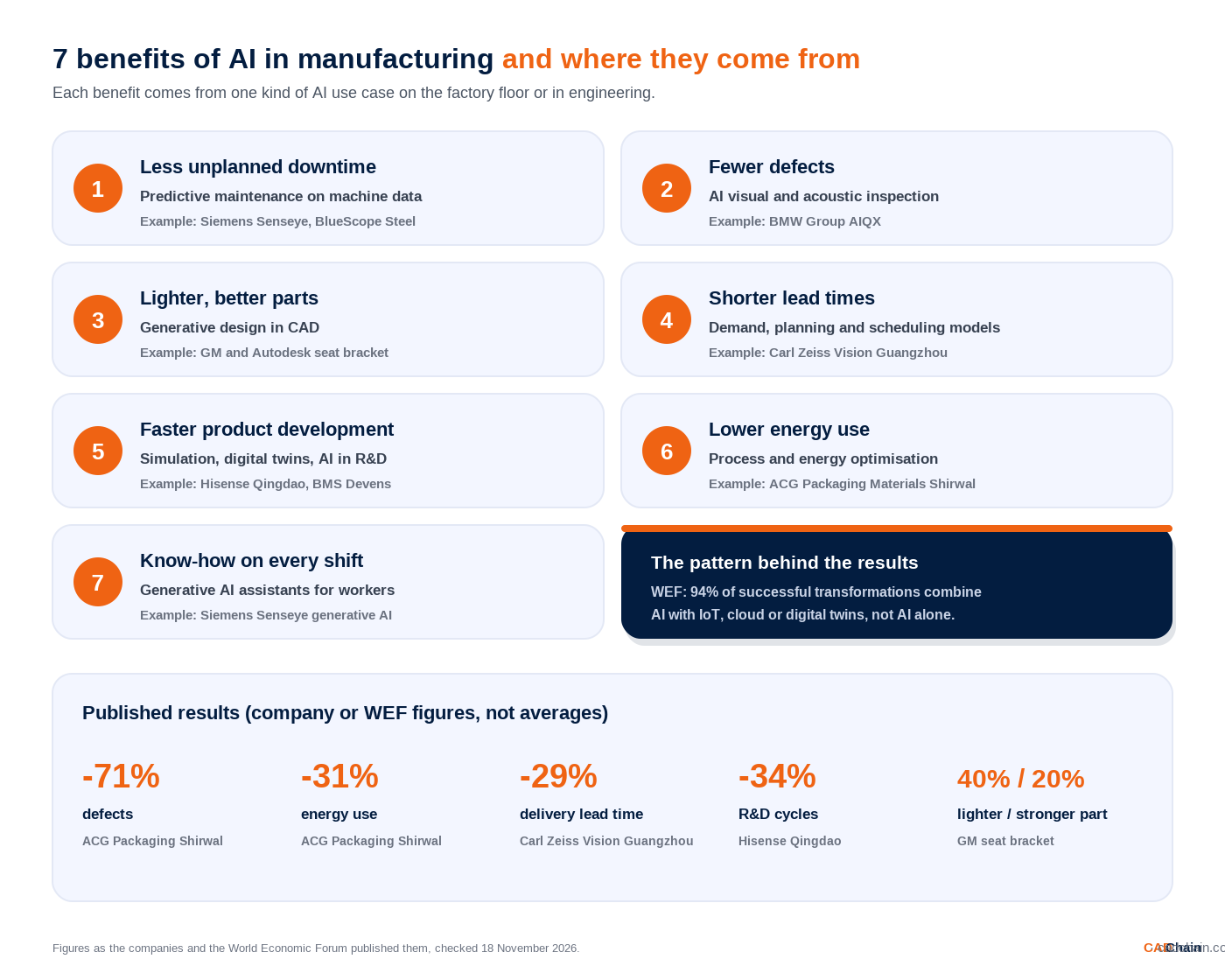
7 benefits of AI in manufacturing, with real examples
1. Less unplanned downtime with predictive maintenance
Predictive maintenance AI watches vibration, temperature, current and other machine signals and flags a part that is likely to fail, so the repair happens in a planned stop instead of a breakdown. Siemens added generative AI to its Senseye Predictive Maintenance software: according to Siemens' announcement, it scans and groups maintenance cases, also in several languages, finds similar past cases and their solutions, and suggests what to do next, while the data stays in a private cloud and is not used to train external generative AI. Australian steelmaker BlueScope Steel is named as an early adopter.
2. Fewer defects with AI quality inspection
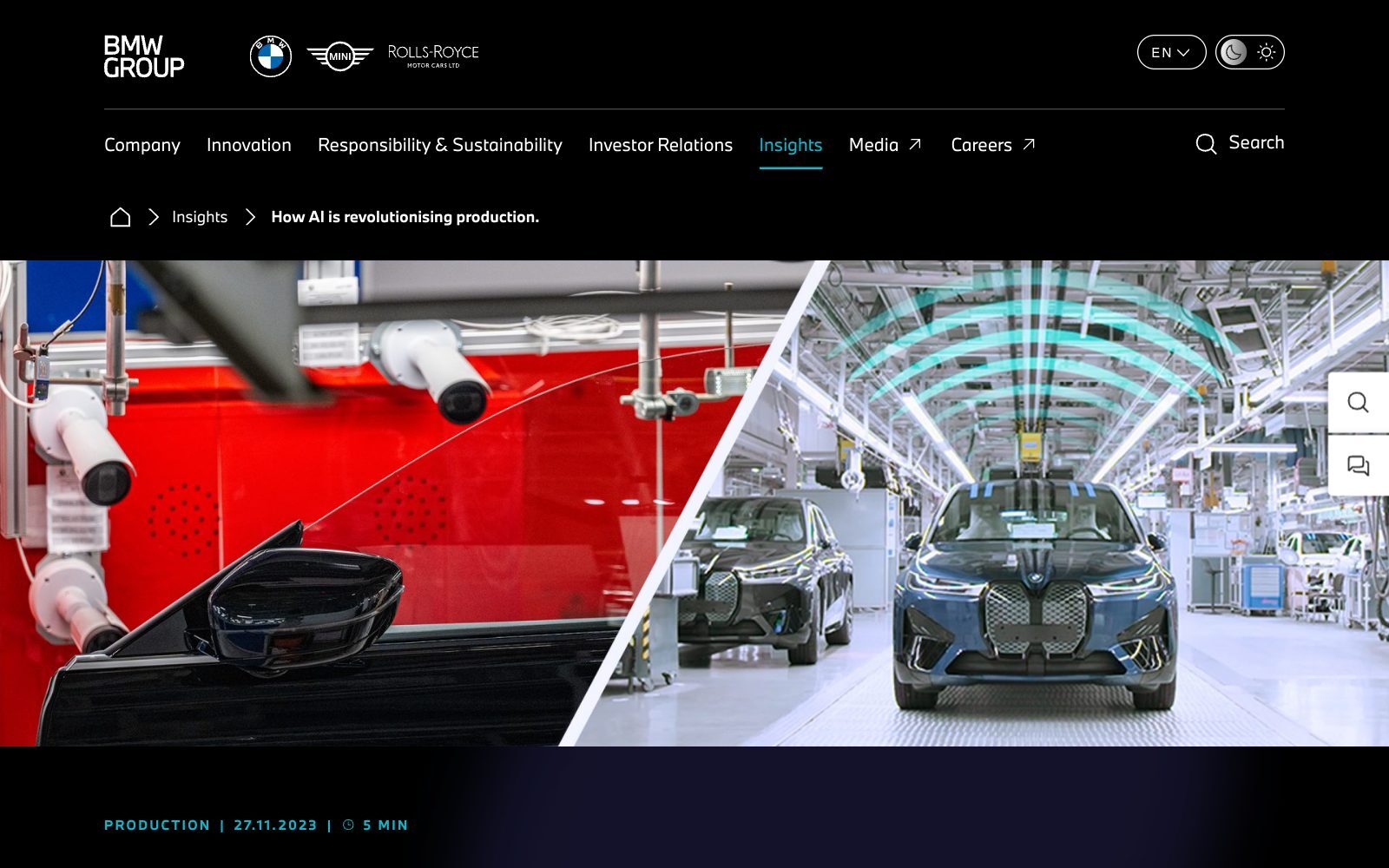
AI quality control uses cameras, microphones and sensors on the line to spot deviations in real time. BMW Group's in-house platform AIQX (Artificial Intelligence Quality Next) places camera systems and sensors along the conveyor belt; algorithms analyse the data in real time and send employees immediate feedback on smart devices, for example when a part is missing. In its Acoustic Analytics module at Plant Dingolfing, microphones record driving noises and an AI model classifies them as a final check before handover, as BMW Group describes AIQX. Published results go further: the World Economic Forum reports that ACG Packaging Materials in Shirwal cut defects by 71% with more than 30 digital use cases, including machine learning, generative AI and digital twins. For more tools in this area, see our guide to vision AI tools and strategies.
3. Lighter, better parts with generative design
Generative design software takes an engineer's goals and limits (loads, materials, manufacturing method, cost) and proposes many shapes that meet them. In a collaboration with Autodesk using the generative design technology in Fusion 360, General Motors engineers redesigned a seat bracket: the software proposed more than 150 alternatives, and the design GM chose is one stainless-steel piece instead of eight welded parts, 40% lighter and 20% stronger than the previous bracket, according to Autodesk's GM customer story. This is the benefit behind searches for "AI-powered CAD": the output is a CAD model that still has to be checked for production readiness, and it is valuable IP from the first iteration.
4. Shorter lead times and steadier supply chains
AI forecasting and scheduling models predict demand, spot supply risks and re-plan production faster than spreadsheets. Carl Zeiss Vision in Guangzhou, which makes personalised optical lenses, built more than 100 digital use cases with machine learning, digital twins and AI agents; the World Economic Forum reports a 29% shorter delivery lead time, 98.5% on-time delivery, and a personalised product range expanded by 400%. ACG Packaging Materials reported 40% shorter lead times and 34% better on-time-in-full delivery.
5. Faster product development with simulation and digital twins
Simulation, digital twins and AI in research and development let teams test designs and processes virtually before they cut metal. Hisense Visual Technology in Qingdao used AI, big data, simulation and large-scale virtual reality in new product development and manufacturing and cut research and development cycles by 34%; Bristol Myers Squibb in Devens, a biologics and cell therapy site, reported a 42% shorter new product introduction time. Our explainer on digital twins on blockchain shows how a twin's data can be given a verifiable history.
6. Lower energy use and emissions
AI that tunes process settings, machine schedules and utilities can lower energy per unit. ACG Packaging Materials reported 31% lower energy consumption and 20% lower raw material costs, and Bristol Myers Squibb Devens cut emissions by more than 40%, according to the World Economic Forum's January 2026 Global Lighthouse Network announcement.
7. Expert know-how on every shift with generative AI assistants
Generative AI assistants answer questions from manuals, past repair cases and work instructions, which helps new staff work like experienced ones. Siemens presents its Senseye generative AI as a way to address skill shortages, by capturing expert knowledge from an ageing workforce and making it available to less-experienced shop-floor staff. Hisense Qingdao reported 60% shorter training time for new employees.
What the strongest results have in common: the World Economic Forum says 94% of the successful transformations in its Lighthouse data combine several technology domains, with AI most often deployed alongside IoT, cloud and digital twins. For the wider technology picture, read our overview of AI/ML technologies transforming industries in 2026.
How is AI used in manufacturing? Use cases by stage
- Design and engineering: generative design, AI-assisted CAD, simulation and digital twins of products.
- Production: predictive maintenance, process optimisation, robot guidance, energy management.
- Quality: visual inspection with cameras, acoustic checks, anomaly detection in process data.
- Supply chain and planning: demand forecasting, scheduling, inventory and supplier risk.
- People: generative AI assistants for maintenance, training and work instructions.
How to start with AI in manufacturing
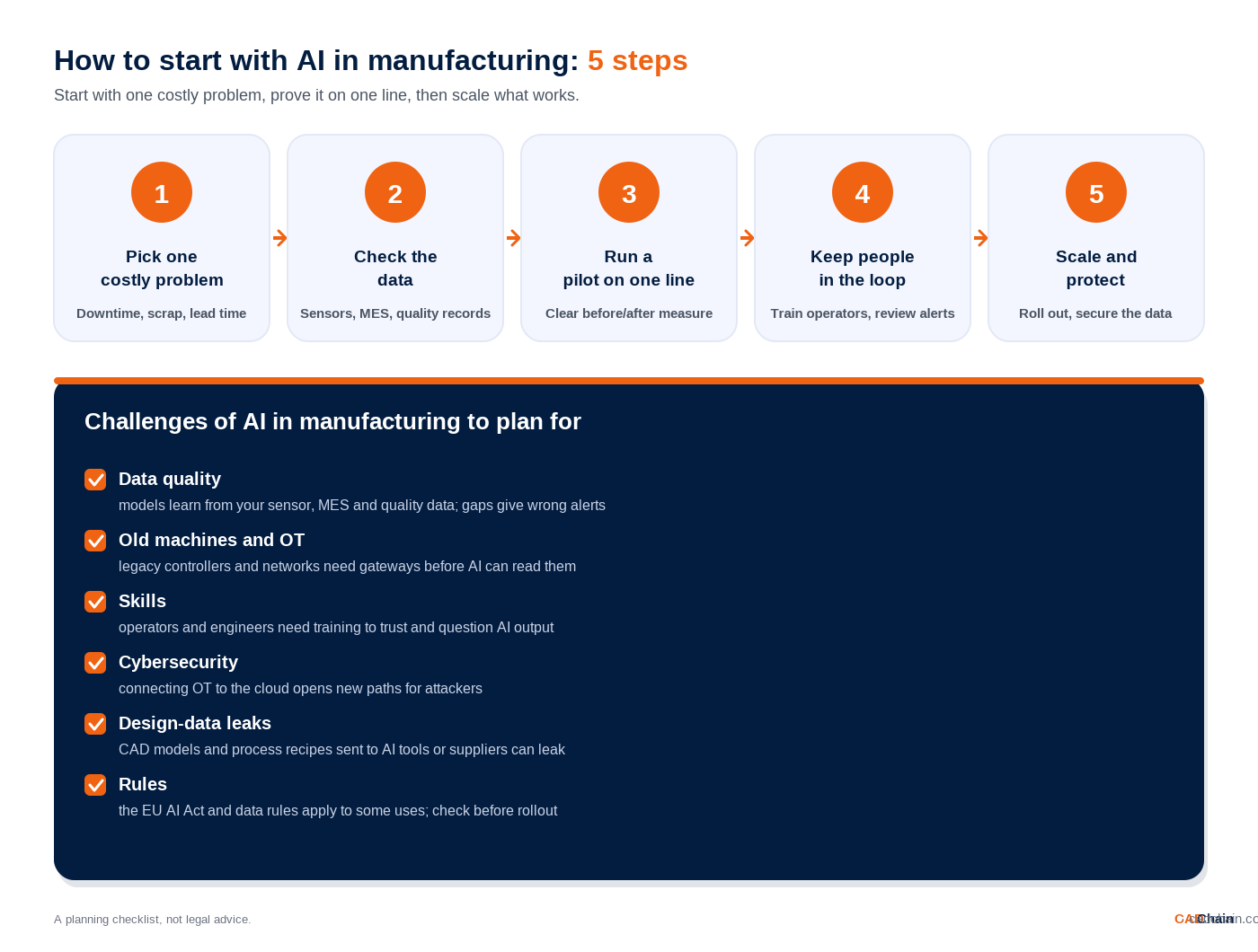
Start with one costly problem, prove the gain on one line, then scale what works. If you are a founder building an AI product for factories, validate the idea first.
1. SANDBOX & PlayPal: The ULTIMATE AI Assistant for Idea Validation and Growth
The F/MS SANDBOX and its AI co-founder, PlayPal, provide the perfect environment to test and validate new startup ideas, even in manufacturing. Imagine testing a manufacturing optimization startup idea with zero risk and solid feedback.
Why It’s a Game-Changer:
- Guides you step-by-step in validating your idea, ensuring it's scalable and worth pursuing.
- PlayPal acts as a hands-on AI co-founder offering personalized insights and solutions based on your unique idea.
- Ideal for optimizing manufacturing frameworks, or even creating AI-driven solutions for factories.
Whether you’re an entrepreneur exploring the manufacturing sector or a small business owner looking to innovate, this is where any great idea begins.
2. Pick one costly problem and check the data
Name the problem in money: unplanned stops, scrap, late deliveries or energy. Then check that the data exists: machine signals, MES records, quality results, images. AI cannot predict what nobody recorded.
3. Choose the right tools
If you’re just starting, consider easy-to-implement AI tools like F/MS Startup Game, which helps entrepreneurs simulate business operations and experiment with AI-driven ideas.
For factory use cases, compare the AI modules of the software you already run (maintenance, MES, CAD, ERP) with specialist tools, and ask each vendor where your data is processed and whether it is used for training.
4. Run a pilot on one line
Use platforms like the F/MS SANDBOX to test innovations or AI integration strategies with zero risks.
On the shop floor, pilot on one line or one machine group for a fixed period, and compare the numbers from the table above before and after.
5. Keep people in the loop
Train operators and engineers to read, question and act on AI alerts. Human review stays essential for decisions about safety, quality releases and design changes.
6. Scale what works and protect the data
Roll out only what proved its value, track the return on investment every quarter, and secure the data the models depend on before you connect more machines and partners.
Challenges and disadvantages of AI in manufacturing
- Data quality: models learn from your sensor, MES and quality data; missing or wrong data gives false alerts.
- Old machines and OT networks: legacy controllers often need gateways before AI can read them.
- Skills: AI tools are only as good as the people who run them, so plan training from day one.
- Cybersecurity: connecting operational technology to the cloud opens new routes for attackers; see our report on IP theft in industrial cyber incidents.
- Design-data leaks: CAD models, process recipes and logs shared with AI tools, vendors or suppliers can leak; read how AI hacking agents reach OEM design data through weaker suppliers.
- Rules: the EU AI Act and data rules apply to some uses, so check them before a rollout.
Protect the design data your AI depends on
Every benefit above runs on data that competitors would like to have: CAD models from generative design, process parameters, inspection images, maintenance histories. Before that data goes to an AI vendor, a cloud service or a supplier, decide who may open which files and keep proof of what you created. Our guide to IP theft in manufacturing explains the common routes. CADChain's own product adds file-level access control and blockchain proof of ownership to CAD files, and the BORIS add-ins for SOLIDWORKS and Autodesk Inventor register a file fingerprint (hash) and a timestamp as tamper-evident, dated proof of authorship.
Unlock SEO Benefits with AI SEO Tools
While manufacturers focus on optimizing operations with AI, why not take control of SEO strategies for your business as well? The F/MS AI SEO Tools allow you to automate SEO on Google, Bing, and even AI tools like ChatGPT.
Why it’s Worth a Try:
- Auto-generates content tailored to your business goals.
- Helps rank your website higher with minimal oversight.
- Saves time and resources by automating research and optimization tasks.
This tool makes digital outreach as easy as incorporating predictive maintenance into your plant floor strategies!
Conclusion: are the benefits of AI in manufacturing worth it?
AI is rapidly transforming the manufacturing world, unlocking opportunities to optimize processes, boost operational efficiency, and drive innovation. From SANDBOX’s idea validation assistance to IBM’s predictive supply chain solutions, entrepreneurs and manufacturers alike have access to technologies that foster growth.
The benefits of AI in manufacturing are real when they are tied to one measurable problem: fewer stops, fewer defects, lighter parts, shorter lead times, faster development, less energy and faster learning. The companies with published results started with clear use cases, combined AI with IoT, cloud and digital twins, and kept people in the loop. Start small, measure, and protect the data before you scale.
Get started today with AI tools like F/MS SANDBOX to test your ideas, optimize innovations, and accelerate your success. Whether you’re building a startup or revamping an established business, AI is the way forward.
Dreaming of startup success but too scared to get started?
Join the Fe/male Switch women-first startup game and turn that dream into your reality. With tailored guidance, support networks, and a plethora of resources, we'll nurture your ascent to the startup stratosphere! And we have AI co-founders, PlayPals!
Join F/MS now.
Benefits of AI in manufacturing: FAQ
What are the 7 benefits of AI in manufacturing?
Less unplanned downtime (predictive maintenance), fewer defects (AI quality inspection), lighter and better parts (generative design), shorter lead times (planning and forecasting), faster product development (simulation and digital twins), lower energy use (process optimisation), and expert know-how on every shift (generative AI assistants).
How is AI used in manufacturing?
In design (generative design, simulation), production (predictive maintenance, process and energy optimisation), quality (visual and acoustic inspection), supply chain (demand forecasting and scheduling) and for people (assistants for maintenance and training).
What are real examples of AI in manufacturing?
BMW Group inspects cars with its AIQX platform using cameras, sensors and microphones; GM and Autodesk used generative design to turn an eight-part seat bracket into one part that is 40% lighter and 20% stronger; Siemens Senseye predicts machine failures and suggests fixes; and World Economic Forum Lighthouse sites such as ACG Packaging Materials and Carl Zeiss Vision publish their results.
What are the key benefits of industrial AI?
Industrial AI improves productivity, quality, supply chain resilience, sustainability and workforce skills, the five dimensions the World Economic Forum's Global Lighthouse Network now uses to recognise leading factories.
What are the advantages of AI-powered CAD for manufacturing?
AI-powered CAD and generative design explore many design options against your loads, materials and manufacturing method, which can cut part count and weight. The designs still need an engineer's review and production checks, and the CAD files become IP worth protecting.
What are the disadvantages of AI in manufacturing?
Poor data gives poor predictions, older machines need extra connectivity, staff need training, connected systems widen the cyberattack surface, and design or process data shared with AI tools and suppliers can leak.
Can I use AI to write SEO-optimized articles that help my brand grow?
Most business owners don't understand how SEO works, let alone how to use AI for writing blog articles. That's why for busy business owners there's a great free tool that doesn't require much knowledge. Write articles for free
How can startups test AI-driven ideas in manufacturing safely?
Platforms like F/MS SANDBOX provide risk-free environments where entrepreneurs can validate and refine their AI-based manufacturing ideas with hands-on insights. Check out F/MS SANDBOX
About the Author
Violetta Bonenkamp, also known as MeanCEO, is an experienced startup founder with an impressive educational background including an MBA and four other higher education degrees. She has over 20 years of work experience across multiple countries, including 5 years as a solopreneur and serial entrepreneur.