TL;DR: What does the Optimizely hack mean for manufacturing companies?
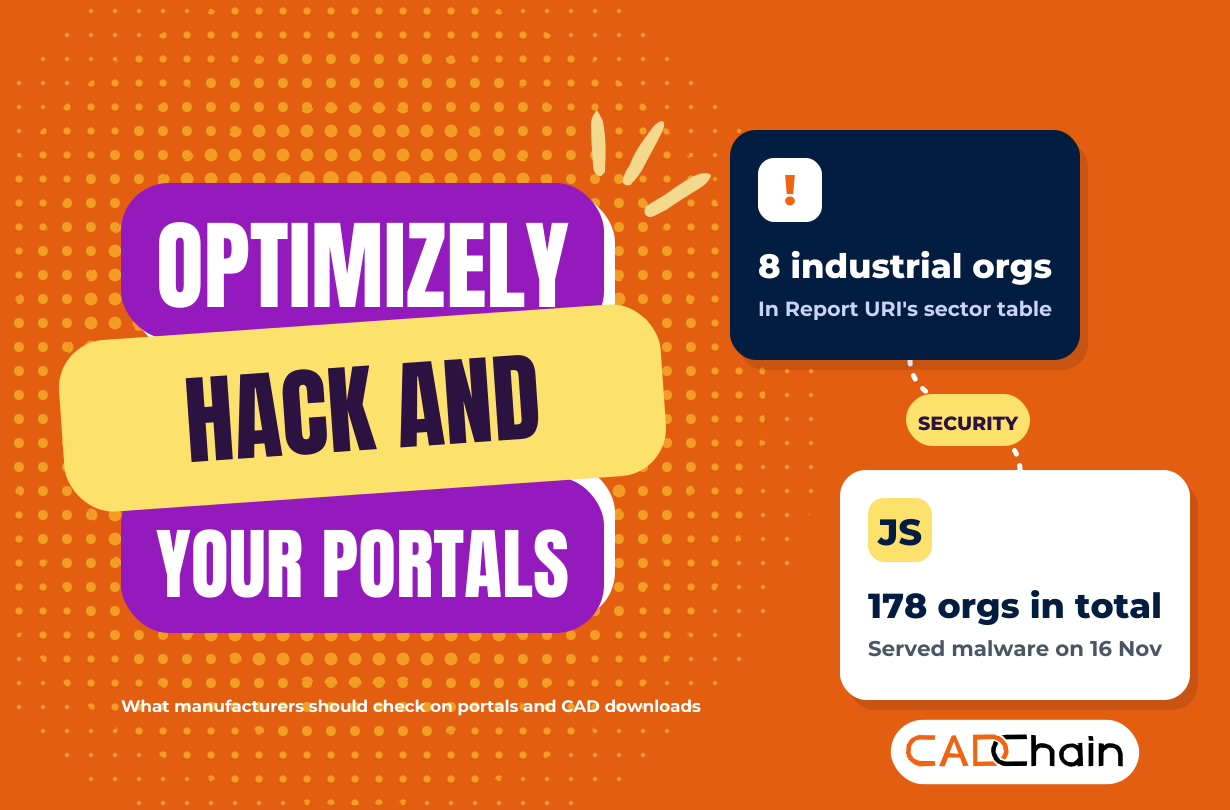
On 16 November 2026 malicious JavaScript in Optimizely snippets reached visitors of 178 organisations, 8 of them industrial and manufacturing firms such as Fluke and Vaillant Germany. The code ran with each page's own access. For OEMs and suppliers: keep marketing and testing scripts off portals, configurators and CAD download pages, and lock down session cookies.
Developing story. Last updated 17 Nov 2026, 14:15 CET. We'll update this article as Optimizely publishes more.
Here is what happened with the Optimizely hack on 16 November; this guide stays with manufacturing and hardware companies whose websites run marketing scripts on the same pages as logins, partner portals and file downloads. Also today: the 3DEXPERIENCE vulnerability in Dassault's launcher app.
What do we know so far about the Optimizely hack?
Each Optimizely Web customer loads a JavaScript snippet from cdn.optimizely.com, with an optional field called Project JavaScript that runs on every page. The attacker wrote code into that field. Optimizely's status notice of 17 November says an unauthorized party "exploited a vulnerability in Experimentation and used it to add malicious JavaScript to some customer projects"; it has fixed the flaw and removed the code. A spokesperson put the flaw in the account signup flow, iTWire reports.
- 16 Nov, 05:23 UTC: the attacker's domain 1688360.cc is registered.
- 16 Nov, 13:43 UTC: a card skimmer is added to the payload, which was rebuilt 26 times that day.
- 16 Nov, 23:11 UTC: every infected snippet is clean again.
- 17 Nov, 01:02 UTC: Optimizely posts its security incident notice.
Which manufacturers were on the Optimizely list?
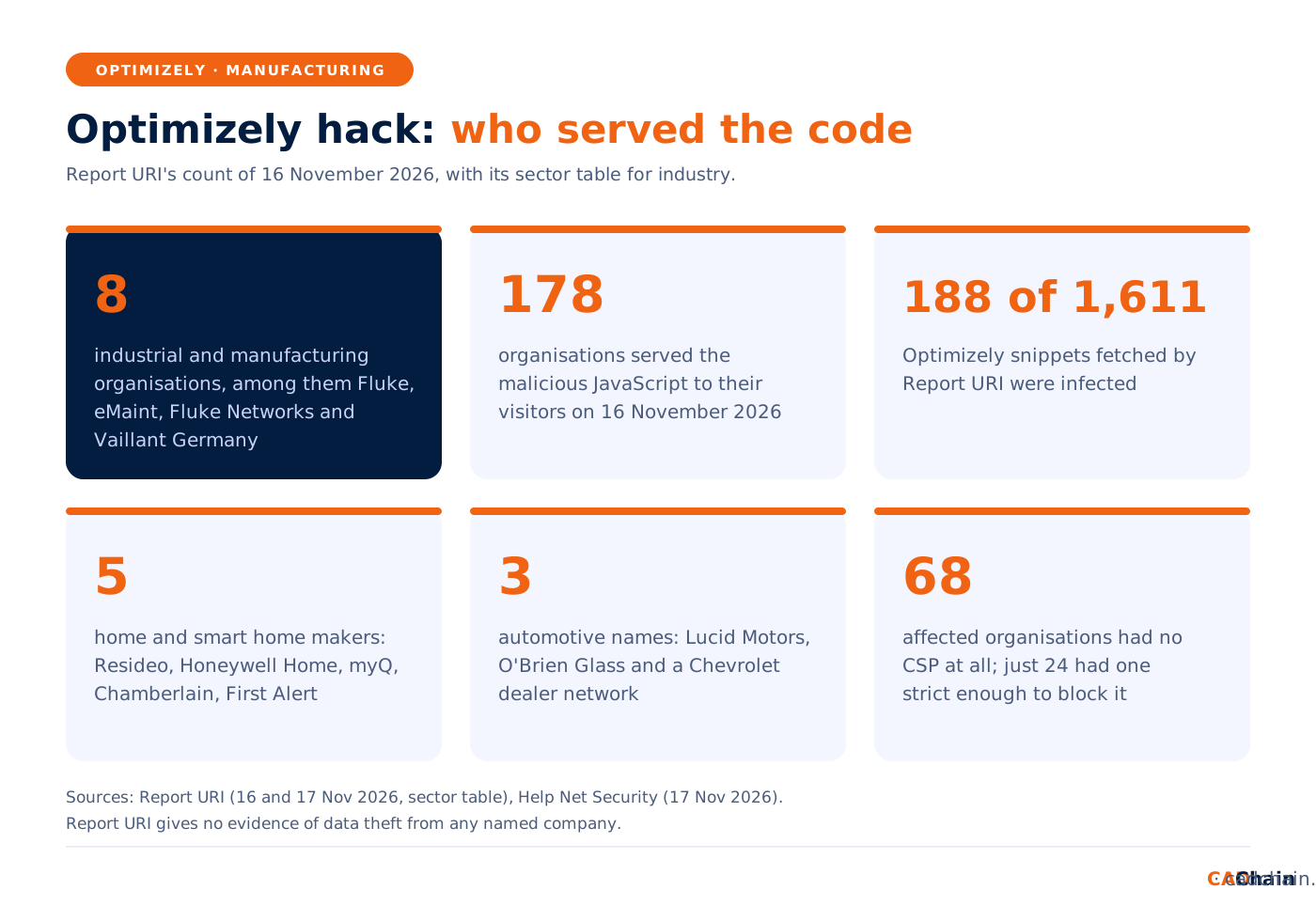
Report URI fetched 1,611 distinct Optimizely snippets and found 188 infected, belonging to 178 organisations. Its sector table counts:
- Industrial and manufacturing: 8 organisations, among them Fluke, eMaint (Fluke), Fluke Networks, Vaillant Germany and Fluke Process Instruments.
- Home and smart home: 5: Resideo, Honeywell Home, myQ (Chamberlain), Chamberlain and First Alert.
- Automotive: 3: Lucid Motors, O'Brien Glass and a Chevrolet dealer network.
Report URI gives no evidence of data theft from any named company, and it doesn't say which pages of these sites carried the code. Its own warning: "The real number is likely higher".
Why does this matter for engineering and hardware websites?
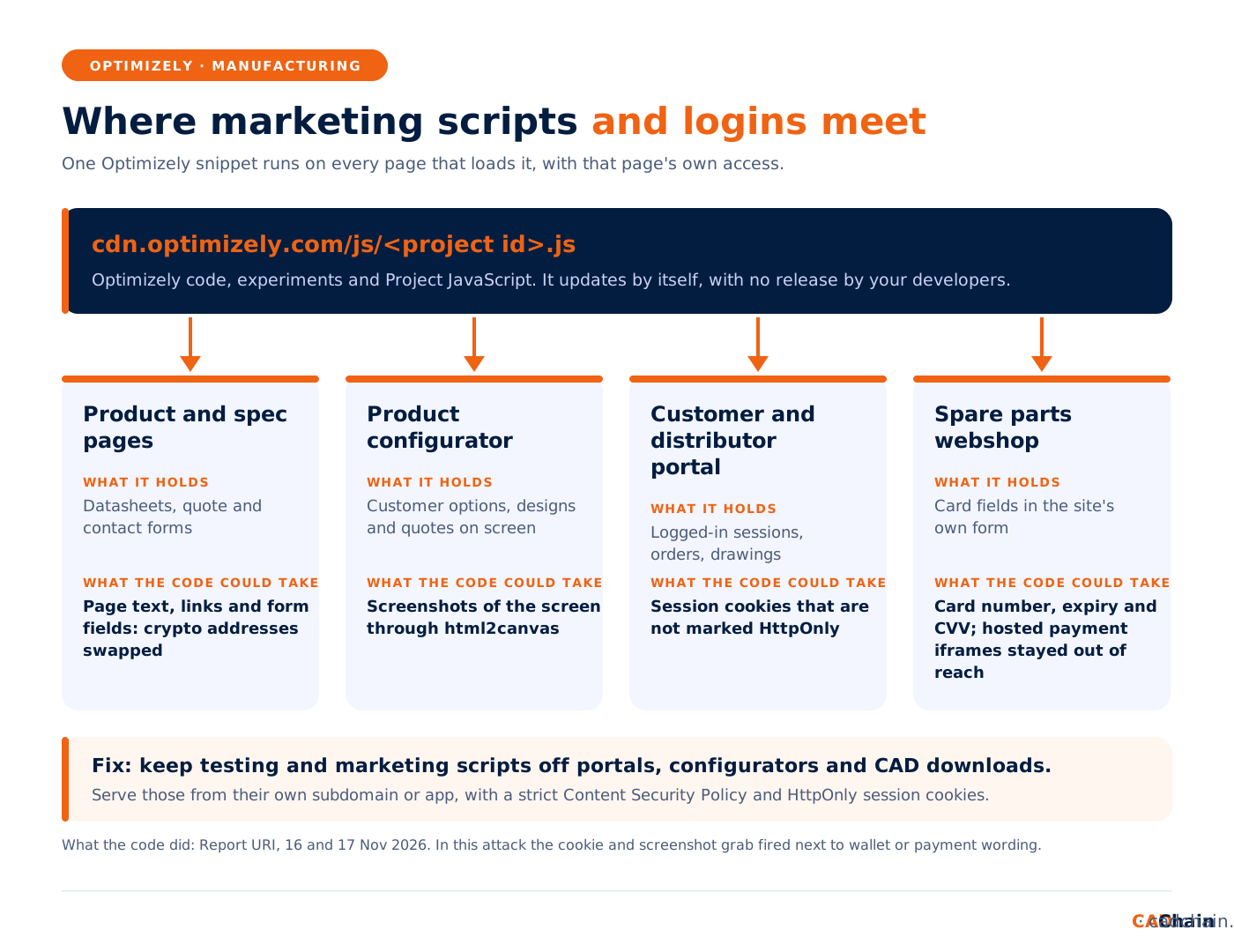
On a manufacturer's website, distributors log in to order spare parts, customers save designs in a product configurator, partners download STEP and native CAD models, and service teams open tickets. On many sites it all shares one header that loads every marketing tag. A testing snippet in that header runs with the page's own access, logged-in session included.
Report URI describes what the code did on 16 November:
- Cookie and screenshot theft: it read cookies not marked HttpOnly and took screenshots with html2canvas. In this attack it fired next to wallet or payment wording; the same access works on a portal page.
- Card skimming in a site's own form fields, like a spare parts webshop's. Hosted payment iframes (Stripe, Adyen and similar) stayed out of reach.
- Crypto address swapping, plus exploit kits for older iPhones and iPads.
The snippet updates by itself, so whoever holds the testing tool can change code on pages engineering never reviews. We saw the same weak spot from another angle in the Loxone breach and its partner portal.
Did Content Security Policy stop the Optimizely malware?
Rarely. Report URI crawled 256 hosts of the affected organisations. Help Net Security sums it up: only 24 organisations had a policy strict enough to block the code, 68 had no CSP at all, and in 50 cases the policy let the malware run and send data out.
- Allowing cdn.optimizely.com never helped, because the malware came from that host.
- 'unsafe-eval', which Optimizely's own documentation tells customers to allow, let an inline copy run. At HSBC the policy blocked track.js and the data theft, and the inline copy still ran.
Scott Helme of Report URI: "The important lesson here is that trusted JavaScript doesn't always remain trustworthy." Our sister guide on Content Security Policy after the Optimizely hack walks through a first policy.
Which pages on your site carry scripts next to logins?
A starting map for a manufacturer's site:
How do you keep marketing scripts away from portals and CAD downloads?
- Split the site. Serve portals, design configurators and PLM or CAD download areas from a separate subdomain or app with its own strict CSP and no testing tools.
- Set HttpOnly and SameSite on every session cookie and check again in the browser. Scripts can't read an HttpOnly cookie.
- Treat the testing tool as production access: who writes code into it, MFA for every user, API tokens and connected apps reviewed.
- Control the files too. Our guide to zero trust for CAD file distribution covers access per file and per partner.
What if your website used Optimizely?
- Open every project's Project JavaScript and every experiment's custom code. Look for 1688360.cc, atob( and any script you didn't write.
- Review who and what can write to the account (users, API tokens, connected apps) and rotate credentials.
- Rotate portal sessions; treat tokens in non-HttpOnly cookies as exposed.
- Read your CSP and browser reports for 16 November: StepSecurity notes in iTWire that a clean script fetched today can't show what visitors got that day.
- Treat cards typed into your own forms that day as potentially exposed, and tell distributors and customers if their sessions were within reach.
General guidance: under the GDPR, card data skimmed from your own form is a personal data breach. Article 33 asks you to notify the supervisory authority within 72 hours of becoming aware, where feasible, unless a risk is unlikely; Article 34 adds telling the people affected when the risk is high.
What we don't know yet
- How the attacker got write access to so many unrelated customer projects. Report URI: "That's for Optimizely to explain."
- How many visitors were exposed and how many cards were skimmed.
- Which pages of the named manufacturers' sites carried the code.
- Whether Optimizely publishes a post-incident report, and whether companies notify customers or regulators.
What should manufacturers do this week?
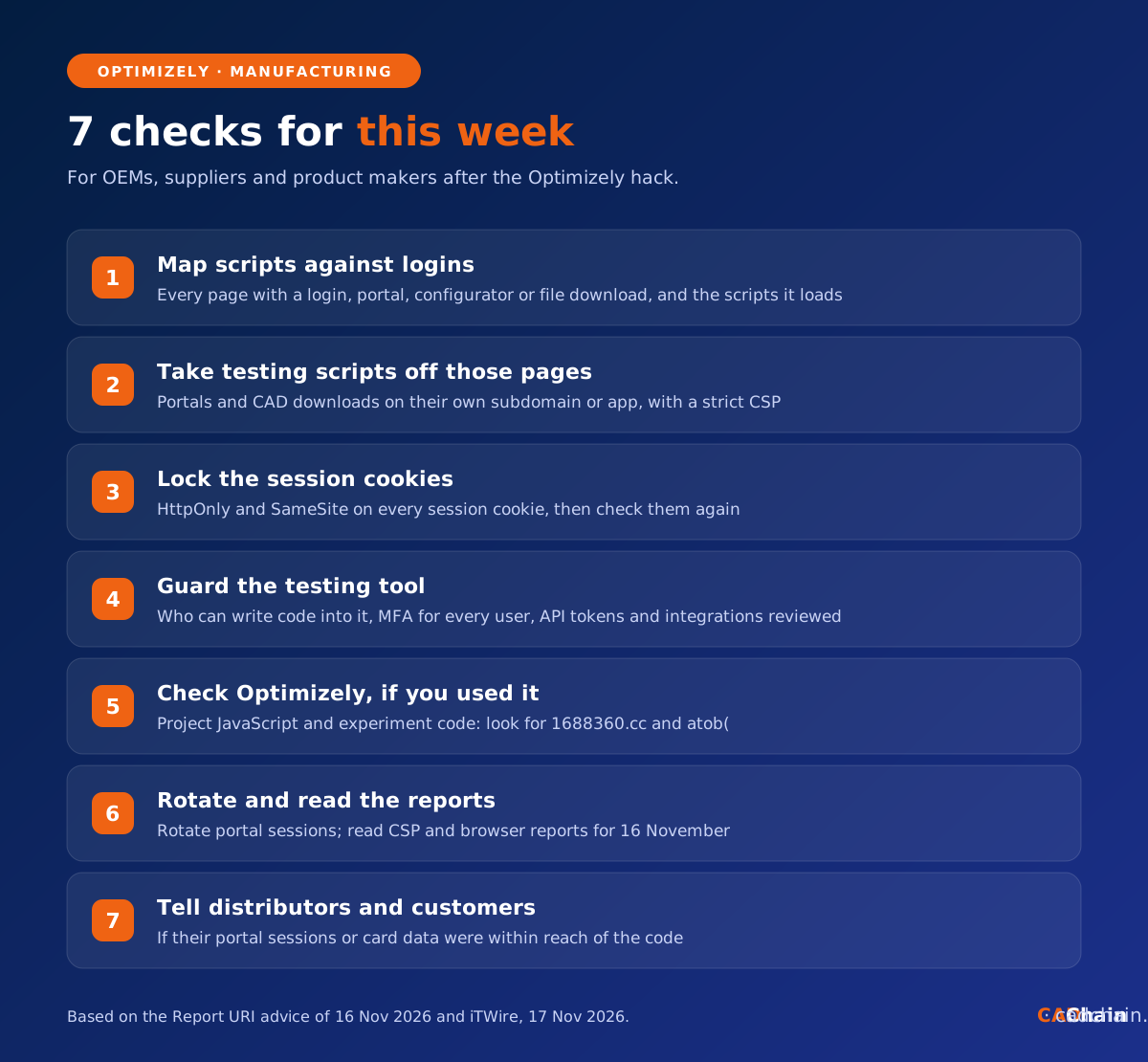
- Map scripts against logins, page by page.
- Take marketing and testing scripts off portals, configurators and CAD downloads.
- Lock the session cookies with HttpOnly and SameSite.
- Guard the testing tool with MFA and an access review.
- Check Project JavaScript if you used Optimizely Web.
- Rotate portal sessions and read your CSP reports for 16 November.
- Tell distributors and customers what was within reach.
Our guide to CAD file security covers vaults and suppliers, and the ARTEX AI warning for manufacturers shows attackers using partner portals as a way in. Script hygiene decides who reaches a page. CADChain adds DRM to the CAD files themselves, so a model taken through a hijacked portal session stays locked to the people you authorised.
FAQ: Optimizely hack and manufacturing
Which manufacturers were affected by the Optimizely hack?
Report URI lists 8 industrial and manufacturing organisations, among them Fluke, Fluke Networks and Vaillant Germany, plus 5 home and smart home makers such as Resideo and 3 automotive names such as Lucid Motors.
Did attackers steal data from Fluke, Vaillant or Resideo?
Report URI gives no evidence of data theft from any named company. Their Optimizely snippets served malicious code to visitors on 16 November 2026, and all infected snippets were clean by 23:11 UTC that day.
What could the Optimizely malware take from a website?
It swapped crypto addresses, skimmed card numbers typed into a site's own form fields, read cookies not marked HttpOnly and took screenshots. Cards entered in hosted payment iframes stayed out of reach.
Does a Content Security Policy stop malicious third-party scripts?
Only a strict one. Help Net Security reports that 24 affected organisations had a policy strict enough to block the code and 68 had none.
Should marketing scripts run on customer and distributor portals?
Keep them off. Serve portals, configurators and CAD downloads from a separate subdomain or app with its own strict CSP, and set HttpOnly and SameSite on session cookies.