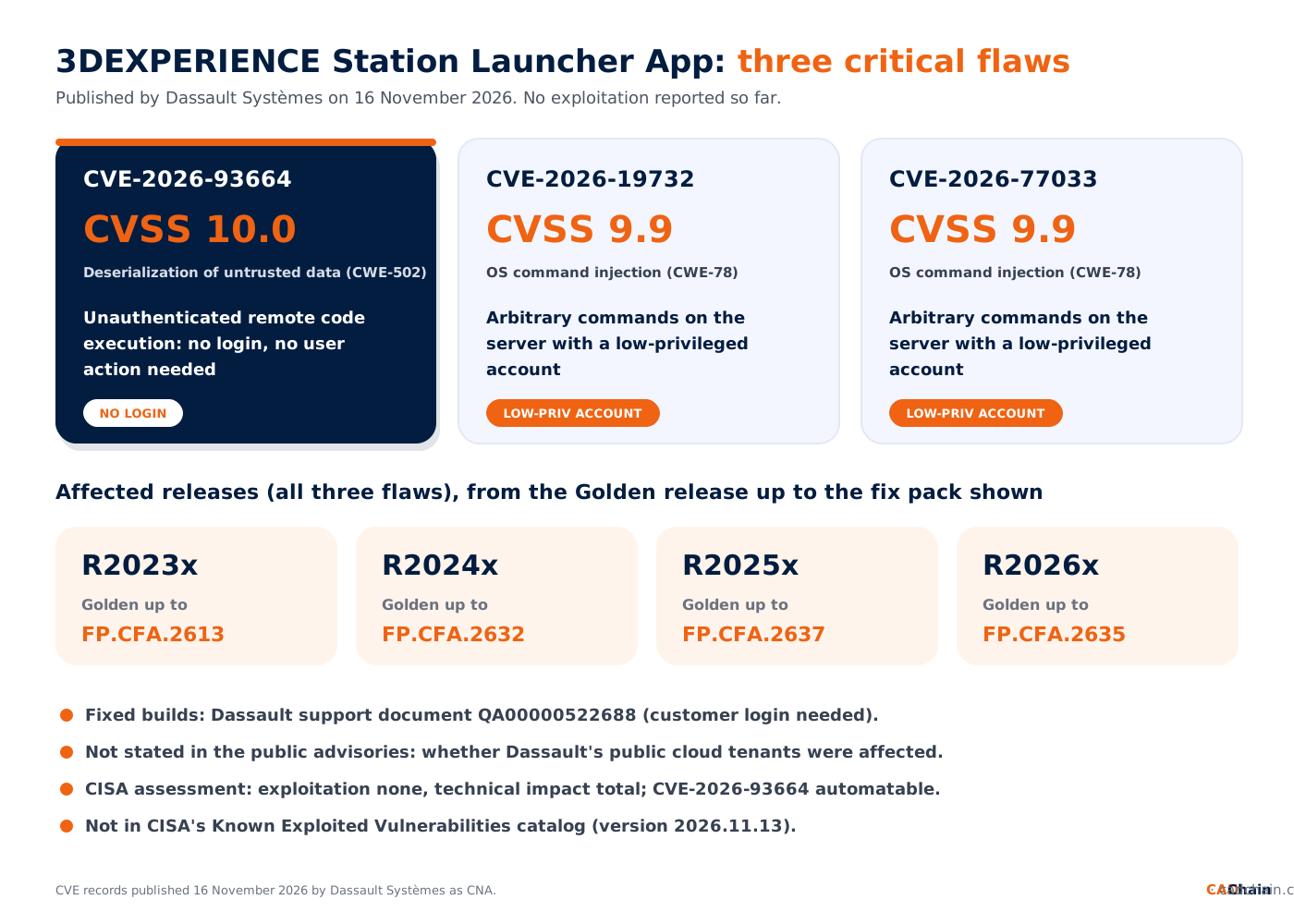
On 16 November 2026, Dassault Systèmes published three critical security advisories for the Station Launcher App in its 3DEXPERIENCE platform, covering every release from R2023x to R2026x. The worst, CVE-2026-93664, is rated CVSS 10.0 and could let an attacker run code without logging in. The other two, CVE-2026-19732 and CVE-2026-77033, are rated 9.9 and could let an attacker with a low-privileged account run commands on the server.
3DEXPERIENCE is the platform behind CATIA, ENOVIA, SIMULIA, DELMIA and connected SOLIDWORKS, and for many companies it holds the master copy of their product data: models, drawings, bills of materials, change orders, simulation results and supplier exchanges. A flaw that gives an outsider code execution on that platform is therefore not only an IT problem. It is a question of who can read, copy or change the designs a company lives on.
No exploitation has been reported so far, and the flaws are not in CISA's Known Exploited Vulnerabilities catalog. But the pattern of the last year is clear: critical flaws in engineering software are found, published and then attacked, sometimes within weeks. For founders, engineering managers, IP lawyers and security teams, this is the moment to find out which 3DEXPERIENCE environments you run, who can reach them, and what happens to your design data if one of them is compromised.
TL;DR: three critical flaws in one 3DEXPERIENCE component, patch now
Dassault Systèmes disclosed CVE-2026-93664 (deserialization of untrusted data, CVSS 10.0, no login needed), CVE-2026-19732 and CVE-2026-77033 (OS command injection, CVSS 9.9 each, a low-privileged account needed) in the Station Launcher App of 3DEXPERIENCE R2023x to R2026x. Affected builds run up to R2023x FP.CFA.2613, R2024x FP.CFA.2632, R2025x FP.CFA.2637 and R2026x FP.CFA.2635. Fix details are in Dassault support document QA00000522688, which needs a customer login. No exploitation has been reported. Lesson: patch on-premises and private cloud platforms, ask Dassault or your partner about hosted tenants, limit network access, review accounts and logs, and keep your most sensitive CAD files encrypted at file level so a platform breach does not hand them over.
What did Dassault Systèmes disclose?
Dassault, acting as its own CVE numbering authority, published the three CVE records shortly after 12:20 UTC on 16 November 2026, with matching advisories in the 3DS Trust Center. All three affect the same component, which the advisories call the Station Launcher App in the 3DEXPERIENCE platform. Dassault does not describe what the component does, and it should not be confused with the 3DEXPERIENCE Launcher, the separate client service on Windows PCs that opens desktop apps from the platform.
CVE-2026-93664 is a deserialization of untrusted data flaw (CWE-502). In plain terms, the component accepts data from the network and turns it back into program objects without checking it well enough, which is a classic route to running an attacker's code. Dassault's description says it "could lead to an unauthenticated remote code execution". The CVSS vector in the CVE record is the worst possible: reachable over the network, low attack complexity, no privileges, no user interaction, and a changed scope, meaning the impact can reach beyond the vulnerable component.
CVE-2026-19732 and CVE-2026-77033 are two separate OS command injection flaws (CWE-78). Both could allow an attacker to execute arbitrary commands on the server, according to Dassault. They need a low-privileged account, which is why they score 9.9 rather than 10. In a platform where suppliers, contractors and partner engineers often get accounts, "low-privileged" can mean a lot of people.
CISA's automated assessment, added to the records the same day, marks exploitation as "none" and the technical impact as "total" for all three. For CVE-2026-93664 it also marks the flaw as automatable, which means an attacker could scan for and exploit it at scale once the details are known. No researcher is credited, and no public proof-of-concept had been reported by 17 November.
Which 3DEXPERIENCE versions are affected?
The CVE records list four affected ranges, the same for all three flaws: R2023x from the Golden release up to FP.CFA.2613, R2024x up to FP.CFA.2632, R2025x up to FP.CFA.2637, and R2026x up to FP.CFA.2635. The public advisory pages do not name the fixed fix packs. They point to support document QA00000522688 in the 3DS Knowledge Base, which customers can open with their support login.
The advisories also do not say whether Dassault's own public cloud is affected, or whether hosted tenants have already been patched. For companies on the public cloud, the first step is to ask Dassault or the reseller directly and get the answer in writing. Timing matters here too: Dassault has scheduled the public cloud upgrade to R2027x for the weekend of 21 and 22 November, as solidboris.com explains in its article on what the 3DEXPERIENCE R2027x upgrade means for SOLIDWORKS users. R2027x is not in the affected ranges, but that does not answer the question for on-premises and private cloud platforms, which stay on the release and fix pack their owners installed.
Why do PLM flaws matter for design IP?
A PLM platform is where a company's product knowledge comes together: the 3D models and drawings, the bill of materials, the change history, test and simulation data, supplier quotes and the access rights that decide who sees what. Code execution on the server that runs it can give an attacker the same view the platform has. In practice, that can mean bulk export of design files, theft of the credentials and keys the platform uses to reach databases and file vaults, or quiet changes to models and documents.
This is not hypothetical for engineering software. CISA added three flaws in Dassault's DELMIA Apriso manufacturing software to its Known Exploited Vulnerabilities catalog in 2025: a deserialization flaw, CVE-2025-5086, in September, and a code injection and a missing authorization flaw, CVE-2025-6204 and CVE-2025-6205, in October. PTC's Windchill has had four critical flaws this year, one of them exploited and linked to ransomware, as we covered in our article on the Windchill vulnerability CVE-2026-126325. Our coverage of Oracle Agile PLM vulnerabilities and the CVSS 10 GitLab flaw shows the same pattern for other systems that hold design data.
Ransomware groups have also learned what engineering data is worth. Our analysis of leak-site claims against manufacturers found gangs naming design drawings and PDM data in their threats, and the SANS 2026 ICS/OT survey reported that intellectual property theft featured in 31% of industrial incidents, up from 6%. A PLM server that can be taken over without a password is exactly the kind of target those groups look for.
Keep design files protected even if a platform is breached. CADChain encrypts CAD files at file level, so a copied file stays unreadable without permission. You grant and revoke access per user and per partner, set expiry dates and see every access, with ownership recorded on a blockchain, across CAD systems and PLM platforms.
👉 See how CADChain protects CAD files
What do the rules say about patching and reporting?
For the companies that run 3DEXPERIENCE, a compromise of the platform can trigger reporting duties. Organisations covered by NIS2 have to give an early warning of a significant incident within 24 hours, and a breach that exposes personal data, for example user accounts or supplier contacts, can start the 72-hour GDPR clock. For Dassault as a software maker, the EU Cyber Resilience Act's reporting duties for actively exploited vulnerabilities have applied since 11 September 2026, as our guide to Cyber Resilience Act reporting explains.
Trade secret law adds another reason to act quickly. Under the EU Trade Secrets Directive, design data is only protected as a trade secret if its holder took reasonable steps to keep it secret. Leaving a known critical flaw unpatched on the system that holds your designs is hard to defend as reasonable. Our trade secrets guide for deep tech startups explains what courts look for, and our article on third-party software vulnerabilities in CAD workflows covers how to manage the risk that comes with the tools you depend on.
What should engineering teams do now?
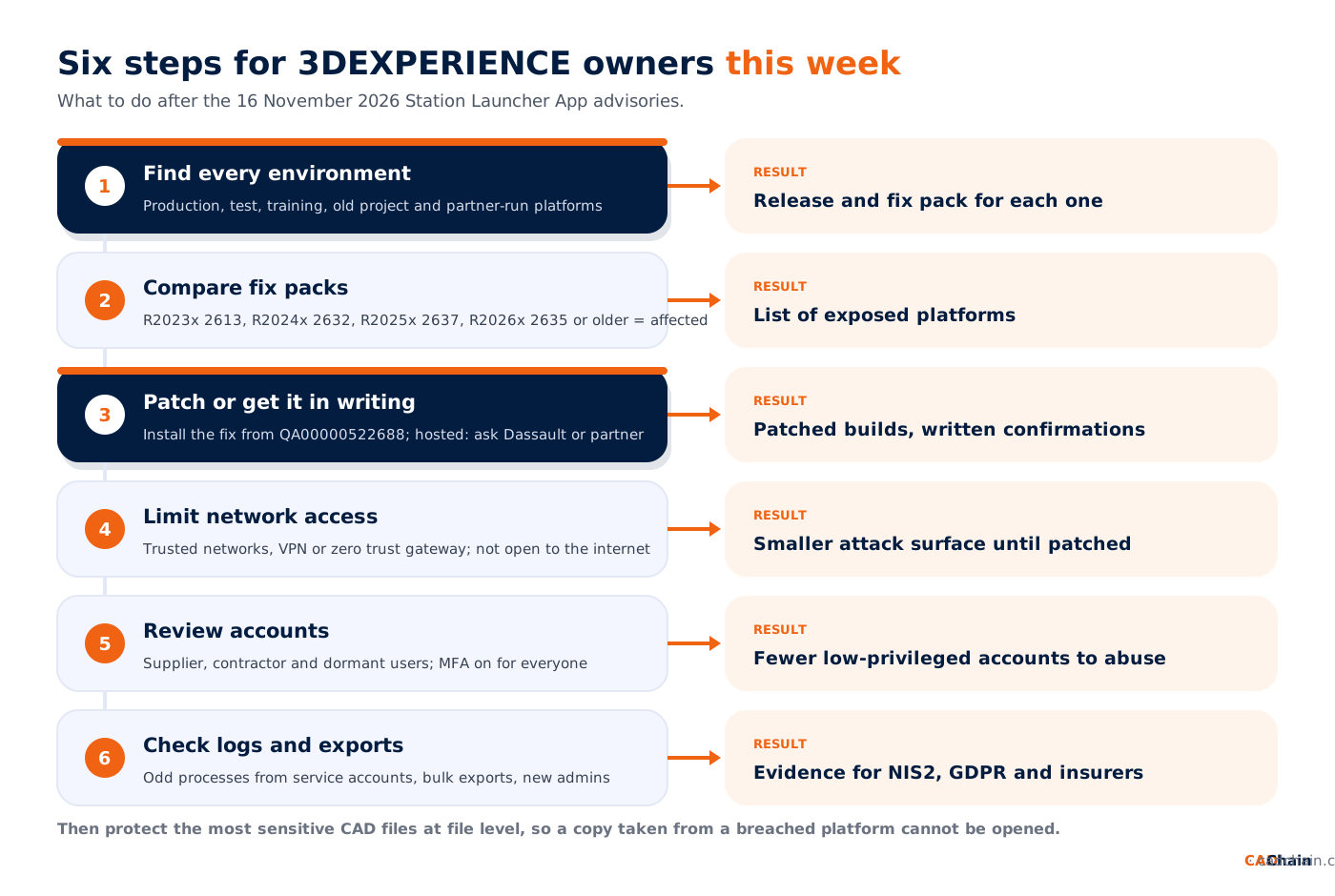
- Find every 3DEXPERIENCE environment. List production, test, training and old project platforms, including those run by partners, with their release and fix pack. Forgotten test servers are often the ones still on old builds.
- Patch on-premises and private cloud platforms. Compare each fix pack with the four affected ranges and install the fix described in QA00000522688. If a partner hosts the platform, ask for the date and a written confirmation.
- Ask about the public cloud. Dassault's public advisory does not say whether hosted tenants were affected. Ask Dassault or your reseller and keep the answer with your security records.
- Limit who can reach the platform. Until patches are in, restrict access to trusted networks, VPN or a zero trust gateway. A PLM server should not be open to the whole internet. Our article on zero trust for CAD file distribution covers the model.
- Review accounts. Two of the flaws need only a low-privileged account. Remove dormant users, check supplier and contractor accounts, and make sure multi-factor authentication is on.
- Check logs and exports. Look for unusual processes started by platform service accounts, unexpected bulk exports and new admin accounts. Our guide on how to audit CAD file access explains what to keep.
- Protect the most sensitive files at file level. Use file-level CAD encryption and DRM access levels for view, edit and export, so a model copied from a breached platform cannot be opened without permission. Our article on PLM integration with CAD DRM shows how the two work together.
- Keep a dated proof of ownership. Record when your designs were created and by whom, so you can show they are yours if a copy turns up elsewhere. Our complete guide to CAD file security explains the options.
How does this fit the bigger picture?
The systems engineering teams rely on, and the people allowed into them, are a recurring theme on our sister sites this week:
- When the whole network goes down. Swedish furniture maker Kinnarps shut down its systems after abnormal network activity on 7 November and stopped production at three factories for two days. Solidboris.com explains what the Kinnarps cyberattack teaches SOLIDWORKS teams about PDM, licence servers and restarting safely.
- AI agents with access to engineering systems. Anthropic launched Claude for Manufacturing on 12 November with connectors for Autodesk Fusion, Infor, Microsoft 365 and Oracle NetSuite, but none for Inventor or Vault. BORIS Inventor covers what Claude for Manufacturing means for Inventor teams and which data such tools can reach.
- Who controls the data behind AI models. Adobe and Disney announced a multi-year AI alliance with custom Firefly Foundry models trained on Disney's own world knowledge, without saying who owns the models. Blended BORIS looks at what the Adobe and Disney AI deal means for 3D artists.
The common thread is that design data is only as safe as the systems and accounts that can reach it. Our guides on ransomware and CAD file protection and protection strategies for CATIA, SOLIDWORKS and other CAD systems cover the main defences.
Conclusion
Dassault's 16 November advisories describe three critical flaws in one component of 3DEXPERIENCE, one of which could let an outsider run code without a password. Nobody has reported an attack yet, and Dassault has put the fix details in its support portal. That gives platform owners a window, but past cases in PLM and manufacturing software show the window can close quickly once technical details spread.
For engineering companies, the practical answer has two parts. Patch and lock down the platform now, and get written answers on any environment someone else runs for you. Then make sure your most valuable CAD files do not depend on a single platform staying secure: encrypt them at file level, control access per person and per partner, and keep a record that proves they are yours.
Make your design files provably yours and revocable at any time. CADChain gives every CAD file a verifiable ownership record, file-level encryption, granular permissions you can revoke at any time and a full access log, across CAD systems, PLM platforms, suppliers and partners.
👉 Protect your CAD files with CADChain
FAQ: 3DEXPERIENCE vulnerability
What is CVE-2026-93664?
It is a deserialization of untrusted data flaw in the Station Launcher App of the Dassault Systèmes 3DEXPERIENCE platform, published on 16 November 2026. Dassault says it could lead to unauthenticated remote code execution. It is rated CVSS 10.0, the highest score.
What are CVE-2026-19732 and CVE-2026-77033?
They are two OS command injection flaws in the same component, each rated CVSS 9.9. Dassault says they could allow an attacker to execute arbitrary commands on the server. Unlike CVE-2026-93664, they need a low-privileged account.
Which versions are affected?
3DEXPERIENCE R2023x up to FP.CFA.2613, R2024x up to FP.CFA.2632, R2025x up to FP.CFA.2637 and R2026x up to FP.CFA.2635, from the Golden release of each. The fixed builds are described in Dassault support document QA00000522688.
Are the flaws being exploited?
No exploitation had been reported by 17 November 2026. CISA's assessment marks exploitation as none, and the flaws are not in its Known Exploited Vulnerabilities catalog. CVE-2026-93664 is marked as automatable, so attacks could scale quickly once details are public.
Is the 3DEXPERIENCE public cloud affected?
Dassault's public advisories do not say. Public cloud customers should ask Dassault or their reseller whether hosted tenants were affected and are fixed, and keep the answer in writing.
Is the Station Launcher App the same as the 3DEXPERIENCE Launcher?
Dassault does not describe the Station Launcher App in its advisories. The 3DEXPERIENCE Launcher is a separate client service on Windows PCs that opens desktop apps from the platform, and the advisories do not name it.
What should we do first?
Find every 3DEXPERIENCE environment, compare its fix pack with the affected ranges, install the fix, restrict network access, review accounts, especially supplier and dormant ones, and check logs for unusual processes and exports.
How does CADChain help?
CADChain encrypts CAD files at file level, sets per-user and per-partner permissions with expiry dates, logs every access and records ownership on a blockchain. A file copied from a breached platform stays unreadable without permission. It complements, and does not replace, patching and securing the platform.