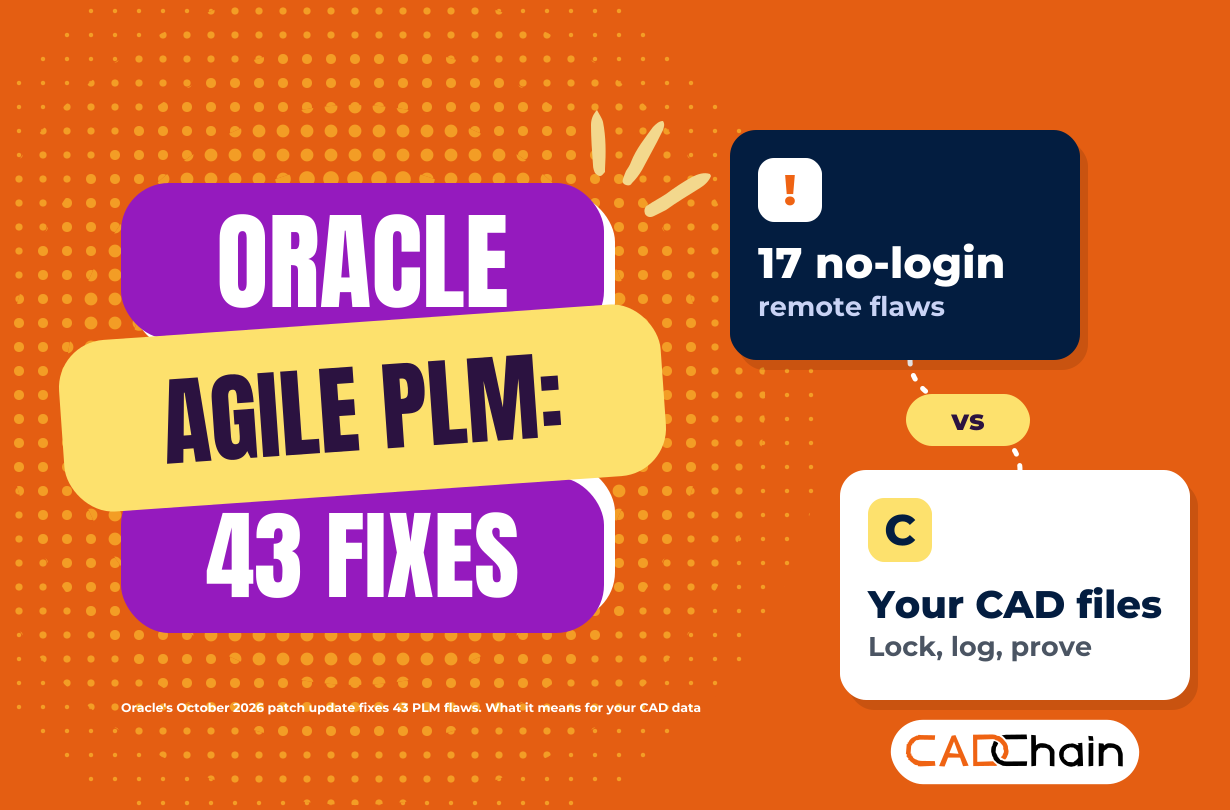
On 20 October 2026, Oracle released its October Critical Patch Update with 1,295 new security patches. Among them are 43 fixes for the Agile product lifecycle management family: Agile PLM, Agile Product Lifecycle Management for Process, Agile Engineering Data Management and the Agile PLM MCAD Connector. Oracle rates 17 of these 43 flaws as remotely exploitable without a username or password, and two of them score above 9 out of 10.
Agile PLM is one of the long-running enterprise PLM systems in manufacturing, medical devices, electronics and consumer goods. It holds bills of materials, change orders, supplier data, quality records and the CAD files and drawings attached to them. A flaw that lets an outsider read data from that system is a flaw that can expose a company's product designs.
For engineering managers, IT security teams and IP lawyers, this update matters for three reasons. Several flaws can be reached over the network without logging in. Some of them sit in the components that store files and attachments. And PLM systems have already been the target of a large data-theft campaign this year. Here is what Oracle fixed, which flaws deserve attention first, and how to protect design data even when the next PLM flaw arrives before the patch.
TL;DR: Oracle Agile PLM vulnerabilities in October 2026
Oracle's October 2026 Critical Patch Update, published on 20 October, contains 50 new security patches for Oracle Supply Chain products, and 43 of them are for the Agile PLM family. Seventeen of the 43 can be exploited over a network without credentials, according to Oracle's risk matrix. The highest scores are 9.3 and 9.1, both in Agile Product Lifecycle Management for Process 6.2.4. Agile PLM 9.3.6 gets 13 fixes, including flaws in its file attachment components. Oracle's advisory does not report that these specific flaws are being exploited, but Oracle warns that attackers have succeeded against customers who failed to patch. What to do: patch, check which PLM servers are reachable from the internet, review accounts and logs, and protect the CAD files themselves so that a PLM breach does not automatically mean a design leak.
What did Oracle fix in the October 2026 Critical Patch Update?
Oracle publishes its Critical Patch Updates four times a year, on the third Tuesday of January, April, July and October. The October 2026 update came out on 20 October. According to the Oracle Critical Patch Update Advisory for October 2026, it contains 1,295 new security patches across Oracle's product families. The Oracle Supply Chain section alone has 50 new patches, 19 of which may be remotely exploitable without authentication.
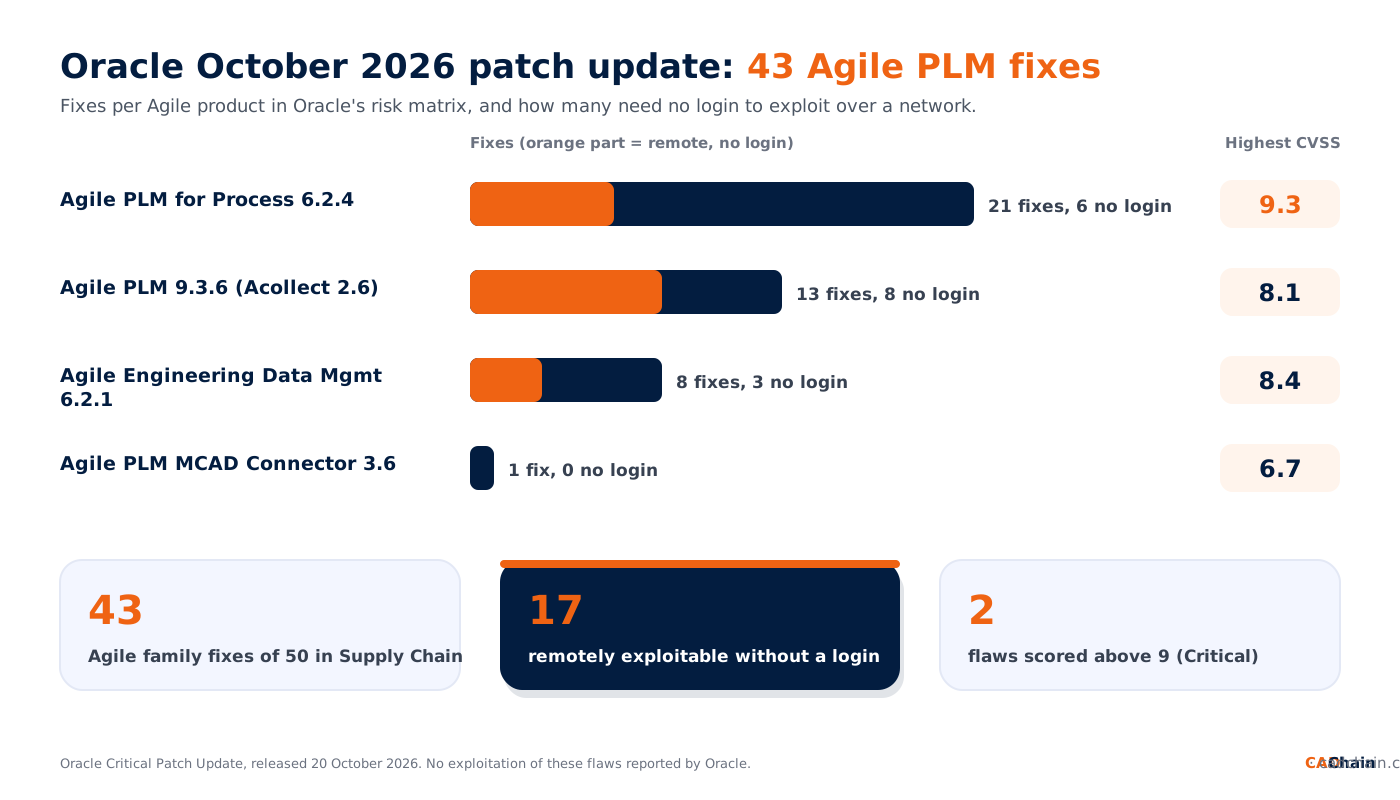
Almost all of the Supply Chain fixes are for PLM products. Based on Oracle's risk matrix, the 43 Agile family fixes break down like this:
- Agile Product Lifecycle Management for Process 6.2.4: 21 fixes, 6 of them remotely exploitable without authentication. Most are in the Product Quality Management component. The highest scores in the whole Supply Chain section, 9.3 and 9.1, are here.
- Agile PLM 9.3.6 (and version 2.6 for one component): 13 fixes, 8 of them remotely exploitable without authentication. The highest score is 8.1.
- Agile Engineering Data Management 6.2.1: 8 fixes, 3 of them remotely exploitable without authentication. The highest score is 8.4, in the Engineering Communication Interface component.
- Agile PLM MCAD Connector 3.6: 1 fix, in the CAX Client, scored 6.7. It needs local access and user interaction.
Oracle Product Lifecycle Analytics 3.6.1 gets 5 more fixes, with a top score of 7.5. In total, 23 of the 43 Agile flaws score 7.0 or higher on the CVSS 3.1 scale, which means High or Critical.
Which Agile PLM flaws are the most serious?
Severity scores are a starting point, not the whole story. A flaw that needs no login and works over HTTP is more urgent for an internet-facing server than a higher-scored flaw that needs local access. With that in mind, these are the entries that stand out in Oracle's risk matrix:
- CVE-2026-91622 (9.3) and CVE-2026-91624 (9.1) in the Product Quality Management component of Agile Product Lifecycle Management for Process 6.2.4. Both are reachable over HTTP without authentication and can have a high impact on confidentiality and integrity. The first needs a user to interact, for example by clicking a link. The second does not.
- CVE-2026-54512 (8.1) in the Agile PLM 9.3.6 Application Server. It is a flaw in jackson-databind, a widely used open-source Java library, and is remotely exploitable without authentication, although Oracle rates the attack complexity as high.
- CVE-2026-68569 (8.1) in the Folders and Files Attachment component of Agile PLM 9.3.6, which comes from Apache Tomcat. It needs a low-privileged account.
- CVE-2026-87362 (6.5) in Agile PLM's Folders, Files and Attachments component. A low-privileged user with network access could read data, with a high impact on confidentiality.
- CVE-2026-101744 (8.4) in the Engineering Communication Interface of Agile Engineering Data Management 6.2.1, with a changed scope, meaning an attack could affect other components.
- CVE-2026-101562 (7.5) in the Acollect component of Agile PLM 2.6, remotely exploitable without authentication, with a high impact on confidentiality.
Two patterns matter for design data. First, several flaws come from third-party components such as jackson-databind and Apache Tomcat, the same kind of inherited risk we described in our article on third-party software vulnerabilities in CAD workflows. Second, the attachment components are where PLM systems keep the CAD files, drawings and specifications. A confidentiality flaw there is, in practice, a design data flaw.
A PLM flaw should not be a design leak. CADChain encrypts CAD files, controls who can open each one and logs every access, inside and outside your PLM, across CAD systems.
👉 See how CADChain works
Are these Agile PLM vulnerabilities being exploited?
Oracle's advisory does not say that any of these specific flaws are being exploited. But Oracle includes a general warning in every advisory. It says it keeps receiving reports of attempts to exploit vulnerabilities that already have patches, and that in some cases "attackers have been successful because targeted customers had failed to apply available Oracle patches." Oracle strongly recommends that customers stay on supported versions and apply patches without delay.
Recent history shows why that warning matters for PLM in particular. This year, the Clop extortion group used a zero-day flaw in PTC's Windchill and FlexPLM to steal data from dozens of organisations, and then published engineering drawings from some of them. Our sister site covered the Clop PLM data leak and what it means for engineering teams. Earlier this month, a joint advisory from seven countries described a China-linked hacking-for-hire company that targeted critical manufacturing through old, unpatched flaws, as we explained in our article on the Integrity Tech hacking advisory and CAD and PLM data.
What if your Agile PLM version is no longer supported?
This is the uncomfortable question for many Agile customers. Oracle states in the advisory that Critical Patch Update fixes are provided only for product versions in Premier Support or Extended Support. Older releases are not tested for these vulnerabilities, but Oracle says it is likely that earlier versions of affected releases are also affected.
The supported versions listed in this update are Agile PLM 9.3.6 (plus 2.6 for the Acollect component), Agile Product Lifecycle Management for Process 6.2.4, Agile Engineering Data Management 6.2.1 and the MCAD Connector 3.6. Companies still running older Agile releases should assume they are exposed and have no patch. Several vendors that sell PLM replacements report that Premier Support for Agile PLM 9.3.6 ends on 31 December 2027. Check the dates in your own Oracle support contract before you plan around them.
How do the affected Agile products compare?
The table summarises Oracle's risk matrix for the Agile family in the October 2026 update.
Why do PLM vulnerabilities matter for CAD files and IP?
A PLM system is a single place where a company keeps its most valuable technical information, organised and searchable. That is useful for engineers. It is also useful for anyone who breaks in. One unauthenticated read flaw can give an attacker access to drawings, 3D models and change history for whole product lines.
Most PLM security depends on the server: user accounts, roles and folder permissions. Once a file is downloaded, by a legitimate user or an attacker, those controls no longer apply. The file opens on any machine with the right CAD software. That is the gap we described in our comparison of file-level DRM protection and folder-level security, and in our guide to PLM integration with CAD DRM systems.
There is also a legal angle. In a trade secret dispute, courts ask whether the owner took reasonable steps to keep the information secret. Patching known flaws is part of that. So is being able to show who accessed which files and when. Our article on how to audit CAD file access explains what such a record should contain. For companies that sell software or connected products in the EU, the Cyber Resilience Act reporting obligations that started on 11 September 2026 add their own pressure to handle vulnerabilities quickly.
What should engineering and IT teams do now?
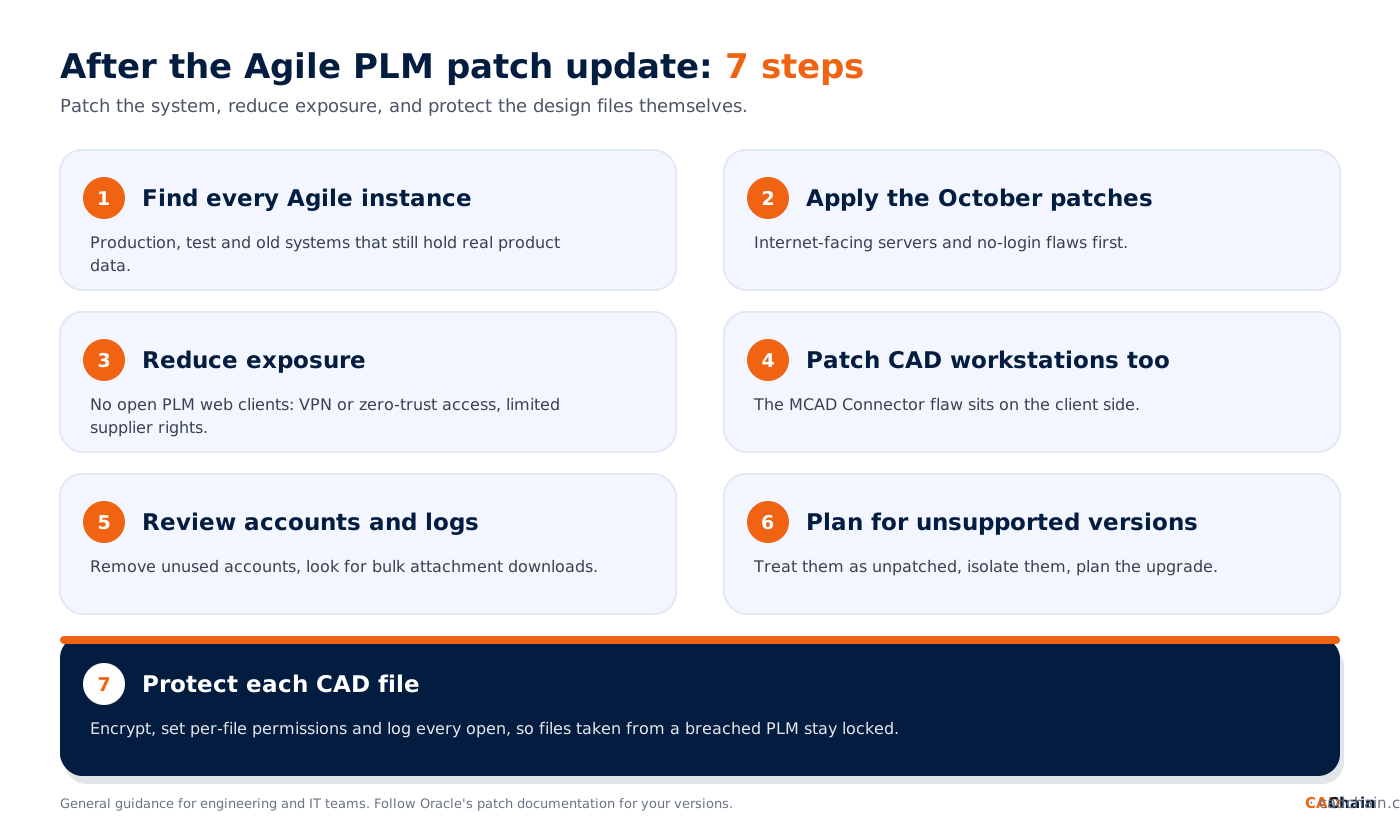
- Find every Agile instance. List all Agile PLM, Agile PLM for Process, Engineering Data Management and MCAD Connector installations, including test and old systems that still hold real data.
- Apply the October 2026 patches. Start with internet-facing servers and with the flaws that need no login. Follow the patch availability documents that Oracle links from the advisory.
- Reduce exposure. PLM web clients should not be open to the whole internet. Put them behind a VPN or zero-trust access, and limit supplier access to what each supplier needs.
- Update the CAD workstations too. The MCAD Connector flaw sits on the client side. Include engineering workstations in the patch plan, not only servers.
- Review accounts and logs. Remove unused accounts, check for unusual bulk downloads of attachments, and keep the logs.
- Plan for unsupported versions. If you run an Agile release outside Premier or Extended Support, treat it as unpatched, isolate it, and plan the upgrade or migration.
- Protect the files, not only the system. Encrypt sensitive CAD files with per-file permissions and access logs, so that files taken from a breached PLM cannot be opened.
For a broader checklist, see our zero trust model for CAD file distribution and the guide to CAD file security for supply chain collaboration, which covers supplier access to PLM data.
How does this connect to other recent security news?
The Oracle update is one of several patch warnings for engineering companies this month. Our article on the PHP vulnerability that engineering teams must patch covers web portals that often sit next to PLM and CAD file servers. Our earlier article on malicious CAD files and Autodesk parsing flaws shows that the CAD files themselves can be a way in. And the guide to ransomware targeting engineering firms explains why stolen design data has become a standard extortion tool.
How does this fit the bigger picture?
Our sister sites covered other developments this week.
- Another exploited engineering software flaw. A flaw in Siemens Software Center was used in a ClickFix malware campaign and added to CISA's list of exploited vulnerabilities. Read what the Siemens Software Center attack means for Inventor workstations on borisinventor.com.
- Trade secret injunctions get harder. The Massachusetts Supreme Judicial Court ruled that irreparable harm is not presumed in trade secret cases. Our sister site explains what the trade secret injunction ruling means for SOLIDWORKS teams.
- Crawling and AI terms. Meta's new Commercial Terms, effective 30 October 2026, add a website crawling clause for business accounts. Blended BORIS looks at what Meta's Commercial Terms mean for 3D artists.
Conclusion
Oracle's October 2026 Critical Patch Update fixes 43 flaws in the Agile PLM family, 17 of them reachable without a login and two scored above 9. There is no report that these flaws are being exploited yet, but PLM systems have already been the target of mass data theft this year, and Oracle itself warns that unpatched customers get breached.
Patching is the first step. The longer-term lesson is that a PLM system should not be the only thing that stands between an attacker and your designs. When the CAD files themselves are encrypted, permissioned and logged, a breached server or a stolen download does not have to become a lost product.
Protect your designs even when the system around them fails. CADChain gives engineering teams file-level access control, access logs and blockchain proof of ownership for CAD files, across CAD systems and PLM.
👉 Protect your CAD files with CADChain
FAQ: Oracle Agile PLM vulnerabilities, October 2026
When did Oracle release the October 2026 Critical Patch Update?
Oracle published it on 20 October 2026. It contains 1,295 new security patches across Oracle products, including 50 for Oracle Supply Chain products.
How many Agile PLM vulnerabilities did Oracle fix?
43 across the Agile family: 21 in Agile Product Lifecycle Management for Process 6.2.4, 13 in Agile PLM 9.3.6, 8 in Agile Engineering Data Management 6.2.1 and 1 in the Agile PLM MCAD Connector 3.6. Oracle rates 17 of them as remotely exploitable without authentication.
Which Agile PLM flaw is the most severe?
CVE-2026-91622 in the Product Quality Management component of Agile Product Lifecycle Management for Process 6.2.4, with a CVSS 3.1 score of 9.3. CVE-2026-91624 in the same component scores 9.1.
Are the Agile PLM vulnerabilities being exploited?
Oracle's advisory does not report exploitation of these specific flaws. It does warn that attackers have succeeded against customers who did not apply available Oracle patches.
Does the MCAD Connector flaw affect CAD workstations?
Yes. CVE-2026-101723 is in the CAX Client of the Agile PLM MCAD Connector 3.6. It needs local access, a low-privileged account and user interaction, and is scored 6.7.
What if we run an older Agile PLM version?
Oracle provides patches only for versions in Premier or Extended Support and says earlier versions are likely affected too. Treat older versions as unpatched, isolate them and plan an upgrade.
How does CADChain help when a PLM system is vulnerable?
CADChain protects the CAD files themselves with encryption, per-file permissions and access logs, so files copied or stolen from a PLM system cannot be opened without permission, and every access is recorded.