On 5 October 2026, Schneider Electric agreed to buy PTC, the company behind Creo, Windchill and Onshape, for about $22.6 billion in cash. It is the French group's largest acquisition ever, and one of the four big CAD and PLM vendors is about to get a new owner.
For investors the story is about price, premium and debt. For the engineering teams that design in Creo or Onshape and manage their product data in Windchill, the questions are more practical. Who will control the platform that holds our designs? Will prices, terms or roadmaps change? Can we take our data elsewhere if we need to? And how do we prove what we designed, and when, if the tool we used belongs to someone else tomorrow?
Here is what was announced, what happens next, and a short checklist for founders, engineering managers and IP owners, written from the point of view of the people whose CAD data sits inside these systems.
TL;DR: the Schneider Electric PTC acquisition in one paragraph
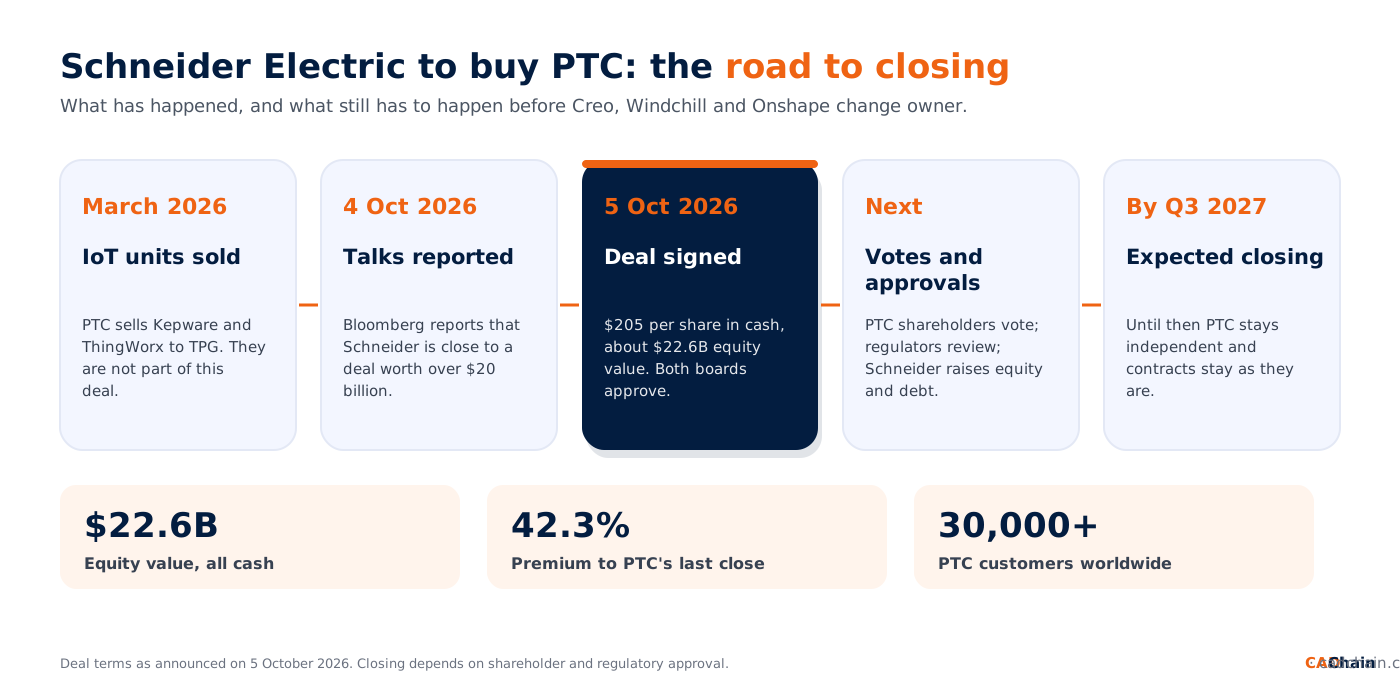
Schneider Electric will pay $205 per share in cash for PTC, about $22.6 billion in equity value and $23.7 billion including debt, a 42.3% premium to PTC's last closing price. The deal covers PTC's CAD, PLM, ALM and service software, used by more than 30,000 customers. It still needs PTC shareholder and regulatory approval and is expected to close by the third quarter of 2027. Nothing changes for users today. Use the time to read your contracts, test a full data export, learn your switching rights under the EU Data Act, and keep proof of your design ownership that does not depend on any single vendor.
What did Schneider Electric announce?
Schneider Electric and PTC signed a definitive agreement on Monday 5 October 2026, a day after Bloomberg reported that talks were close to a deal. The boards of both companies approved it unanimously, and PTC's board recommends that shareholders vote in favour. The official terms are in Schneider Electric's announcement.
The market did not cheer. Reuters reported that Schneider's shares fell almost 10% in early trading in Paris, wiping out about €15 billion of market value, while PTC's shares jumped more than 30% in US premarket trading. Analysts were split on whether the price was too high.
Why does an energy company want a CAD and PLM vendor?
Schneider Electric is best known for electrical equipment, automation and energy management. Over the past decade it has also become a large industrial software company: it has fully owned AVEVA, the industrial software group, since January 2023, and in June 2026 it agreed to buy Cognite, an industrial data platform. PTC fills the gap at the start of the product lifecycle: the design and engineering data created in CAD and managed in PLM.
Schneider's stated aim is to connect that product data with operational data from plants and assets, into one "digital thread" that feeds industrial AI. Its CEO, Olivier Blum, summed up the logic in an interview with Reuters: "Data is becoming a very critical layer."
That sentence is the reason this deal matters to anyone who designs products. The asset being bought is not only software. It is the position at the centre of the data your engineers create every day. Your designs are your intellectual property; the platform they live on is someone else's business. When the platform changes hands, it is worth checking that the line between the two is clear.
What changes for Creo, Windchill and Onshape users?
Today: nothing. Until the deal closes, PTC remains an independent, listed company. Your licences, subscriptions, support and roadmaps stay with PTC. Closing is expected by the third quarter of 2027, so there are many months in which nothing changes by law.
After closing: unknown. The announcement promises to preserve "an open-by-design approach across vendors and hardware", but it contains no specific commitments for customers: nothing on contract terms, pricing, product roadmaps, brands or data policies. That is normal for a merger announcement. It also means that every customer should plan on the basis of what their own contracts say, not on what they hope a new owner will do.
The products in PTC's portfolio include Creo and Onshape for CAD, Windchill and Arena for PLM, Codebeamer for application lifecycle management and ServiceMax for field service. Many teams use several of them together, with years of designs, revisions and bills of materials inside. If your company also works in other CAD systems, the same questions apply to every vendor you rely on. We cover the different tools in our guide to CAD protection strategies for Autodesk, SolidWorks, CATIA, Creo and NX, and the PTC-specific options in Creo rights management.
Who owns your design data when your CAD vendor changes owner?
You do. A change of ownership of the software company does not change who owns the designs created with it. Your models, drawings and product data remain your intellectual property, protected by copyright, design rights, patents or trade secret law depending on what they are.
What can change is your practical control over that data: where it is hosted, which formats it can be exported in, how much it costs to leave, which features use it, and what the terms of service say about analytics and AI. The more of your engineering history lives only inside one vendor's platform, the more those terms matter.
There is also a quieter issue: evidence. In a dispute over who designed what and when, many companies rely on revision histories and logs stored in their PDM or PLM system. Those records are useful, but they live inside a system controlled by a software vendor, and they can be lost in a migration. Independent, tamper-evident proof is stronger. We explain why in CAD file ownership: legal proof and documentation and in our guide to tamper-proof CAD audit trails.
Keep proof of your designs that no vendor controls. CADChain registers your CAD files with a blockchain timestamp and protects them with file-level access control, whichever CAD system you use.
👉 Protect your CAD files with CADChain
Six checks to vendor-proof your CAD data
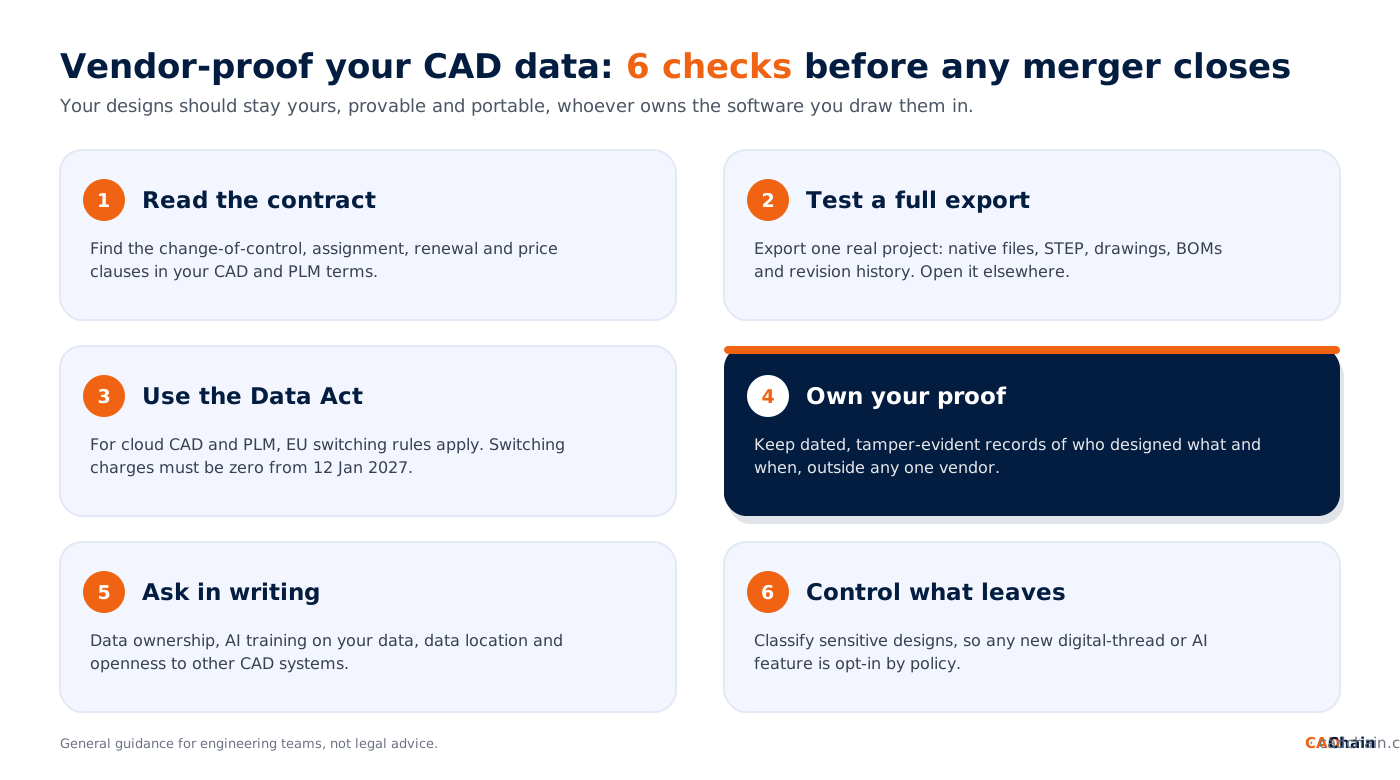
- Read the contract now. Find the clauses on change of control and assignment, the renewal dates, price-increase limits and your termination rights. Many software terms allow the vendor to transfer the contract to a new owner after a merger.
- Test a full export. Export one real project: native files, neutral formats such as STEP, drawings as PDF, bills of materials and revision history. Then open it outside the vendor's tool and check it is complete. An export you have never tested is not a plan. See our notes on neutral CAD formats like STEP and IGES.
- Know your EU Data Act rights. Cloud CAD and PLM services count as data processing services under the EU Data Act. Its switching rules have applied since September 2025, and from 12 January 2027 providers may no longer charge switching fees at all. Put these rights in writing at your next renewal.
- Keep your own proof of ownership. Record who created each important design and when, in a form that stays valid outside any vendor's system. A blockchain ownership registration gives you a dated, independent record.
- Ask the vendor in writing. Ask how customer data ownership, AI training on customer data, data location and interoperability with other CAD systems will be handled. The announcement commits only to an open approach in general terms.
- Control what leaves the company. Classify sensitive designs and set access and sharing rules, so that any new "digital thread" or AI feature is switched on by your policy, not by default. Our guide to cloud storage security for CAD files covers the basics.
How does this fit the bigger picture for CAD users?
The PTC deal is part of a wider shift. CAD vendors are moving design data into the cloud and building AI features on top of it, and the question of who controls engineering data is moving from the IT department to the boardroom.
- Autodesk announced at Autodesk University 2026 that Inventor will become a cloud-connected client of Fusion, with an AI assistant that can work on models through Inventor's APIs. We look at what that means for Inventor users in Autodesk Inventor AI after AU 2026 on borisinventor.com.
- Dassault Systèmes keeps moving SOLIDWORKS users towards its 3DEXPERIENCE platform. Our sister site covers the latest in what SOLIDWORKS 2027 means for your design data.
- AI training on creative work is now in court. In October 2026 a US judge found that a 3D artist had adequately alleged that a Sketchfab NoAI tag can count as copyright management information, although the case was dismissed for now. Read the details in the NoAI tag ruling explained for 3D artists on blendedboris.com.
Each story points in the same direction. Your design data is becoming more valuable to the companies that host it, so it pays to know exactly what you own, where it lives and how you can prove it. The same logic drives trade secret disputes like the one in our analysis of the Joby trade secret verdict, and the security duties in the Cyber Resilience Act reporting rules.
What happens next?
For customers, the most useful window is the one before closing. Renewal negotiations, export tests and internal data policies are all easier to settle while nothing is changing than after.
Conclusion
Schneider Electric's $22.6 billion bid for PTC is a bet that engineering data is one of the most valuable layers in industry. That is good news for anyone who already treats their designs as assets, and a warning for anyone who has left all of their design history, proof and access control inside one vendor's platform. Read the contract, test the exit, keep independent proof of what you designed, and decide your own rules for what leaves the company. Then it matters much less who owns the software.
Protect your CAD IP, whatever tools you use. CADChain gives engineering teams blockchain proof of ownership and file-level control for CAD files across systems.
👉 See how CADChain works
FAQ: Schneider Electric's acquisition of PTC
How much is Schneider Electric paying for PTC?
$205 per share in cash, which values PTC's equity at about $22.6 billion and the whole company, including debt, at about $23.7 billion. That is a 42.3% premium to PTC's last closing price before the announcement.
When will the Schneider Electric PTC acquisition close?
Schneider expects the deal to close by the third quarter of 2027. It still needs approval from PTC shareholders and the required regulators.
Which PTC products are included?
PTC's CAD, PLM, ALM and service lifecycle software, which includes products such as Creo, Onshape, Windchill, Arena, Codebeamer and ServiceMax. Kepware and ThingWorx are not included, because PTC sold them to TPG in March 2026.
Will Creo, Windchill or Onshape change?
Nothing changes before closing, and Schneider has not announced specific plans for products, prices or brands. Its announcement only promises an open approach across vendors and hardware.
Do I still own my designs if my CAD vendor is acquired?
Yes. Ownership of your designs does not depend on who owns the software. What can change is your practical control: hosting, export formats, switching costs and terms of service. Keep your own proof of ownership outside the vendor's system.
What does the EU Data Act mean for cloud CAD and PLM users?
Cloud CAD and PLM services fall under the Data Act's switching rules, which have applied since September 2025. From 12 January 2027 providers may not charge switching fees, which makes it easier to move your data to another provider.
Why did Schneider Electric's share price fall?
Reuters reported a fall of almost 10% on the day of the announcement, as investors weighed the high price and the new debt and shares needed to pay for it.
What should engineering managers do now?
Read the contracts, test a complete export of a real project, list your switching rights, ask the vendor in writing about data and AI policies, and keep independent, dated records of your designs.