A supplier signs an NDA, sends over its engineering drawings, 3D models and test data, and a few months later the customer asks to buy the IP. The supplier says no. Four years later a jury puts a price on what happened next: $116.9 million.
In early October 2026 a federal jury in Tampa, Florida, found eVTOL developer Joby Aero liable for breaching a 2021 nondisclosure agreement with aircraft component maker Aerosonic, and for willful and malicious misappropriation of Aerosonic's trade secrets around air data probes. According to AVweb's report on the verdict, the jury awarded about $68.6 million for the breach of contract, $29.9 million for trade secret misappropriation and $18.3 million in exemplary damages, and rejected Joby's counterclaims, including its claim that Aerosonic supplied defective probes.
Joby denies the allegations, says it developed its air data technology independently, and has asked the court to overturn a verdict it calls unsupported by the evidence. It is not a final judgment. But for anyone who builds hardware and shares design data with partners, the case is already a textbook. I run CADChain, a company whose whole product exists because engineering files leave the building every day. Here is what this verdict teaches founders, suppliers and engineering managers, and what to change in how you share drawings and models this week.
TL;DR: the Joby trade secret verdict in one paragraph
Aerosonic shared engineering drawings, 3D models, test procedures and wind-tunnel data with Joby under a 2021 NDA while supplying air data probes for Joby's flight-test aircraft. Days after receiving its first probe in April 2022, Joby asked to buy the probe IP; Aerosonic refused. Aerosonic says Joby kept asking for confidential information while developing its own probe, and pointed to a distinctive interface geometry on Joby's probe that matched its confidential design. The jury agreed and awarded about $116.9 million. Joby will challenge the verdict. The lesson for startups on both sides of an NDA: the contract matters, but the evidence that wins or loses a trade secret case lives in your files, your access logs and your engineering history.
What happened between Joby and Aerosonic
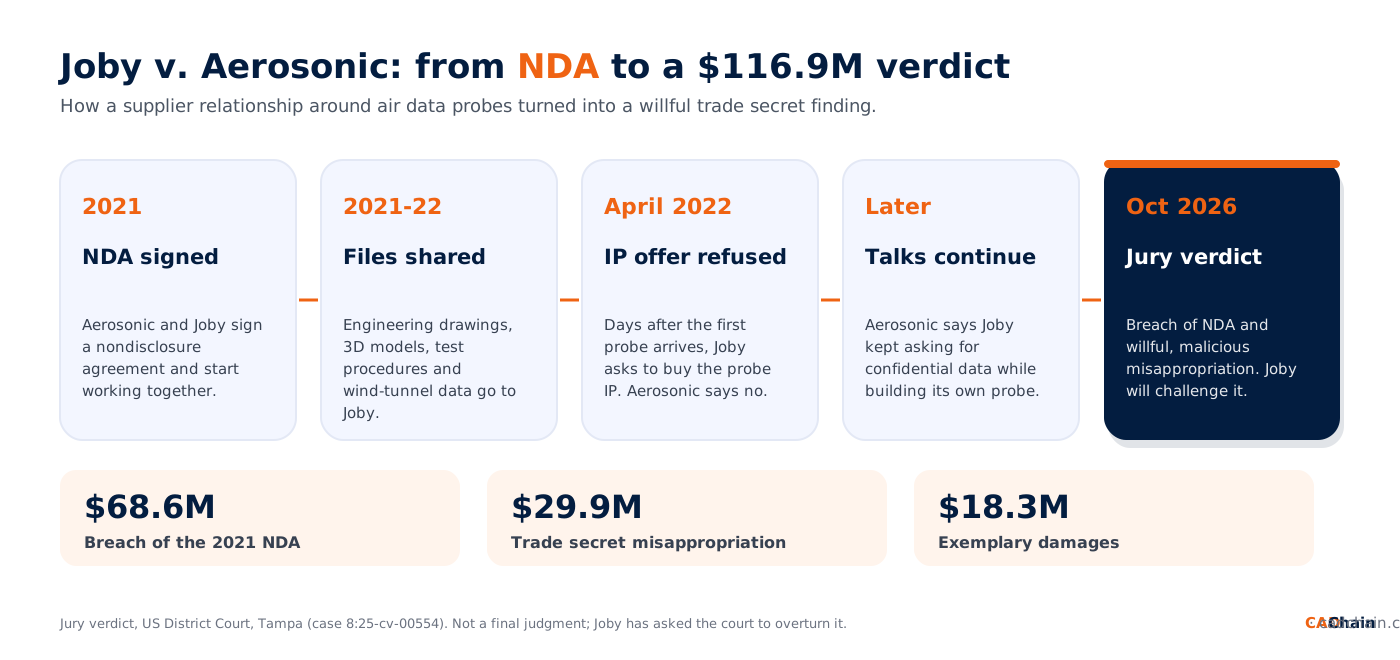
Aerosonic argued that Joby either used its materials directly or reverse-engineered the probes it bought, and pointed to one detail: a distinctive interface geometry on Joby's own probe that matched a design in Aerosonic's confidential engineering materials. That one geometric feature carried a lot of weight. In design-heavy industries, the proof of copying is often not a stolen folder but a shape, a tolerance or a test procedure that appears somewhere it should not.
Joby is also on the other side of this kind of dispute: it is pursuing its own trade secret case against competitor Archer Aviation and a former Joby employee, alleging confidential information was taken before he joined Archer. Trade secret litigation is now a normal part of competition in eVTOL, and it will be in every hardware sector where talent and suppliers move between rivals.
Why the damages are so large
Three separate numbers make up the award, and each comes from a different legal theory. Founders tend to think of an NDA breach as a contract dispute and trade secret theft as something criminal and rare. This case shows how both run in parallel.
Under the US Defend Trade Secrets Act and most state laws modelled on the Uniform Trade Secrets Act, a finding of willful and malicious misappropriation lets the court add exemplary damages and, often, attorney's fees. In Europe, the Trade Secrets Directive (EU) 2016/943 and national laws such as the Dutch Wet bescherming bedrijfsgeheimen do not do punitive damages in the same way, but they give injunctions, recall and destruction of infringing goods, and compensation. For the basics, see our trade secrets guide for deep tech startups and the legal framework for protecting CAD designs as trade secrets.
The reverse engineering question every NDA must answer
One of Aerosonic's theories was that Joby reverse-engineered the probes it bought. That point should worry every supplier. In the EU, reverse engineering a product that you lawfully acquired is a lawful way to obtain a trade secret, unless you are under a valid duty not to. That rule is in Article 3 of the Trade Secrets Directive. In practice, the only thing standing between your product and a customer's teardown lab is often one clause in your NDA or supply agreement.
- Write the restriction down. Prohibit disassembly, reverse engineering and analysis of samples and supplied parts for the purpose of designing a competing product.
- Tie samples to the NDA. State that parts delivered under the agreement are confidential information in physical form.
- Cover derivatives. Make clear that designs derived from your information belong to you or cannot be used, not only the original files.
- Plan the exit. Require return or certified destruction of files, and keep the right to audit that it happened.
We explain why contracts alone fall short in NDA limitations for CAD protection.
The evidence lives in your files
Trade secret cases are won on proof. A plaintiff has to show that the information was secret, that it took reasonable steps to keep it secret, what exactly was shared and when, and that the defendant used it. A defendant has to show independent development: who designed what, when, and from which inputs. Both sides end up reconstructing engineering history from email attachments, file shares, PDM logs and memories. Whoever has the better record usually wins.
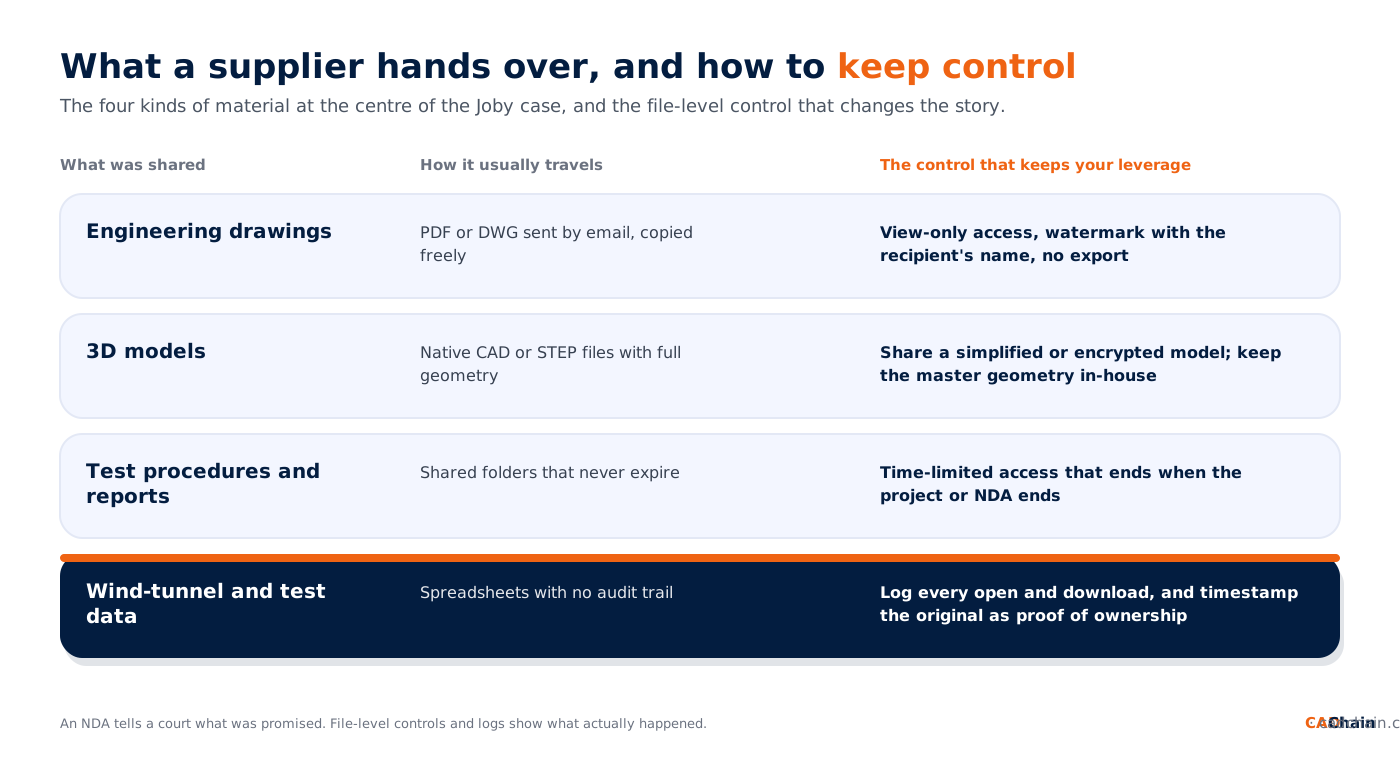
This is where CAD security stops being an IT topic and becomes a legal one. View-only sharing, watermarking of CAD geometry, time-limited file sharing and the ability to revoke access to CAD files are not only ways to prevent leaks. They are the documentation of the "reasonable steps" that trade secret law requires, and of what happened after an IP request was refused.
If you are the supplier: protect your designs before the first sample ships
- Classify before you share. Decide which drawings, models and test data are crown jewels and which are not. Share the minimum the customer needs to integrate your part.
- Send simplified geometry. Envelope models and interface drawings usually do the job. Keep the full parametric model in-house.
- Share through controlled channels. Use view-only CAD access for vendors and partners instead of email attachments, with named users and expiry dates.
- Timestamp your originals. Anchor every released version so you can prove it existed, in that form, on that date.
- Watch for the signal. A request to buy your IP that you refuse is the moment to tighten access, not to keep sending files.
- Write the NDA for engineers, not only lawyers. Cover reverse engineering, derivatives, return of files and audit rights.
If you are the customer: protect yourself from a claim like this
- Run a clean room. If you decide to build in-house what a supplier provides, separate the engineers who saw supplier data from those who design the replacement.
- Record independent development. Keep dated design history, requirements and test data for your own design, with provenance.
- Quarantine supplier files. Store them in a restricted area with access logs, and do not let them drift into your PDM or shared drives.
- Mind the timing. Asking for more confidential data after an IP purchase is refused looks bad in front of a jury, whatever the intent.
- Check new hires. The same applies to engineers joining from competitors or suppliers; see how employees accidentally leak CAD files.
What this means for European hardware startups
European founders often read a US verdict like this and think it is an American problem. It is not. Most deep tech startups in Europe sell to, buy from or co-develop with US companies, and the files cross the Atlantic in both directions. On top of that, a European court will ask the same question as a US jury: did you take reasonable steps to keep this secret? An NDA and a shared Dropbox folder will not impress anyone.
There is also a strategic choice behind this case. Aerosonic's know-how was a trade secret, not a patent. That is often the right call for manufacturing know-how and test methods, but it means your protection depends entirely on secrecy and evidence. Our comparison of trade secrets and patents for CAD designs and the 8-layer IP protection playbook help you decide which tool fits which asset. For the security side of sharing with partners, see CAD file security in supply chain collaboration and our analysis of competitor espionage tactics.
Make your NDA provable. CADChain's BORIS plugins for SolidWorks, Autodesk Inventor and Blender encrypt and certify CAD files inside the tools your engineers already use, control who can open them and for how long, and keep a tamper-proof record of every version and every access. If a partner relationship ends in a dispute, you have the evidence, not just the contract.
👉 Protect your CAD files with CADChain
Mistakes this case exposes
- Treating the NDA as the protection. It is the rulebook. The protection is what you do with the files.
- Sharing full models when an interface drawing would do. Every extra detail you send is a detail you may have to defend.
- No record of what was shared. Reconstructing three years of attachments for litigation is slow, expensive and incomplete.
- Ignoring the IP purchase request. A refused offer changes the relationship. Access policies should change with it.
- No clean room on the buyer's side. Independent development is a defence only if you can prove it.
What happens next
Joby has asked the court to set aside or reduce the verdict, and can appeal after that. The final numbers may change, and the facts will be argued again. Whatever the outcome, the pattern is already clear: shared engineering data, a refused IP deal, a competing in-house design and a jury looking for evidence in files and emails. If you share CAD data with anyone, plan for the day you might need to prove what you sent, to whom and when. Our guide to malicious CAD files covers the other side of the same coin: what can come back in through the files you receive. And the Cyber Resilience Act reporting guide explains the new EU duties for anyone selling software or connected hardware.
This article reflects public reporting on the verdict as of 13 October 2026. It is general information, not legal advice.
FAQ: the Joby trade secret verdict
What was the Joby trade secret verdict about?
A federal jury in Tampa, Florida, found that Joby Aero breached a 2021 nondisclosure agreement with Aerosonic and willfully and maliciously misappropriated Aerosonic's trade secrets related to air data probes, including engineering drawings, 3D models, test procedures and reports, and wind-tunnel data.
How much was Joby ordered to pay?
About $116.9 million in total: roughly $68.6 million for breach of the NDA, $29.9 million for trade secret misappropriation and $18.3 million in exemplary damages. The verdict is not a final judgment, and Joby has asked the court to overturn it.
Does Joby accept the verdict?
No. Joby denies the allegations, says it developed its air data technology independently, and plans post-trial motions and an appeal.
What are exemplary damages in a trade secret case?
Extra damages a court can award when misappropriation is willful and malicious. Under the US Defend Trade Secrets Act they can be up to twice the damages awarded for the misappropriation itself.
Is reverse engineering a supplier's part legal?
Often yes, if you lawfully acquired the part and are not under a contractual duty that forbids it. In the EU this is set out in the Trade Secrets Directive. That is why NDAs and supply agreements should explicitly prohibit reverse engineering of samples and supplied parts.
What counts as reasonable steps to protect a trade secret?
Courts look at the whole picture: confidentiality agreements, but also access control, marking, limiting who can see what, logging access and having policies people actually follow. File-level controls on CAD data are strong evidence of reasonable steps.
How can a startup prove it developed a design independently?
Keep dated design history, requirements, calculations and test data, separate engineers who saw third-party data from those designing a competing part, and timestamp versions so you can show what existed when.
What should I change in how I share CAD files with partners?
Share the minimum geometry needed, use view-only or encrypted sharing with named users and expiry, watermark drawings, log every access, timestamp your originals and tighten access as soon as a relationship changes.