On 10 November 2026, the security firm Claroc reported that it could open 35,578 apps built with Grok Build, the vibe-coding agent of SpaceXSI, without signing in. That is 94.7% of the 37,571 Grok apps it found online. About one in ten held internal business or personal data, including data from two defence organisations, and 24 of the open apps had been built by SpaceXSI and X staff themselves.
Grok Build turns a description typed or spoken into a chat into a working web app, and lets the user publish it at its own address on grok.me. Each address is made of four random words, which looks like a secret. Claroc showed that it is not: the names end up in passive DNS databases, which anyone with an account can search. Combined with a publish dialog that, in Claroc's paid test account, preselected "Anyone with the link", that turned thousands of internal tools into public web pages.
This matters well beyond one AI product. Engineering teams are among the keenest users of AI app builders: a project manager turns a supplier spreadsheet into a dashboard, a test engineer builds a results viewer, a sales engineer builds a quote calculator with real margins in it. None of these apps goes through IT, and few have an owner who checks who can open them. For founders, engineering managers and IP lawyers, the Grok case is a clear warning that the new route for leaking design data and trade secrets is not a hacker, but a share button.
TL;DR: thousands of AI-built internal apps were readable by anyone
Claroc found 35,578 Grok Build apps that opened without sign-in. About one in ten held sensitive internal or personal data, and Claroc estimates 650 to 800 hold data it rates high or critical. Thirty organisations were identified, six of them Fortune 500 companies, across construction, energy and defence. SpaceXSI took down its own 24 staff apps on 10 November but, as of 12 November, had not been reported to have changed the default for other users. Lesson for engineering teams: treat AI app builders as a publishing channel, find the apps your people have built, and protect design files so that a link shared by mistake does not hand over your IP.
What did Claroc find?
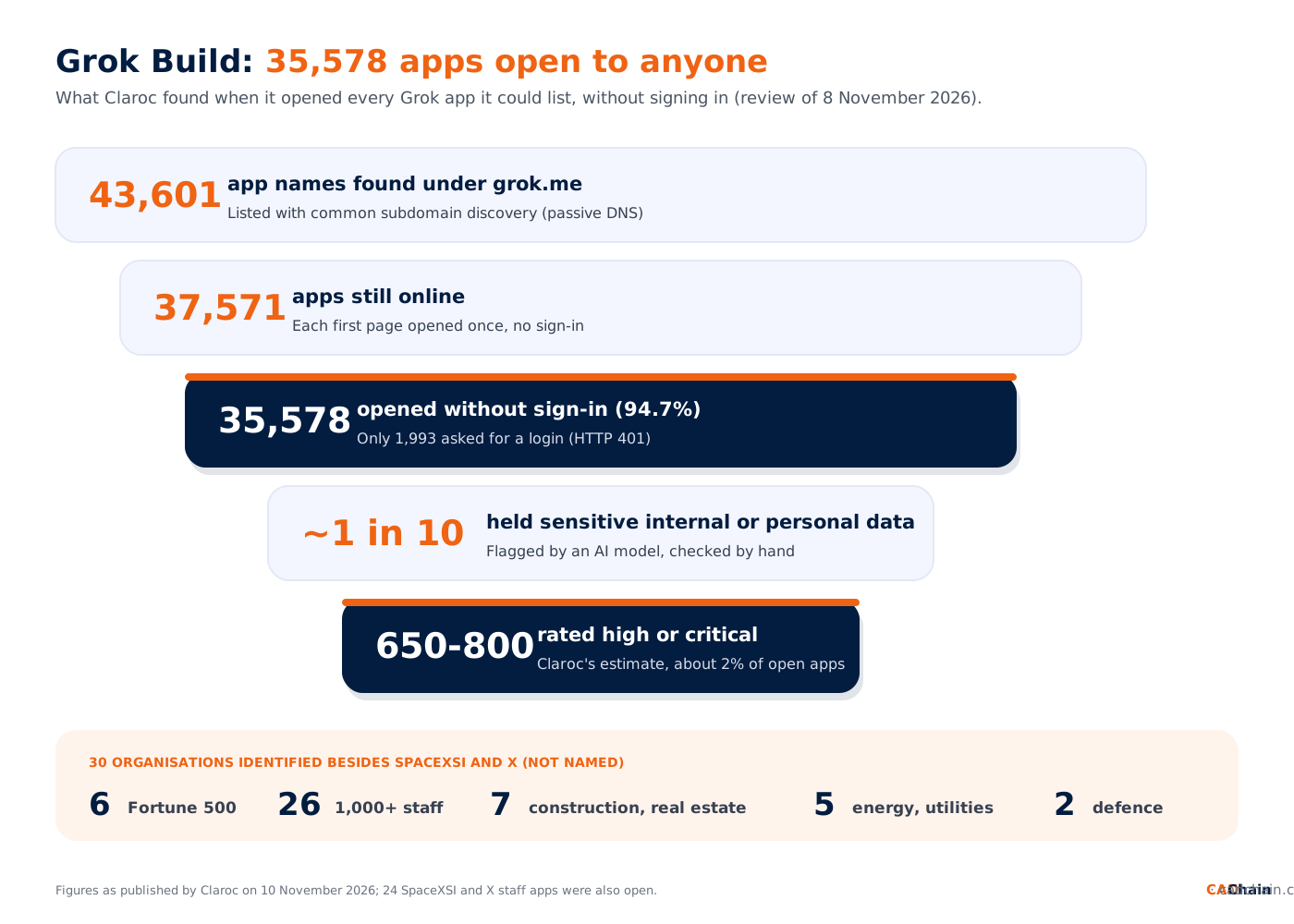
Claroc published its findings as GhostShares 2, written by co-founder and CTO Asaf Aprozper. The team used common subdomain discovery techniques to collect 43,601 names under grok.me. It opened the first page of each app once, without signing in, and read saved copies offline. Of the 37,571 apps that were still online, 35,578 opened for anyone and 1,993 asked for a login.
Most open apps were harmless: games, landing pages and calculators. But an AI model flagged likely private pages, the researchers checked them by hand, and they concluded that about one in ten open apps held sensitive internal or personal data. Roughly 2% were rated high or critical, which Claroc puts at 650 to 800 apps.
Besides SpaceXSI and X, the researchers identified 30 organisations whose internal data was exposed. Twenty-six have more than 1,000 employees and six are Fortune 500 companies. Seven are in construction and real estate, five in energy and utilities and two in defence. Claroc has not named them. Ars Technica, which reported the research, described a roster of 108 people on a US Navy logistics support contract held by a ship engineering contractor, and a Peruvian construction company's dashboard with 3,784 worker medical examinations.
Other examples in the report include an intensive care patient's lab values, a hospital group's roster of more than 3,500 staff, a fire department's shift board and a contractors' timesheet app whose code, downloaded by every visitor's browser, held plain-text passwords for 18 accounts. SpaceXSI's own staff apps exposed a confidential onboarding plan for an enterprise sales hire, a territory map of 594 strategic accounts, internal system addresses and eight advertising proposals, one of them to a US federal agency and marked confidential.
How could anyone find apps with secret addresses?
The design looked safe on paper. Each Grok app gets its own hostname, such as four-random-words.grok.me, and only people with the exact address were supposed to find it. The problem is where the secret sits. When a browser opens an app, it first asks the domain name system where the hostname lives, and passive DNS services record those lookups. Anyone with access to such a service can list the names under grok.me. Claroc notes that shared chats in Claude, ChatGPT and Gemini keep their secret part in the path of the URL, which DNS never sees.
The second problem was the default. In the paid account Claroc used, the publish screen proposed "Anyone with the link" as the access setting, with "Invited users" and "Only you" as alternatives. Most people accept defaults. A test app built in ChatGPT, by contrast, defaulted to "Only me". As Aprozper put it in the report: "AI app builders turned publishing into a few clicks, and the default answer to who can see it is everyone."
The third problem is the code the AI writes. In one of Claroc's own test apps, a team customer list with Google and X sign-in, the generated code added every signed-in user to the team before checking whether they were a member. An outside Google account could then read, edit and delete records. Another test app had a database and no login at all, so anonymous visitors could add entries. Claroc says it only wrote to or deleted data in apps it had built itself.
What did SpaceXSI say, and what has changed?
Claroc reported the issue to SpaceXSI on 8 November through its security contact and flagged the remaining staff apps on 9 November. On 10 November, after questions from Ars Technica, SpaceXSI took down the 24 apps built by SpaceXSI and X staff. It did not take down other users' apps. According to Claroc, SpaceXSI had not replied to the report itself, and the researchers began notifying affected organisations directly.
SpaceXSI said apps stay private until their creator shares them, that publishing takes several steps including a legal notice, and that employee accounts start on "Only you". A representative of Cursor, which SpaceX bought in August, told Ars Technica: "Apps are private by default and nothing goes public unless the creator chooses to share it." Claroc's answer is that the owners of 35,578 open apps did go through those steps, and that the 24 staff apps show a stricter default for employees was not enough. As of 12 November, no change to the default for ordinary users had been reported.
Grok is not alone. The Cursor representative pointed out that ChatGPT, Lovable and Bolt also offer shareable links, and Aprozper said Lovable, Bolt and Replit also create addresses that DNS can reveal, while adding that Grok is where Claroc found by far the most sensitive company data. In October, Claroc found about 6,800 shared items from Meta's Muse agent the same way, and Meta paused sharing. A Cloud Security Alliance research note lists earlier cases at Lovable and Base44 and calls the pattern public by default. In July, Grok Build was also reported to have uploaded whole Git repositories to the company's servers without asking.
Why does this matter for engineering data and IP?
Engineering companies run on small internal tools. Before AI app builders, they lived in spreadsheets on a file server. Now a project engineer can turn the same spreadsheet into a polished web app in an afternoon, with a database behind it and a link to share with a supplier. The data inside does not change: bills of materials, supplier prices, test results, customer project lists, drawing numbers, sometimes the drawings themselves. What changes is where it lives and who can reach it.
Trade secret law makes that a legal question, not only a security one. Under the EU Trade Secrets Directive, information is only protected if its holder took reasonable steps to keep it secret, as our trade secrets guide for deep tech startups explains. An internal app that anyone on the internet can open is hard to defend as a reasonable step. If the app holds personal data, such as staff rosters or customer contacts, an exposure can be a personal data breach under the GDPR, with a 72-hour notification clock. Customer NDAs often forbid putting their drawings on unapproved third-party services at all, and our article on why NDAs are not enough for CAD protection shows how little an NDA helps once data is out.
For defence and dual-use suppliers there is a fourth layer. Technical data for controlled items cannot simply be placed where foreign persons can read it, so a public app can also become an export control question. Our guide to aerospace CAD file security for defence contractors covers those requirements. The two defence organisations in Claroc's data are a reminder that this is not hypothetical.
Keep design files protected wherever a link ends up. CADChain encrypts CAD files at file level, lets you grant and revoke access per user and per partner, logs every access and records ownership on a blockchain, so a file shared through the wrong channel still cannot be opened without permission.
👉 See how CADChain protects CAD files
What are the weak points in an AI-built app?
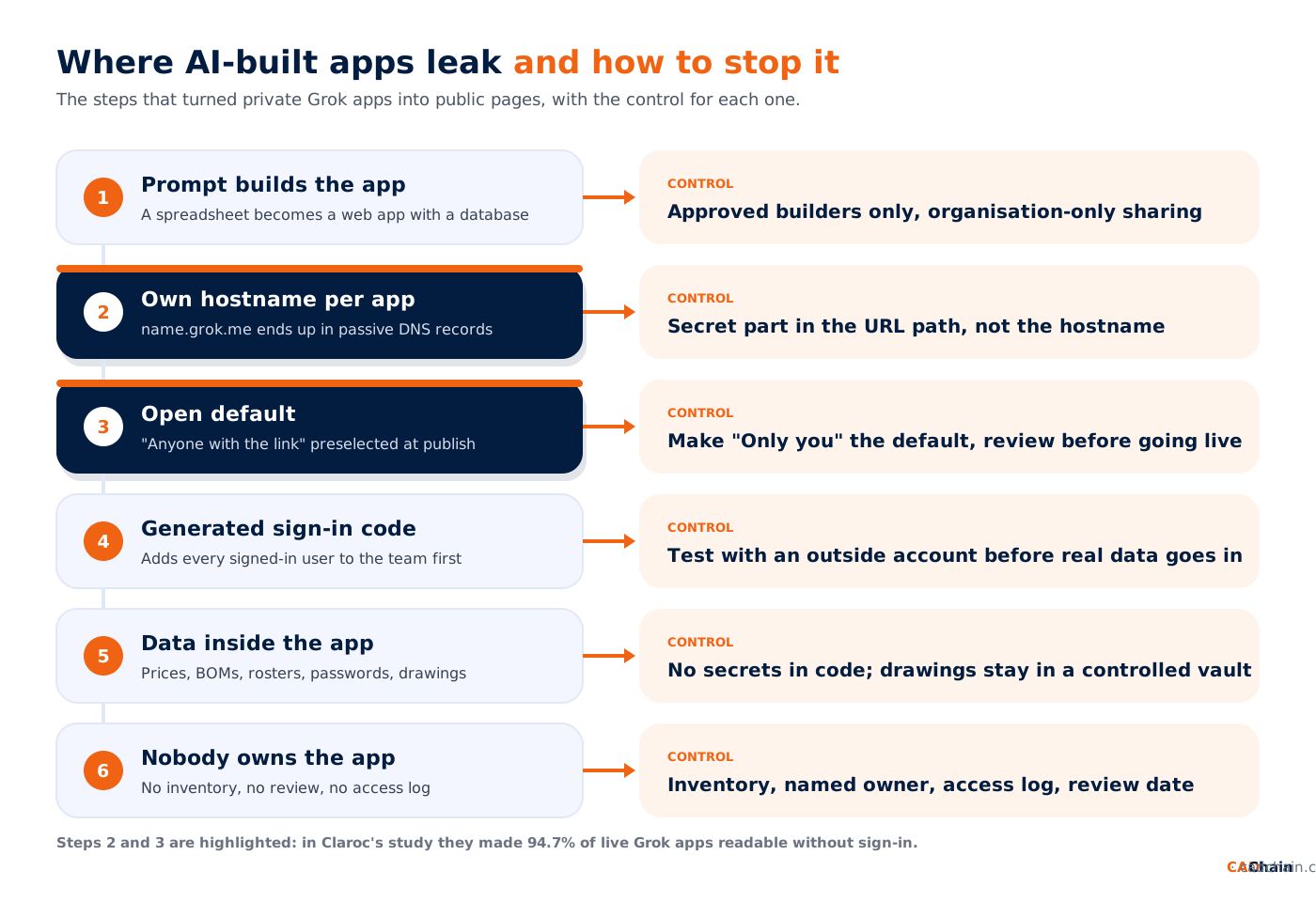
The Grok case shows three separate failures that engineering teams should look for in any AI-built tool, not just Grok: an address that is easier to find than it looks, a sharing default that is too open, and sign-in code that looks right but does not check permissions properly. Each has a simple control.
What should engineering teams do now?
- Find the apps your people have built. Ask teams which AI app builders they use, and search for apps under builder domains that can be traced to your company. Check each one from a browser that is not signed in.
- Close what is open. Switch exposed apps to invited users or "Only you", or unpublish them, then confirm that an outside visitor gets an error.
- Rotate anything that was inside. Look for passwords, API keys and server addresses in app code and data, and change them. Our article on secrets leaking through AI coding tools shows how often they end up in the wrong place.
- Decide which tools may hold which data. Approve a short list of builders for internal data, with organisation-only sharing, and ban design files, customer drawings and export-controlled data from all of them.
- Test sign-in with an outside account. Before an AI-built app holds real data, try to open, edit and delete records with an account that should not have access.
- Keep design files in controlled systems. Drawings and models belong in a vault with access control and file-level CAD encryption, not in an app database or a public link. Our complete guide to CAD file security explains the options.
- Log access and review it. You can only show what was exposed, and to whom, if you record it. See how to audit CAD file access.
- Train people on sharing. Most leaks are accidental. Our list of ways employees accidentally leak CAD files now needs one more entry: the AI app with a public link.
How does this fit the bigger picture?
AI tools are becoming a regular route for business data to leave the company, and our sister sites covered other cases this week:
- AI chat transcripts exposed through a supplier. Notion said a breach at its AI provider Fireworks AI exposed AI chat transcripts from fewer than 1% of workspaces. Solidboris.com explains what the Notion AI breach means for SOLIDWORKS teams and what engineers type into AI tools.
- Stolen logins from infected PCs. Europol announced a new Operation Endgame phase against Gootloader, CastleRAT and StealC on 12 November. BORIS Inventor covers what Operation Endgame means for Inventor workstations and logins.
- AI and creators' rights. Indonesia's parliament heard Google, Meta and TikTok on a draft copyright law with AI rules on 11 November. Blended BORIS explains what the Indonesia AI copyright bill means for Blender artists.
The common thread is that data leaves through tools people trust. Our articles on generative AI and CAD IP and on cloud storage security for CAD files look at both sides of that trade-off, and sharing CAD files with contractors covers the safe way to give partners what they need.
Conclusion
Nobody hacked the Grok apps in Claroc's study. Their owners published them, the platform made the open setting the easy choice, and the addresses were easier to find than anyone assumed. The result was internal plans, staff data and passwords readable by anyone, at SpaceXSI itself and at 30 other organisations, including defence suppliers.
For engineering companies, the fix is not to ban AI app builders, which people will keep using anyway. It is to know which apps exist, make private the default, keep secrets out of app code, and keep drawings and models in systems where access is controlled at file level, so that one wrong click on a share button does not become a loss of the know-how behind your product.
Make leaked design files useless and your ownership provable. CADChain gives every CAD file a verifiable ownership record, file-level encryption, granular permissions you can revoke at any time and a full access log, across CAD systems, suppliers and partners.
👉 Protect your CAD files with CADChain
FAQ: Grok Build data leak
What is Grok Build?
Grok Build is SpaceXSI's vibe-coding agent. It turns a description typed or spoken into a chat into a working web app, which the user can publish at its own address on grok.me.
What did Claroc find?
In a review on 8 November 2026, published on 10 November, Claroc found 37,571 live Grok apps, of which 35,578 (94.7%) opened without sign-in. About one in ten held sensitive internal or personal data, and Claroc estimates 650 to 800 hold data it rates high or critical.
Whose data was exposed?
Claroc identified 30 organisations besides SpaceXSI and X, including six Fortune 500 companies, seven in construction and real estate, five in energy and utilities and two in defence. It has not named them. Twenty-four apps built by SpaceXSI and X staff were also open.
How were the apps found?
Each app has its own hostname under grok.me. Hostnames are recorded by passive DNS services when apps are visited, so the supposedly secret addresses could be listed. In Claroc's paid test account, the publish screen also preselected "Anyone with the link".
Has SpaceXSI fixed it?
SpaceXSI took down its 24 staff apps on 10 November. It says apps are private until shared and that employee accounts default to "Only you". As of 12 November, no change to the default for other users had been reported, and most other open apps were still reachable.
Are other AI app builders affected?
Claroc says Lovable, Bolt and Replit also create addresses that DNS can reveal, and it found shared items from Meta's Muse the same way in October. It found the most sensitive company data on Grok. A ChatGPT test app defaulted to "Only me".
What should engineering teams do?
Find the AI-built apps your people use, close or restrict the open ones, rotate any secrets inside them, approve a short list of builders, test sign-in with an outside account, keep design files out of app databases, log access and train people on sharing.
How does CADChain help?
CADChain encrypts CAD files at file level, so a drawing or model shared through the wrong channel cannot be opened without permission. It also logs every access and records ownership on a blockchain. It works alongside good sharing settings and app governance, not instead of them.