TL;DR: trade secrets in 60 seconds
A trade secret is any confidential business or technical information, such as a process, formula, design file, algorithm, model weights or customer list, that is valuable because competitors don't know it and that you protect with reasonable secrecy measures. There is no registration, no fee and no expiry date: protection lasts as long as the secret does.
For early-stage deep tech startups, trade secrets are usually the best first line of IP protection. They are cheap, immediate, cover things patents can't (process recipes, parameters, training data, negative know-how) and never publish your invention. The catch: the law only protects you if you can prove what the secret was, when you had it and that you took reasonable steps to keep it secret. This guide shows you exactly how, with the data, the law in the EU and US, the biggest cases and a 10-step program you can start this week.
Key takeaways
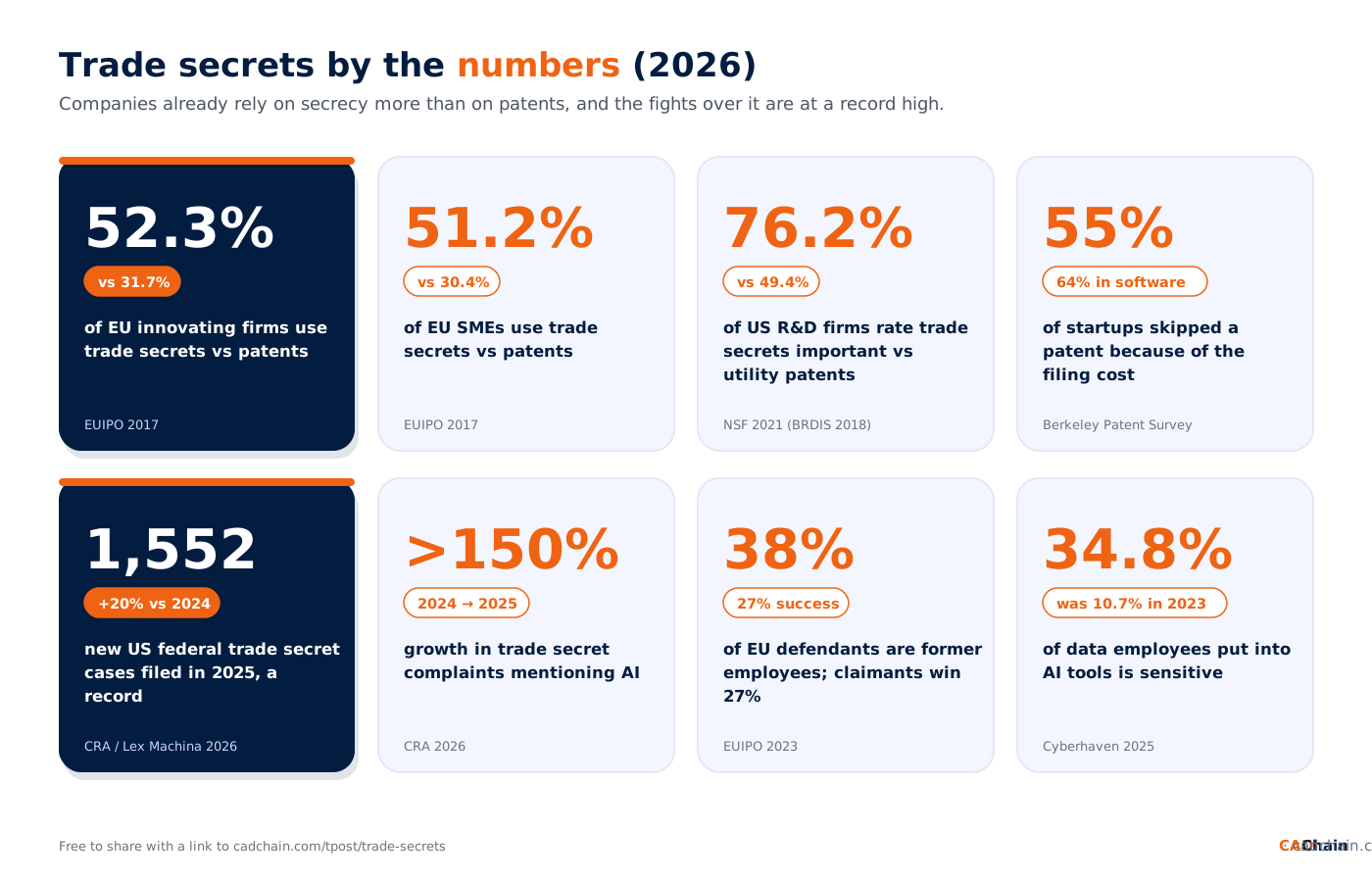
- Companies already rely on secrecy more than on patents: 52.3% of innovating EU firms use trade secrets versus 31.7% that use patents (EUIPO, 2017).
- The rules are almost identical worldwide: information that is secret, valuable because it is secret and protected by reasonable steps (EU Directive 2016/943, US DTSA, TRIPS Art. 39).
- Trade secret litigation hit a record 1,552 new US federal cases in 2025, up 20% in a year, and complaints mentioning AI grew more than 150% (CRA, 2026).
- Most leaks are people, not hackers: 38% of defendants in EU trade secret cases are former employees (EUIPO, 2023).
- The best startup strategy is usually hybrid: keep the invisible core (process, data, weights, tolerances) secret and patent only what competitors can see or reverse engineer.
What is a trade secret?
A trade secret is confidential information that has commercial value because it is secret, and that its owner protects with reasonable measures. It can be technical (a manufacturing process, a CAD design, source code, model weights) or commercial (customer lists, pricing, supplier terms). Unlike a patent, it is not registered anywhere and it never expires, as long as it stays secret.
The legal definitions in the main markets say the same thing in slightly different words:
- European Union: Directive (EU) 2016/943, Article 2(1), protects information that is secret, has commercial value because it is secret, and "has been subject to reasonable steps under the circumstances, by the person lawfully in control of the information, to keep it secret".
- United States: the Defend Trade Secrets Act (18 U.S.C. §1839(3)) covers "all forms and types of financial, business, scientific, technical, economic, or engineering information" if the owner took reasonable measures and the information derives independent economic value from not being generally known.
- International: TRIPS Article 39(2) sets the same three-part test for all WTO members, which is why the EU, US, UK, Japan and China all look alike on the basics.
Are trade secrets intellectual property?
Yes, in practice, but they are not an exclusive right like a patent. A patent stops everyone from using your invention, even someone who invents it independently. A trade secret only protects you against people who obtain, use or disclose it unlawfully: by theft, breach of contract or breach of confidence. If a competitor invents the same thing on its own or reverse engineers a product it bought legally, that is allowed (EU Directive Art. 3). That trade-off is the heart of every trade secret vs patent decision.
Trade secrets are one of several IP rights, alongside patents, trademarks, copyright and design rights. For the full picture and how they fit together, see our intellectual property law guide.
The 3 requirements for trade secret protection
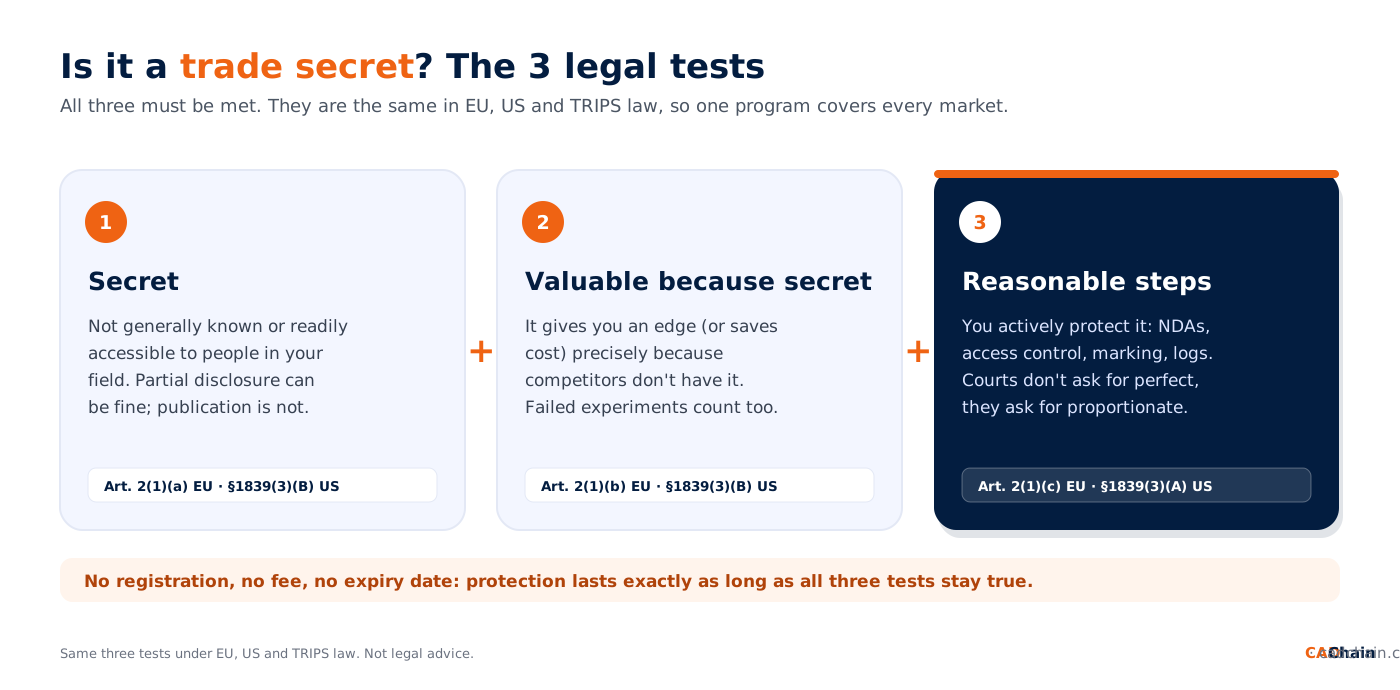
To be protected, information must meet all three tests at the same time. Lose one and you lose the protection.
- It is secret. Not generally known or readily accessible to people in your field. Sharing it with employees, suppliers or partners under confidentiality does not destroy secrecy; publishing it, presenting it at a conference or filing it in a patent application that gets published does.
- It has commercial value because it is secret. It gives you a competitive edge, saves you money or time, or would help a competitor. This includes negative know-how: the 200 experiments that failed are valuable precisely because a competitor would have to repeat them.
- You take reasonable steps to keep it secret. NDAs, access controls, marking, logging, training. Courts look for proportionate, layered measures, not perfection. This is the requirement startups most often fail. The 2026 Joby verdict shows what that costs when it goes wrong: see our Joby trade secret verdict breakdown.
Some US sources talk about "four elements" of a trade secret claim. That usually means the three requirements above plus misappropriation, i.e. that someone acquired, used or disclosed the secret by improper means. You need all four to win in court; you need the first three to own a trade secret at all.
Types of trade secrets
The EU's own litigation data shows how broad this is: in about 700 EU trade secret judgments analysed by the EUIPO, 62% of disputes concerned commercial information and 33% technical information (EUIPO, 2023). For deep tech startups the balance is usually the other way around: the crown jewels are technical.
Trade secret examples
Famous examples
- Coca-Cola's formula. Created in 1886 and never patented, because a patent would have expired and published the recipe. Coca-Cola says the formula was kept in a bank vault for more than 86 years before moving to a purpose-built vault at the World of Coca-Cola in Atlanta in December 2011.
- KFC's 11 herbs and spices. The handwritten recipe sits in a safe at the Louisville headquarters, and different suppliers each blend only part of the mix, so no single supplier knows the whole recipe. That compartmentalisation is a textbook "reasonable step".
- OpenAI's GPT-4. The technical report states that "given both the competitive landscape and the safety implications" it contains no details about the architecture, model size, hardware, training compute or dataset construction. That is a trade secret strategy in a single sentence.
- SpaceX. Elon Musk told Wired in 2012: "We have essentially no patents in SpaceX... If we published patents, it would be farcical, because the Chinese would just use them as a recipe book." SpaceX now holds around 100 patent families, but its launch technology is still protected mainly by secrecy (Mathys & Squire, 2026).
- TSMC. The world's leading chipmaker runs a formal Trade Secret Registration System. By 2022 it had registered more than 240,000 trade secrets, according to its annual report.
Deep tech examples by sector
What is NOT a trade secret?
- Public or easily found information: anything in a publication, a patent, a product manual or a conference talk.
- What anyone can learn from your product. If a competitor can buy your device and reverse engineer it, that knowledge is not protected unless a contract forbids reverse engineering (EU Directive Art. 3(1)(b)).
- An employee's general skill, knowledge and experience. Engineers can take their expertise to a new job; they cannot take your files, recipes or customer lists.
- Secrets you didn't protect. If you shared it freely, without NDAs or access limits, courts will usually say it wasn't a trade secret to begin with.
Trade secrets vs patents vs copyright vs NDAs
Why trade secrets are the best IP strategy for early-stage deep tech startups
Patents are the IP tool founders hear about first. For most pre-seed and seed deep tech companies, trade secrets are the better first move. Here is why, backed by data.
1. They cost almost nothing and start working today
In the largest survey of US tech startups, the Berkeley Patent Survey of 1,332 companies, 55% said the cost of filing was a reason they had not patented their last major innovation; in software it was 64%. The average out-of-pocket cost of their most recent patent was more than $38,000, in 2008 dollars (Graham et al., Berkeley Technology Law Journal). Renewal fees alone for a Unitary Patent add up to €35,555 over 20 years (EPO). A trade secret costs the hours you spend running a sensible program.
2. Patents are slow; your runway is not
The wait for a first decision at the US Patent Office rose 39% to 20.5 months by January 2025, from 14.8 months at the end of 2020 (USPTO FY2025 Agency Financial Report). At the EPO, examination alone takes on average 24.2 months to grant (EPO). A seed-stage company may pivot twice in that time. A trade secret protects the version of the technology you actually have, today.
3. A patent publishes your recipe, even if it is never granted
Patent applications are published about 18 months after filing (EPC Art. 93; 35 U.S.C. §122(b)). If the application is later refused or abandoned, competitors still got the recipe for free. For process innovations that a competitor cannot see in your product, that is a bad trade. In the Berkeley survey, 59% of biotech startups said they skipped a patent because they did not want to disclose the information, and 49% said trade secrecy was adequate.
4. Much deep tech is hard to patent anyway
Software, AI models, simulations and data-driven process tweaks face serious patentability hurdles: the Alice test in the US and the "technical character" requirement at the EPO. Model weights, training data, hyperparameters and process windows are usually not patentable at all. Trade secret law covers them all, as long as you keep them secret.
5. That is how innovative companies actually behave
Across the EU, trade secrets are used by 51.2% of innovating SMEs versus 30.4% for patents (EUIPO, 2017). In the US, 76.2% of companies doing R&D rate trade secrets as very or somewhat important, against 49.4% for utility patents (NSF, 2021). The EUIPO found trade secrets are preferred "by most types of companies, in most economic sectors and in all Member States", especially for process and service innovation.
When patents are the better choice
A credible IP strategy is balanced, so here is the other side. Patents win when:
- Your product reveals the invention. If a competitor can buy and reverse engineer it, secrecy gives no protection.
- You need to raise money. A first patent increases a startup's chance of VC funding within three years by 47% (Farre-Mensa, Hegde & Ljungqvist, Journal of Finance, 2020). Notably, a second patent showed no significant additional effect, so one well-chosen patent captures most of the signal.
- You plan to license the technology or operate in regulated sectors where disclosure is required anyway (medtech, pharma).
- Someone else may invent and patent it. A trade secret gives no exclusivity. Prior-user rights may let you keep using your invention, but they are national, narrow and depend on dated evidence.
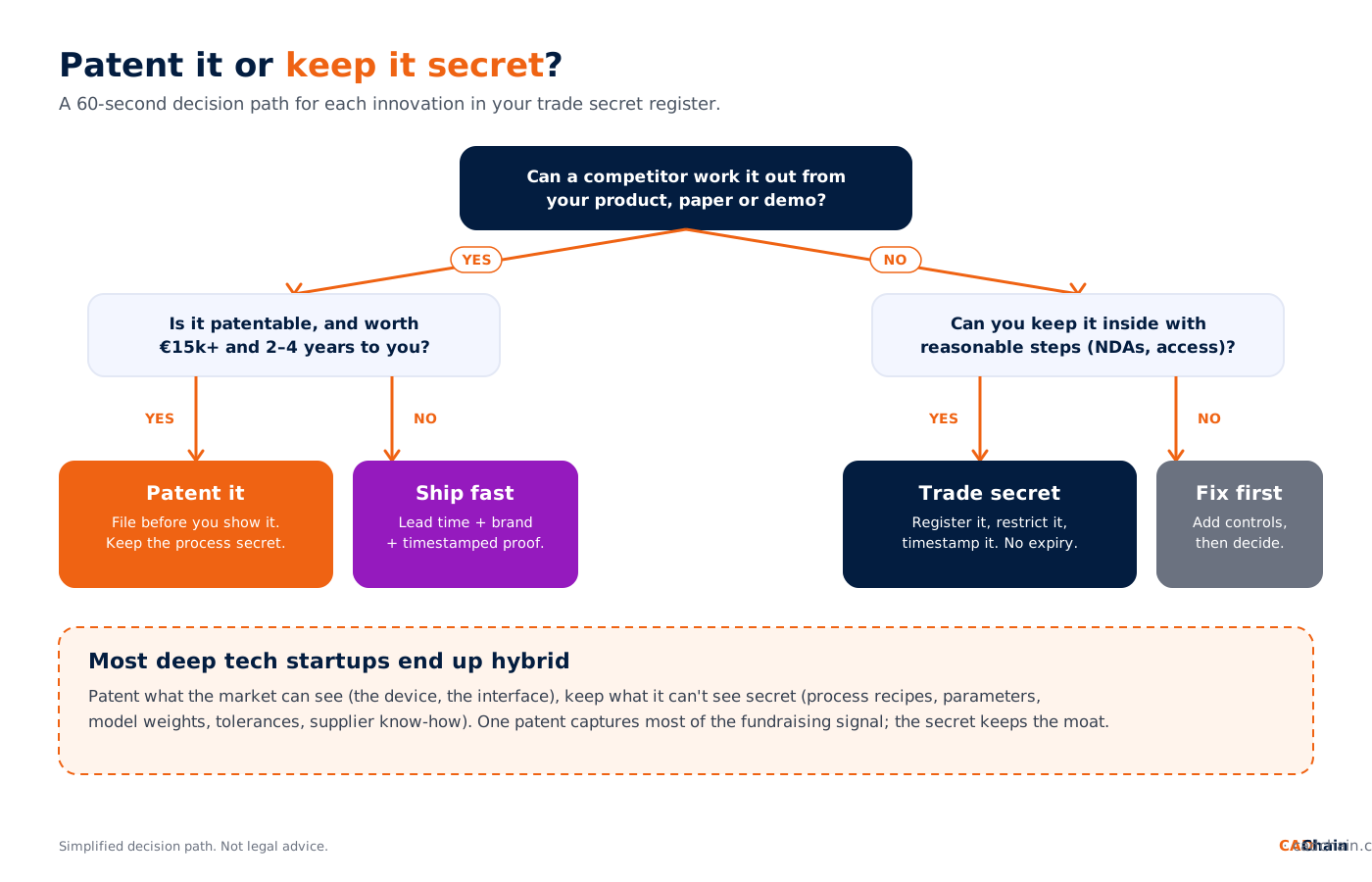
The hybrid playbook most deep tech startups end up with: patent what the market can see (the device, the interface, the core claim investors want to see protected) and keep what it can't see as trade secrets: process recipes, parameters, tolerances, model weights, datasets and supplier know-how. Paul Graham put the patent side bluntly: "The only real role of patents, for most startups, is as an element of the mating dance with acquirers."
Trade secret statistics (2026)
Use these figures freely, with a link to this page as the source.
A note on the big number: the widely quoted $180–540 billion figure comes from proxy modelling, not measured losses, and economists have criticised it. Treat it as an order of magnitude, not a fact. The litigation and usage figures above are measured data.
Trade secret law around the world
European Union: the Trade Secrets Directive
Directive (EU) 2016/943 harmonised trade secret protection across the EU, with a transposition deadline of 9 June 2018. Key points for startups:
- Definition (Art. 2): the three tests above.
- Lawful acquisition (Art. 3): independent discovery, and "observation, study, disassembly or testing" of a product that is publicly available or lawfully held, unless a contract says otherwise. Put reverse-engineering bans in your supplier and customer contracts.
- Unlawful acquisition, use and disclosure (Art. 4): including third parties who knew or ought to have known the information was obtained unlawfully, and products that benefit significantly from a stolen secret ("infringing goods").
- Exceptions (Art. 5): whistleblowing in the public interest, freedom of expression, and disclosure to workers' representatives.
- Limitation period (Art. 8): set by each Member State, but no longer than 6 years.
- Confidentiality in court (Art. 9): courts can restrict access to the secret during proceedings, so suing doesn't force you to publish it.
- Remedies (Arts. 10–14): provisional measures, injunctions, recall and destruction of infringing goods, and damages (or a lump sum based on a hypothetical licence fee).
The Netherlands
The Directive is implemented by the Wet bescherming bedrijfsgeheimen (Wbb), in force since 23 October 2018, with procedural rules in Articles 1019ia–1019ie of the Code of Civil Procedure. Dutch courts have accepted confidentiality clauses and splitting work between contractors as reasonable measures, and rejected claims where information was shared with third parties without reservation. German courts are stricter still: in 2024 the Federal Labour Court held that blanket "catch-all" confidentiality clauses are void and do not count as appropriate measures. Name what is secret.
United States: DTSA, UTSA and criminal law
- Defend Trade Secrets Act (2016): federal civil claims, a 3-year limitation period from discovery, exemplary damages of up to 2x for wilful and malicious misappropriation, attorney fees, and civil seizure "in extraordinary circumstances".
- Whistleblower notice (18 U.S.C. §1833(b)): every agreement with an employee, contractor or consultant that covers confidential information must include a notice of whistleblower immunity (or refer to a policy that does). Without it you cannot recover exemplary damages or attorney fees from that person.
- No injunction based on knowledge alone: the DTSA does not let you stop someone taking a new job merely because of what they know; you need evidence of threatened misappropriation.
- State law: almost every state has adopted the Uniform Trade Secrets Act; New York relies on common law. The DTSA does not replace state law.
- Economic Espionage Act (1996): theft of trade secrets is a federal crime (up to 10 years in prison), and up to 15 years when it benefits a foreign government.
United Kingdom, China and Japan
- UK: the Trade Secrets (Enforcement, etc.) Regulations 2018 implement the Directive alongside the common-law action for breach of confidence. Limitation is 6 years in England and Wales.
- China: the 2019 Anti-Unfair Competition Law amendment introduced punitive damages of 1–5x for malicious infringement, raised statutory damages to RMB 5M and shifted part of the burden of proof to defendants.
- Japan: the Unfair Competition Prevention Act requires information to be "managed as secret", useful and not publicly known. The "managed as secret" test is the one most often litigated.
For a country-by-country overview of the wider IP rules that apply to design data, see IP protection laws by country.
Trade secret misappropriation: what counts and what doesn't
Misappropriation means acquiring, using or disclosing a trade secret without consent and in breach of law, contract or good faith. Typical scenarios:
- An engineer downloads design files or code before leaving for a competitor or starting a company.
- A partner, investor or acquirer uses information shared under NDA during due diligence or a pilot.
- A supplier or contract manufacturer reuses your drawings or process for another customer.
- A competitor hires your people in order to get your know-how, and uses it.
What is not misappropriation: independent development, reverse engineering of a lawfully bought product (unless your contract prohibits it), and an employee using their general skills. Hiring a competitor's engineer is not unlawful in itself: in 2026 a US court dismissed xAI's trade secret claims against OpenAI, holding that hiring people and asking about their past work did not plausibly show the new employer induced misappropriation.
Departing employees, non-competes and the AI talent war
People are the main leak path. In the EU, 38% of trade secret defendants are former employees (EUIPO, 2023). Non-competes are becoming less useful at the same time. The US FTC's nationwide ban was set aside in 2024 and the FTC dropped its appeal in 2025, but California, Minnesota, North Dakota, Oklahoma and Wyoming ban most non-competes, and the Netherlands is preparing a bill to cap them at 12 months with mandatory compensation. With non-competes weaker, trade secret protection becomes your main legal defence when someone leaves. See also our guides to employee IP agreements and preventing former employee IP theft.
Remedies, damages and deadlines
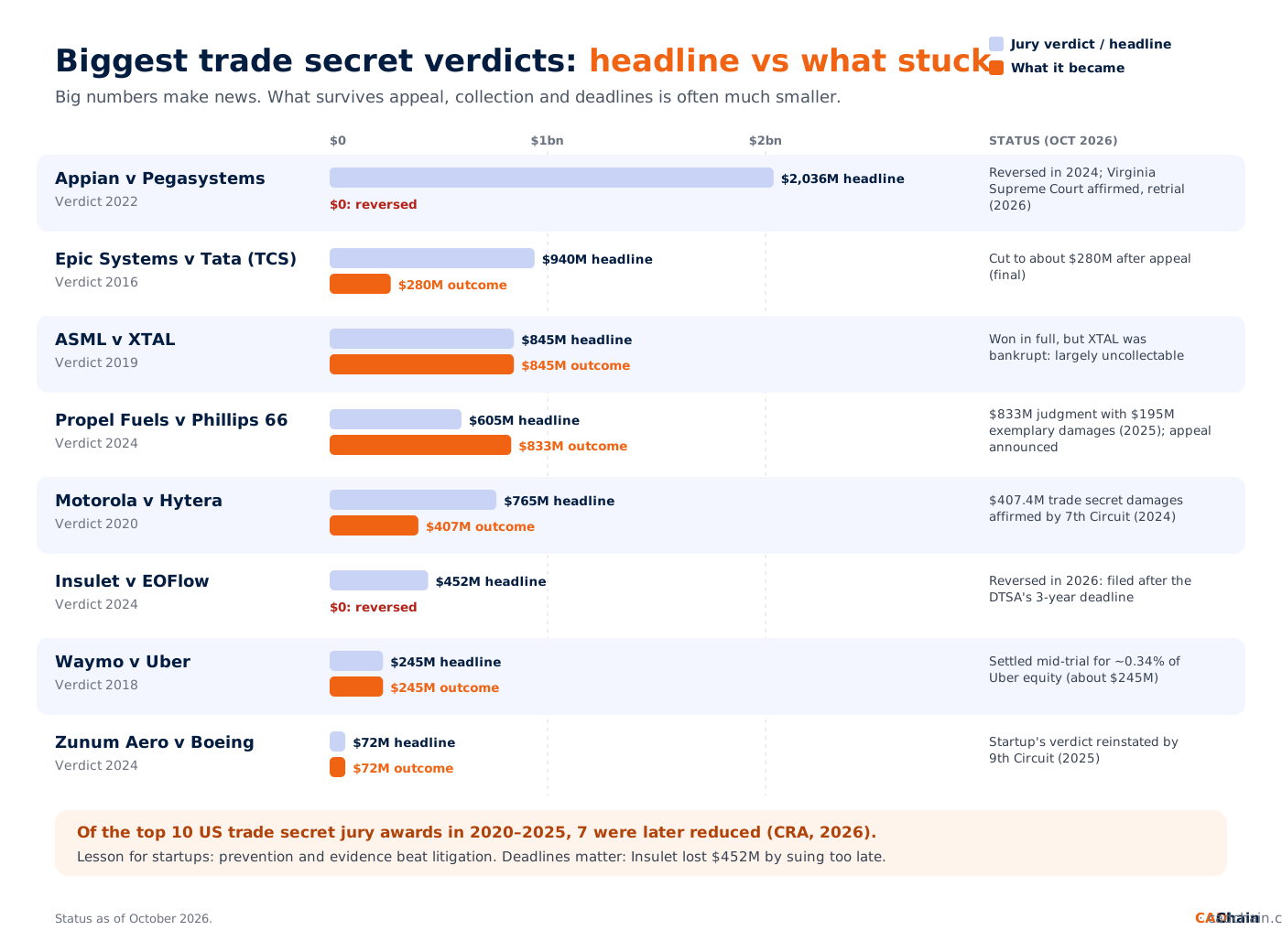
Deadline warning: in May 2026 the US Federal Circuit wiped out a $452M verdict for insulin-pump maker Insulet because it had "cause for concern" by 2019 but only sued in 2023, outside the DTSA's 3-year limit. When you suspect a leak, the clock is already running.
What does a leak really cost a smaller company? See the true cost of CAD IP theft for SMEs and the legal steps to take when CAD files are stolen.
The biggest trade secret cases and what startups should learn
For CAD-specific legal detail, see trade secret protection for CAD designs and audit trail requirements for IP litigation.
Trade secrets in the AI era
AI changes trade secrets in two ways: it creates new secrets worth protecting, and it creates new ways to leak them.
- Model weights, training data and fine-tuning recipes are usually best protected as trade secrets. Copyright struggles here: in Thaler v Perlmutter (2025) a US appeals court confirmed that purely AI-generated works lack the human authorship copyright requires. Openly released weights lose any secrecy protection.
- Employees pasting secrets into AI tools is now a top leak path. In 2023 Samsung restricted generative AI after engineers reportedly pasted source code and meeting notes into ChatGPT. Cyberhaven found that 34.8% of the corporate data employees put into AI tools in 2025 was sensitive, up from 10.7% two years earlier (Cyberhaven).
- AI is now in the litigation. Complaints mentioning artificial intelligence grew more than 150% in 2025 (CRA), and the first AI-related economic espionage conviction came in January 2026 (US v Ding).
Practical AI policy: allow approved enterprise AI tools that don't train on your inputs, ban putting register-listed secrets into public tools, log AI usage, include AI chat histories in your offboarding checklist, and record the policy in your trade secret register as one of your "reasonable steps".
For engineering teams, generative AI raises its own design-IP questions. We cover them in generative AI and CAD IP.
How to protect trade secrets: the 10-step program for startups
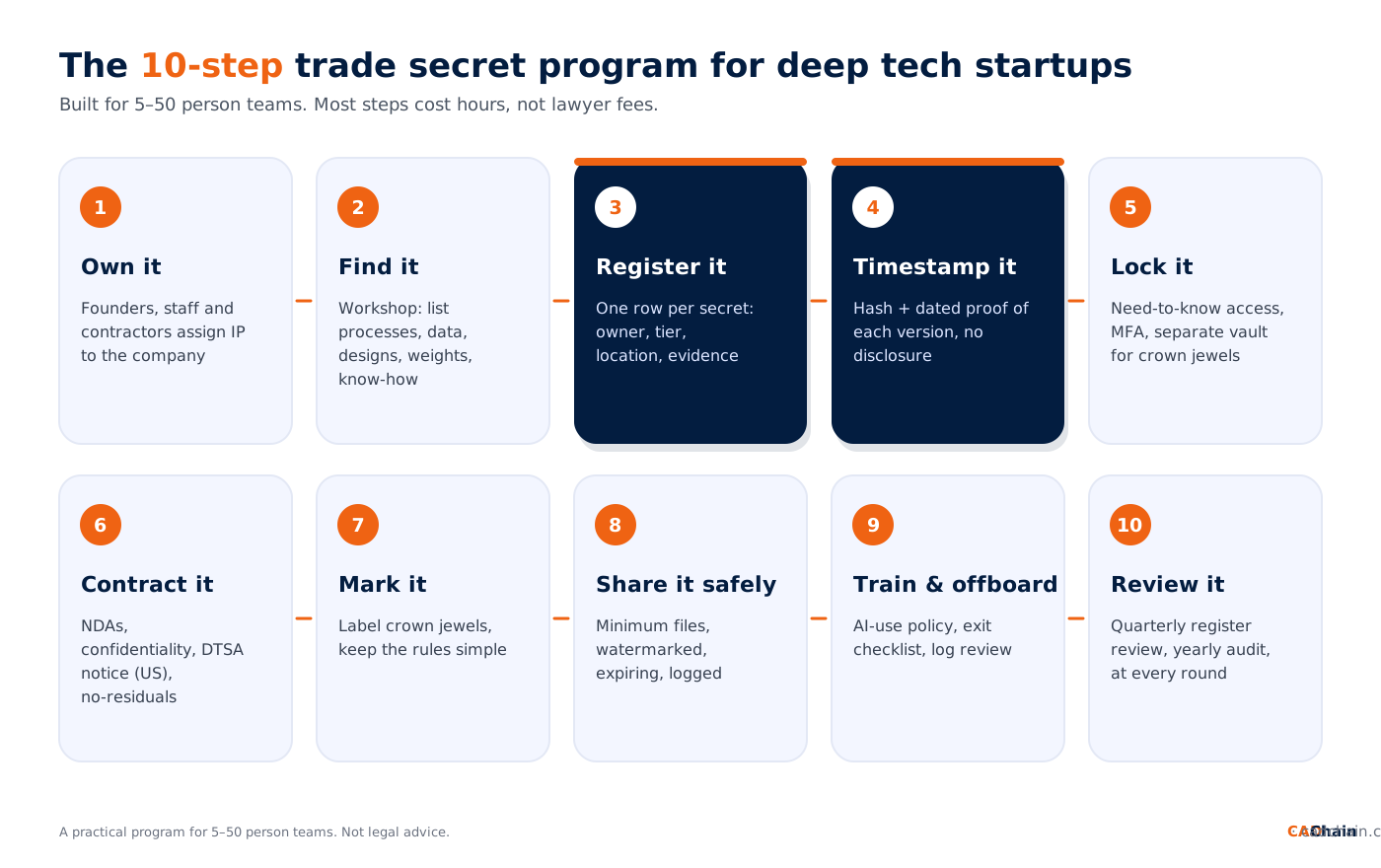
You don't need a legal department. You need a system you can show a judge or an investor. This program is adapted from the WIPO Guide to Trade Secrets and Innovation (2024) and EU and US case law. As WIPO puts it, reasonable protection measures "do not always (and almost never) mean the strictest protection in the absolute".
Step 1: Own it
Every founder, employee, contractor and advisor signs a confidentiality agreement and an invention assignment ("hereby assigns"). Founders assign anything they built before incorporation. This is the first thing investors check.
Step 2: Find it
Run a 2-hour workshop with your technical leads. Walk through the product, process and data flows and list what would hurt if a competitor had it. WIPO's advice: "Prefer over-designation to under-designation".
Step 3: Register it
Create a trade secret register with one row per secret (template below). Describe each secret precisely enough to identify it in court, but store the secret itself elsewhere. Courts dismiss claims when owners can't say exactly what the secret was.
Step 4: Timestamp it
Create dated, tamper-proof evidence that you had each version on a given date, without disclosing the content: a cryptographic hash plus a qualified timestamp, an i-DEPOT at the Benelux Office for IP, or a blockchain certificate. This evidence matters in disputes with ex-employees and partners, and for prior-user rights if someone else later patents the same thing.
Courts increasingly accept this kind of evidence: see blockchain evidence in IP litigation.
Step 5: Lock it
Need-to-know access, multi-factor authentication, encryption, a separate vault for crown jewels, no personal cloud sync. Layer measures: one court found passwords alone were not enough.
Step 6: Contract it
Use NDAs before sharing anything; one-way with suppliers, mutual with partners. Define the information, exclude residuals clauses, require return or destruction, and make the duty for real trade secrets indefinite. In the US, add the DTSA whistleblower notice to every employee and contractor agreement.
Step 7: Mark it
Label crown-jewel files and documents ("CONFIDENTIAL – [Company] trade secret"). Don't mark everything, or the label stops meaning anything.
Step 8: Share it safely
Give suppliers the minimum: an envelope STEP file instead of your native parametric model, drawings without process notes. Use watermarked, expiring, revocable access and log every download. Ban reverse engineering in the contract.
Step 9: Train and offboard
Train on what your secrets are and how to handle them, including AI tools. When people leave: exit interview, written acknowledgement, certified return or deletion, same-day access revocation, and a review of the last 30–90 days of logs.
Step 10: Review it
Review the register quarterly, audit yearly, and always before a fundraising round, an acquisition, a key departure or a supplier switch.
Trade secret register template
Copy these columns into a spreadsheet or your document management system. Keep the register itself confidential.
Onboarding and offboarding checklist
- Before day one: signed confidentiality agreement, invention assignment and (US) DTSA notice.
- Written declaration that no previous employer's confidential material is being brought in.
- Trade secret policy and AI acceptable-use policy acknowledged; short training completed.
- Least-privilege access by role; crown-jewel access approved by the owner and logged in the register.
- At exit: reminder of continuing obligations, signed acknowledgement, certification of return or deletion (including personal devices, cloud and AI chats).
- Same day: revoke all accounts, repositories, CAD/PDM vaults, shared links and API keys; rotate shared credentials.
- Review recent logs for unusual downloads or uploads, within the limits of labour and privacy law.
Trade secrets, fundraising and due diligence
Founders often worry that investors won't value something they can't see. In practice, investors check two things: that the company owns its IP, and that it has a credible program to protect it. A register, signed assignments and dated evidence make trade secrets "diligence-ready".
- Don't expect VCs to sign NDAs. As Cooley's startup guide puts it, "professional investors nearly always refuse to sign NDAs". Pitch the problem, the results and what your technology achieves, not how it works.
- Disclose in stages. Technical detail belongs in confirmatory due diligence, under NDA, in a logged and watermarked data room.
- Timestamp before you disclose. Record exactly what you shared, with whom and when. Propel Fuels' $833M judgment started with information shared under NDA during acquisition talks.
Trade secrets for CAD files and hardware teams
For hardware, robotics and manufacturing startups, the crown jewels usually live in CAD: native models, tolerances, GD&T, assembly know-how and test data. They also leave the building more often than any other secret, every time you send an RFQ to a supplier, onboard a contract manufacturer or work with a freelancer. That's why sharing CAD files securely, proving CAD file ownership and CAD file protection are trade secret topics, not just IT topics.
If you share native CAD files at scale, CAD file DRM adds usage controls that stay with the file.
How CADChain helps: BORIS works inside your CAD software. It registers each design version with a blockchain-timestamped certificate of ownership, which is dated proof that you had it, without disclosing the design. It also lets you share files with suppliers under access control. That covers steps 4 and 8 of the program, so your "reasonable steps" are documented automatically.
👉 See how BORIS protects your CAD designs
7 trade secret mistakes startups make
- Not knowing what the secrets are: no list, so no proof.
- Founders and early contractors who never signed an IP assignment.
- Generic catch-all NDAs that courts won't enforce.
- Pitching the "how" to investors and at conferences.
- Sending native CAD files and full process notes to every supplier who asks for a quote.
- No offboarding routine, and access left open after people leave.
- Waiting too long after a suspected leak, and losing the claim to the deadline.
Trade secret trends and predictions for 2026–2027
- More litigation: US federal filings hit a record in 2025 and the drivers (talent mobility, AI, weaker non-competes) are getting stronger, not weaker.
- AI everywhere: expect more disputes over model weights, training data and prompts, and over employees leaking secrets through AI tools.
- Courts demand specifics: plaintiffs must identify their secrets precisely and prove their measures were adequate. Registers and dated evidence will separate winners from losers.
- Deep tech and national security: semiconductor, battery and AI secrets are increasingly treated as strategic. Taiwan's first corporate penalty under its National Security Act (Tokyo Electron, 2026) is a sign of things to come.
- EU review: the Commission's evaluation of the Trade Secrets Directive was due by June 2026. Watch for proposals on criminal sanctions and cross-border enforcement.
Conclusion
For an early-stage deep tech startup, trade secrets are the IP right you already have, at no cost, from day one, covering exactly the things that make your technology hard to copy: the process, the parameters, the data and the know-how. But the law only protects secrets that are managed. Start with the basics this week: assignments signed, a register of your crown jewels, dated evidence of each version, and controlled sharing with everyone outside the company. Then patent selectively, where the market can see your invention.
This guide is general information, not legal advice. Talk to an IP lawyer in your jurisdiction before making decisions about specific inventions.
FAQ: trade secrets
What is a trade secret in simple terms?
Any confidential information that gives your business an edge because others don't know it, such as a recipe, process, design, algorithm or customer list, and that you actively keep secret.
What are the 3 requirements of a trade secret?
The information must be secret, have commercial value because it is secret, and be protected by reasonable steps. The EU Directive (Art. 2), the US DTSA and TRIPS Art. 39 all use this test.
How long does a trade secret last?
Indefinitely, for as long as it stays secret and you keep protecting it. Coca-Cola's formula has been a trade secret since 1886.
Do you need to register a trade secret?
No. There is no registry and no fee. What you do need is evidence: a register, dated proof of what you had and when, and records of your protection measures.
Is a recipe a trade secret?
It can be, if it isn't public, has value because it's secret and you protect it. KFC's spice blend and the Coca-Cola formula are the classic examples.
Can software or source code be a trade secret?
Yes. Source code, algorithms and model weights are common trade secrets, as Motorola v Hytera and the Linwei Ding case show. Copyright protects the code's expression; trade secret law protects the confidential logic and know-how.
Can AI model weights be trade secrets?
Yes, as long as they are kept confidential and protected. Once weights are released openly, trade secret protection is lost.
Is reverse engineering a trade secret legal?
Generally yes, if you bought or lawfully hold the product and no contract forbids it (EU Directive Art. 3). That's why products that reveal their invention are better protected by patents.
Trade secret or patent: which is better for a startup?
For invisible innovations (processes, parameters, data, weights), a trade secret is usually better: cheaper, faster and no disclosure. For innovations visible in the product, or when you need investor signalling, a patent may be worth it. Many startups use both.
Can you patent something that was a trade secret?
Yes, as long as it hasn't been disclosed publicly and still meets the patent criteria. But once the application is published, usually at 18 months, the secret is gone.
What happens if a trade secret is stolen?
You can seek an injunction, damages (or a reasonable royalty) and, in the US, up to double damages and attorney fees for wilful theft. Theft can also be a crime. Act fast: the deadline is 3 years in the US and at most 6 years in the EU.
Is stealing trade secrets a crime?
In the US, yes, under the Economic Espionage Act, with up to 10 years in prison (15 if it benefits a foreign government). In the EU, criminal law is national; many Member States have criminal provisions, such as Article 273 of the Dutch Criminal Code.
What are reasonable measures to protect trade secrets?
Proportionate, layered steps: NDAs and IP assignments, need-to-know access, marking, logging, training, secure sharing with suppliers and an offboarding routine. Courts look at the whole picture, not a single measure.
Can more than one company own the same trade secret?
Yes. If two companies develop the same information independently, both can hold it as a trade secret. Neither can stop the other.
Should I ask investors to sign an NDA?
Usually not; professional investors rarely sign them. Instead, don't share the 'how' in early meetings, and share technical details only in later due diligence, under NDA and with logs.