
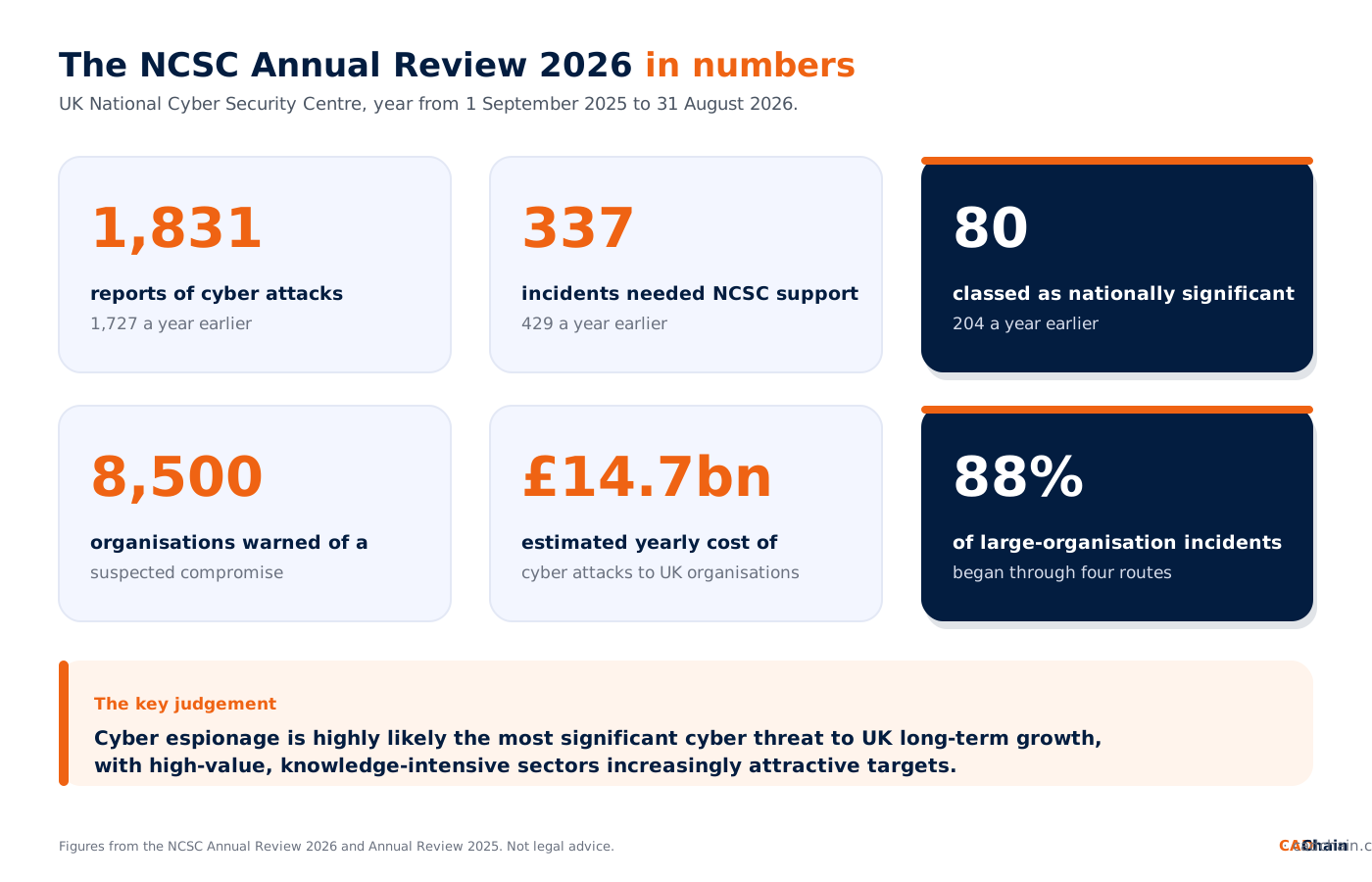
On 3 November 2026, the UK's National Cyber Security Centre (NCSC) published its Annual Review 2026, covering September 2025 to August 2026. The agency received 1,831 reports of cyber attacks, gave hands-on support in 337 incidents and classed 80 of them as nationally significant. Its most important line for companies that live on their designs is a judgement, not a number: cyber espionage is highly likely to be the most significant cyber threat to the UK's long-term economic growth.
The NCSC is part of GCHQ and has been the UK's technical authority for cyber security since 2016, so this review marks its tenth year. It names China as the most sophisticated and sustained cyber challenge facing the UK and Russia as the most audacious, and it warns that AI is making known attacks faster, cheaper and easier to run at scale. It also admits something agencies rarely say so plainly. In the foreword, NCSC chief executive Richard Horne writes: “The UK’s cyber resilience is not yet where it should be.”
The review is written for the UK, but its lessons travel. The attackers it describes target the same aerospace, automotive, semiconductor and defence supply chains that run through the Netherlands, Germany, France and the rest of Europe. Below: what the NCSC found, why espionage now tops the economic risk list, how most attackers still get in, and what engineering and IP teams should do about their CAD files and design data.
TL;DR: the UK's cyber agency says spies are the biggest long-term threat to growth
The NCSC Annual Review 2026 counts 1,831 reports, 337 supported incidents and 80 nationally significant incidents in the year to August 2026, and estimates that malicious cyber activity costs UK organisations £14.7 billion a year. It judges cyber espionage highly likely to be the most significant cyber threat to long-term economic growth, with high-value, knowledge-intensive sectors increasingly attractive targets. For large organisations, 88% of incidents started through four familiar routes: exposed applications, phishing, misused valid accounts and exposed remote services. Lesson: fix the basics now, and protect design files themselves so that a stolen login or an unpatched server does not hand over your IP.
What did the NCSC Annual Review 2026 find?
The NCSC Annual Review 2026 is an 84-page report called The State of the Cyber Nation. Its incident team received 1,831 reports of cyber attacks on UK organisations between 1 September 2025 and 31 August 2026. After triage, 337 incidents needed NCSC support, and 80 of those were classed as nationally significant. Through its Early Warning service, the NCSC also told 8,500 organisations about events that pointed to a suspected compromise of their systems.
- Reports up, supported incidents down: a year earlier the NCSC received 1,727 reports, handled 429 incidents and classed 204 as nationally significant. The review stresses that incident numbers do not follow a simple year-on-year trend and that early warnings likely stopped some incidents from growing.
- Four threat trends: China is changing the scale of cyber competition, cyber operations have become a tool of state power, economic security depends on cyber security, and new technology is increasing the threat.
- The cost: citing UK government research, the review estimates that malicious cyber activity costs UK organisations £14.7 billion every year.
- The basics still decide most cases: for large organisations, 88% of incidents came from four initial access routes, and many state-linked attacks used vulnerabilities for which patches existed but had not been applied in time.
- AI as an accelerator: attackers are adding AI tools to their work, but none of the uses the incident team observed created a new class of attack.
Why does the NCSC rank cyber espionage as the biggest threat to growth?
Ransomware gets the headlines because it stops production lines. Espionage is quieter, but the NCSC judges it the bigger threat over the long term. In the section on economic security, the review states: “Cyber espionage is highly likely to be the most significant cyber threat to the UK’s long-term economic growth.” The damage, it explains, builds up through reduced innovation, diminished competitive advantage and lost commercial opportunities, and high-value, knowledge-intensive sectors are increasingly attractive targets.
For engineering companies, that knowledge sits in specific files: 3D models, drawings, simulation results, process parameters, bills of materials and test data. A stolen invoice database is a breach; a stolen set of CAD models can be the next five years of a competitor's product line. Our guide to trade secrets for deep-tech startups explains why this kind of know-how is often worth more than the patents around it, and our overview of CAD file theft tactics in industrial espionage shows how attackers go after it.
The review also explains why China worries the NCSC most. It describes a whole-of-state approach that combines legislation, private sector contractors and technology development, with data at the centre: China acquires large amounts of information, trains models, improves capability and generates insight, which the NCSC says has implications far beyond traditional espionage. As a case study, it recalls that in December 2025 the UK sanctioned two China-based technology companies, i-Soon and Integrity Technology Group. We covered what the October 2026 international advisory on Integrity Tech means in our article on China-linked hackers for hire and CAD and PLM data.
How do attackers get in?
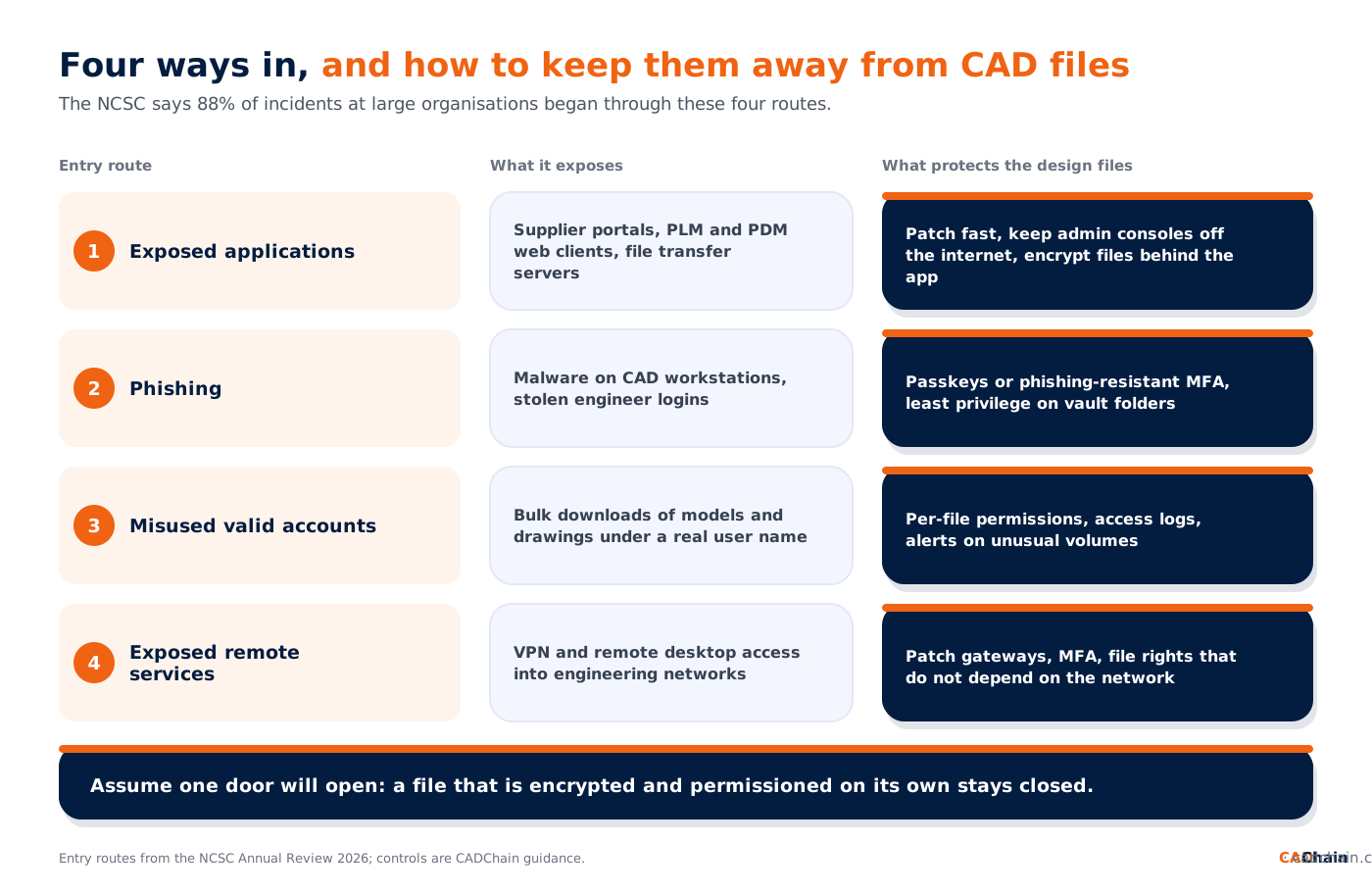
The most practical finding in the review is how ordinary the entry points are. The NCSC notes that the bulk of capability seen in recent state-backed incidents was not an advanced, autonomous AI attack but the exploitation of common, known vulnerabilities. For large organisations, 88% of incidents began in one of four ways:
- Exploiting external public-facing applications, such as web portals, file transfer tools and remote access gateways.
- Phishing, including messages that steal credentials or deliver malware.
- Misuse of valid accounts, where attackers log in with stolen or reused credentials.
- Exploiting external remote services, such as VPNs and remote desktop access.
Each of these routes leads straight to design data in a typical engineering company. Supplier portals and PLM web clients are public-facing applications. Engineers' accounts open the PDM vault. Remote access is how contractors reach the CAD workstations. Our recent reports show the pattern in practice: China-linked hackers using the ARTEX AI agent framework against more than 200 organisations, KeyDrift malware stealing network encryption keys from defence and aerospace firms and APT28's campaign against a NATO naval shipbuilder all relied on exposed systems or stolen access, not science fiction.
What does the NCSC say about AI?
The review treats AI as an accelerator of existing threats rather than a new kind of attack, at least for now. Horne writes that AI did not create the UK's cyber security weaknesses; it revealed them, exposing years of technical debt and missing basic protections. The NCSC judges it highly likely that by 2028 China, Russia and other states will routinely use AI in cyber operations, and that AI-powered malware will have been used in a ransomware attack on UK critical national infrastructure.
The review also sketches a pessimistic scenario for 2028, which it stresses is an illustration and not a prediction, in which AI tools spread to every kind of attacker and AI-enabled espionage becomes harder to detect. For design owners the trend matters twice: AI helps attackers find exposed systems faster, and data is increasingly valuable for training models. Files that are encrypted and permissioned on their own stay protected even when an automated attacker finds a way into the network around them, as our guide to CAD encryption at rest, in transit and in use explains.
What happened at Jaguar Land Rover, and why does it matter to suppliers?
The review uses the 2025 Jaguar Land Rover attack as its case study for economic harm. It says the incident caused severe and prolonged disruption to JLR's global production and retail, that suppliers relying on JLR's schedules, orders and payments faced operational and workforce pressures, and that JLR reported approximately £196 million in direct cyber-related costs. The NCSC adds that the attack contributed to the UK economy growing by only 0.1% in the third quarter of 2025.
The supplier side of that story is the part engineering SMEs should study. When a prime is hit, its suppliers lose orders and cash flow; when a supplier is hit, the prime's drawings and models may leak with it. Our report on 23 leak-site claims against Korean manufacturers shows ransomware gangs now advertising stolen drawings and PDM data, and our guide to CAD file security in supply chain collaboration covers what to share and how.
Make stolen access worth less. CADChain encrypts CAD files at file level and controls who can open them, across CAD systems, partners and suppliers, with access logs and blockchain proof of ownership.
👉 Protect your CAD files with CADChain
What should engineering companies do now?
The NCSC's own advice is to fix the fundamentals at scale. Translated to design data, that means:
- Patch what faces the internet first. List every portal, PLM or PDM web client, file transfer server and remote access gateway, and patch them before anything else. The review shows that many state-linked attacks used flaws with patches already available.
- Replace passwords where you can. The NCSC promotes passkeys in place of passwords. Require phishing-resistant MFA for every account that can open the vault, including suppliers' accounts.
- Classify your crown-jewel files. Decide which models, drawings and process data would hurt most in a competitor's hands, and give them stricter rules than the rest.
- Encrypt and permission files individually. A file that carries its own protection stays closed on a compromised server, a phished laptop or a supplier's share. Our article on zero trust for CAD file distribution explains the model.
- Watch who opens what. Misused valid accounts look like normal users, so unusual download volumes and odd hours are often the only clue. See our guide to real-time CAD access monitoring.
- Bring suppliers into scope. The NCSC asks organisations to understand their supplier dependencies, and UK Cyber Essentials is a simple baseline to ask small suppliers for. Share only what each partner needs, with expiry dates.
- Keep dated proof. Timestamped records of what you created, when and who accessed it support claims after a leak; our article on audit trail requirements for IP litigation lists what courts look for.
- Report to the board in outcomes. The review says boards should seek assurance of measurable improvements in preparedness and recovery, not only that policies exist.
What does this mean for companies in the EU?
UK figures do not bind EU companies, but the same threat actors work across the Channel, and the legal tests line up. Under the EU Trade Secrets Directive, information is only protected when its holder took reasonable steps to keep it secret, so unpatched portals and shared passwords weaken a claim as well as a network. Our legal framework for trade secret protection of CAD designs walks through those steps.
Reporting duties are also tightening on both sides. The UK is working on its Cyber Security and Resilience Bill, which the minister for security calls the biggest update to UK cyber regulation in years. In the EU, many manufacturers and their suppliers already have NIS2 incident duties, and makers of products with digital elements must report actively exploited vulnerabilities and severe incidents under the Cyber Resilience Act, as our article on Cyber Resilience Act reporting explains.
How does this fit the bigger picture?
Our sister sites covered other sides of the same pressure this week.
- Spies posing as recruiters. ESET reports that North Korea's Lazarus group restarted its fake job offer campaign against drone makers and their suppliers. Solidboris.com explains how the fake job offer malware targets SOLIDWORKS users and engineering suppliers.
- AI agents inside CAD software. Inventor 2027.2 adds a local MCP server that lets AI agents inspect and change the open model. BORIS Inventor covers what the Inventor MCP server means for your design data.
- AI training and copyright in the EU. An Advocate General's opinion in the first generative AI case at the EU Court of Justice suggests that training is, as a rule, allowed under the text and data mining exception. Blended BORIS explains what the EU AI copyright opinion means for Blender artists.
Conclusion
The NCSC Annual Review 2026 sends two messages to engineering companies. The first is about priorities: the UK's national cyber security agency ranks espionage, not only ransomware, as the cyber threat most likely to hold back long-term growth, and it names knowledge-intensive sectors as attractive targets. The second is about method: most attackers still walk in through exposed applications, phishing, stolen accounts and remote services that could have been closed.
The answer is equally twofold. Fix the basics fast, because AI is shrinking the time between a flaw and its exploitation. And protect the design files themselves, so that when a door is left open, what lies behind it stays encrypted, permissioned, logged and provably yours.
Protect the designs that spies are after. CADChain gives engineering teams file-level encryption, per-file permissions, access logs and blockchain proof of ownership for CAD files, so a stolen login does not become a stolen product line.
👉 See how CADChain protects CAD files
FAQ: NCSC Annual Review 2026
What is the NCSC Annual Review 2026?
It is the yearly report of the UK National Cyber Security Centre, part of GCHQ, published on 3 November 2026. It covers 1 September 2025 to 31 August 2026 and describes the threats the NCSC saw, the incidents it handled and its work with government and industry.
How many incidents did the NCSC handle?
The NCSC received 1,831 reports of cyber attacks. After triage, 337 incidents required its support and 80 were classed as nationally significant. Its Early Warning service also notified 8,500 organisations about signs of a suspected compromise.
Why is cyber espionage called the biggest threat to growth?
The NCSC judges cyber espionage highly likely to be the most significant cyber threat to the UK's long-term economic growth, because its costs accumulate through reduced innovation, lost competitive advantage and lost commercial opportunities, with knowledge-intensive sectors increasingly targeted.
Which countries does the review name?
It calls China the most sophisticated and sustained cyber challenge facing the UK and Russia the most audacious cyber threat, and says Iran-linked groups continue to cause indiscriminate disruption.
How do most attacks start?
For large organisations, 88% of incidents began with one of four routes: exploiting public-facing applications, phishing, misuse of valid accounts or exploiting external remote services.
Does the review apply to EU companies?
It describes the UK, but the same threat actors target European supply chains, and EU rules such as the Trade Secrets Directive, NIS2 and the Cyber Resilience Act reward the same basic controls and quick incident handling.
How does CADChain help?
CADChain encrypts CAD files at file level, applies per-file permissions, logs access and timestamps files on a blockchain, so a copied design stays unreadable without permission and ownership can be proven. It does not replace patching, MFA or legal advice.