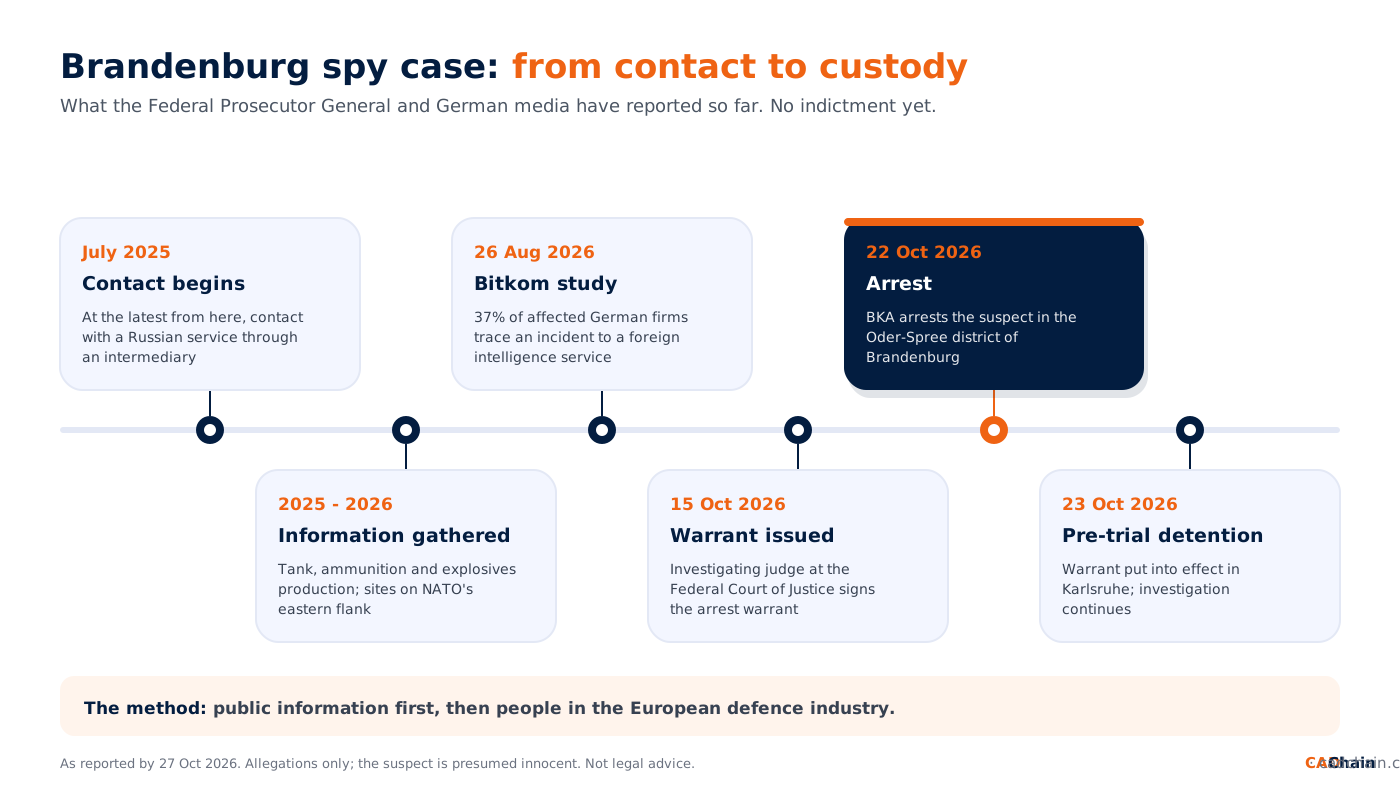
On 22 October 2026, officers of Germany's Federal Criminal Police Office (BKA) arrested a Ukrainian man in the Oder-Spree district of Brandenburg on suspicion of spying for a Russian intelligence service. According to Germany's Federal Prosecutor General, he collected information on the production of tanks, ammunition and explosives, partly by targeting people in the European defence industry. On 23 October, an investigating judge at the Federal Court of Justice ordered him held in pre-trial detention.
The suspect, named only as Vadym Y., is accused of working for a foreign intelligence service under Section 99 of the German Criminal Code. Prosecutors say he had been in contact with a Russian service through an intermediary since July 2025 at the latest. The case came from information supplied by the Federal Office for the Protection of the Constitution (BfV), Germany's domestic intelligence service. He has not been charged, and he is presumed innocent.
For engineering companies, the detail that matters is not the nationality of the suspect or the politics. It is the method. Some of the information was public. The rest, prosecutors say, came from people who work in the defence supply chain. Chancellor Friedrich Merz called the arrest a success and said Germany will probably see such cases more often in the coming months and years. Here is what is known, what is not, and what manufacturers, suppliers and engineering offices can do now.
TL;DR: Russian spy suspect arrested in Germany, October 2026
A Ukrainian national was arrested in Brandenburg on 22 October 2026 on a warrant from 15 October. The Federal Prosecutor General says he gathered information for a Russian intelligence service from July 2025 at the latest, on tank, ammunition and explosives production and on military sites protecting NATO's eastern flank, partly by targeting people in the European defence industry. He is in pre-trial detention. No companies have been named and no indictment exists yet. Germany's 2026 Bitkom survey found that 37 percent of affected companies traced at least one incident to a foreign intelligence service, up from 28 percent a year earlier. The lesson for engineering firms: small facts from sales, project and supplier contacts add up. Decide what stays internal, train the people who talk to outsiders, and control access to design files at the file level.
What happened in Brandenburg?
According to the Federal Prosecutor General's press release of 22 October 2026, BKA officers arrested the man in the district of Oder-Spree on a warrant issued on 15 October 2026 by the investigating judge at the Federal Court of Justice (BGH). German media reported that the arrest took place in Eisenhüttenstadt, a town on the Polish border. The next day, the investigating judge in Karlsruhe put the warrant into effect, which means he stays in custody while the investigation continues.
Prosecutors say that, working from Germany, he gathered military information for a Russian intelligence service. The topics listed are the production of armoured vehicles, ammunition and explosives, and personnel and military sites that protect NATO's eastern flank. Some of this information was publicly available. For the rest, the suspect is said to have targeted people working in the European defence industry.
Security sources quoted by the German press agency dpa said the man was not a so-called disposable agent, the term used for people recruited online for small, low-paid tasks without any intelligence training. The investigation is run by the BKA. Neither the prosecutors nor the press have named any company or person who was approached.
What is confirmed and what is not?
It is easy to read too much into a short press release. Here is what the official statement and the main reports actually say, and where the gaps are.
Why are engineering suppliers in the firing line?
Germany and its European partners are expanding weapons and ammunition production. That makes facts about capacity, bottlenecks, delivery dates and sites valuable to a foreign intelligence service. Those facts do not only sit with the big prime contractors. They are spread across machine builders, component suppliers, engineering offices, software vendors, logistics firms and the people who build trade fair stands.
Most of these companies do not see themselves as defence firms. A supplier of fasteners, castings, test rigs or control software may not hold a single classified document. But its order book, drawings, tolerances, material specifications and delivery schedule can show how many units a customer plans to build and where. Each detail looks harmless. Put together, they describe production.
This is why the prosecutors' wording matters. The suspect is not accused of hacking a network. He is accused of collecting public information and then working on people. That is the oldest form of industrial espionage, and the hardest to stop with firewalls alone. We described the main tactics in our guide to competitor industrial espionage and CAD file theft and in social engineering attacks that target CAD data.
How big is the espionage problem for German companies?
The arrest fits a wider pattern. The Bitkom Wirtschaftsschutz 2026 study, presented in Berlin on 26 August 2026 together with the BfV, surveyed 1,003 companies in Germany with at least 10 employees. 96 percent said they had been affected, or probably affected, by data theft, industrial espionage or sabotage in the previous 12 months. Bitkom put the damage at between 211 and 270.8 billion euros.
Among companies that were affected, 37 percent traced at least one incident to a foreign intelligence service, up from 28 percent in 2025 and 7 percent in 2023. Only organised crime, at 62 percent, was named more often. The single largest damage item in 2026 was lost sales from copied products and plagiarism, at 38.9 billion euros, and 21 percent of affected companies said the damage also hit business partners, for example through production stoppages.
The Brandenburg case is also one of several this year. The dpa report lists the arrest in January 2026 of a German-Ukrainian woman in Berlin, accused of gathering information for an officer at the Russian embassy and since indicted; two men accused of spying on a person who supplied drones and components from Germany to Ukraine; and a couple arrested in May 2026 on suspicion of spying on German universities for Chinese intelligence.
Design files that only open for the right people. CADChain encrypts CAD files, sets per-file permissions for each partner and logs every open, edit and export with blockchain timestamps, so a drawing shared with a supplier does not travel further without you knowing.
👉 See how CADChain works
What do these approaches usually look like?
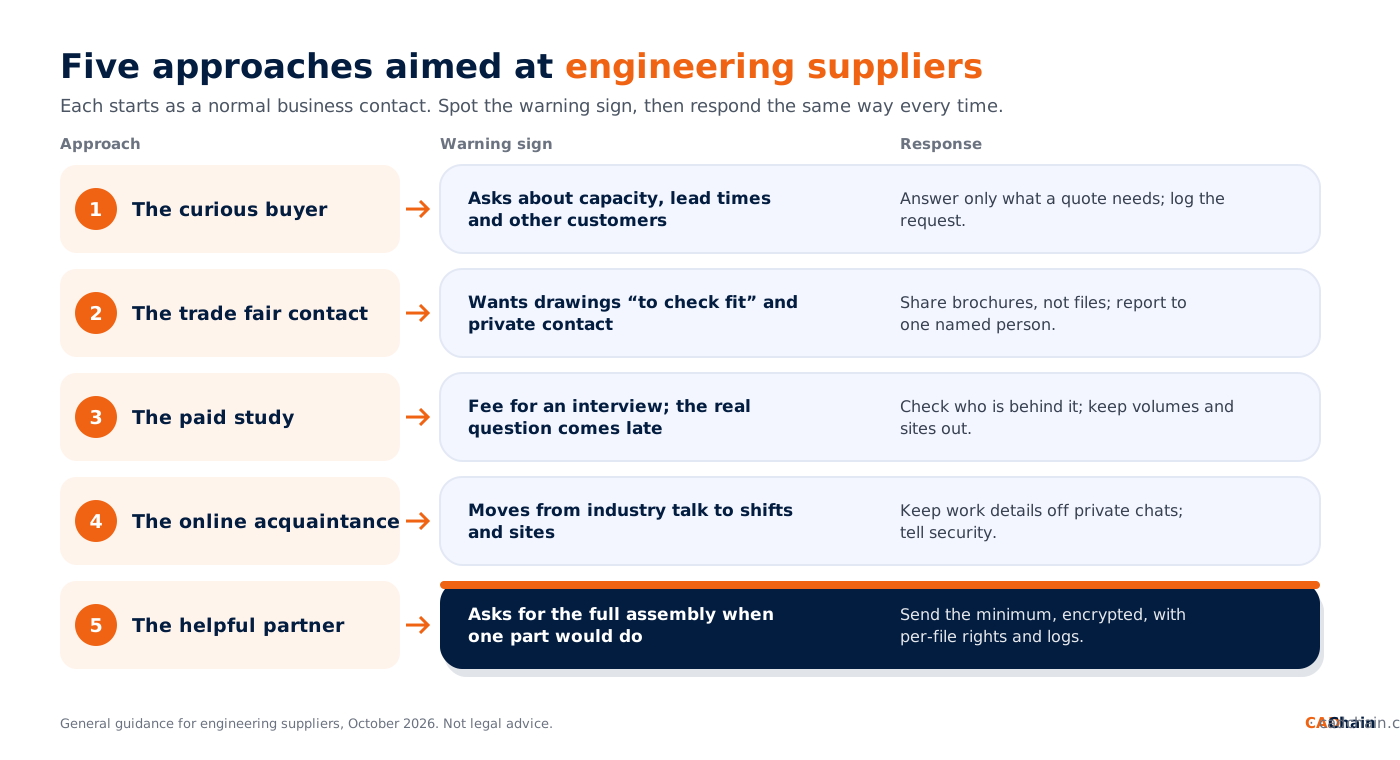
The press release does not describe how this suspect approached his contacts. But business protection advisers commonly describe patterns like the ones below. None of them involves a dramatic recruitment pitch. They start with a normal business conversation.
- The curious buyer. A prospect asks detailed questions about capacity, lead times, other customers and how fast you could scale up, then never orders.
- The trade fair contact. A visitor shows unusual interest in your projects and customers, asks for drawings "to check fit" and wants to stay in touch privately.
- The paid study. A consultancy or researcher offers a fee for an interview or a market report, and the real question only appears late.
- The online acquaintance. A contact on a professional network slowly moves from industry talk to questions about your workplace, shifts and site.
- The helpful partner. A subcontractor or freelancer asks for the full assembly when a single part would do, or forwards files to someone you never approved.
What should engineering companies do now?
- Decide what stays internal. Write down which information is sensitive for your business: customer lists, production volumes, delivery dates, sites, drawings and test data. If you supply defence customers, include anything that reveals their volumes.
- Train the people who talk to outsiders. Sales, project managers, application engineers and trade fair staff hear the questions first. Show them the patterns above and tell them it is fine to say no.
- Log unusual requests and report them. Do not just decline a strange question quietly. Note who asked, when and what, and send it to one named person. Patterns only show up when someone sees all the notes.
- Share the minimum, at file level. Send a single part, a simplified model or a neutral export instead of the full assembly. Give each partner access only to the files they need, for as long as they need them.
- Control and log every file you send out. Encrypted files with per-file permissions can be revoked when a project ends. An access log shows who opened, printed or exported a drawing, and when.
- Review access rights regularly. Remove former staff, finished subcontractors and old shared folders. Most leaks run through access that nobody remembered to close.
- Check your own public footprint. Job ads, press releases, case studies and supplier portals can reveal more than intended. Read them as an outsider would.
- Know who to call. In Germany, the BfV and the state offices for the protection of the constitution offer confidential business protection advice. Talk to them early if something feels wrong.
For more detail, see our guides to aerospace CAD file security for defence contractors, CAD file security for supply chain collaboration, controlling CAD files beyond first-level partners, zero trust for CAD file distribution, view, edit, print and export permissions, real-time access monitoring for supply chain partners, tamper-proof CAD audit trails, why NDAs alone are not enough and how employees accidentally leak CAD files. This month we also covered the Integrity Tech advisory on China-linked hackers targeting manufacturing, North Korean remote IT workers inside Western companies and the hidden recording device found at OpenAI.
What does this mean beyond Germany?
The case was brought in Germany, but the defence supply chain is European. The suspect is said to have targeted people in the European defence industry, not only in Germany. Suppliers in the Netherlands, Poland, the Nordic countries or anywhere else that deliver parts, software or services into defence programmes should assume the same interest.
Rules are also catching up. Under the EU's NIS2 directive, companies in scope must manage supply chain security, access control and incident handling. The practical steps above overlap heavily with those duties, so work done to resist human-led espionage also helps with compliance. And for companies that build dual-use products, the same file controls support export control obligations for technical data.
How does this fit the bigger picture?
Our sister sites covered other developments this week that touch the same question: who controls engineering data, and who can prove it.
- Print files for spare parts. A French draft decree would make manufacturers give repairers 3D print files of unavailable spare parts, with an IP reservation. Read what the French 3D-printed spare parts decree means for SOLIDWORKS teams on solidboris.com.
- Web servers around design data. Critical PHP flaws took government websites offline, while Autodesk said Inventor and Vault were not affected. Our sister site explains where the php2shell PHP vulnerabilities sit around Inventor data.
- Disclosure and provenance. Epic's Tim Sweeney has challenged Steam's AI disclosure label, while asset stores keep their own AI labels. Blended BORIS looks at the Steam AI disclosure debate and what it means for 3D asset sellers.
Conclusion
The Brandenburg arrest is a single case, and the suspect has not been charged, let alone convicted. But the method described by prosecutors is familiar: start with what is public, then ask the right people the right questions. In a supply chain that is expanding fast, those people work at small and mid-sized suppliers as often as at prime contractors.
Engineering companies cannot stop every conversation. They can decide what is sensitive, prepare the people who face outsiders, share design data in the smallest useful pieces and keep control of every file that leaves the building. When the question comes, and the German government expects more of them, that preparation is what counts.
Keep control of every CAD file you share. CADChain gives engineering teams file-level encryption, per-file permissions, access logs and blockchain proof of ownership for CAD files, across CAD systems, suppliers and partners.
👉 Protect your CAD files with CADChain
FAQ: Russian spy arrest and the defence supply chain
Who was arrested in Germany on 22 October 2026?
A Ukrainian national named as Vadym Y. was arrested by the BKA in the Oder-Spree district of Brandenburg on a warrant from 15 October 2026. He is suspected of working for a Russian intelligence service and has been in pre-trial detention since 23 October.
What information was he allegedly collecting?
According to the Federal Prosecutor General, information on the production of armoured vehicles, ammunition and explosives, and on personnel and military sites securing NATO's eastern flank. Some was public; for the rest he allegedly targeted people in the European defence industry.
Has he been charged?
No. As of 27 October 2026 there is no indictment. He is suspected of an offence under Section 99 of the German Criminal Code and is presumed innocent.
Were any companies or CAD files involved?
No company has been named, and no report says that design files were taken. The case shows that people in the supply chain are targets, not that a specific file was stolen.
How common is espionage against German companies?
In Bitkom's 2026 survey of 1,003 companies, 96 percent said they were affected or probably affected by data theft, espionage or sabotage in the past year, and 37 percent of affected companies traced at least one incident to a foreign intelligence service.
Why would a small supplier be a target?
Because order volumes, drawings, tolerances, delivery dates and sites can reveal a customer's production plans. Small pieces from several suppliers can add up to a clear picture.
What is the first thing an engineering supplier should do?
Define which information stays internal, train sales, project and trade fair staff to recognise unusual questions, and give one person the job of collecting reports.
How can CADChain help?
CADChain encrypts CAD files, sets per-file permissions for each partner, logs every access with blockchain timestamps and lets you revoke access when a project ends.