
On 18 November 2026, the US Justice Department announced a federal indictment against Igor D'iu, a Russian national accused of acting as an agent of the Russian government in Silicon Valley. Prosecutors say he was told to sit in a coffee shop near a large technology and defence company's Palo Alto office, pick out its employees and photograph their laptop screens while they worked. He is also accused of collecting staff home addresses and following employees by car, including one woman he allegedly trailed for nearly 30 miles.
The charging documents do not name the company. They describe it as a large, publicly traded technology and defence firm with offices across the United States, including Palo Alto, that makes software used by Ukraine. Bloomberg and Reuters reported, citing people familiar with the matter, that the target was Palantir Technologies. Palantir did not immediately respond to requests for comment from CBS News and Gizmodo.
Most espionage stories we cover on this blog are about malware, stolen credentials or insiders who copy files. This case is different, and for deep-tech founders, engineering managers and security teams it is uncomfortable for that reason. According to the prosecution, the method was low-tech: a phone camera pointed at a screen in a café, a laptop placed near an office, a notebook of home addresses. None of it needed a hacked server. All of it targeted people who were simply doing their work in public.
TL;DR: an alleged Russian agent was told to photograph engineers' laptop screens in a café
The US Justice Department announced on 18 November 2026 that Igor D'iu, a Russian national arrested on 30 October according to AP, has been indicted in the Northern District of California on four charges: conspiracy to act as an agent of a foreign government, acting as an agent without notifying the Attorney General, interstate stalking and fraud involving false identity documents. Prosecutors say Telegram contacts directed him to photograph employees' laptop screens near a Palo Alto office, to place a computer near the office for remote access, and to collect employees' home addresses. These are allegations; he has not been convicted. Lesson: protect what is visible on screens and nearby networks, and make sure a photographed or copied design file is not automatically a usable one.
What is Igor D'iu accused of?
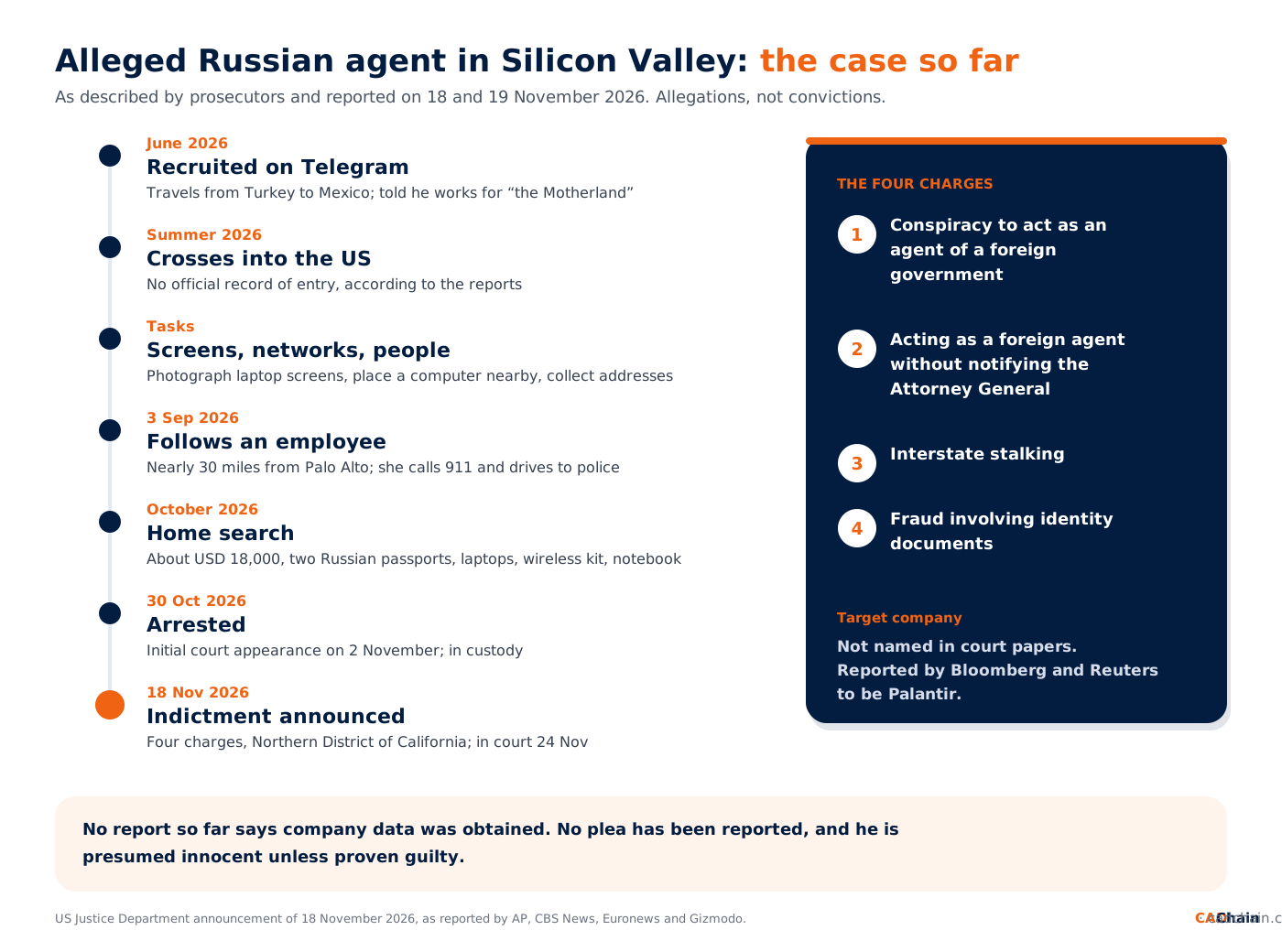
According to the indictment and an FBI affidavit, as reported by CBS News, AP, Euronews and Gizmodo, D'iu was recruited through the messaging app Telegram by unidentified co-conspirators based in Russia, who told him he was working for "the Motherland". The reports say he travelled from Turkey to Mexico in June 2026 and crossed into the United States illegally in the summer, with no official record of entry.
Once in California, prosecutors say, his handlers sent him instructions, equipment and money. The tasks described in the reports fall into three groups:
- Screens. He was told to go to a coffee shop near the company's Palo Alto office, identify company employees and photograph their laptop screens while they worked. The Justice Department released a photo it says shows this.
- Networks. He was told to place his own computer at specific locations near the company so that his co-conspirators could access it remotely and try to collect information from employees nearby. Gizmodo reports that he was also told to buy laptops, wireless networking equipment and remote-access software.
- People. He searched for employees' home addresses, including a senior executive's, followed staff from the office by car and kept a notebook that, according to CBS News, listed the addresses of 10 employees and personal profiles of three, including family and work details. CBS also reports messages with photos of at least four employees and instructions to pose as a food delivery driver to confirm where they lived.
The most serious incident took place on 3 September 2026. Prosecutors say D'iu followed a female employee for nearly 30 miles from Palo Alto towards San Francisco. She called 911 and was directed to a San Francisco police station. After Palo Alto police contacted him, he allegedly changed cars, got a new phone number and left the state for a time on his handlers' instructions, before returning to Northern California.
What did investigators find, and what happens next?
Investigators searched his home in East Palo Alto in October. According to AP and Gizmodo, they found about USD 18,000 in cash, two Russian passports, laptops, iPhones, wireless networking equipment and the notebook with employee addresses and profiles. CBS News reports a forged US passport and a California ID card in another name. AP reports that he was arrested on 30 October and remains in custody.
The four charges are conspiracy to act as an agent of a foreign government, acting as an agent of a foreign government without notifying the US Attorney General, interstate stalking and fraud in connection with identity documents. Reports differ on the combined maximum sentence, so we do not repeat a figure. He is due in court on 24 November 2026. It was not clear from court records whether he had a lawyer who could comment, and no plea has been reported. An indictment contains allegations only, and he is presumed innocent unless proven guilty.
US Attorney Craig Missakian said his office would not tolerate efforts by foreign governments or anyone else "to turn Silicon Valley into a base for foreign intelligence operations", as quoted by Euronews. Roman Rozhavsky, assistant director of the FBI's Counterintelligence and Espionage Division, also commented on the case. None of the reports says that any company data was actually obtained.
Why would a spy photograph laptop screens?
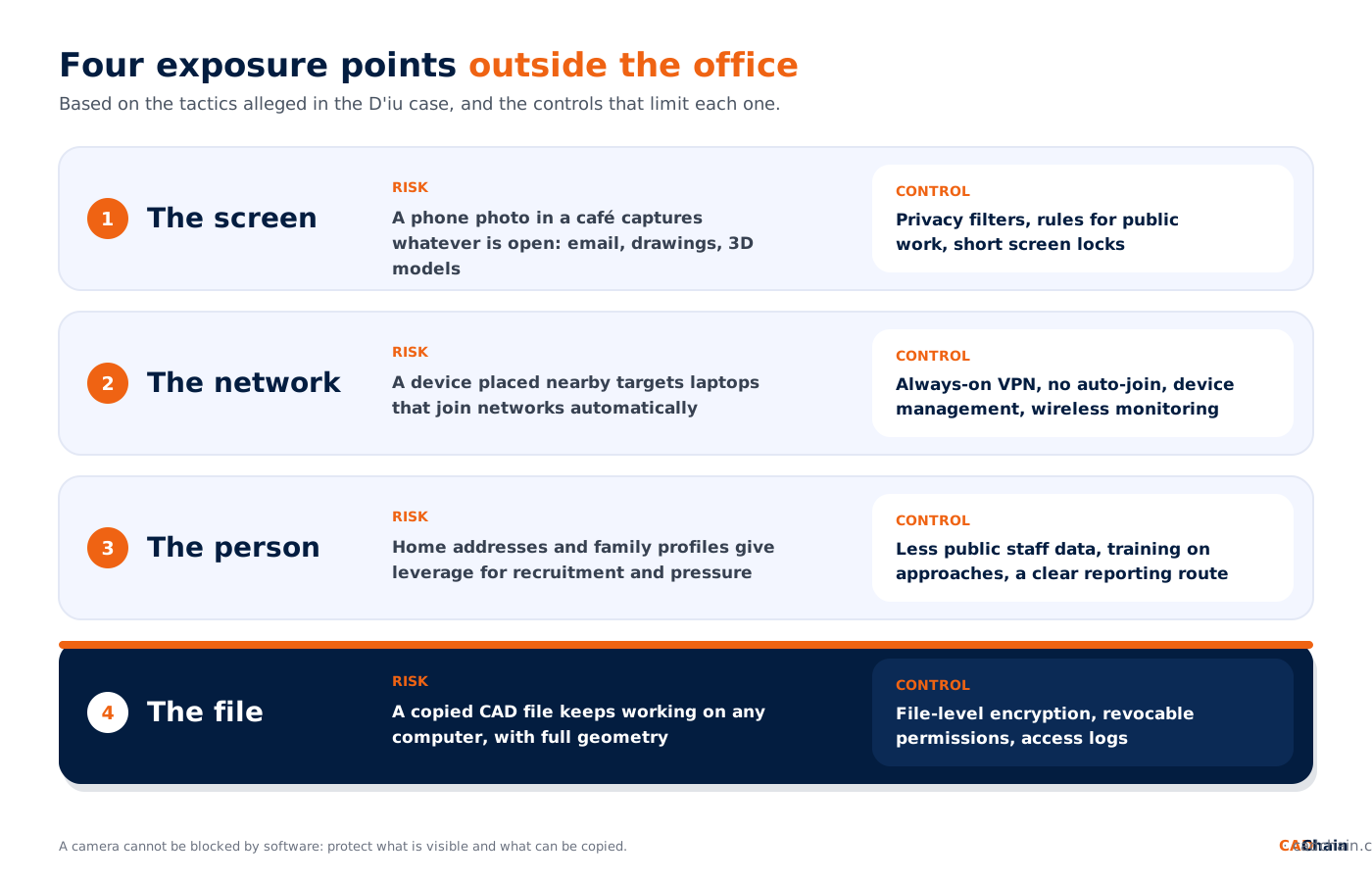
Because a screen shows information after every other control has done its job. Encryption, access rights and network security protect a file on its way to an authorised person. Once that person opens it in a public place, anyone with a line of sight and a phone camera can capture what is displayed: an email thread, a customer list, a slide on a new programme or a 3D model of a part under development. A photo leaves no trace in any log.
We have written before about how screenshots, screen recordings and phone photos leak engineering designs. In most of those cases the person holding the camera is an insider. This case adds an outside observer who never touches the company's systems. Our guide to industrial espionage tactics against CAD files describes the wider toolkit, from fake suppliers to recruitment approaches.
The second tactic, placing a computer near the office for remote access, points at a different weakness: devices that look for wireless networks and connect automatically, and staff who join whatever network seems to belong to the café or the company. The third, collecting home addresses and following staff, is about pressure and recruitment. Profiles of employees and their families are the raw material for social engineering attacks and for approaches outside work.
How does the case fit other espionage against defence and deep-tech firms?
It is the latest in a run of cases that show state actors treating technology companies and their staff as targets. In October, German federal prosecutors announced the arrest of a man suspected of gathering information on the defence industry for Russia, a case we covered in Russian spy arrested in Germany over defence industry contacts. On the cyber side, the Russia-linked group APT28 targeted a NATO naval shipbuilder, as described in our article on APT28 and European engineering suppliers, and the UK's cyber agency said in its NCSC Annual Review 2026 that cyber espionage is the biggest threat to long-term growth.
Physical and human methods appear in other recent cases too. An engineer who worked at OpenAI has been charged with planting a hidden recording device in an executive meeting room, a case we analysed in what the OpenAI hidden recording device case teaches about insider threats. The pattern is consistent: attackers go where the information is visible or audible, not only where it is stored.
What does this mean for engineering teams and their design files?
Engineers often work outside the office: at a client site, on a train, in a hotel lobby or at the café next door. Design reviews, supplier calls and CAD work happen on laptops. If a foreign service is willing to send someone to photograph the screens of a software company's staff, a team developing drones, chips, medical devices or energy systems should assume the same can happen to it.
A photo of a screen captures one view. A stolen or copied file is far more valuable, because it contains full geometry, tolerances and history. That is why the strongest protection sits on the file itself. With DRM access control levels for CAD files, a model can be opened only by named users, for a set period, with view, edit, print and export rights set separately. A zero trust model for CAD file distribution assumes that any network, including the café Wi-Fi, may be hostile.
Work on the move also raises the question of what happens without a connection. Our article on offline access management for CAD DRM explains cached permissions and time-limited keys, so that protection does not stop at the edge of the office network. And because a camera cannot be blocked by software, digital watermarking of CAD geometry helps to trace a leaked model back to its source.
Make sure a copied CAD file is not a usable one. CADChain encrypts CAD files at file level, lets you grant and revoke access per user and per partner, records ownership on a blockchain and logs every access, across CAD systems.
👉 See how CADChain protects CAD files
What should deep-tech founders and security teams do now?
- Set rules for public places. Decide which documents and models may be opened outside the office, and say so plainly. Sensitive design reviews do not belong in a café.
- Fit privacy filters and short screen locks. Give staff in exposed roles privacy screen filters and set laptops to lock quickly when idle.
- Harden wireless behaviour. Turn off automatic joining of open networks, require an always-on VPN on company devices and keep them under device management.
- Watch the area around your offices. Ask your security provider about monitoring for unknown wireless devices near sites where sensitive work happens.
- Protect staff data. Limit the personal information about employees that the company publishes, and help people in sensitive roles reduce what is findable about their homes and families.
- Give people a reporting route. Tell staff whom to call if they are approached, photographed or followed, and treat reports seriously. The employee in this case called 911, which was the right move.
- Protect the file, not only the device. Use file-level encryption and permissions that travel with each CAD file, so that a copy taken from a laptop or a network does not open for the wrong person.
- Keep evidence ready. Keep dated ownership records and access logs, so you can show what was yours and who used it if an incident ever reaches a court. Our trade secrets guide for deep tech startups explains why reasonable protection steps matter legally.
How does this fit the bigger picture?
Our sister sites covered other sides of the same question this week: where valuable work is exposed, and who controls it.
- Wikis as a target. Attackers are exploiting an old Apache Axis flaw in Confluence Data Center when its Remote API is switched on. BORIS Inventor explains the Confluence vulnerability and what engineering wikis should check.
- Where results live. SOLIDWORKS Simulation 2027 lets Plastics users store study results in a custom location, separate from the CAD files. Solidboris.com looks at what is new in SOLIDWORKS Simulation 2027 and how to handle simulation results.
- Consent for creative work. Irish artists told a parliamentary committee that their work is being scraped for AI training without permission. Blended BORIS reports what Irish artists asked for on AI scraping.
The thread running through all four stories is that information leaks where people work with it, not only where it is stored. Our list of ways employees accidentally leak CAD files is a practical checklist for closing the everyday gaps.
Conclusion
The case against Igor D'iu is still at an early stage, and the allegations have not been tested in court. The company has not been officially named, and nothing reported so far shows that any data was taken. But the methods described by prosecutors are a clear warning: a foreign service allegedly tried to gather information from a technology company by watching its employees' screens, placing equipment near its office and mapping where its people live.
For deep-tech founders and engineering managers, the practical answer has three parts. Reduce what is visible in public, harden the devices and networks your staff use on the move, and protect the design files themselves so that a copy is not a usable design. People will keep working in cafés. Your most valuable CAD files should stay under your control wherever that is.
Keep control of your CAD files wherever your engineers work. CADChain gives every CAD file file-level encryption, granular permissions you can revoke at any time, a blockchain ownership record and a full access log, across CAD systems, suppliers and partners.
👉 Protect your CAD files with CADChain
FAQ: the Russian spy case in Silicon Valley
Who is Igor D'iu?
Igor D'iu is a Russian national whom the US Justice Department accuses of acting as an agent of the Russian government. The indictment, announced on 18 November 2026 and filed in the Northern District of California, says he surveilled employees of a Silicon Valley technology and defence company. He has not been convicted.
Is the target company Palantir?
The charging documents do not name the company. Bloomberg and Reuters reported, citing people familiar with the matter, that it was Palantir Technologies. Palantir did not immediately respond to requests for comment.
What is he charged with?
Four charges: conspiracy to act as an agent of a foreign government, acting as an agent of a foreign government without notifying the Attorney General, interstate stalking, and fraud involving identity documents.
What did he allegedly do?
Prosecutors say he photographed employees' laptop screens in a coffee shop near the company's Palo Alto office, was told to place a computer near the office for remote access, collected home addresses and followed staff, including one employee for nearly 30 miles on 3 September 2026.
Was any company data stolen?
None of the reports published by 19 November 2026 says that company data was obtained. The case is about the alleged surveillance and the methods used.
When is the next court date?
He is due in court on 24 November 2026, according to AP and Euronews. He was arrested on 30 October and remains in custody.
How can engineering teams protect designs outside the office?
Set rules for public work, use privacy filters and short screen locks, turn off automatic joining of open networks, use an always-on VPN, and protect CAD files with file-level encryption and revocable permissions.
How does CADChain help?
CADChain encrypts CAD files at file level, sets per-user and per-partner permissions that can be revoked, records ownership on a blockchain and logs every access, so a copied file does not open for the wrong person.