TL;DR: intellectual property law in 60 seconds
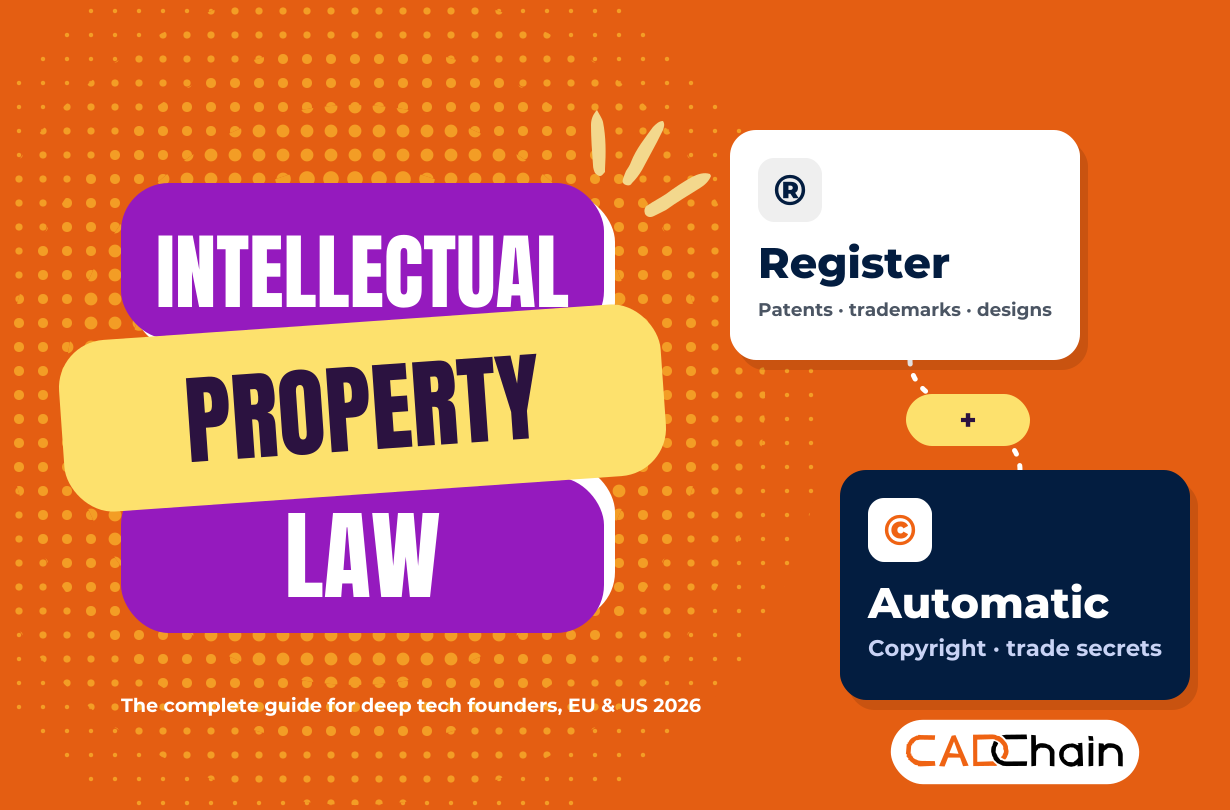
Intellectual property law is the body of law that gives people and companies exclusive rights over creations of the mind: inventions, brands, creative works, designs and confidential know-how. The four main types are patents, trademarks, copyright and trade secrets, with design rights, database rights and a few specialist rights alongside them.
For a deep tech startup, IP is usually the most valuable thing the company owns, and the first thing investors check. This guide explains each right in plain language, how the EU and US rules differ, what protection costs, the deadlines that can wipe out your rights, how AI changes the picture, and a stage-by-stage IP strategy you can follow from idea to Series A.
Key takeaways
- IP law protects intangible assets. Some rights arise automatically (copyright, trade secrets, unregistered designs); others must be registered (patents, trademarks, registered designs).
- IP rights are territorial: a US patent does nothing in Germany. Treaties such as Paris, PCT and Madrid make filing abroad easier, but you still need rights in each market.
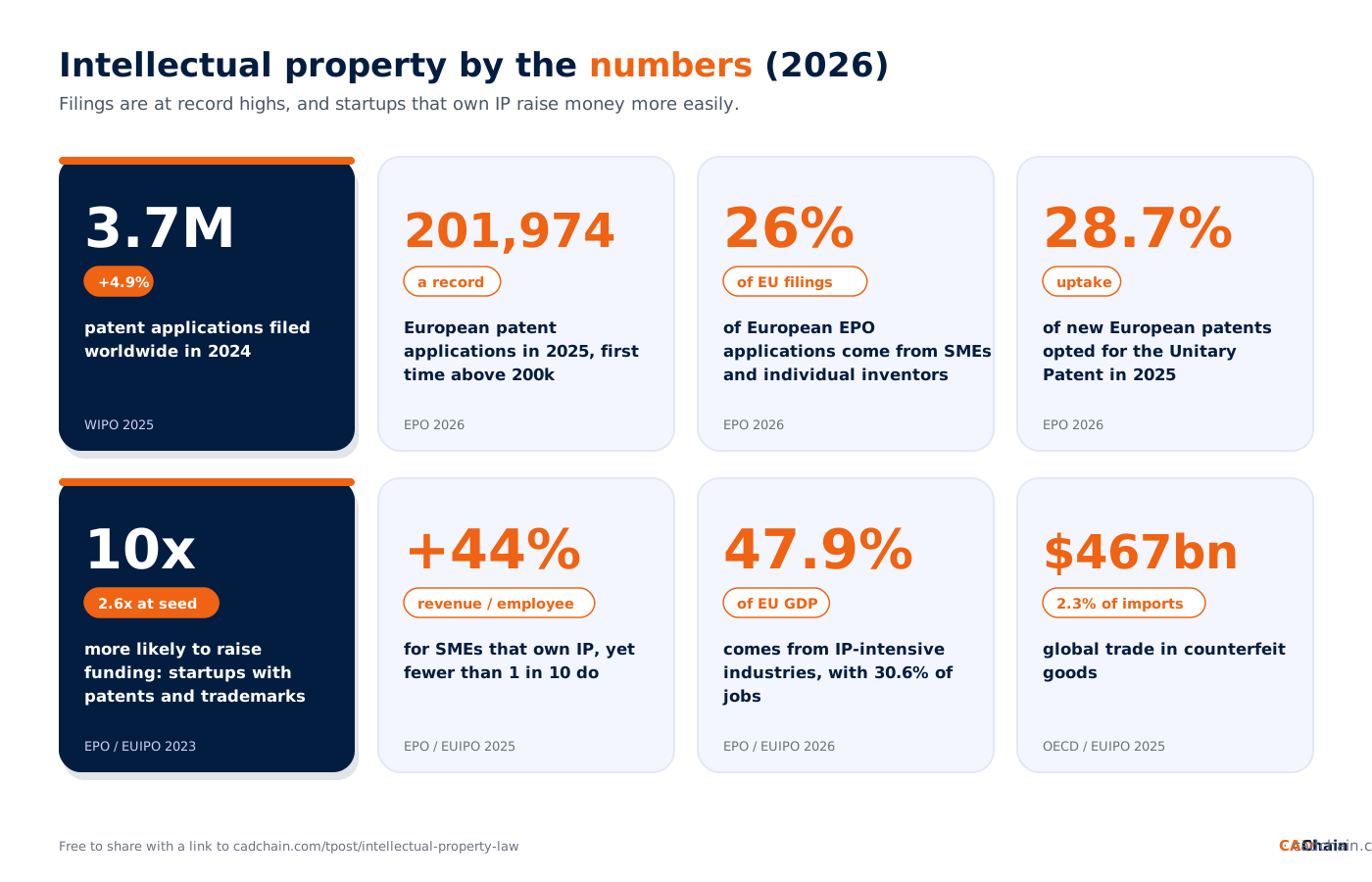
- Filings are at record highs: 3.7 million patent applications worldwide in 2024 and 201,974 at the European Patent Office in 2025.
- Startups that own patents and trademarks are up to 10x more likely to raise funding (EPO/EUIPO, 2023), yet fewer than 1 in 10 EU SMEs own any registered IP.
- The most expensive mistakes are cheap to avoid: publishing before filing, missing the 12-month priority deadline, and not getting IP assignments from founders and contractors.
What is intellectual property law?
Intellectual property law is the set of national laws and international treaties that grant creators and owners exclusive, time-limited rights over intangible creations of the mind, such as inventions, brand names, software, designs and confidential information, and that let them stop others from copying or using those creations without permission.
WIPO, the UN agency for intellectual property, describes IP simply as "creations of the mind". The law turns those creations into assets you can own, license, sell, use as collateral and enforce in court, just like physical property. Unlike physical property, most IP rights expire, and all of them are limited to the countries that grant them. How to value those assets, show them on the balance sheet and borrow against them is covered in our guide to intellectual property as a business asset.
Intellectual property law vs intellectual property rights
The two terms are often used interchangeably, but there is a difference. IP law is the whole system: statutes, treaties, case law, patent offices and courts. IP rights are the individual entitlements that system gives you, such as your European patent, your EU trademark or the copyright in your source code. You build an IP strategy out of rights; the law decides what those rights are worth. For what each right lets you stop, its limits and how rights are licensed, see our guide to intellectual property rights.
Industrial property vs copyright
Traditionally, IP is split into two families. Industrial property covers patents, utility models, trademarks, industrial designs and geographical indications, and is governed internationally by the Paris Convention (1883). Copyright and related rights cover literary, artistic and software works and are governed by the Berne Convention (1886). Trade secrets sit alongside both and are protected through unfair competition law.
Why IP law exists
IP law is a trade-off. Society grants a temporary monopoly so that people have a reason to invest in invention and creativity, and in return the public gets something: patents must disclose how the invention works, and every right except trademarks and trade secrets eventually expires and enters the public domain. That bargain explains most of the rules you will meet, from patent publication at 18 months to copyright's fixed term.
The 4 main types of intellectual property
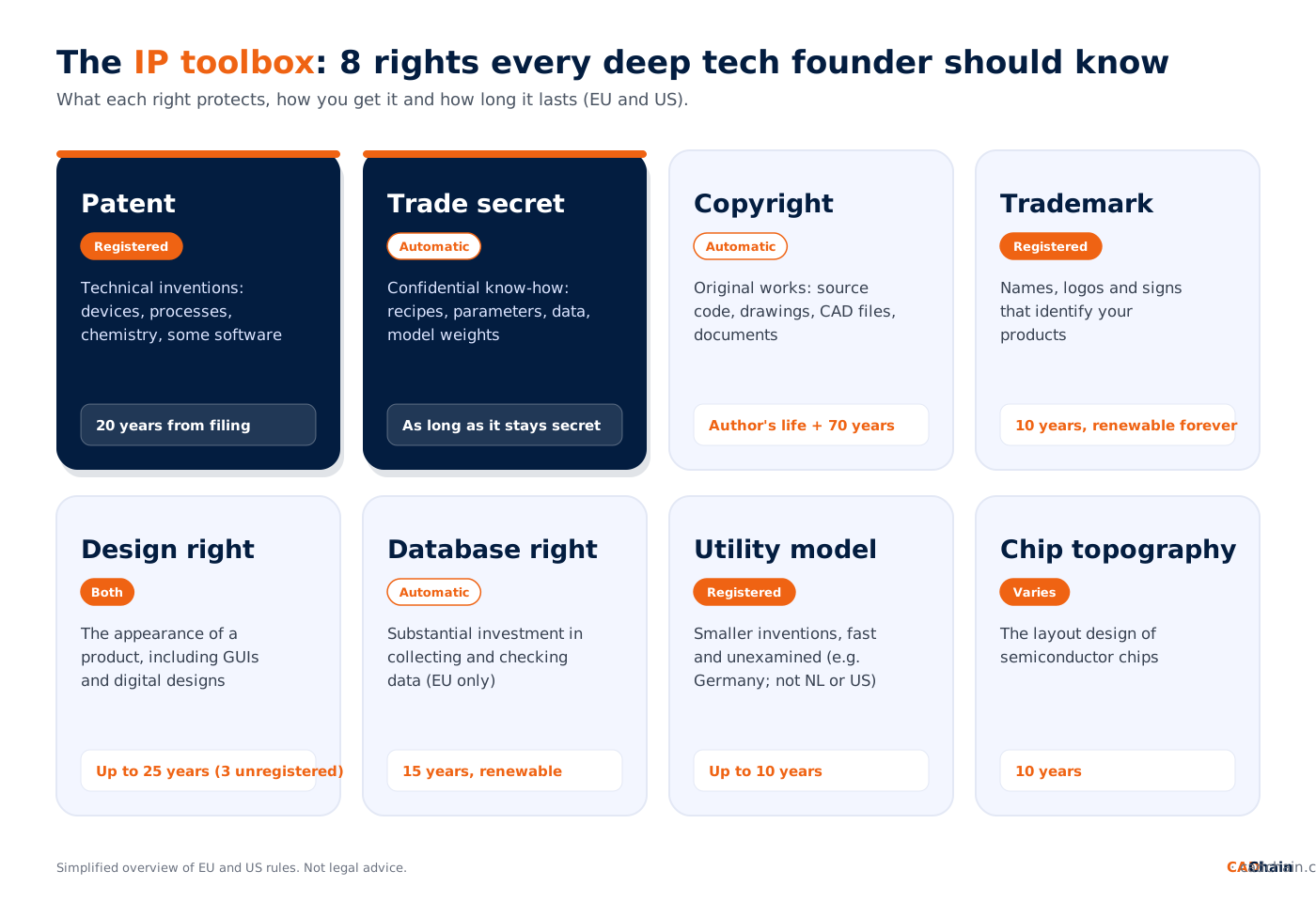
- Patents protect technical inventions: new devices, processes, materials and, within limits, software. Up to 20 years from filing.
- Trademarks protect brand signs such as names, logos and slogans. Renewable every 10 years, potentially forever.
- Copyright protects original works, including source code, drawings, CAD files and documentation. Automatic, lasting the author's life plus 70 years.
- Trade secrets protect valuable confidential information, such as process recipes, model weights or customer lists, for as long as it stays secret.
Patents
A patent gives you the right to stop others from making, using, selling or importing your invention for up to 20 years. To be patentable in Europe, an invention must be new, involve an inventive step and be industrially applicable (EPC Articles 52–57); the US tests are novelty, non-obviousness and utility (35 U.S.C. §§101–103). The price is disclosure: the application is published about 18 months after filing, so the world learns how your invention works.
Some countries, such as Germany, also offer utility models: cheaper, faster, unexamined rights for smaller inventions, lasting up to 10 years. The Netherlands abolished its short-term patent in 2008, and the US has no equivalent.
For a deep dive on patents, read our guide to intellectual patent rights.
Trademarks
A trademark protects the signs customers use to recognise you: your company name, product names, logos, even sounds and colours. It must be distinctive, and it cannot simply describe the product. Trademarks are the only major right that can last forever, as long as you keep using and renewing them. Clear your name before you launch: rebranding after a dispute is far more expensive than a search.
Copyright
Copyright protects the expression of an idea, not the idea itself. It arises automatically when an original work is created, with no registration needed (Berne Convention Art. 5(2)). For deep tech companies it covers source code, firmware, documentation, technical drawings and CAD models. It does not protect the functionality behind them, which is why software companies often combine copyright with patents and trade secrets.
Trade secrets
A trade secret is any valuable information you keep confidential with reasonable measures: process parameters, training data, model weights, supplier terms. There is no registration and no expiry date, but protection ends the moment the secret leaks or a competitor discovers it independently. For many early-stage deep tech startups, trade secrets are the first and cheapest line of defence. We cover them in depth in our trade secrets guide.
Other IP rights founders overlook
Industrial designs
Design rights protect how a product looks: its shape, lines, colours and ornamentation. The EU overhauled its design system in 2025–26 (Regulation (EU) 2024/2822): the "Community design" became the EU design, and protection now explicitly covers animated designs, graphical user interfaces and designs of non-physical products, which matters for 3D models and digital twins. A registered EU design lasts up to 25 years; an unregistered EU design gives 3 years of protection against copying from first disclosure in the EU.
Designs have something patents in Europe lack: a 12-month grace period. You can show your product and still file a valid design application within a year.
Database rights
The EU (but not the US) grants a sui generis right to anyone who has made a substantial investment in obtaining, verifying or presenting the contents of a database (Directive 96/9/EC). It lasts 15 years and is renewed by each substantial new investment. Curated sensor datasets and test libraries can qualify.
Semiconductor topographies
The layout of a chip is protected by a dedicated right in the EU (Directive 87/54/EEC) and the US (Semiconductor Chip Protection Act, 17 U.S.C. §§901–914) for 10 years. In practice, chip designers rely more on patents and trade secrets, but the right exists and can matter in disputes over copied layouts.
Plant varieties, geographical indications and domain names
Plant variety rights protect new plant varieties (25–30 years in the EU) and matter for agritech and synthetic biology. Geographical indications protect names linked to a place, and since December 2025 the EU also protects craft and industrial products this way. Domain names are not IP rights in themselves, but disputes over them are decided using trademark law, so register your trademark before your domain becomes valuable.
Intellectual property law examples from deep tech
- Patent cross-licensing: ASML and Carl Zeiss settled their immersion lithography patent disputes with Nikon in 2019 for €150 million in total, plus a cross-licence. Even market leaders end up licensing.
- Strategic patent pledges: in 2014 Tesla said it "will not initiate patent lawsuits against anyone who, in good faith, wants to use our technology". The pledge was conditional, and Tesla kept its patents; in 2023 it sued a supercapacitor maker.
- Standards and licensing pools: carmakers license 4G and 5G patents through pools such as Avanci, whose 5G vehicle licence costs $32 per car. Owning standard-essential patents can be a business model in itself.
- Smaller company vs giant: in November 2025 a US jury awarded Masimo $634 million against Apple for patent infringement over blood-oxygen technology (Apple is appealing).
- Inherited licences: lidar maker Ouster's patent case against Hesai at the US ITC was terminated in 2023 because a licence signed by Velodyne, which Ouster later merged with, covered Hesai. Check the licences you inherit in any deal.
- Trade secrets and people: the biggest IP losses in deep tech often come from departing employees. See our trade secrets guide for the Waymo, ASML and Motorola cases.
How long does IP protection last?
A short history of intellectual property law
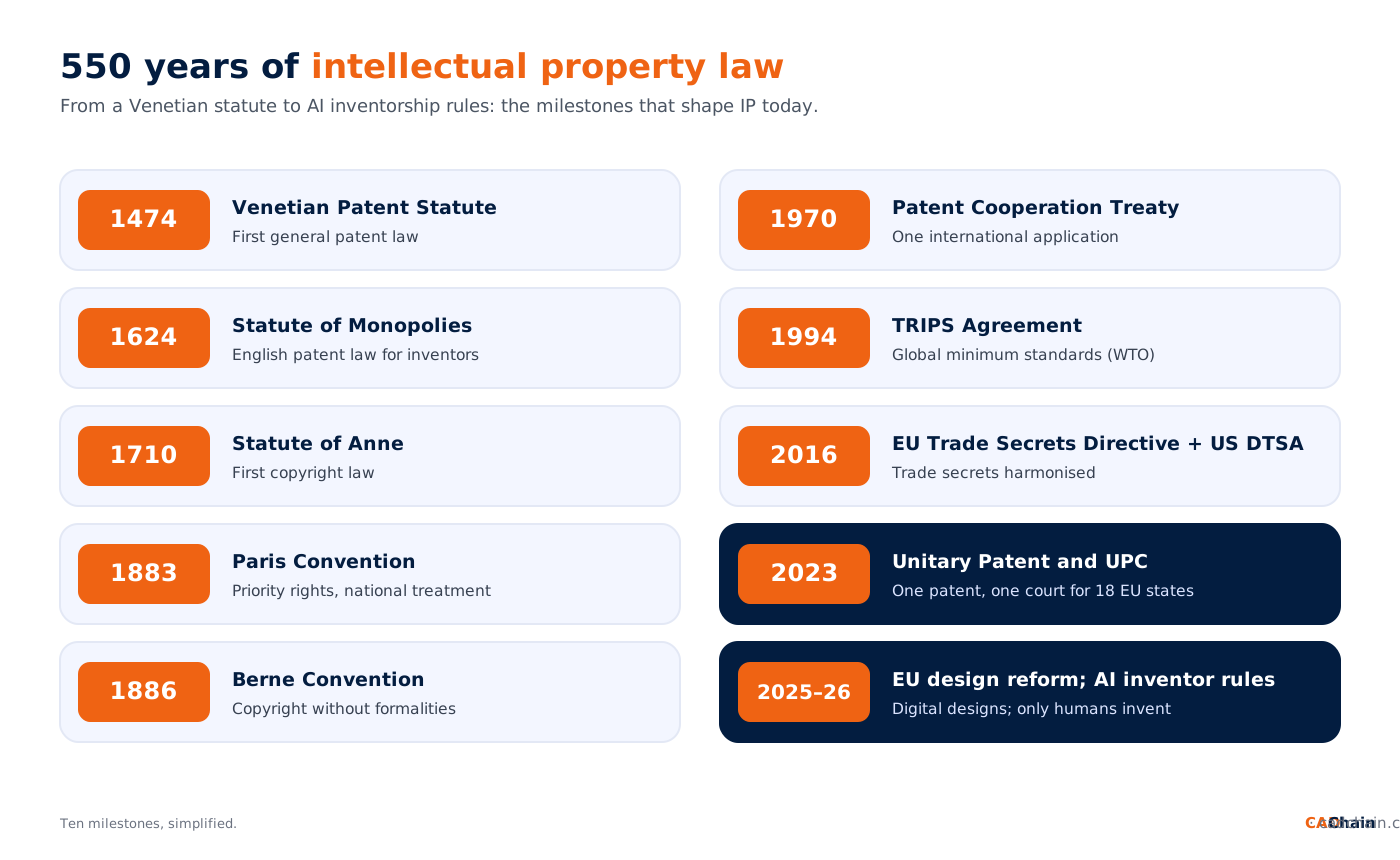
Modern IP law is more than 550 years old. Venice passed the first general patent statute in 1474, England's Statute of Monopolies (1624) limited patents to genuine inventors, and the Statute of Anne (1710) created the first copyright law. The Paris (1883) and Berne (1886) Conventions internationalised IP, and the TRIPS Agreement (1994) made minimum IP standards a condition of WTO membership. The most recent milestones are European: the Unitary Patent and Unified Patent Court in 2023, and the EU design reform in 2025–26.
International IP law and treaties
There is no such thing as a worldwide patent or trademark. IP rights are territorial, so you need protection in each market that matters to you. What treaties do is make that cheaper and simpler:
The European patent, the Unitary Patent and the UPC
Since 1 June 2023, a granted European patent can be turned into a Unitary Patent covering 18 EU countries with a single renewal fee, and enforced in one action at the Unified Patent Court (UPC). Uptake reached 28.7% of granted European patents in 2025 (EPO Technology Dashboard 2025). The EPO estimates a Unitary Patent costs up to 85% less to maintain than a classic European patent validated in the same 18 states (EPO). The trade-off is central risk: a single revocation action can wipe out protection in all 18 countries at once.
For a country-by-country view of IP protection for design data, see our guide to IP protection laws by country.
IP law in the EU vs the US: key differences
The grace-period trap: in the US, you can publish a paper and still file a patent application within a year. In Europe, the same paper destroys novelty on day one. Many founders lose European patent rights by pitching, presenting or publishing before filing. The rule of thumb: file first, talk later.
IP for AI, software, CAD and hardware
Can AI be an inventor or an author?
No, not under current law. In the DABUS cases, the EPO Legal Board of Appeal (J 8/20, 2021), the US Federal Circuit (Thaler v Vidal, 2022) and the UK Supreme Court (2023) all held that an inventor must be a human. The USPTO's revised guidance of November 2025 treats AI as a tool: a human who conceives the invention can be the inventor even if AI assisted. On copyright, the US Supreme Court declined on 2 March 2026 to hear Thaler v Perlmutter, leaving in place the rule that purely AI-generated works have no copyright. Human selection, arrangement and editing can still be protected.
Training data, models and the courts
- EU AI Act: since 2 August 2025, providers of general-purpose AI models must have a copyright compliance policy, respect text-and-data-mining opt-outs and publish a summary of their training content (Art. 53). The Commission's enforcement powers apply from August 2026.
- Germany: in GEMA v OpenAI (Munich, November 2025) the court held that memorising song lyrics in model parameters is a reproduction not covered by the text-and-data-mining exception. In Kneschke v LAION (Hamburg), building a training dataset was allowed under the research exception.
- UK: in Getty Images v Stability AI (November 2025), the High Court held that model weights trained on images are not themselves an "infringing copy".
- US: Bartz v Anthropic ended in a $1.5 billion settlement, approved in 2026, after the court found that training on lawfully acquired books was fair use but that building a library from pirated copies was not.
For founders, the practical points are: keep records of where your training data comes from, respect opt-outs, keep model weights and data confidential (they are usually protected as trade secrets, not patents or copyright), and do not assume AI-generated code or designs are yours to protect. For engineering teams, we discuss the design side in generative AI and CAD IP.
Protecting software
Software is protected by copyright automatically (the EU Software Directive 2009/24/EC treats programs as literary works). Patents are possible for software that solves a technical problem in a technical way, but they are harder to get in both the EU and the US. Algorithms, architectures and know-how that you do not ship are usually best kept as trade secrets. Watch open-source licences: GPL code embedded in a device you distribute can force you to release your own source, and AGPL extends this to software offered over a network.
Protecting CAD files and hardware designs
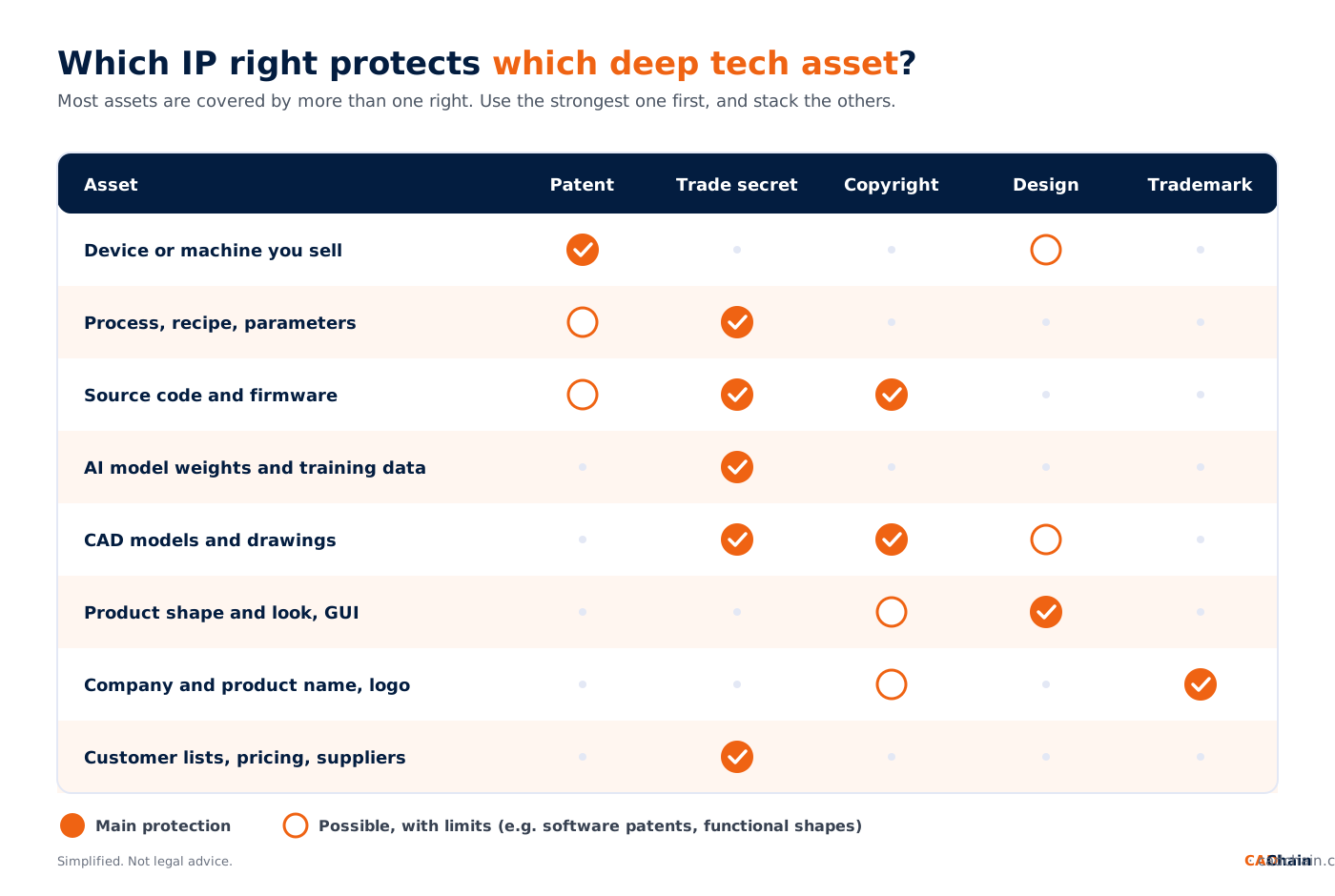
Hardware companies can stack rights: patents for the technical solution, design rights for the product's appearance, copyright for drawings and CAD models, and trade secrets for tolerances, processes and supplier know-how. In the EU, copyright can even protect a functional product shape if it reflects free creative choices (Brompton, CJEU 2020), unlike in the US. The weak point is sharing: every RFQ, supplier and contractor is a potential leak. See CAD file protection basics and how to share CAD files securely.
Who owns the IP? Founders, employees, contractors and universities
Owning IP is not automatic. As US Chief Justice Roberts wrote in Stanford v Roche (2011): "Since 1790, the patent law has operated on the premise that rights in an invention belong to the inventor." Unless the right documents are signed, the person who created something owns it, not the company that paid for it.
Founder IP assignment
Code, designs and inventions created before the company was incorporated belong to the founders personally. Every founder should sign an IP assignment to the company, ideally with the share issue. Use present-tense wording ("hereby assigns"), not a promise to assign later; in Stanford v Roche the difference between "agree to assign" and "do hereby assign" decided who owned a patent.
Employee inventions
- Netherlands: under Article 12 of the Dutch Patents Act (ROW 1995), an employer owns an invention if the nature of the job involves using the employee's special knowledge to make such inventions. The employee is entitled to fair compensation if their salary does not already reflect it, and a contract cannot exclude that right.
- Germany: the Employee Inventions Act requires employees to report inventions; the employer is deemed to claim them unless it releases them within four months, and must then pay statutory compensation.
- US: inventions belong to the inventor unless assigned, so employment agreements must contain an assignment clause. Some states, such as California, limit assignments of inventions made on the employee's own time.
More detail in our guide to employee IP agreements.
Contractors and freelancers
This is the most common gap in startup due diligence. In the US, "work made for hire" applies to copyright only, and covers contractors only in a few listed categories, never patents. In the Netherlands, employers own copyright in work made by employees, but a freelancer keeps copyright unless it is transferred by a signed deed. Paying an invoice does not transfer IP. Get a written assignment from every contractor, agency and advisor before work starts.
University spin-outs
If your technology comes out of a university, the university usually owns the IP and will license or assign it in exchange for equity, royalties or both. Dutch universities adopted national, non-binding deal term principles in 2023, updated in 2025, to make spin-out negotiations faster and more predictable. Negotiate milestones, a research licence back to the university and who pays for patent costs, and make sure the final licence covers everything your product needs.
How to build an IP strategy, step by step
1. Audit what you have
List your intangible assets: inventions, software, data, designs, brand names, know-how, customer and supplier information. For each, record who created it, when, and whether the company actually owns it. This is also the moment to fix missing assignments.
2. Choose the right protection for each asset
Ask two questions. Can a competitor see or reverse engineer it from your product? Is it worth the cost and disclosure of a patent? Visible, valuable inventions usually go to patents; invisible process know-how, data and model weights usually stay trade secrets; the brand gets a trademark; the product's look gets a design. Our trade secrets guide includes a decision tree for the patent-or-secret choice.
3. File in the right order
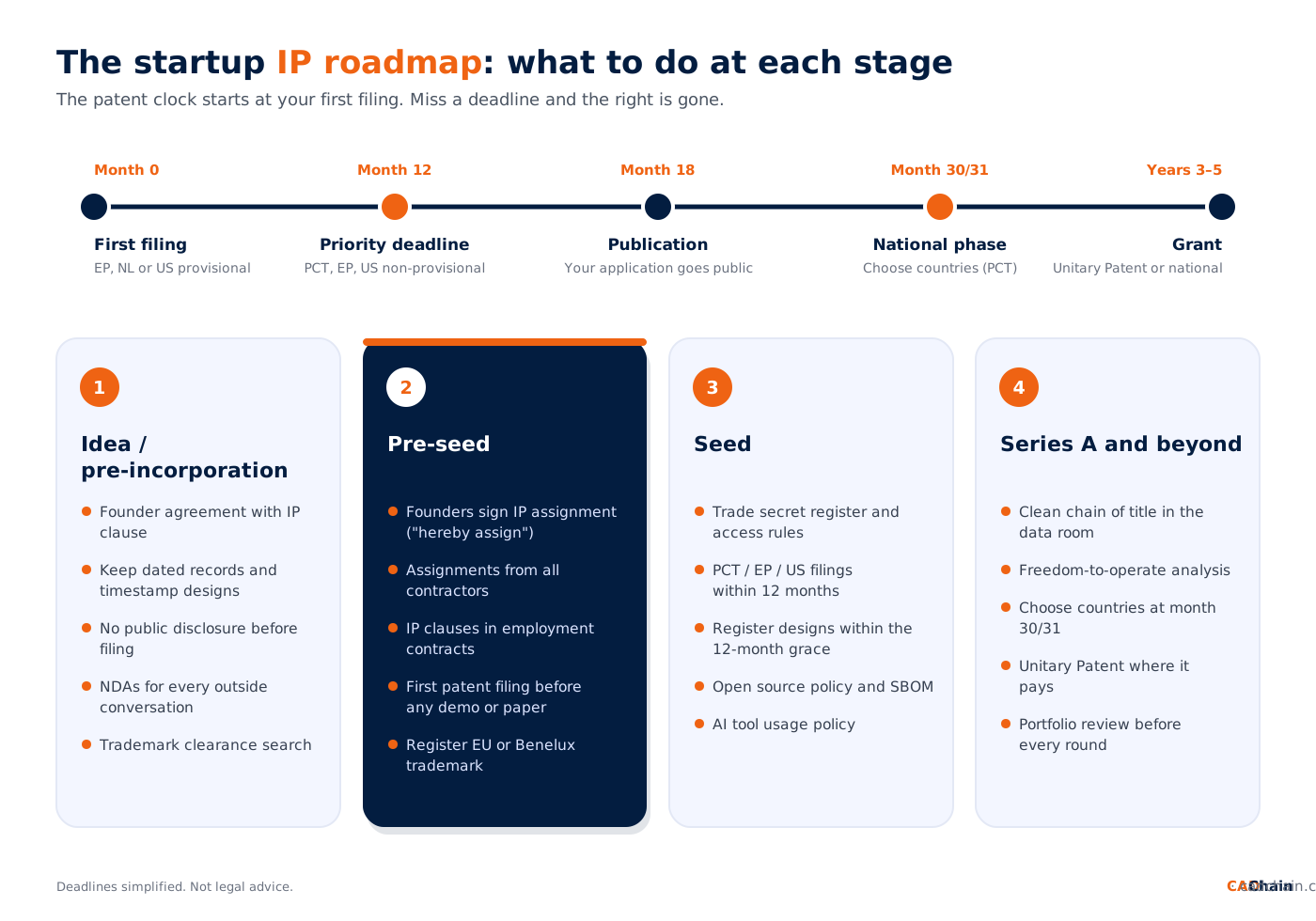
Make a first filing before any public disclosure, pitch deck in the open, paper or demo. That filing sets your priority date. Within 12 months, file abroad (usually a PCT application and/or a European application, and a US application). At month 30 (31 at the EPO), choose the countries where you really need protection. Budget accordingly: most of the cost arrives at the national phase and at grant.
4. Check freedom to operate
Owning patents does not mean you are free to sell your product: someone else's patent may cover it. A freedom-to-operate search before launch, and a formal analysis before a large round, reduces the risk of an injunction later.
5. Use the support schemes
- USPTO: small entities pay 60% less and micro entities 80% less in most fees; a provisional application costs $65–$325.
- EPO: since April 2024, micro-enterprises, individuals, universities and non-profits get a 30% reduction on the main fees (if they filed fewer than 5 European applications in the past 5 years).
- Unitary Patent: EU-based SMEs filing in a non-English/French/German language can claim €500 translation compensation.
- EUIPO SME Fund 2026: vouchers for EU SMEs; the patent vouchers are still available, the trademark and design vouchers ran out in August 2026.
- Netherlands: the WBSO R&D tax credit reduces the wage cost of R&D work, including the work that produces your IP.
6. Record, monitor and review
Keep dated evidence of what you created and when, especially for things you do not patent. Monitor competitors' filings and trademark registers, review your portfolio before every funding round, and drop rights that no longer earn their renewal fees.
Intellectual property statistics (2026)
Use these figures freely, with a link to this page as the source.
IP in fundraising and due diligence
Investors buy future cash flows, and in deep tech those depend on the company owning, and being free to use, its technology. As one Fenwick partner put it: "Investors will ask about your IP protections—if you don't have an answer, it raises red flags." Expect these checks:
- Chain of title: signed assignments from every founder, employee, contractor and advisor, and any university licence.
- Filings: what is filed where, who the inventors and owners are, upcoming deadlines and costs.
- Freedom to operate: known third-party patents and how you avoid them.
- Open source: a software bill of materials, with GPL/AGPL components flagged.
- Trade secrets: a register and evidence of reasonable protection measures.
- AI: where training data came from, and which outputs you claim to own.
Good records make due diligence faster and cheaper. Audit trails and dated proof of file ownership answer many of these questions before they are asked.
IP infringement and enforcement
What counts as infringement
Infringement is doing something that only the right holder may do, without permission: making or selling a patented product, using a confusingly similar trademark, copying protected code or designs, or using a trade secret obtained unlawfully. Independent creation is a defence for copyright and trade secrets, but not for patents or registered designs.
Remedies
Across the EU, the Enforcement Directive (2004/48/EC) gives right holders evidence-preservation orders, injunctions, recall of infringing goods, damages and recovery of reasonable legal costs. In the Netherlands, patent cases go exclusively to the District Court of The Hague. In the US, courts award at least a reasonable royalty for patent infringement and up to three times damages for wilful infringement, but injunctions are discretionary. EU customs can also seize counterfeit goods at the border.
Enforcing in Europe: the UPC
The UPC can grant an injunction covering all participating countries in one action, and it has become busy quickly, with hundreds of infringement actions since 2023, most of them filed at the German local divisions. For a startup, that cuts both ways: it is easier to enforce your patents across Europe, and easier for others to enforce theirs against you.
What to do if you are accused of infringement
Do not ignore a cease-and-desist letter, and do not reply on impulse. Preserve documents, check whether the right is valid and actually covers your product, look for prior art, and get a specialist's view before responding. Many disputes end in a licence or a design change rather than in court. For steps when your own designs are taken, see legal steps after CAD theft.
When to hire an IP lawyer or patent attorney
A patent attorney (European or US) drafts and prosecutes patent applications; an IP lawyer handles contracts, licensing, disputes and litigation. You need specialist help before your first patent filing, before signing a university licence or acquisition, when you receive or send a cease-and-desist letter, and before a large funding round. You can do a lot yourself: trademark searches, a trade secret register, IP clauses checked against a template, and good records.
10 common IP mistakes startups make
- Publishing, pitching or demoing before filing, and losing novelty in Europe.
- No IP assignment from founders for work done before incorporation.
- Contractors and agencies who still own the code or designs they delivered.
- "Agree to assign" wording instead of "hereby assign".
- Ignoring statutory inventor compensation in the Netherlands and Germany.
- Missing the 12-month priority deadline or the 30/31-month PCT deadline.
- Launching a brand without a trademark search.
- Unmanaged GPL or AGPL code in shipped products.
- Assuming AI-generated output is protected and owned.
- No records: unable to prove what you had, when, and who created it.
A single leak can be expensive: see the true cost of CAD IP theft for SMEs and how to prevent IP theft by former employees.
How CADChain helps hardware teams protect their IP
For engineering companies, most of the IP lives in CAD files, and most of the risk comes from sharing them. Copyright, design rights and trade secrets all depend on being able to show what you created and when, and that you controlled who could see it. Courts increasingly accept tamper-proof digital timestamps as evidence; see blockchain evidence in IP litigation.
BORIS by CADChain works inside your CAD software. It registers each design version with a blockchain-timestamped certificate of ownership, so you have dated proof of what you created without disclosing it, and lets you share files with suppliers under access control with CAD DRM. That covers the record-keeping and secure-sharing steps of your IP strategy.
👉 See how BORIS protects your CAD designs
Conclusion
Intellectual property law can look like a maze of rights, treaties and deadlines, but the logic for a deep tech founder is simple. Make sure the company owns what its people create. Keep secret what competitors cannot see. Patent what they can see and what investors need protected, and file before you talk. Register your brand early. And keep records good enough to prove all of it. Do that from day one and IP becomes what it should be: the asset that makes your startup fundable and defensible.
This guide is general information, not legal advice. Talk to a patent attorney or IP lawyer in your jurisdiction before making decisions about specific inventions or disputes.
FAQ: intellectual property law
What is intellectual property law in simple terms?
It is the set of laws that lets you own creations of the mind, such as inventions, brands, software and designs, and stop others from copying or using them without permission for a set period.
What are the 4 types of intellectual property?
Patents, trademarks, copyright and trade secrets. Design rights, database rights, utility models, plant variety rights and geographical indications are additional, more specialised rights.
What is the difference between IP law and IP rights?
IP law is the whole legal system (statutes, treaties, courts and offices). IP rights are the individual entitlements it grants, such as a specific patent or trademark.
Can you patent an idea?
No. You can patent a concrete technical invention that is new and inventive, not an abstract idea. Ideas can be protected as trade secrets while kept confidential.
Do I need to register copyright?
No, copyright is automatic in the EU and in all Berne Convention countries. In the US, registration is needed before suing over a US work and unlocks statutory damages.
Is IP protection international?
No. IP rights are territorial. Treaties such as the PCT, Madrid and Hague systems make it easier to file in many countries, but you still need rights in each one.
How much does a patent cost in Europe?
Official EPO fees to grant average about €6,800, before attorney fees and validation or Unitary Patent renewal fees. Micro-entities can get a 30% reduction on the main fees.
Who owns IP created by an employee or contractor?
It depends on the country and the contract. Employers often own employee inventions and copyright, but contractors usually keep their rights unless they sign an assignment. Always get it in writing.
Can AI be named as an inventor?
No. The EPO, the US, the UK and other major systems require a human inventor. AI-assisted inventions can be patented if a human made a significant contribution.
Who owns AI-generated content?
Purely AI-generated material is not protected by copyright in the US, and EU law requires a human author's own intellectual creation. Human selection, editing and arrangement can be protected.
What is the Unitary Patent?
A single European patent covering 18 EU countries since June 2023, with one renewal fee and enforcement at the Unified Patent Court.
Is a domain name intellectual property?
Not in itself, but domain disputes are resolved under trademark law, so a registered trademark is the best way to protect a valuable domain name.
What happens if I infringe someone's IP?
You can face an injunction, damages, destruction of infringing goods and legal costs. Many disputes settle with a licence or a design change. Get advice before replying to a demand letter.
Why is IP important for startups?
IP is often a deep tech startup's main asset. It protects your lead, supports valuation and licensing, and is checked in every investment and acquisition.