Emerging technologies 2026: the top 10 lists compared, and proven secrets to business success for founders
TL;DR: What are the top emerging technologies of 2026?
The World Economic Forum's Top 10 Emerging Technologies of 2026 are everything-to-grid energy, direct lithium extraction, passive radiative cooling materials, PFAS destruction, precision fermentation, exosome drug delivery, personalized mRNA cancer vaccines, quantum simulation for drug discovery, world models and lattice-based cryptography. Juniper Research's 2026 list puts post-quantum cryptography first, and Stanford's Emerging Technology Review 2026 covers ten fields from AI to space. Where the lists overlap, quantum-safe security, AI for the physical world and energy, is where founders should look first.
Emerging technologies in 2026 are no longer a guessing game: three serious lists were published this year by the World Economic Forum, Juniper Research and Stanford University. This guide puts the three lists side by side, explains each emerging technology in plain words, shows where the lists agree, and turns it into 10 proven moves a startup can make this year, plus the IP steps to take before you share anything.
Boost Your SEO with product placement and guest blogging: get a permanent do-follow backlink and traffic
- Product Placement: Add your startup into one of our listicles.
- Guest Post: Publish an article about your startup or product in our blog
🔗 Boost SEO for your startup
What are emerging technologies?
An emerging technology is a scientific or technical advance that is moving from the lab into real use but is not yet mainstream. The World Economic Forum selects its list for three things: novelty, development progress and potential impact, drawing on scientists, technologists and innovation leaders. That is a useful test for founders too: a technology is worth your attention when it is new, actually working outside the lab, and big enough to change how a market works.
If you want the business side first, read our overview of emerging technology business opportunities for entrepreneurs. This page focuses on the 2026 lists themselves and what they mean for your roadmap.
The World Economic Forum's top 10 emerging technologies of 2026
The Top 10 Emerging Technologies of 2026 report is the 14th edition of the World Economic Forum's flagship list. It was published on 23 June 2026 in collaboration with Frontiers, with a strategic outlook developed with the Dubai Future Foundation. The 2026 edition spans energy, materials, health and computing.
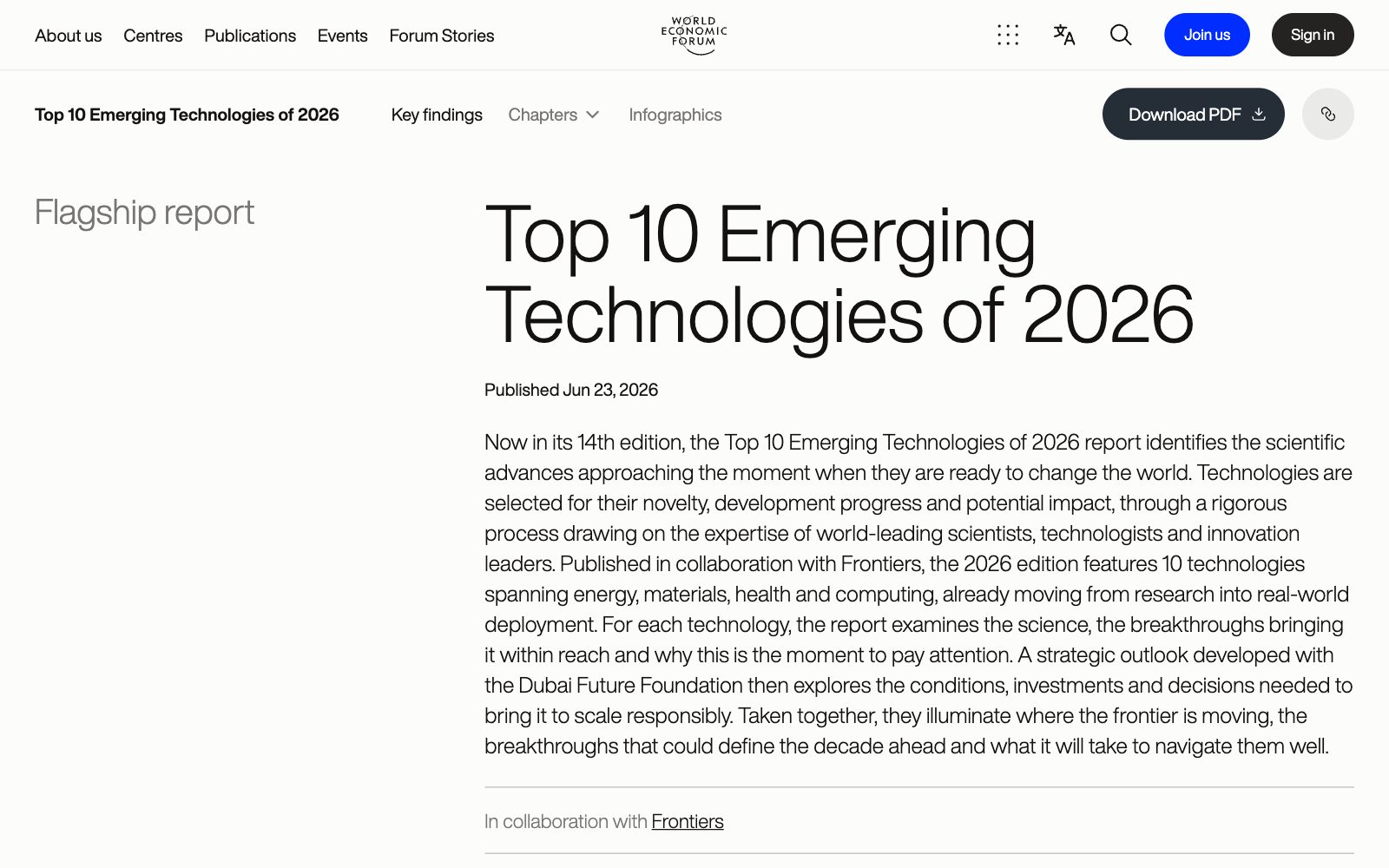
- Everything-to-grid energy: buildings, vehicles and devices become active grid resources that store and return power in real time.
- Direct lithium extraction: lithium is recovered from brine in hours rather than months, without large evaporation ponds; early operations run in Argentina and California.
- Passive radiative cooling materials: paints, films, roof tiles and fabrics that cool surfaces below ambient temperature without electricity.
- PFAS destruction: supercritical water, electrochemical treatment and UV photocatalysis break the carbon-fluorine bond of forever chemicals.
- Precision fermentation: programmed microbes produce proteins and fats at industrial scale, already supplying dairy and egg proteins to food brands.
- Exosome drug delivery: engineered exosomes carry drugs across biological barriers, including the blood-brain barrier.
- Personalized mRNA cancer vaccines: vaccines made from a patient's own tumour mutations; trials in pancreatic cancer and melanoma have moved into phase 3.
- Quantum simulation for drug discovery: modelling how drug candidates fold and bind from physical principles.
- World models: AI systems that learn the dynamics of physical environments; the WEF names NVIDIA's Cosmos platform among the first deployments.
- Lattice-based cryptography: encryption based on high-dimensional lattices that classical and quantum computers cannot practically reverse.
Juniper Research: top 10 emerging tech trends to watch in 2026
On 5 January 2026, Juniper Research published its Top 10 Emerging Tech Trends for 2026, ranked by expected impact and focused on technologies with a credible path to deployment. Its list is more enterprise and infrastructure focused:
- Post-quantum cryptography, with standardisation driving hybrid deployment models.
- Neuromorphic computing, with commercial chipsets aimed at AI bottlenecks.
- Physical AI, with advances in humanoid robotics expected over the next three years.
- Multi-agent systems, as enterprises invest in domain-specific agents.
- Wireless EV charging.
- Counter-drone technology.
- Microfluidics as a next-generation cooling system for AI chips.
- Multi-cloud models, after the 2025 outages put the focus on resilience.
- Small modular reactors, as regulatory approvals open the way.
- Open-source smart buildings with interoperable platforms.
Stanford Emerging Technology Review 2026: 10 technology areas
The Stanford Emerging Technology Review takes a wider view: instead of single technologies, its 2026 report covers ten fields and their policy implications: artificial intelligence, biotechnology and synthetic biology, cryptography and computer security, energy technologies, materials science, neuroscience, quantum technologies, robotics, semiconductors and space. It is the best place to learn the basics of a field before you read the narrower lists.
Emerging technologies 2026 compared: where the lists agree
Two things stand out. First, three themes appear on all three lists: quantum-safe security, AI that works in the physical world, and energy. Second, AI shows up in a new form: not chatbots, but AI that understands the physical world, from world models to humanoid robots. For a closer look at the AI side, see our list of breakthrough AI and machine learning technologies of 2026, and for products you can already buy, our roundup of new technology inventions of 2026.
Top 10 proven emerging technologies in 2026 for startups, and what to do with each
The lists above tell you what is coming. Here is how each emerging technology translates into a move a startup can make in 2026, starting with the tool we built for founders.
1. SANDBOX and PlayPal: The Game-Changers for Aspiring Entrepreneurs
At the heart of empowering entrepreneurs is the F/MS Startup Game, featuring the SANDBOX tool and PlayPal, your AI co-founder. These innovative tools help startup founders refine their ideas step-by-step in a dynamic, gamified environment.
- SANDBOX Benefits:
- Validates startup ideas systematically.
- Breaks down the entrepreneurial journey into actionable Towers, Blocks, and SOPs.
- Encourages feedback loops with Elona, PlayPal, and even the "Mean CEO."
- PlayPal’s Persona:
- Not just any AI, PlayPal is a personalized co-founder who guides you, provides insights, and remembers your progress.
- Real-world Example: Entrepreneurs using the SANDBOX tool reported a 61% success rate in early-stage idea validation, saving months of effort otherwise wasted on unvalidated concepts.
Why it’s a must-have: With startup survival rates being painfully low, tools like SANDBOX and PlayPal significantly reduce risks while boosting confidence and skills. Entrepreneurs can begin their journey here.
2. Generative AI and AI agents for content and operations
Generative AI as such is not one of the WEF or Juniper picks for 2026; it is already in daily use. What is emerging is the next layer: multi-agent systems, which Juniper ranks fourth for 2026. Use generative AI for drafts, research and support, and test agents on one repeatable workflow before you hand them anything that touches customers or confidential files.
Pro tip: Don’t forget to pair these tools with innovative solutions like the AI SEO Tools to rank higher on Google, Bing, and even AI platforms like ChatGPT and Perplexity.
3. Quantum computing and quantum simulation
The WEF picks quantum simulation for drug discovery, where modelling molecules from physical principles promises a fidelity classical computing cannot match, and says the quantum drug discovery market has roughly doubled in value in five years. Stanford lists quantum computing, quantum communication and quantum sensing as the three most mature quantum technologies. For most startups the move is to follow access programmes and partnerships, not to buy hardware.
4. Post-quantum and lattice-based cryptography
This is the most urgent item for any company that stores valuable data. NIST released its first three finalized post-quantum encryption standards on 13 August 2024: FIPS 203 (ML-KEM) for general encryption, FIPS 204 (ML-DSA) for digital signatures, both lattice-based, and FIPS 205 (SLH-DSA) as a hash-based backup. The WEF notes that the EU, the NSA and SWIFT have all set transition deadlines, because data harvested today can be decrypted later. Start with an inventory of where you use encryption, then read our guide to quantum-resistant encryption for CAD files.
5. Blockchain beyond crypto: proof, provenance and timestamps
Blockchain is not on the 2026 top 10 lists. In our view that is a sign of maturity, not failure: the useful parts are becoming plain infrastructure. For deep-tech teams the practical use is proof. CADChain combines file-level access control with blockchain proof of ownership, a kind of DRM that goes further than classic DRM. Our BORIS add-ins register a file's fingerprint (hash) and a timestamp as tamper-evident, dated proof of a design, without uploading the file itself.
6. World models and physical AI
World models learn how physical environments behave, so AI can reason about situations it has never seen. The WEF calls for governance for accountability, audit and assumption-testing as these systems move into real operations. Juniper adds physical AI and humanoid robotics. Hardware and engineering startups should watch this closely: simulation, robotics and CAD workflows are where it will land first.
7. Everything-to-grid energy and green tech
Energy appears on all three lists: everything-to-grid energy and direct lithium extraction (WEF), wireless EV charging, small modular reactors and open-source smart buildings (Juniper), and energy technologies (Stanford). The WEF's open question for everything-to-grid energy is whether distributed assets become a shared resilience system or stay fragmented, which is exactly the kind of coordination gap software startups can fill.
8. Neuromorphic computing and new ways to cool AI chips
AI's appetite for compute is pushing new hardware. Juniper expects commercial neuromorphic chipsets aimed at AI bottlenecks and growing interest in microfluidics as a cooling system for AI chips, and Stanford keeps semiconductors as one of its ten fields. If your product depends on AI, plan your compute costs and keep your models portable across cloud providers.
9. Biotechnology: precision fermentation, exosomes and mRNA cancer vaccines
Three of the WEF's ten picks are biotech. Precision fermentation already supplies fermentation-derived dairy and egg proteins to major food brands, more than 200 clinical trials of exosome drug delivery have launched since 2022, and personalized mRNA cancer vaccines have reached phase 3 studies. These are long, capital-heavy roads, so IP strategy matters from day one.
10. Advanced materials: passive radiative cooling and PFAS destruction
Passive radiative cooling materials are already being written into building codes in California and China, according to the WEF, and PFAS destruction now runs at commercial scale for groundwater and industrial waste. Materials startups move from lab to factory through partners, which means sharing recipes, process data and CAD files, so protect them before the first pilot.
Validate your startup idea with the unique borrowed authority approach: we publish articles about your product in our blog and you get traffic and testers for your MVP
- Prove Market Demand: See real organic traffic and waitlist conversions
- Unlock High-Potential Keywords: Receive a curated list of top-performing keywords directly from Google Search Console data.
- Estimate Customer Acquisition Cost (CAC): Gain financial foresight with an estimated CAC based on real keyword performance data.
🔗 Start validating your startup now
How to harness emerging technologies: a step-by-step guide
- Identify Problem Areas: Start by determining which operations or areas in your business need optimization.
- Select Technology: Match your needs to the appropriate emerging technology. Example: Use SANDBOX for idea validation or AI SEO Tools for ranking better online.
- Start Small: Pilot the technology on a smaller scale before a full-scale rollout.
- Seek Expert Help: Consult platforms like F/MS Startup Game or other strategic hubs for advice and guided implementation.
- Iterate and Optimize: Use feedback to enhance your deployment continuously.
Protect the IP behind your emerging technology before you pitch
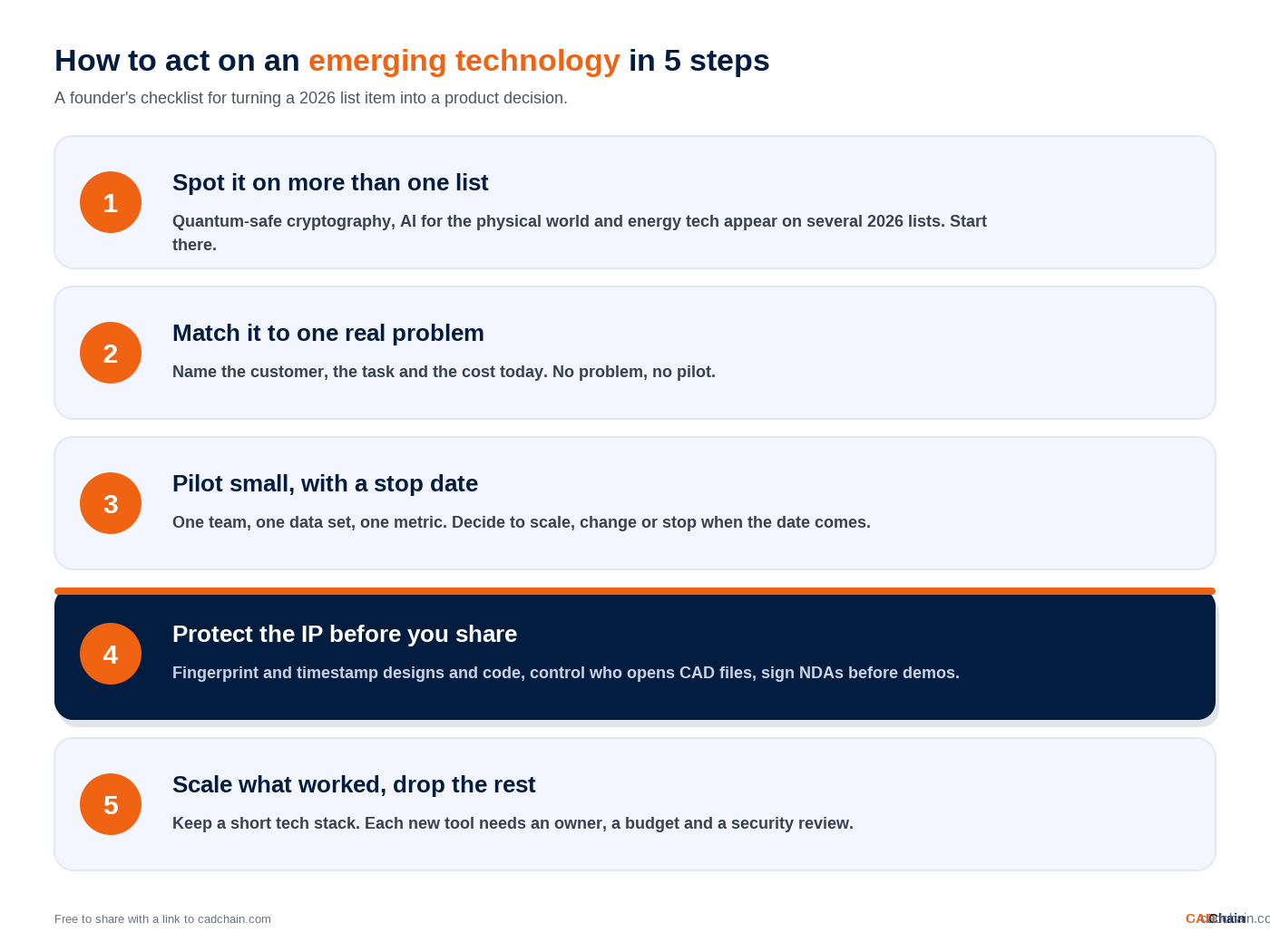
Every technology on these lists is built on know-how: designs, models, code, formulas and test data. Startups lose that value most often in the early, friendly phase, when files go to pilots, suppliers and investors before anything is protected.
- Decide what is a patent and what is a trade secret before the first paper, demo or pitch deck.
- Create dated proof of each design version, for example a file fingerprint and a timestamp, so you can show what you had and when.
- Control access to CAD and design files you share with partners, instead of emailing copies.
- Plan for post-quantum encryption for data that must stay secret for years.
Our 8-layer IP protection playbook for deep tech and hardware teams walks through each layer. Engineers working in SOLIDWORKS can read what quantum computing means for CAD encryption, and Inventor users can follow the latest engineering technology trends for CAD teams.
Common mistakes to avoid with emerging technologies
- Overloading Tech Stack: Integrating too many tools without focus can lead to inefficiency.
- Ignoring Feedback Loops: For instance, in SANDBOX, skipping feedback from PlayPal or Elona often leads to misguided decisions.
- Underestimating Risks: Don’t downplay challenges like data security or regulatory compliance, especially with blockchain or AI.
One more: picking a technology because it is on a list. A list tells you where the frontier is moving; only a customer problem tells you whether to build on it.
Deep insights: technology's role in funding success
Access to emerging technologies can directly impact how fundable your startup becomes. Tools like AI SEO by F/MS boost your online visibility, ensuring investors find and trust your business. Additionally, gamified platforms like F/MS Startup Game enhance learning outcomes, making founders tech-savvy and better equipped to secure funding.
Public funders follow the same lists. If you are building deep tech in Europe, read our breakdown of the EIC Work Programme 2027 for deep tech founders.
Conclusion
The top 10 emerging technologies of 2026 are more than tools; they are enablers of success. By staying informed and proactive, entrepreneurs can harness innovations like the SANDBOX and AI SEO Tools to drive better outcomes.
Boost Your SEO by listing your startup and get a FREE backlink.
Create a profile in the F/MS Startup Game, add the link to your website and submit.
👉 List my startup now!
Whether it's validating your idea with PlayPal, automating your SEO strategy, or leveraging blockchain for enhanced transparency, the time to integrate these solutions is now. Ready to take your startup to the next level? Start with the F/MS Startup Game today and turn your idea into an impactful venture.
Explore, innovate, and thrive in this exciting new era of technology! Join SANDBOX here.
FAQ about emerging technologies in 2026
1. What are the top emerging technologies for startups in 2026?
Some of the most impactful technologies for startups include AI-powered tools like SANDBOX and PlayPal for idea validation, generative AI for content creation, and blockchain for transparency. Startups leveraging these tools report faster scalability and improved profitability. Learn more about SANDBOX and PlayPal
2. What are the top 10 emerging technologies of 2026?
According to the World Economic Forum's 2026 report: everything-to-grid energy, direct lithium extraction, passive radiative cooling materials, PFAS destruction, precision fermentation, exosome drug delivery, personalized mRNA cancer vaccines, quantum simulation for drug discovery, world models and lattice-based cryptography.
2. How can AI help with content creation?
Generative AI tools, such as OpenAI’s GPT models, can create high-quality content for blogs, ads, and even product designs. Businesses using generative AI report increased lead generation and better brand visibility. Discover AI SEO tools
4. What are some examples of emerging technologies?
Examples on the 2026 lists include post-quantum cryptography, world models and physical AI, multi-agent systems, neuromorphic computing, small modular reactors, wireless EV charging, precision fermentation and personalized mRNA cancer vaccines.
5. Is quantum computing an emerging technology in 2026?
Yes. Stanford's 2026 review lists quantum technologies as one of its ten fields, with quantum computing, communication and sensing as the most mature, and the WEF picks quantum simulation for drug discovery as one of its top 10.
6. What is lattice-based cryptography and why does it matter now?
It is a family of encryption methods that classical and quantum computers cannot practically break. NIST's ML-KEM (FIPS 203) and ML-DSA (FIPS 204) standards, finalized in August 2024, are lattice-based, and organisations are now migrating to them before quantum computers can decrypt data harvested today.
7. Can I use AI to write SEO-optimized articles that help my brand grow?
Most business owners don't understand how SEO works, let alone how to use AI for writing blog articles. That's why for busy business owners there's a great free tool that doesn't require much knowledge. Write articles for free
8. What is the difference between emerging technologies and technology trends?
An emerging technology is a specific advance, such as direct lithium extraction. A technology trend is a broader shift in how companies use technology, such as moving AI from pilots into daily operations. Emerging technologies often become the trends of later years.
9. Which list of emerging technologies should a founder trust?
Read more than one. The WEF list is science-led, Juniper Research's is enterprise and infrastructure led, and Stanford's covers whole fields and their policy implications. A technology that appears on several lists is a stronger signal than one that appears on a single list.
10. How do I protect the IP of an emerging technology startup?
Decide early what to patent and what to keep as a trade secret, keep dated proof of each design version, control who can open your design files, and use encryption that will hold up in the post-quantum era.
About the Author
Violetta Bonenkamp, also known as MeanCEO, is an experienced startup founder with an impressive educational background including an MBA and four other higher education degrees. She has over 20 years of work experience across multiple countries, including 5 years as a solopreneur and serial entrepreneur.
Violetta is a true multiple specialist who has built expertise in Linguistics, Education, Business Management, Blockchain, Entrepreneurship, Intellectual Property, Game Design, AI, SEO, Digital Marketing, cyber security and zero code automations. Her extensive educational journey includes a Master of Arts in Linguistics and Education, an Advanced Master in Linguistics from Belgium (2006-2007), an MBA from Blekinge Institute of Technology in Sweden (2006-2008), and an Erasmus Mundus joint program European Master of Higher Education from universities in Norway, Finland, and Portugal (2009).
She is the founder of Fe/male Switch, a startup game that encourages women to enter STEM fields, and also leads CADChain, and multiple other projects like the Directory of 1,000 Startup Cities with a proprietary MeanCEO Index that ranks cities for female entrepreneurs. Violetta created the "gamepreneurship" methodology, which forms the scientific basis of her startup game. She also builds a lot of SEO tools for startups. Her achievements include being named one of the top 100 women in Europe by EU Startups in 2022 and being nominated for Impact Person of the year at the Dutch Blockchain Week. She is an author with Sifted and a speaker at different Universities. Recently she published a book on Startup Idea Validation the right way: from zero to first customers and beyond and launched a Directory of 1,500+ websites for startups to list themselves in order to gain traction and build backlinks.