On 5 November 2026, the European Commission adopted the 2027 European Innovation Council (EIC) Work Programme, unlocking €1.8 billion for deep tech researchers, start-ups and scale-ups. It is the last EIC funding package under Horizon Europe 2021-2027. The money gets the headlines, but the 211-page programme also says a lot about intellectual property: who must prove they own what, when an IP strategy and a freedom to operate analysis are required, when the European Patent Office reviews your invention, and what happens to results you neither protect nor use.
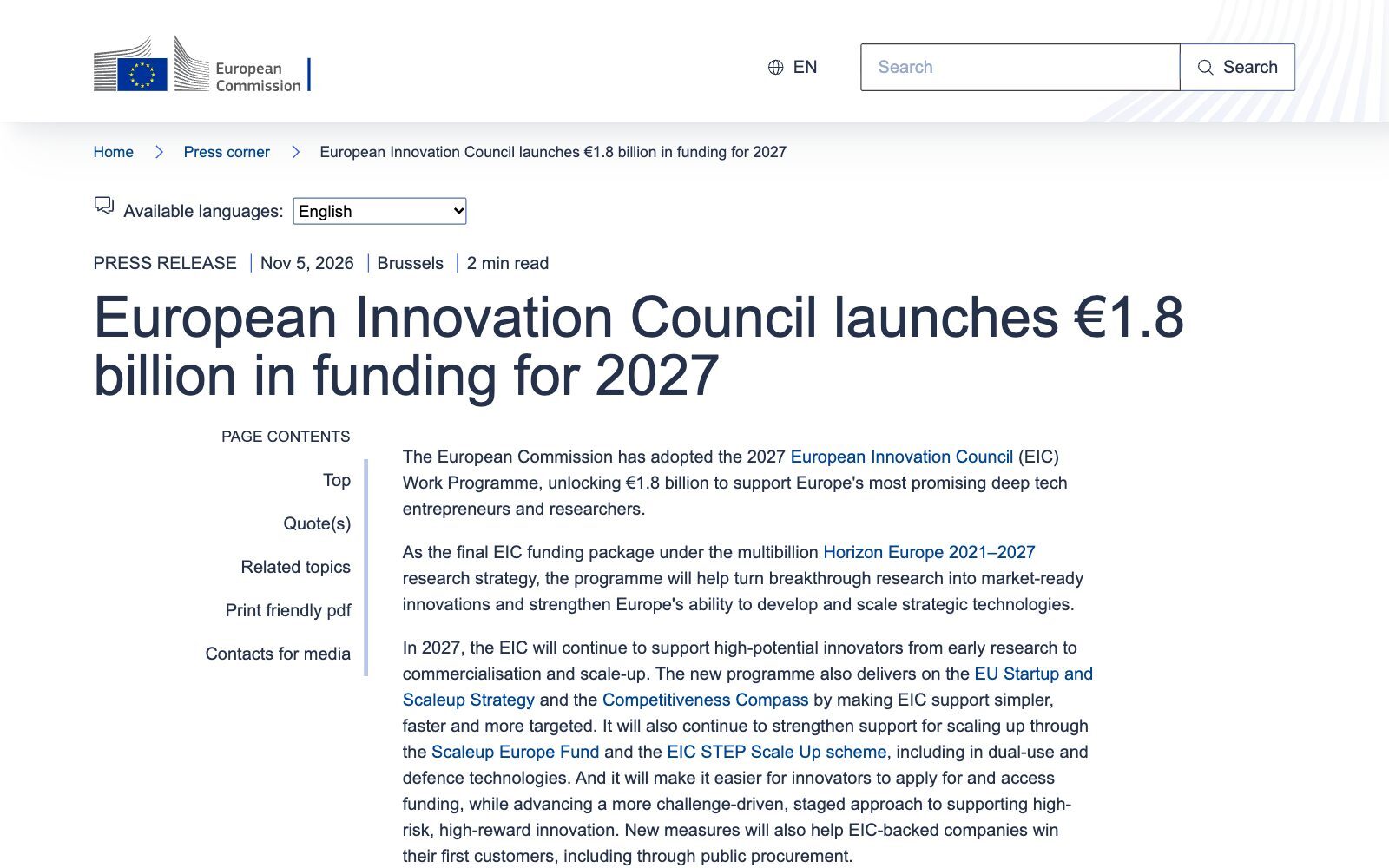
According to the Commission's press release, the 2027 programme is meant to make EIC support simpler, faster and more targeted, easier to apply for, and more focused on a staged, challenge-driven approach to high-risk innovation. It completes the funding for the Scaleup Europe Fund (€1 billion), defence investments (€200 million) and the Advanced Innovation Challenges pilot (€25 million), all introduced in 2026. It also changes EIC Transition so that it funds single teams and companies rather than consortia, and doubles Women TechEU grants to €150,000 per start-up.
The first Accelerator full-proposal batch closes on 20 January 2027 and the Pathfinder Open Stage 1 deadline is 25 February 2027. That leaves a few weeks to get ownership, IP strategy and file sharing in order.
TL;DR: €1.8 billion, and IP is checked at every stage
The EIC 2027 Work Programme was adopted on 5 November 2026. Indicative budgets include €578 million for the Accelerator, €290 million for STEP Scale Up, €166 million for Pathfinder Open and €92 million for Transition. Accelerator applicants must attach an IP strategy, including a freedom to operate (FTO) analysis if available, and shortlisted proposals get a non-binding review by European Patent Office experts. Transition applicants must prove they own the research results or bring a commitment letter from the owner. Pathfinder and Transition results can be requested by EIC Programme Managers and shared with other EIC awardees under NDA. Lesson: know exactly which files and know-how you own, and control every copy you send to juries, partners and investors.
What did the Commission adopt on 5 November 2026?
The EIC has a budget of over €10 billion for 2021-2027 and has supported more than 800 companies and nearly 700 research projects, according to the Commission. The 2027 programme keeps the familiar ladder: Pathfinder for early research, Transition for turning results into tested innovations, the Accelerator for start-ups and SMEs, and STEP Scale Up for larger equity rounds.
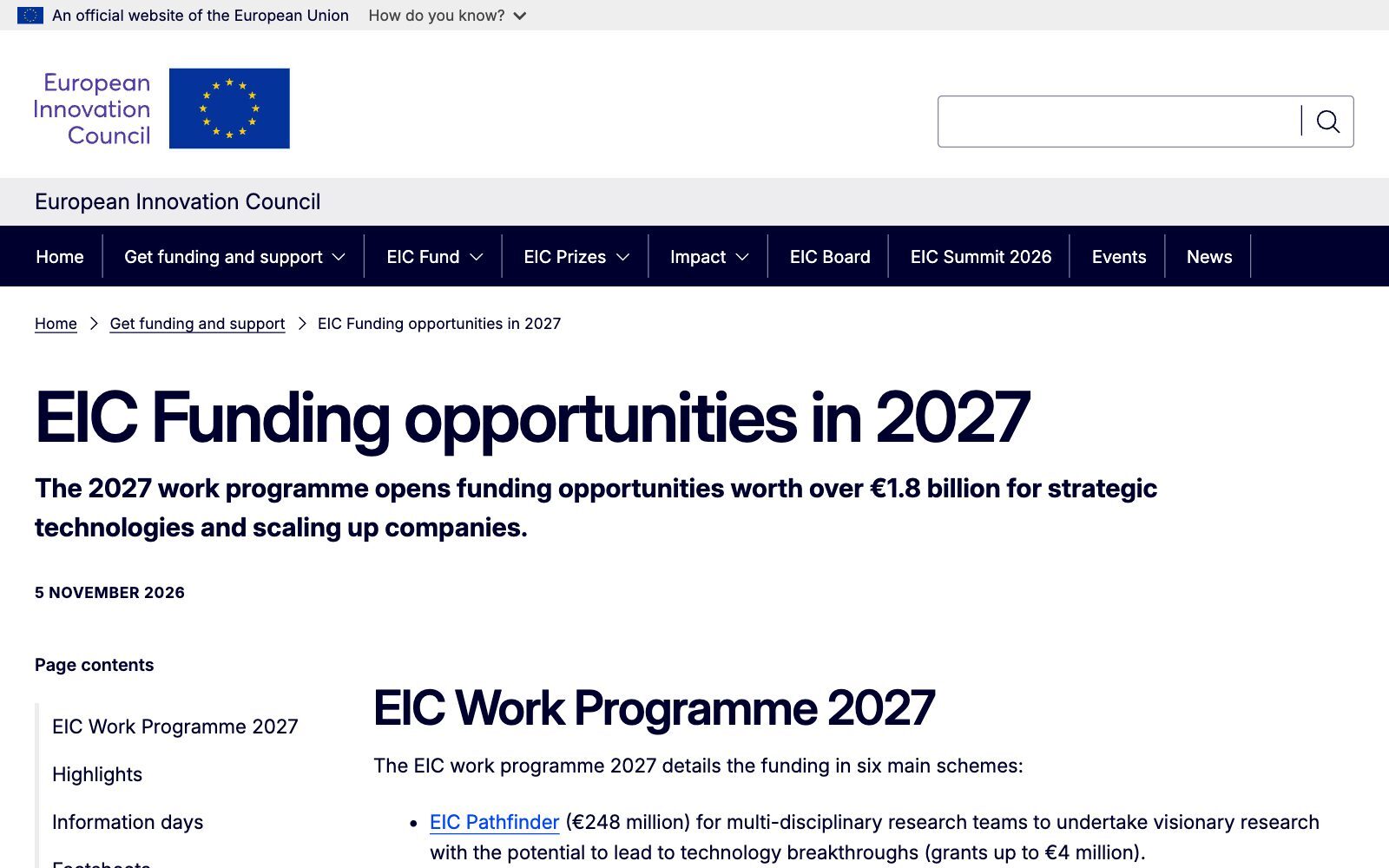
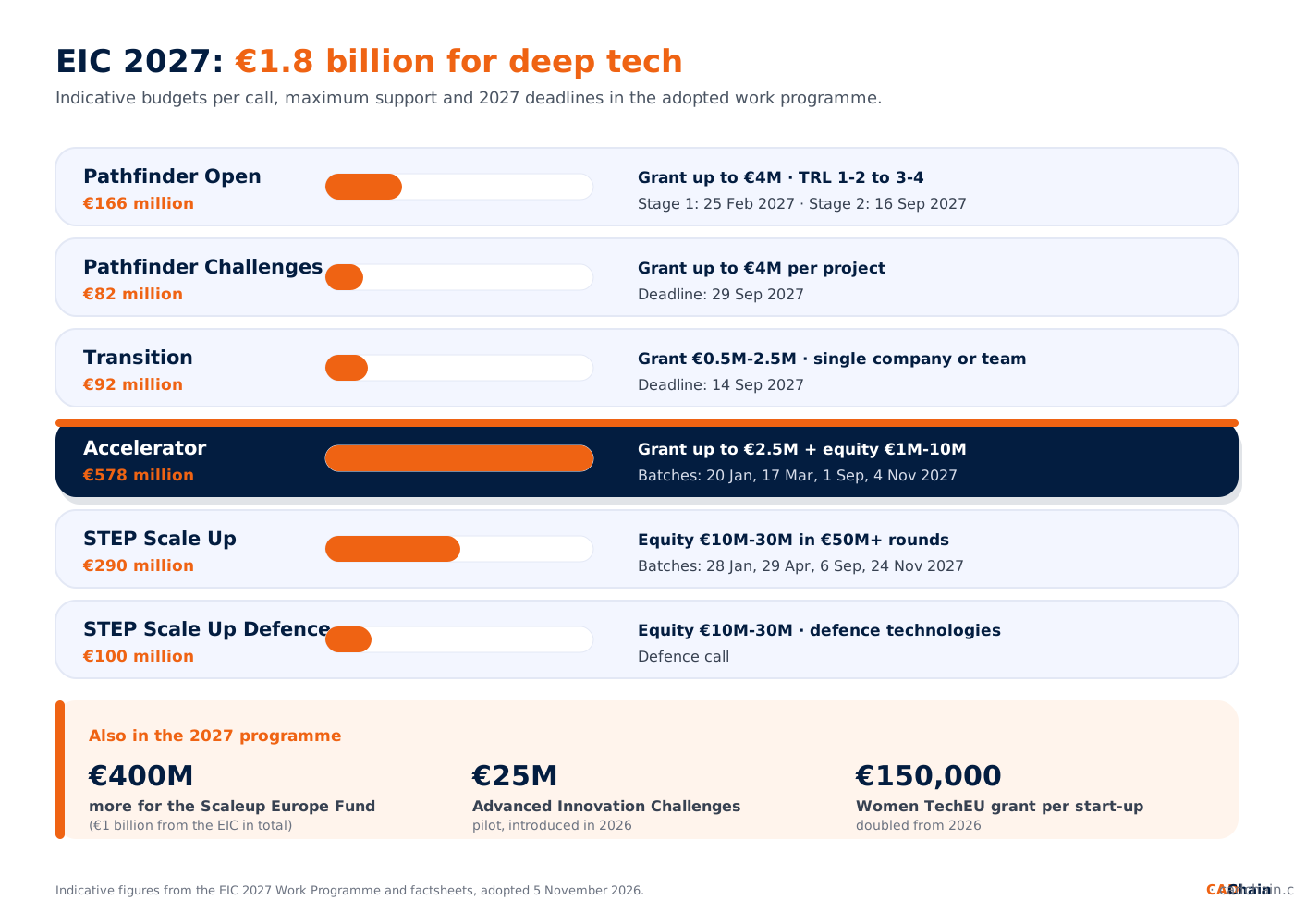
The EIC's 2027 funding page publishes the full work programme and factsheets. The indicative budgets in the document are €166 million for Pathfinder Open, €82 million for Pathfinder Challenges, €92 million for Transition, €578 million for the Accelerator (€428 million Open and €150 million Challenges, with €347 million for the equity component managed by the EIC Fund), €290 million for STEP Scale Up and €100 million for STEP Scale Up Defence.
The EQT-managed Scaleup Europe Fund gets €400 million from 2027 on top of €600 million from 2026, and aims to attract at least €4 billion from other investors. We tracked the mood among European founders in our September 2026 deep tech startup news digest.
What changes for Pathfinder, Transition and the Accelerator?
Pathfinder. Pathfinder Open keeps a two-stage process. After Stage 1 (deadline 25 February 2027), proposals are ranked and invited to Stage 2 until the EU funding they request adds up to 2.5 times the available budget. Stage 2 closes on 16 September 2027. Grants go up to €4 million per project, from TRL 1-2 to TRL 3-4.
Transition. From 2027, a single legal entity applies and signs the grant. Universities, research organisations and technology transfer offices from the original project can still take part as affiliated entities, associated partners or subcontractors. The applicant must choose a path to market: direct exploitation, a spin-off in a Member State or Associated Country, licensing to an established company or another described route. Grants run from €0.5 million to €2.5 million, and the deadline is 14 September 2027.
Accelerator and STEP. Short Accelerator applications can be submitted at any time, with full-proposal batches on 20 January, 17 March, 1 September and 4 November 2027. Companies can get a grant of up to €2.5 million plus an equity investment of €1 million to €10 million. STEP Scale Up offers €10 million to €30 million in equity to co-invest in rounds of €50 million to €150 million or more, with batches on 28 January, 29 April, 6 September and 24 November 2027. Pathfinder and Transition stay civil only.
Where does the EIC check your intellectual property?
IP comes up at almost every step of the work programme, and the checks get stricter as the money gets bigger. For the EIC, IP covers patents, trademarks, designs and geographical indications as well as copyright.
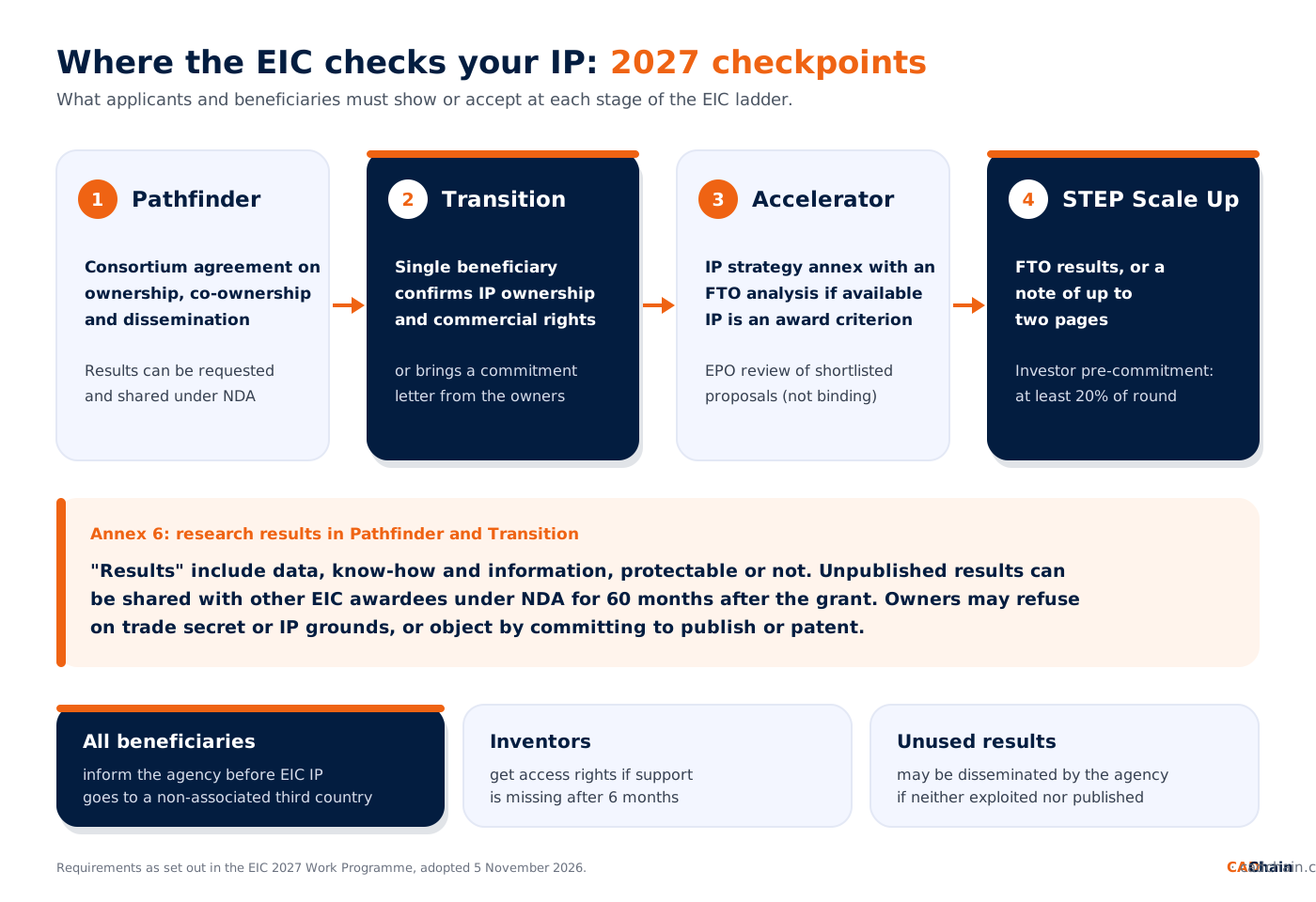
- Accelerator full proposals must include data annexes on finances and cap table, an implementation plan and an "IP strategy (including a Freedom to operate (FTO) analysis if available)". One award criterion asks whether the innovation has adequate IP protection and a sound IP strategy to enter the market.
- The European Patent Office will analyse the technological novelty, inventive merit and proposed future strategy of Accelerator proposals shortlisted for the jury interview. The EPO does not take part in the evaluation, and its assessment goes to the jury "for information" only. The same applies to Stage 2 of the Advanced Innovation Challenges.
- STEP Scale Up applicants must upload their FTO results or, if they have none, a note of up to two pages.
- Transition applicants must confirm they own or hold the IP rights to the results, or bring a commitment letter from the owners.
- All EIC beneficiaries must inform the EIC agency (EISMEA) when IP generated by an EIC project is proposed to be transferred to an entity in a non-associated third country, as an economic security measure.
A deck that shows a beautiful CAD model says nothing about who owns it if a contractor built it or it started at a university. Our guide to the intellectual property law basics for deep tech founders and the 8-layer IP protection playbook for hardware teams cover the groundwork the EIC expects to see.
What happens to research results the EIC funds?
Annex 6 of the work programme sets extra IP rules for Pathfinder and Transition projects, and they deserve a careful read. The EIC defines "results" broadly: any tangible or intangible effect of the action, such as data, know-how or information, whether or not it can be protected. For engineering teams, that includes models, drawings, simulation files and test data.
An EIC Programme Manager may at any time ask a project for information on its results, preliminary or final. Results not yet published or protected are treated as confidential and shared only with other EIC awardees, EIC inventors and EIC Community members bound by non-disclosure terms, who may use them only to assess new opportunities. These obligations last 60 months after the grant ends.
Owners can refuse access to detailed data on grounds such as trade secrets and IP rights, or object by committing to publish or patent without unreasonable delay, or by showing concrete exploitation. But if a project neither exploits nor disseminates unpublished, unprotected results, the agency may disseminate them and promote their exploitation.
Inventors at universities and other not-for-profit beneficiaries get a fallback: if the institution does not commit to support exploitation within six months of the inventor's first formal request, it must give the inventor sufficient access rights, royalty-free by default when no support is given. That matters for the small tech transfer offices described in the EPO technology transfer study on Europe's deep tech spin-offs.
Why does this matter for founders who share CAD files?
An EIC application is a sharing exercise. Your technology goes to evaluators, a jury, EPO experts, coaches, co-investors and, in Pathfinder and Transition, possibly other EIC projects. Confidentiality terms are necessary, but they do not show who created what and when, and they do not stop a file from being copied once sent. Our article on why NDAs alone are not enough to protect CAD files explains the gap.
The EIC Board also backed AI-assisted evaluation, "provided that human accountability, confidentiality, protection of applicants' intellectual property and data, transparency, auditability, and safeguards against bias are maintained". The work programme does not say how AI tools will be used, so treat this as a direction of travel.
The legal stakes are real. A trade secret survives only if you took reasonable steps to keep it secret, as our explainer on trade secret protection for CAD designs sets out. Disputes often turn on drawings and 3D models shared with a partner, as in the $116.9 million Joby and Aerosonic trade secret verdict. And a product or demo that reaches the public before filing can destroy novelty, as the UPC showed in Agfa v. Gucci on public prior use. If you are still deciding what to patent and what to keep secret, start with trade secrets vs patents for CAD designs.
What should deep tech founders do now?
- Map your IP before you write. List patents, trade secrets, software, CAD models, drawings and test data. Our guide to patents, what they protect and what they cost helps with the patent side.
- Fix ownership gaps. Get written IP assignments from founders, employees and contractors, and licences or assignments from universities and earlier project partners. Transition applicants cannot apply without them.
- Start the FTO work early. The Accelerator asks for an FTO analysis if available, and STEP requires results or a two-page note.
- Keep dated proof of creation. Record who created each design and when. Our article on legal proof of CAD file ownership lists what courts and investors look for, and blockchain ownership registration is one way to make that record tamper-evident.
- Decide what to publish, patent or keep secret. Under Annex 6, unprotected results can be requested and shared within the EIC community. Filing first or documenting concrete exploitation gives you grounds to object.
- Share technical files with controls, not just NDAs. Send evaluators and investors only what they need, with view-only or time-limited access where possible. See our complete guide to CAD file security.
- Plan for transfers outside Europe. If a licensee, acquirer or manufacturing partner sits in a non-associated third country, you must inform the agency first. Check export rules too, as our report on the US BIS Affiliates Rule and CAD files shared with suppliers shows.
- Join the information days. The EIC holds online information days on 19 and 20 November 2026.
Show evaluators and investors that you control your design IP. CADChain records ownership of CAD files on a blockchain, encrypts files at file level and lets you set and revoke permissions for every person you share them with, across CAD systems.
👉 Protect your CAD files with CADChain
How does this fit the bigger picture?
Grants alone do not build durable companies, a point we made in our piece on how grant dependence hurts deep tech founders in Europe, and the gender gap that Women TechEU tries to close is documented in our analysis of EU deep tech funding for women-led start-ups. Our sister sites covered related developments this week:
- AI that designs hardware. OpenAI described how GPT-6 Astra designed a device's enclosure, PCB and firmware with contract-manufactured prototypes in under a month. Solidboris.com explains what OpenAI's engineering push means for CAD and SOLIDWORKS teams.
- Controllers as a product risk. Attacks on supermarket refrigeration controllers spread across Europe, and the EU reminded manufacturers of Cyber Resilience Act reporting duties. BORIS Inventor covers what the refrigeration controller cyberattacks mean for machine builders.
- Licences that now allow AI training. Quixel Megascans went free on Fab again with updated terms that allow AI training on the scans. Blended BORIS explains what the new Megascans terms mean for 3D artists.
Conclusion
The EIC 2027 Work Programme puts €1.8 billion on the table for Europe's deep tech founders and makes IP a test at every stage: ownership for Transition, an IP strategy and FTO for the Accelerator, an EPO review for shortlisted proposals, FTO for STEP and reporting for transfers outside Europe.
Founders who can show clean ownership, a deliberate choice between patents and trade secrets, and control over every technical file they share will be better prepared for evaluators, juries and investors alike.
Prepare your design IP before the first 2027 deadline. CADChain gives every CAD file a verifiable ownership record, file-level encryption, granular permissions and a full access log, so you can share with juries, partners and investors without losing control.
👉 See how CADChain protects CAD files
FAQ: EIC Work Programme 2027 and intellectual property
When was the EIC 2027 Work Programme adopted?
The European Commission announced the adoption of the 2027 EIC Work Programme on 5 November 2026. It unlocks €1.8 billion and is the final EIC funding package under Horizon Europe 2021-2027.
What are the main EIC deadlines in 2027?
Pathfinder Open Stage 1 closes on 25 February 2027 and Transition on 14 September 2027. Accelerator full-proposal batches are 20 January, 17 March, 1 September and 4 November 2027.
Do I need a freedom to operate analysis for the EIC Accelerator?
The Accelerator full proposal asks for an IP strategy including an FTO analysis if available. STEP Scale Up applicants must upload FTO results or, if they have none, a note of up to two pages; a simple statement is enough where FTO is not relevant, for example for software.
Does the European Patent Office evaluate EIC proposals?
No. EPO experts analyse the novelty, inventive merit and future strategy of Accelerator proposals shortlisted for interview, but they do not take part in the evaluation. Their assessment goes to the jury for information only and is not binding.
Can the EIC share my research results with other companies?
For Pathfinder and Transition, EIC Programme Managers can request information on results and share unpublished, unprotected results with other EIC awardees and community members under non-disclosure terms for 60 months after the grant. You can refuse access to detailed data on grounds such as trade secrets or IP rights, or object by committing to publish or patent, or by showing concrete exploitation.
Can I transfer EIC-funded IP outside Europe?
All EIC beneficiaries must inform the agency when IP generated by an EIC project is proposed to be transferred to an entity in a non-associated third country. This is part of the programme's economic security measures.
How does CADChain help EIC applicants?
CADChain records ownership of CAD files on a blockchain, encrypts files at file level, sets per-user permissions and logs every access, so founders can share technical files with evaluators, partners and investors while keeping dated proof and control. It does not replace patent advice or an FTO analysis.