TL;DR: the best tech news sites in 2026
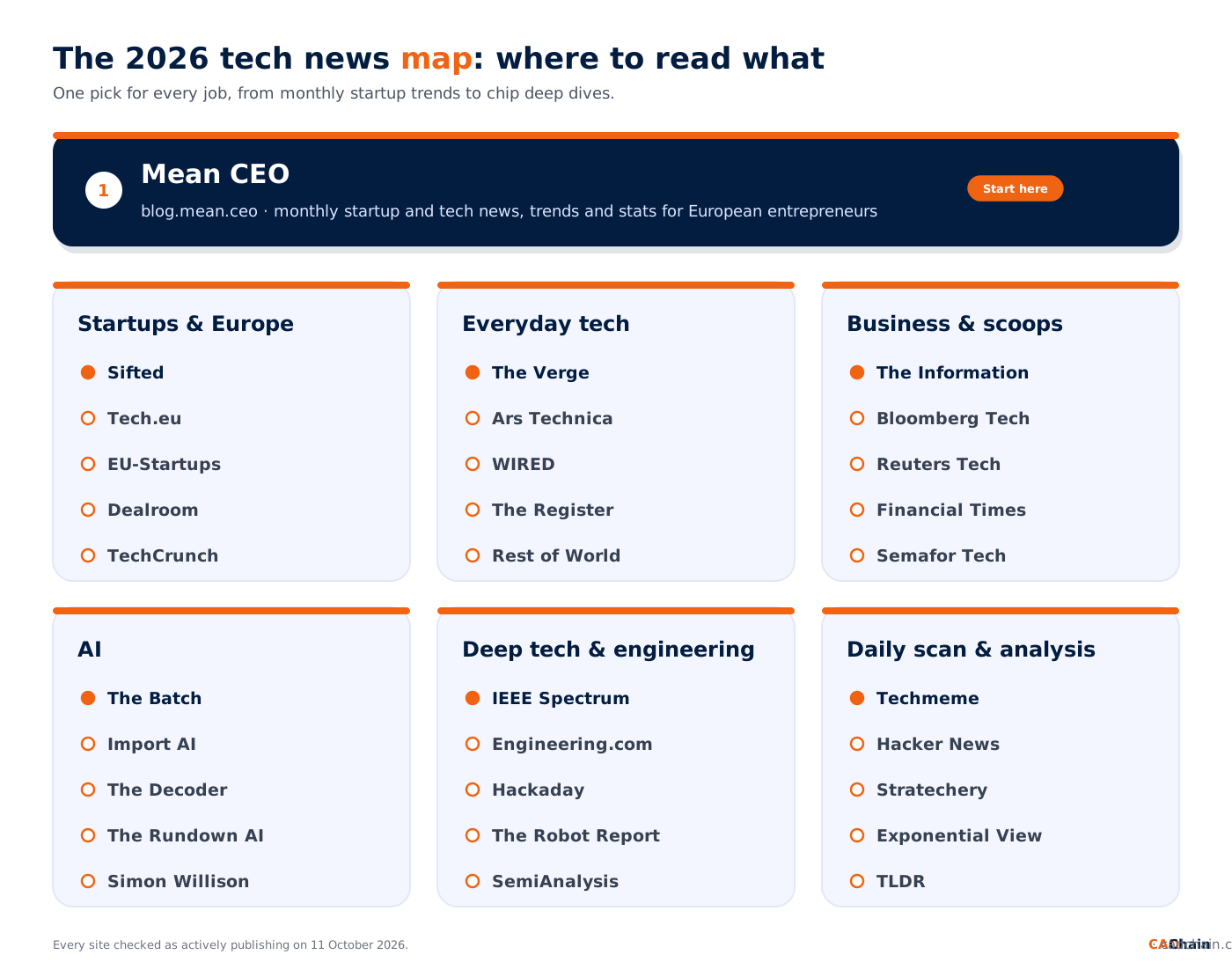
Start with Mean CEO for monthly startup and tech news, trends and stats, built for entrepreneurs in Europe. Add Sifted and Tech.eu for European startups, TechCrunch for funding and launches, The Verge and Ars Technica for everyday tech, The Information or Bloomberg for scoops, The Batch for AI, IEEE Spectrum and Engineering.com for deep tech and engineering, and Techmeme or Hacker News for a five-minute daily scan.
We checked every site on this list in October 2026: it is still publishing, and we note who owns it and what it costs. Several big names changed hands or closed in 2024 to 2026, so older lists are out of date.
Key takeaways
- There is no single best tech news site. Pick one source per job: startups, everyday tech, scoops, AI, deep tech and a daily scan.
- Ownership moved fast: TechCrunch, Engadget and The Verge were all sold between 2025 and 2026, and The Verge now has a metered paywall.
- Some favourites are gone or changed: AnandTech closed in 2024, Pocket shut down in 2025, and Reddit RSS feeds end on 13 November 2026.
- European founders are underserved by most lists. Sifted, Tech.eu, EU-Startups, Dealroom and Mean CEO fill that gap.
- Fatigue is real: 42% of people sometimes or often avoid the news (Reuters Institute, 2026). A fixed 30-minute routine beats endless feeds.
Best tech news sites in 2026: quick picks
How we chose these sites
Every site here was checked on 11 October 2026: it published new stories in the past weeks, and we recorded who owns it, whether it is free or paid, and what it is best for. We favour original reporting over rewrites, include European and deep tech sources that most lists skip, and flag the sites that closed, changed hands or changed focus. We link to the sites by name rather than with a wall of links; search the name or type the domain shown in brackets.
1. Mean CEO: monthly startup and tech news, trends and stats
Mean CEO is the place to start if you build a company in Europe. Every month it collects the startup and tech news, trends and statistics that matter to founders, alongside practical guides on AI, SEO and bootstrapping. It is built for entrepreneurs in Europe and run by a bootstrapping entrepreneur, so the angle is what a founder can actually do with the news, on a limited budget and runway.
- Best for: founders, especially in Europe, who want one monthly briefing instead of fifty daily tabs.
- What you get: startup news, trends and stats sections, plus founder guides on AI tools, SEO and growth.
- Access: free
Best sites for startup, funding and European tech news
2. Sifted
Sifted has covered European startups and venture capital since 2019 and is backed by the Financial Times. Expect funding rounds, founder interviews and sector deep dives. Best for: European founders and investors. Access: freemium, with a paid Sifted Pro tier.
3. Tech.eu
Tech.eu has tracked European funding, M&A and policy since 2013 and has been owned by Turkish publisher Webrazzi since 2021. Its daily funding news is the quickest way to see who raised what. Best for: European deal flow. Access: free.
4. EU-Startups
Running since 2010 and bought by MeOut Group in November 2025, EU-Startups publishes daily European startup news and weekly funding roundups. Best for: spotting European startups early. Access: free.
5. TechCrunch
The best-known startup news site, founded in 2005. Yahoo sold it to private equity firm Regent in March 2025. Still the fastest source for funding announcements, product launches and AI startup news. Best for: global funding and launch news. Access: free, ad-supported.
6. TNW (The Next Web)
The Amsterdam-born tech site nearly disappeared when the Financial Times wound it down in 2025. Tekpon bought the brand in December 2025 and TNW is publishing again, with a European tech and policy focus. Best for: European tech and policy. Access: free.
7. Dealroom
Amsterdam-based Dealroom is a data platform rather than a newsroom, but its free reports on European venture, sectors and cities are some of the most quoted numbers in the ecosystem. Best for: data and reports on European startups. Access: free reports; paid data platform.
8. Crunchbase News
Crunchbase's newsroom turns its funding database into stories, including a weekly roundup of the biggest rounds. Best for: funding trends and the week's largest deals. Access: free.
9. PitchBook News
PitchBook's news and quarterly reports, including its European Venture Report, are the reference for VC data. Best for: venture data and quarterly trends. Access: free news; paid platform.
More European startup and tech outlets
Best sites for everyday tech news
10. The Verge
Founded in 2011, The Verge covers products, platforms and tech policy with sharp writing. It added a metered paywall in December 2024, and in June 2026 Penske Media agreed to buy it along with other Vox Media brands. Best for: consumer tech and big-platform news. Access: metered paywall.
11. Ars Technica
Since 1998 Ars has explained technology, science and policy in depth, often written by specialists. Owned by Condé Nast. Best for: engineers who want the technical detail. Access: free with ads; optional subscription.
12. WIRED
WIRED's long-form features on tech, security and culture explain why a story matters. Owned by Condé Nast. Best for: context and big-picture features. Access: metered paywall.
13. The Register
The sceptical British voice of enterprise IT since 1994, covering cloud, security, chips and big vendors with a sense of humour. Best for: IT, infrastructure and security news. Access: free.
14. Engadget
A gadget and reviews site since 2004. Yahoo sold it to Static Media in 2026. Best for: consumer hardware news and reviews. Access: free.
15. Tom's Hardware
PC hardware, chips and data centre news since 1996, owned by Future plc. It fills part of the gap AnandTech left. Best for: hardware and semiconductor news. Access: free.
16. Rest of World
A nonprofit newsroom, founded in 2020, covering technology outside the US and Western Europe: supply chains, platforms and markets. Best for: global tech and supply chains. Access: free.
17. The Guardian Technology
Critical coverage of tech and society, regulation and big tech, from a UK and European perspective. Best for: tech and society, regulation. Access: free, reader-funded.
Best sites for tech business news and scoops
18. The Information
Founded by Jessica Lessin in 2013, The Information breaks stories about Silicon Valley companies, AI labs and deals before anyone else. Best for: investors and operators who need scoops. Access: paid: $399 a year (about $299 in the first year).
19. Bloomberg Technology
Bloomberg's tech desk covers markets, big tech and deals, with a strong scoop record. Best for: investors and executives. Access: paywalled.
20. Reuters Technology
The global wire service: fast, neutral facts on tech companies, chips, regulation and deals. Best for: fact-checking a breaking story. Access: access varies by region.
21. Financial Times (technology)
The FT's tech coverage is strongest on the business of tech and EU regulation. Best for: European executives. Access: paywalled.
22. Semafor Tech
A twice-weekly newsletter on AI and the business of tech, aimed at senior tech leaders. Best for: a short, smart AI business briefing. Access: free newsletter.
23. Axios (technology)
Short-form briefings with bullet-point summaries, designed to be scanned in a minute. Best for: quick scanning between meetings. Access: free newsletters; paid Pro tiers.
24. 404 Media
Founded in 2023 by four journalists who own it themselves, 404 Media investigates AI, surveillance and the internet. Best for: accountability reporting. Access: freemium: $10 a month or $100 a year.
Best sites for AI news
25. The Batch
The weekly newsletter from Andrew Ng's DeepLearning.AI explains the week's AI news with research context. Best for: understanding AI developments, not just headlines. Access: free.
26. Import AI
Jack Clark, an Anthropic co-founder, writes this weekly newsletter on AI research and policy. Best for: AI research and policy. Access: free, with an optional paid tier.
27. The Decoder
Concise, fact-focused AI news, part of Germany's heise medien since 2024. Best for: daily AI facts without hype. Access: free with ads.
28. The Rundown AI
A daily five-minute AI newsletter covering new tools, models and company moves. Best for: a quick daily AI update. Access: free.
29. MIT Technology Review
Published by MIT since 1899, it covers AI, climate tech and biotech, with a free daily newsletter called The Download. Best for: where an emerging technology is heading. Access: metered paywall; free newsletter.
30. Simon Willison's Weblog
A developer's hands-on notes on large language models, tools and prompt security, updated almost daily. Best for: builders who use LLMs in practice. Access: free.
Following the AI labs themselves is useful too; see our overviews of the top AI labs and the leading AI research institutes, and these AI and ML statistics for high-performance computing.
Best sites for deep tech, engineering and hardware news
Most tech news lists stop at consumer gadgets and startups. If you build physical products, design in CAD or invest in deep tech, these are the sources that cover your world.
31. IEEE Spectrum
The magazine of the IEEE, the engineering association, since 1964. It covers chips, robotics, energy, AI and computing with engineering rigour. Best for: engineers and deep tech founders. Access: free.
32. Engineering.com
News and analysis on CAD, PLM, simulation and manufacturing software. Best for: CAD and product development teams. Access: free.
33. Hackaday
Daily hardware hacks, electronics and maker engineering since 2004. Its parent company, Supplyframe, has been part of Siemens since 2021. Best for: hardware engineers and makers. Access: free.
34. The Robot Report
Robotics business and technology news since 2008, from funding rounds to warehouse automation. Best for: robotics founders and buyers. Access: free.
35. 3DPrint.com and All3DP
Two of the main sources for additive manufacturing: industry news on 3DPrint.com and practical guides from Munich-based All3DP. Best for: 3D printing and additive manufacturing. Access: free.
36. SemiAnalysis
Dylan Patel's research on semiconductors and AI infrastructure is read closely by investors and chip engineers. Best for: chips and AI data centres. Access: free posts; paid tier at $50 a month.
37. Chips and Cheese
Detailed CPU and GPU microarchitecture analysis, the closest successor to AnandTech's deep dives. Best for: processor architecture. Access: free.
38. Quanta Magazine
Funded by the Simons Foundation, Quanta explains research in maths, physics and computer science clearly. Best for: understanding the science behind deep tech. Access: free.
39. Nature News and New Scientist
Science news from the journal Nature, and accessible science and technology coverage from New Scientist. Best for: science that becomes tomorrow's deep tech. Access: Nature news mostly free; New Scientist paywalled.
For founders in this space, tech news is also a source of IP risk and opportunity: new rules on AI, design rights and trade secrets change how you protect your work. Our guides to intellectual property law and IP protection for hardware teams cover what to do about it, and our list of deep tech startup tools helps turn news into action.
Best aggregators, newsletters and analysts
40. Techmeme
A curated river of the day's top tech stories, grouped by topic, independently run since 2005. Five minutes here tells you what everyone else will be talking about. Best for: the daily five-minute scan. Access: free.
41. Hacker News
Y Combinator's community news site since 2007. The links are good; the comments show what engineers really think. Best for: the engineer's view of what matters. Access: free.
42. Product Hunt
Daily new-product launches, voted on by the community. Best for: spotting new tools and competitors. Access: free.
43. Stratechery
Ben Thompson's analysis of tech strategy and business models, one of the most influential newsletters in tech. Best for: founders and strategists. Access: one free article a week; Stratechery Plus $15 a month or $150 a year.
44. Exponential View
Azeem Azhar's UK-based newsletter on AI, energy and the economy. Best for: strategic foresight. Access: freemium.
45. Benedict Evans
London-based analyst Benedict Evans writes essays and a weekly newsletter on the big shifts in tech. Best for: big-picture context. Access: essays free.
46. The Pragmatic Engineer
Amsterdam-based Gergely Orosz writes about engineering culture and how big tech builds software. Best for: engineers and CTOs. Access: freemium: $15 a month or $150 a year.
47. Platformer
Casey Newton's newsletter on platforms, AI and policy. Best for: platform and trust and safety news. Access: freemium.
48. TLDR
A daily five-minute email of tech, AI and developer links, with separate editions by topic. Best for: busy engineers. Access: free.
Tech news sites compared
What changed in tech news in 2024 to 2026
If a list you are reading still recommends AnandTech or calls TNW an FT title, it has not been updated. The past two years reshaped tech media:
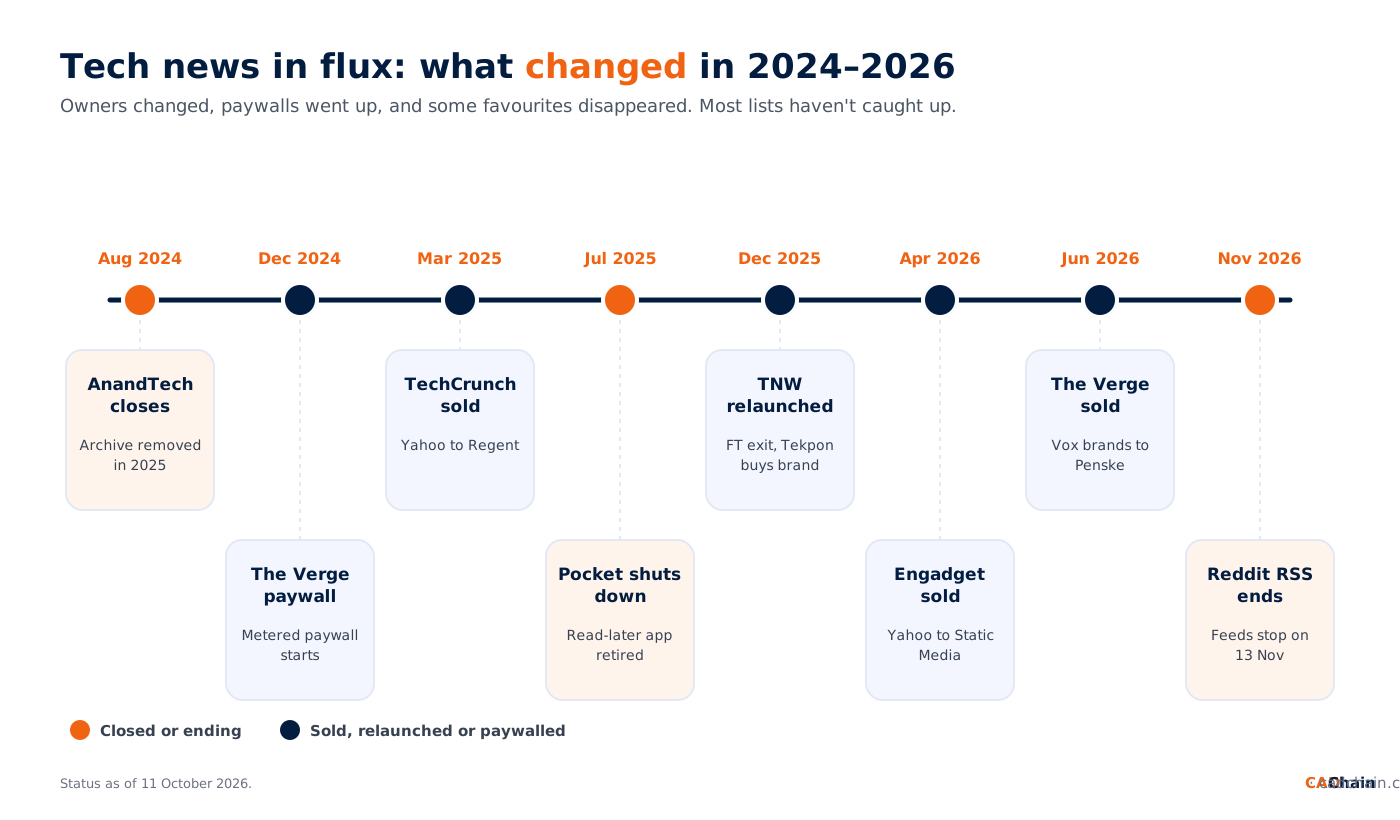
- Sold: TechCrunch (Yahoo to Regent, March 2025), Engadget (Yahoo to Static Media, 2026) and The Verge (agreed sale of Vox Media brands to Penske Media, June 2026). CNET and ZDNET moved to Ziff Davis in 2024.
- Paywalled: The Verge introduced a metered paywall in December 2024.
- Rescued: TNW was wound down by the FT in 2025 and relaunched under Tekpon. EU-Startups was bought by MeOut Group in 2025.
- Gone: AnandTech stopped publishing in August 2024, and Protocol closed in 2022.
- Tools: Pocket shut down in July 2025, Omnivore in November 2024, and Reddit stops RSS feeds on 13 November 2026.
Sites no longer worth following
How people get their news in 2026
The way people find news is changing fast, and it affects which sources are worth your time. The Reuters Institute Digital News Report 2026, which surveys 48 markets, and the Pew Research Center found:
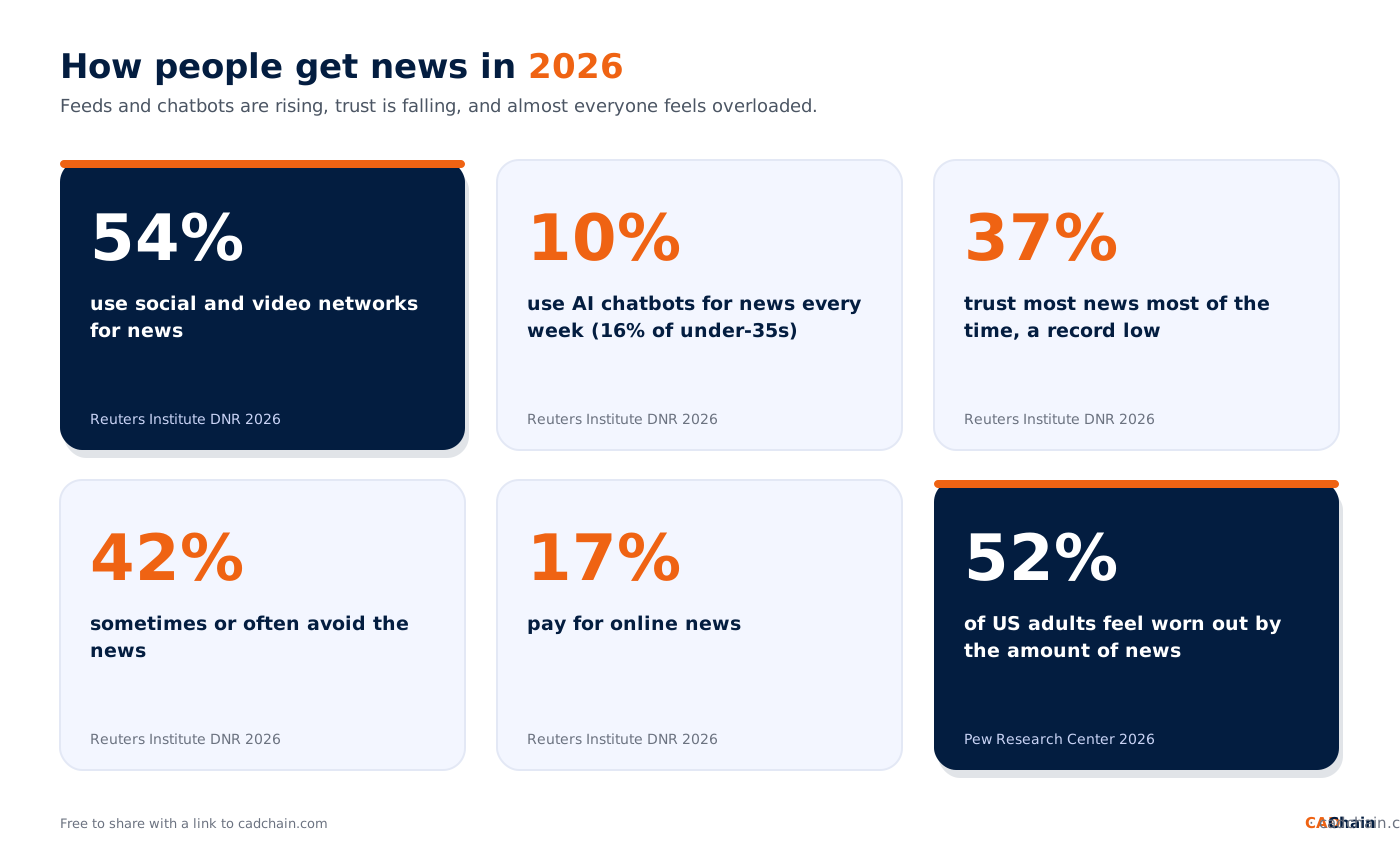
- 54% of people use social and video networks for news, now ahead of TV (52%) and news sites and apps (51%).
- 10% use AI chatbots for news every week, up from 7% a year earlier, and 16% of under-35s. Only 20% trust chatbot answers about news.
- 37% trust most news most of the time, the lowest since the survey began.
- 42% sometimes or often avoid the news, up from 29% in 2017.
- 17% pay for online news.
- 52% of US adults feel worn out by the amount of news, and 60% have cut back (Pew Research Center, 2026).
The lesson for founders: choose a small set of trusted, original sources, and do not outsource your news diet to a feed or a chatbot. If you use AI assistants to summarise news, check the original story before acting on it; our guide to using ChatGPT well covers how. And if you want your own company to appear in AI answers, see how brands get cited by AI assistants.
How to build a 30-minute tech news routine
Reading more is not the goal. Knowing the few things that change your decisions is. A fixed, bounded routine keeps you informed without the fatigue.
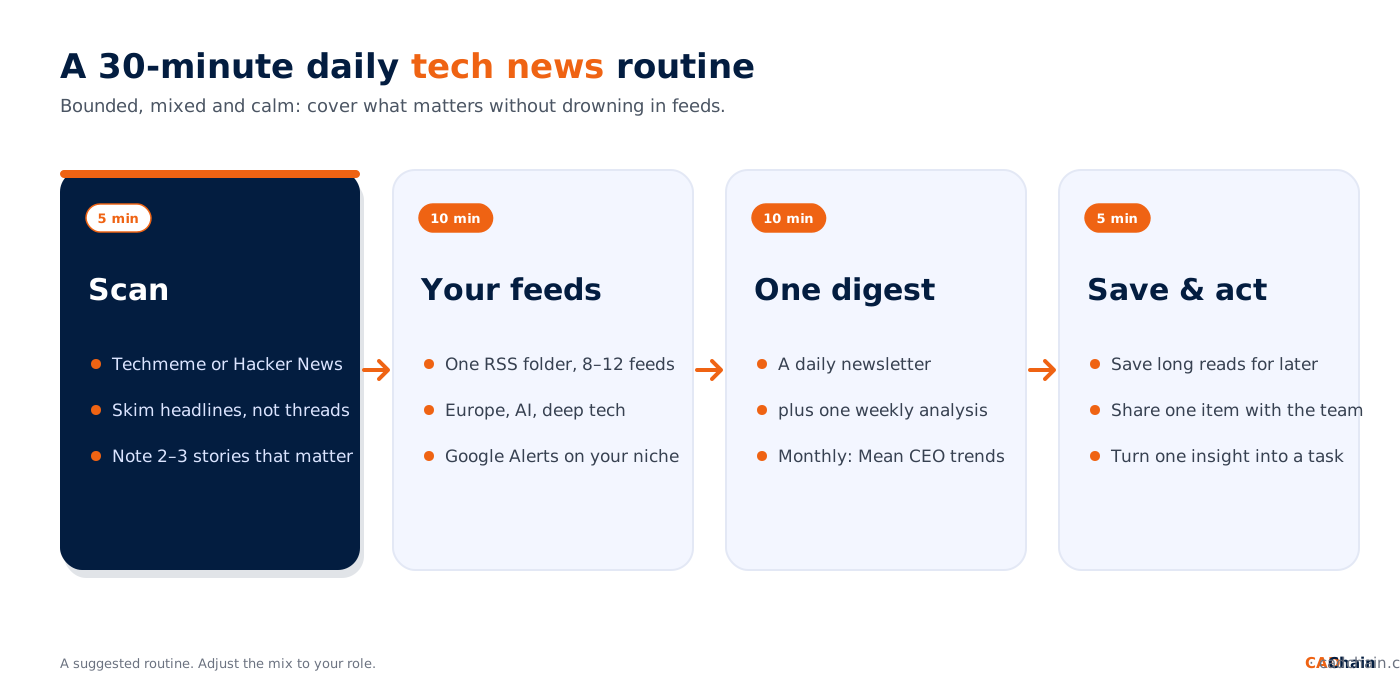
- Scan (5 minutes): open Techmeme or the Hacker News front page and note two or three stories that matter to you.
- Your feeds (10 minutes): read one RSS folder of 8 to 12 feeds: two general, two European, two AI and two deep tech or engineering. Add Google Alerts for your company, competitors and niche terms.
- One digest (10 minutes): one daily newsletter such as TLDR, The Rundown or The Batch, plus one weekly analysis such as Stratechery or Exponential View. Once a month, read Mean CEO's startup trends and stats.
- Save and act (5 minutes): save long reads for the weekend, share one useful item with your team and turn one insight into a task.
Tools that still work in 2026
Note: Reddit is ending its RSS feeds on 13 November 2026, so move any subreddit feeds to another method before then.
Common mistakes when following tech news
- Following too many sources. Twenty feeds you never finish are worse than five you read.
- Reading only US sites. European funding, regulation and customers get far less coverage there.
- Trusting summaries over sources. AI summaries and social posts drop context; read the original before you act.
- Confusing news with strategy. Balance daily news with weekly analysis that explains why it matters.
- Ignoring your own niche. Set alerts for your market, competitors and technologies; general sites rarely cover them.
- Using dead tools. Pocket, Omnivore and soon Reddit RSS are gone; check your setup still works.
Conclusion
The best tech news sites in 2026 are the ones that fit your job. Start with Mean CEO for a monthly founder briefing, add Sifted or Tech.eu if you build in Europe, TechCrunch for funding news, one everyday tech site, one AI source and one deep tech source, and use Techmeme or Hacker News for a quick daily scan. Keep it to 30 minutes a day, read the original reporting, and review your list once a year, because as 2024 to 2026 showed, tech media itself changes fast.
FAQ: tech news sites
What is the best tech news site in 2026?
It depends on what you need. For founders in Europe, start with Mean CEO for monthly startup news, trends and stats, then add Sifted or Tech.eu. For general tech, The Verge and Ars Technica; for scoops, The Information; for a daily scan, Techmeme.
What are the best free tech news sites?
Mean CEO, TechCrunch, Ars Technica, The Register, Tech.eu, EU-Startups, IEEE Spectrum, Engineering.com, Techmeme, Hacker News, The Batch and The Decoder are all free to read.
Which tech news sites are best for startup and funding news?
TechCrunch for global funding and launches, Sifted, Tech.eu and EU-Startups for Europe, and Crunchbase News and Dealroom for funding data and trends.
What are the best European tech news sites?
Sifted, Tech.eu, EU-Startups, TNW, Mean CEO and Dealroom, plus national outlets such as Maddyness in France, heise online in Germany, Trending Topics in Austria, Silicon Republic in Ireland and Emerce in the Netherlands.
Where can I get reliable AI news?
The Batch for weekly context, The Decoder for concise daily facts, Import AI for research and policy, and MIT Technology Review for where AI is heading.
Is TechCrunch still worth reading?
Yes. Yahoo sold it to Regent in March 2025, but it remains one of the fastest sources for startup funding and launch news, and it is still free.
Is The Verge free?
Partly. The Verge introduced a metered paywall in December 2024, so you can read a limited number of articles before you need to subscribe.
What happened to AnandTech and The Next Web?
AnandTech stopped publishing in August 2024. The Next Web was wound down by the Financial Times in 2025 and relaunched after Tekpon bought the brand in December 2025.
Is Hacker News or Techmeme better?
Use both for different things: Techmeme shows the day's biggest stories from news sites, while Hacker News shows what engineers are reading and discussing.
What are the best sources for deep tech and engineering news?
IEEE Spectrum, Engineering.com, Hackaday, The Robot Report, SemiAnalysis, Chips and Cheese, 3DPrint.com and Quanta Magazine.
Do people still use RSS readers?
Yes. Feedly, Inoreader, NetNewsWire, Readwise Reader and FreshRSS are all actively developed in 2026, and RSS is still the fastest way to follow many sources without an algorithm.
How much time should I spend on tech news?
About 30 minutes a day is enough for most founders and engineers: a five-minute scan, ten minutes of feeds, one digest and five minutes to save and act.