
Technology trends transforming startups in 2026 and 2027: where the money goes, what Gartner expects next, and proven secrets for founders
TL;DR: What are the top technology trends for startups right now?
Follow the money first: AI-driven startups raised $102 billion, or 64% of global venture funding, in Q3 2026 (Crunchbase), and physical AI sectors such as robotics, aerospace, semiconductors, data centers and energy each raised $10 billion or more. Gartner's top strategic technology trends for 2027 point the same way: large quantitative models, speech reasoning models, world models, AI context platforms, agent coding harnesses, AI agent identity, autonomous exposure remediation, sovereign tech, disposable applications and wetware as a service. For a startup, the winning moves are AI agents with guardrails, physical AI, sovereign and quantum-safe infrastructure, and protecting your IP before you share it.
Technology trends for startups in 2026 are easier to read than they look: two hard signals, where venture capital actually goes and what the big analyst lists expect next, point in the same direction. This guide puts the latest funding data from Crunchbase next to Gartner's top strategic technology trends for 2027, turns them into 10 technology trends transforming startups, and gives you a table, a 5-step filter and the IP steps to take before you build on any of them.
Healthy Restaurants in Malta ! Our Restaurants in Malta Directory prioritizes establishments with healthy cuisine that adds to your longevity and quality of life.
👉 Find the best restaurants here
What are the top trends in tech innovation for startups in 2026?
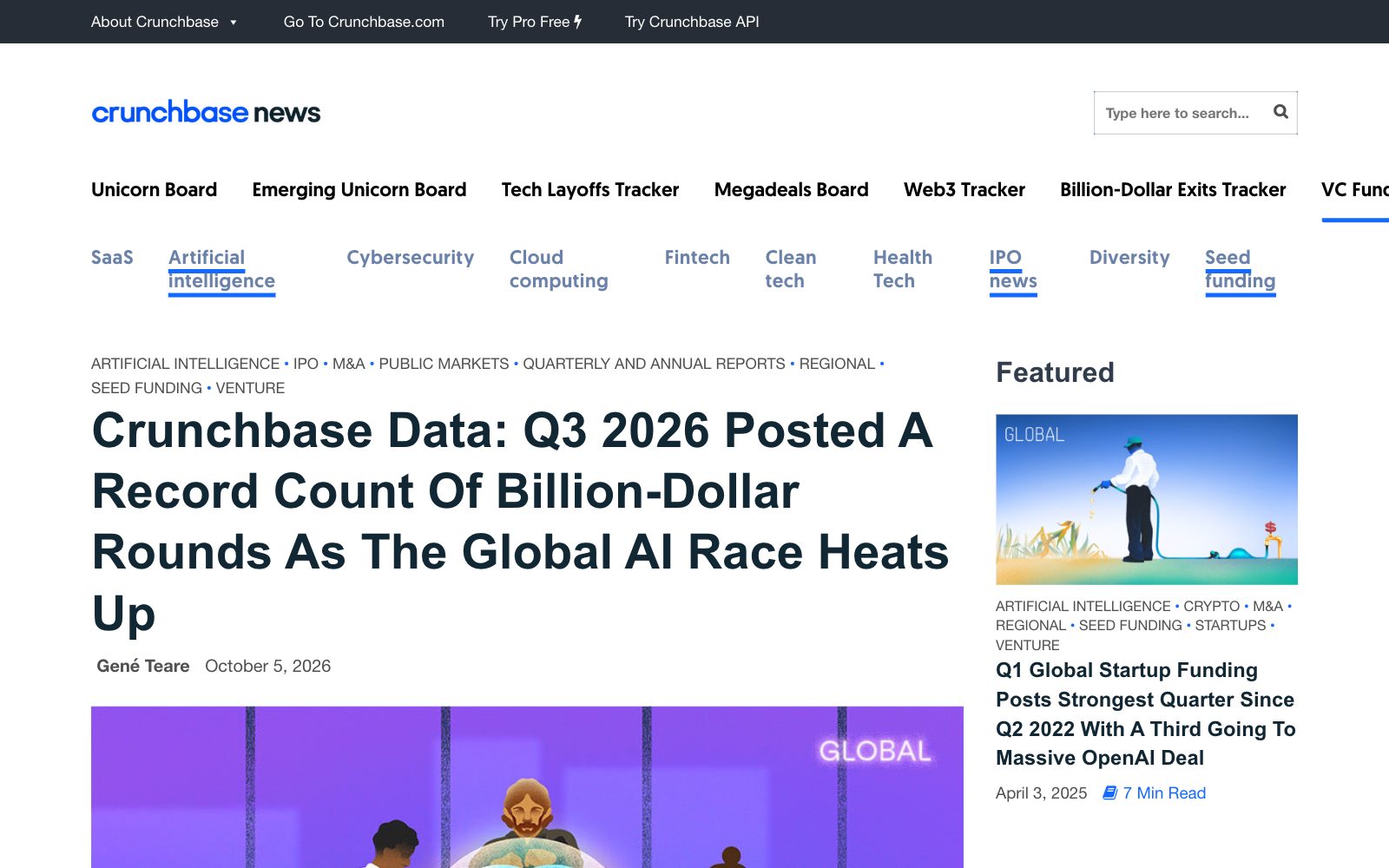
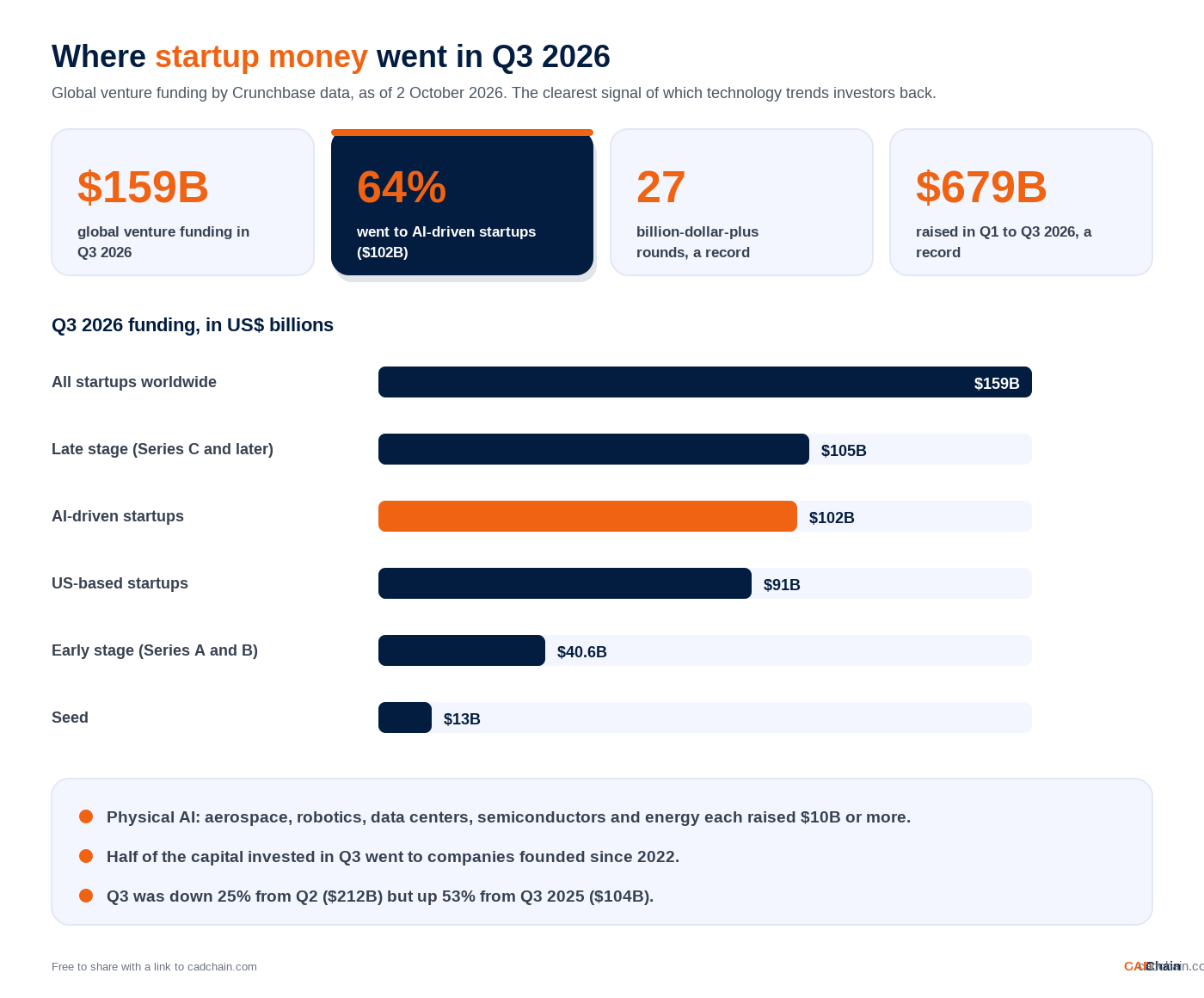
Start with the money, because it shows which trends investors believe in. The Crunchbase Q3 2026 global funding report counted $159 billion in global venture funding in Q3 2026, across close to 6,000 startups. AI-driven startups across the stack raised $102 billion of it, or 64%. That share was lower than in the two previous quarters, but still 14 percentage points above Q3 2025.
- Bigger rounds, earlier: a record 27 companies raised billion-dollar-plus rounds in Q3 2026, up from 16 in Q2 and 14 in Q1, and half of the capital invested in Q3 went to companies founded since 2022.
- Physical AI is the new frontier: aerospace, robotics, data centers, semiconductors and energy each raised $10 billion or more in the quarter.
- Record year: startups raised $679 billion in Q1 to Q3 2026, the highest total for the first three quarters of any year.
- Still concentrated: US-based companies took $91 billion, about 57% of the global total, and the San Francisco Bay Area alone took 24%.
For a small startup, the message is not "raise a billion". It is that customers, partners and investors are now buying AI that works in the real world and AI that can be trusted. If you want the science-led view of what comes next, read our comparison of the top 10 emerging technologies of 2026 from the WEF, Juniper Research and Stanford; this page stays with the trends that already move money and roadmaps.
Gartner's top strategic technology trends for 2027
On 20 October 2026, at Gartner IT Symposium/Xpo in Orlando, Gartner announced its top strategic technology trends for 2027. These are the ten trends Gartner expects to drive disruption and opportunity for CIOs and IT leaders within the next five years, which makes them a good map of what your customers will be buying:
- Large quantitative models (LQMs): hybrid neural network models built to process and analyse numbers, instead of language models guessing at numerical tasks.
- Speech reasoning models: voice AI that reasons directly on audio and tracks context and intent across a conversation.
- World models: AI that understands space, time and cause and effect, so agents and robots can simulate outcomes before they act.
- AI context platforms: a context layer that gives AI agents the business knowledge they need to decide and act correctly.
- Agent coding harness: a closed-loop control system that governs AI coding agents across the software development lifecycle.
- AI agent identity: dynamic, policy-controlled access for AI agents instead of static credentials.
- Autonomous exposure remediation: AI and automation that find, prioritise and fix security vulnerabilities, including deploying patches.
- Sovereign tech: hardware, software, databases and AI models built so you can realistically exit a critical provider.
- Disposable applications: software built for one purpose and retired on purpose when that purpose is done.
- Wetware as a service: remote, cloud-based access to living or synthetic biological systems used for computation.
Two Gartner predictions in the same release matter for founders: by 2028, 25% of enterprise security breaches will trace back to AI agent abuse, and by 2030, over 75% of non-US organisations will adopt digital sovereignty strategies. Both turn into buying criteria: if you sell AI agents or software to large companies, expect questions about agent permissions and about how a customer can leave you.
10 technology trends transforming startups in 2026 and 2027
Here is the founder's version: the ten technology trends that change how startups are built, sold and funded, with what to do about each one. The first is our own favourite starting point.
1. Your AI Co-Founder: The SANDBOX and PlayPal
Enter the SANDBOX, where startups meet their AI-powered co-founder, PlayPal, designed by Fe/male Switch. The SANDBOX is a revolutionary platform where entrepreneurs validate their startup ideas in a gamified environment.
What Makes It Indispensable?
- Helps entrepreneurs deeply validate startup problems and ideas with guided tasks and feedback loops.
- Provides structured frameworks (Towers, Blocks, and Actions) to systematically develop your business idea.
- Enables collaboration and reflection with the help of PlayPal, an AI co-founder tailored to your needs and progress.
Pro Tip: Use the SANDBOX to avoid the capital-intensive mistake of building a poorly validated MVP. It's also ideal for adapting your business strategies on-the-go!
Start building your startup today by exploring the SANDBOX and PlayPal on the Fe/male Switch platform.
2. AI agents for marketing, sales and content
Generative AI has moved from writing drafts to running small workflows: AI agents research, write, schedule and report, with a person approving the output. For a startup, that means one marketer can do the work of a small team, as long as someone owns the quality.
Example Tool: The F/MS AI SEO Tool creates optimized content for search engines and generative AI platforms like ChatGPT or Perplexity. You also get human oversight to ensure quality matches your brand's voice.
Mistake to Avoid: Over-relying on AI without adding a human touch can make your content feel robotic or impersonal. Balance automation with your unique brand voice.
3. Physical AI, robotics and world models
Physical AI is AI that senses and acts in the real world: robots, drones, vehicles, factory systems. It is where venture money moved fastest in 2026, and Gartner's world models trend explains why: models that understand space, time and causality let machines simulate an action before they take it. In Q3 2026, AMD announced its intent to acquire World Labs, a builder of models for physical intelligence, for $8.2 billion (Crunchbase). Startup move: hardware and engineering startups can now buy simulation and robot foundation models instead of building them; your edge is the data and the CAD designs of your own product. See also our guide to breakthrough AI and machine learning technologies of 2026.
4. AI agent identity and autonomous security
Every AI agent that books, buys, codes or answers on your behalf needs credentials. Gartner's AI agent identity trend replaces static passwords and API keys with dynamic, policy-controlled access that ties each agent action to a model, a prompt and a credential. Its autonomous exposure remediation trend goes one step further: AI that finds, prioritises and patches vulnerabilities. Startup move: give each agent its own identity and the smallest set of permissions it needs, log what it does, and never hand an agent access to your design files or source code by default.
5. Large quantitative models and domain-specific AI
Language models are good with words and unreliable with numbers. Large quantitative models are built for numerical data, and Gartner expects them to make autonomous forecasting possible in strictly regulated industries such as finance and healthcare. Startup move: if your product forecasts, prices, plans or simulates, do not let a chatbot do the maths; use a quantitative model or classic code, and keep the language model for the interface.
6. Speech reasoning models and voice AI
Voice is still the highest-volume channel between companies and customers. Speech reasoning models reason directly on audio and keep track of context and intent across a conversation, so harder calls can be automated. Startup move: start with one narrow call type, such as order status or appointment changes, measure resolution rather than call length, and keep a fast handover to a person.
7. Agent coding harnesses and disposable applications
AI coding agents now write code faster than people can review it. An agent coding harness is the control loop around them: tests, policies and checks that decide what an agent may change and ship. Disposable applications are the other side of the same trend: when software is cheap to build, you can build an internal tool for one project and retire it on purpose. Startup move: let agents build throwaway tools and prototypes, but put your core product behind code review, tests and clear ownership of the code and its IP.
8. Sovereign tech and the European alternatives wave
Sovereign tech means hardware, software, data and AI models designed so you can leave a provider without losing your business. Gartner predicts that by 2030 over 75% of non-US organisations will adopt digital sovereignty strategies. For European startups this is both a buying trend and a sales opportunity: customers ask where data is hosted, who can access it and how they can exit. Startup move: keep your data portable, document where it lives, and if you sell in Europe, compare your stack with our list of European alternatives to US software for engineering and deep tech companies.
9. Post-quantum cryptography
Quantum computers are not breaking today's encryption yet, but data stolen today can be decrypted later. In August 2024, NIST released its first three finalized post-quantum encryption standards (FIPS 203, 204 and 205), and organisations are now planning their migration. Startup move: list where you use encryption (files, backups, customer data, design exchange) and ask your vendors for their post-quantum plan. For design data, read our guide to quantum-resistant encryption for CAD files and SolidBoris on what quantum computing means for CAD encryption.
10. Frontier compute: wetware as a service and quantum
Gartner's most unusual 2027 trend is wetware as a service: cloud access to living or synthetic biological systems that compute with very little energy, a response to the energy demands of AI on silicon. Quantum computing sits in the same frontier category for most startups. Startup move: watch, do not bet the company. Unless you are a deep tech startup in this field, follow the research, talk to the labs and keep your options open.
Technology trends for startups compared: what to do first
How to pick the right technology trend for your startup
Not every trend suits every startup. Use this filter before you spend money or time on one:
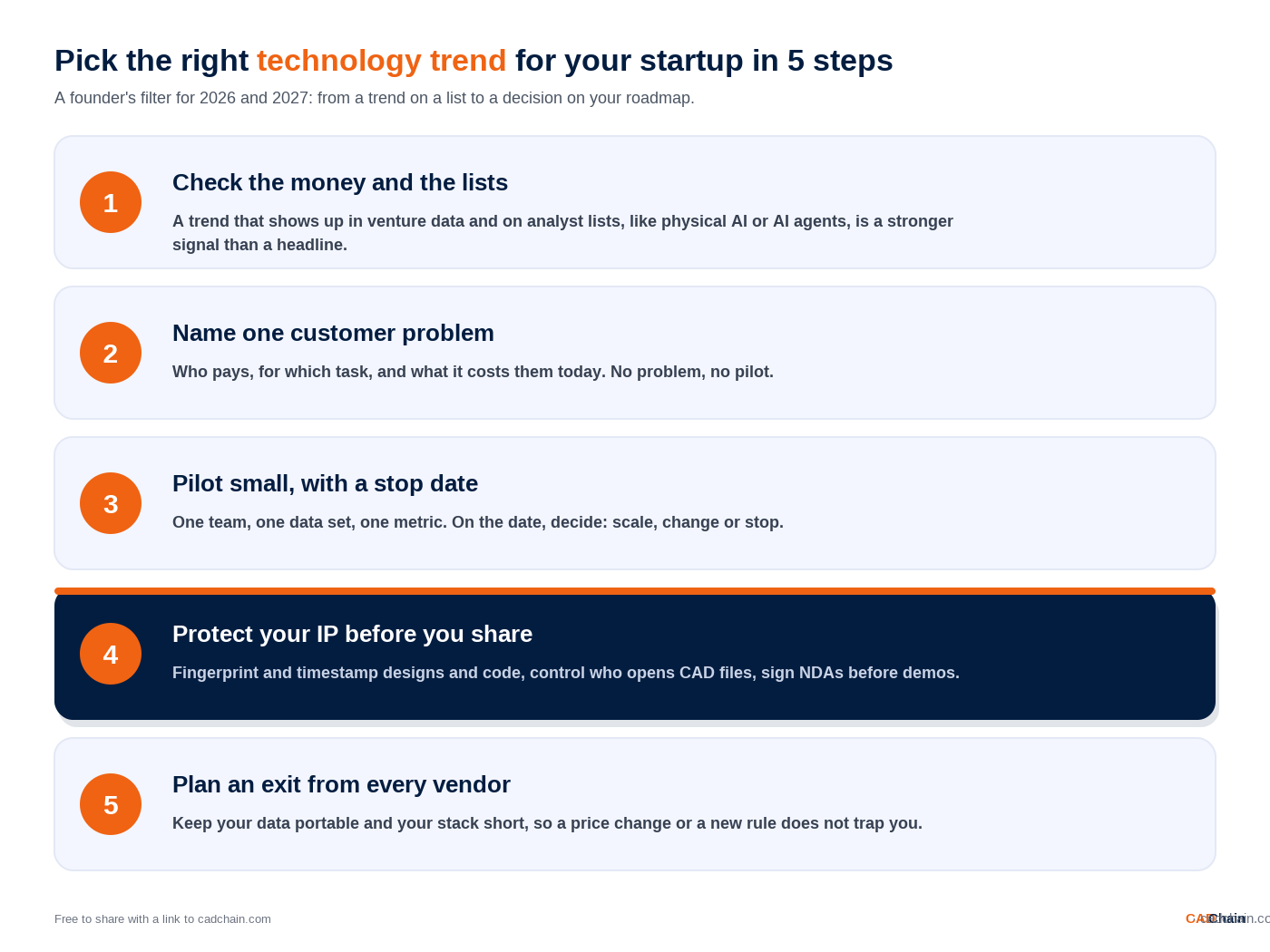
- Check the money and the lists. A trend that shows up in venture data and on analyst lists is a stronger signal than one headline.
- Name one customer problem. Who pays, for which task, and what it costs them today. No problem, no pilot.
- Pilot small, with a stop date. One team, one data set, one metric. On the date, decide to scale, change or stop.
- Protect your IP before you share. Prove what you created and when, and control who can open your files.
- Plan an exit from every vendor. Keep your data portable and your tech stack short.
“Startup Idea Validation the Right Way” shows you how to conceive, test, and launch a customer-driven venture in 2026 without giving away your equity to VCs.
Packed with lean startup tools, real-life case studies, and the latest in generative AI strategies, this e-book is a practical guide to building and scaling products people truly want. If you’re craving faster traction, sustainable growth, and full control of your business, this is your go-to blueprint.
👉 Get your FREE copy of the book here
How to leverage these trends for your startup success
Trends only help when they fit your stage and budget. Read one serious source each quarter, such as the Crunchbase funding reports and Gartner's annual list, instead of chasing every headline. Test new tools with a small pilot before you roll them out, and give each tool an owner and a budget.
Pro Tip: Tools offered on platforms like Fe/male Switch often combine elements of multiple trends, giving startups an ecosystem to experiment in one place!
Funding your pilot: AI grant tools
Need funding but don’t have time to write endless grant applications? An AI-driven grant finder and writer, like those from Fe/male Switch, is perfect for startups navigating tight schedules. Assemble data, draft applications, and submit them effortlessly!
Common mistake? Using generic grant applications. Precision tailored to the organization offering the grant is key.
For deep tech founders in Europe, the EIC Work Programme 2027 for deep tech founders is one of the largest public funding routes for exactly these trends.
Protect your IP when you build on a new technology trend
Every trend on this page makes it easier to copy: AI agents read your files, partners see your prototypes, and code and designs move between more tools than ever. Your designs, models, data and code are what investors and buyers pay for, so protect them before you share them:
- Decide what is a patent and what is a trade secret before the first demo or partner meeting.
- Keep dated proof of each version: a file fingerprint and a timestamp show what existed and when, without revealing the file.
- Control who opens your CAD files: CADChain gives engineering teams file-level access control for CAD files plus blockchain proof of ownership, a kind of DRM that goes further than classic DRM.
- Limit what AI agents and vendors can reach: no default access to design files or source code.
Our 8-layer IP protection playbook for deep tech and hardware teams walks through each layer, and BORIS Inventor covers the latest engineering technology trends for CAD teams.
Common mistakes founders make with technology trends
- Jumping on every trend: "tech FOMO" splits a small team's focus and budget. Pick one trend per quarter, at most.
- Buying the label, not the result: "agentic" or "AI-powered" says nothing about whether a tool solves your customer's problem.
- Giving AI agents too much access: an agent with your admin credentials is a security incident waiting to happen.
- Ignoring the exit: a tool you cannot leave becomes a cost you cannot control.
- Sharing before protecting: demos, pitch decks and design files leave the building long before a patent is filed.
Conclusion: the tech-driven startup future awaits
Startups that adapt to these Top 10 Proven Technology Trends Transforming 2026 will not only survive but thrive in this ever-changing landscape. From platforms like the SANDBOX and PlayPal, which ensure all-round validation, to industry clouds and generative AI tools, the opportunities for innovation are boundless.
Ready to future-proof your startup? Begin by experimenting with AI-driven solutions like those offered by F/MS Startup Game and AI SEO Tools for optimized growth and market visibility.
The best time to embrace these innovations? Right now.
Validate your business idea in the Fe/male Switch Sandbox! Test, experiment, and pivot your way to success, all in a risk-free environment with an AI Co-Founder.
FAQ
1. How can AI serve as a co-founder for startups in 2026?
AI tools like PlayPal on the SANDBOX platform offer guided validation for startup ideas and frameworks to optimize business development. Discover the SANDBOX and PlayPal
2. What is generative AI’s role in marketing and content creation?
Generative AI tools like ChatGPT help automate blog writing, ad copy creation, and email marketing, saving significant time and costs. Learn more about generative AI in content creation
3. What are the top trends in tech innovation for startups?
In 2026 and 2027 the top trends are AI agents for growth and operations, physical AI and world models, AI agent identity and security, large quantitative models, speech reasoning models, agent coding harnesses, sovereign tech and post-quantum cryptography. AI-driven startups took 64% of global venture funding in Q3 2026.
4. What are Gartner's top strategic technology trends for 2027?
Large quantitative models, speech reasoning models, world models, AI context platforms, agent coding harness, AI agent identity, autonomous exposure remediation, sovereign tech, disposable applications and wetware as a service, announced on 20 October 2026.
5. How much venture funding goes to AI startups?
In Q3 2026, AI-driven startups raised $102 billion of the $159 billion invested globally, about 64%, according to Crunchbase data as of 2 October 2026.
6. What is physical AI and why are investors funding it?
Physical AI is AI that senses and acts in the real world, in robots, vehicles, drones and factories. Investors fund it because models that understand space and cause and effect now make it practical: in Q3 2026, aerospace, robotics, data centers, semiconductors and energy each raised $10 billion or more.
7. Can I use AI to write SEO-optimized articles that help my brand grow?
Most business owners don't understand how SEO works, let alone how to use AI for writing blog articles. That's why for busy business owners there's a great free tool that doesn't require much knowledge. Write articles for free
8. Which startup trends will matter most in 2027?
Trust and control: AI agent identity, governance around AI coding agents, sovereign tech that lets customers exit a provider, and quantum-safe encryption. Large customers will ask about all four before they buy.
9. Should my startup invest in quantum computing now?
Only if it is your field. For most startups the urgent quantum task is defensive: plan the move to post-quantum encryption, based on NIST's FIPS 203, 204 and 205 standards.
10. How do I protect my startup's IP while adopting new technology?
Decide early what to patent and what to keep as a trade secret, keep dated proof of each design and code version, control who can open your files, and limit what AI agents and vendors can access.
About the Author
Violetta Bonenkamp, also known as MeanCEO, is an experienced startup founder with an impressive educational background including an MBA and four other higher education degrees. She has over 20 years of work experience across multiple countries, including 5 years as a solopreneur and serial entrepreneur.
Violetta is a true multiple specialist who has built expertise in Linguistics, Education, Business Management, Blockchain, Entrepreneurship, Intellectual Property, Game Design, AI, SEO, Digital Marketing, cyber security and zero code automations. Her extensive educational journey includes a Master of Arts in Linguistics and Education, an Advanced Master in Linguistics from Belgium (2006-2007), an MBA from Blekinge Institute of Technology in Sweden (2006-2008), and an Erasmus Mundus joint program European Master of Higher Education from universities in Norway, Finland, and Portugal (2009).
She is the founder of Fe/male Switch, a startup game that encourages women to enter STEM fields, and also leads CADChain, and multiple other projects like the Directory of 1,000 Startup Cities with a proprietary MeanCEO Index that ranks cities for female entrepreneurs. Violetta created the "gamepreneurship" methodology, which forms the scientific basis of her startup game. She also builds a lot of SEO tools for startups. Her achievements include being named one of the top 100 women in Europe by EU Startups in 2022 and being nominated for Impact Person of the year at the Dutch Blockchain Week. She is an author with Sifted and a speaker at different Universities. Recently she published a book on Startup Idea Validation the right way: from zero to first customers and beyond and launched a Directory of 1,500+ websites for startups to list themselves in order to gain traction and build backlinks.