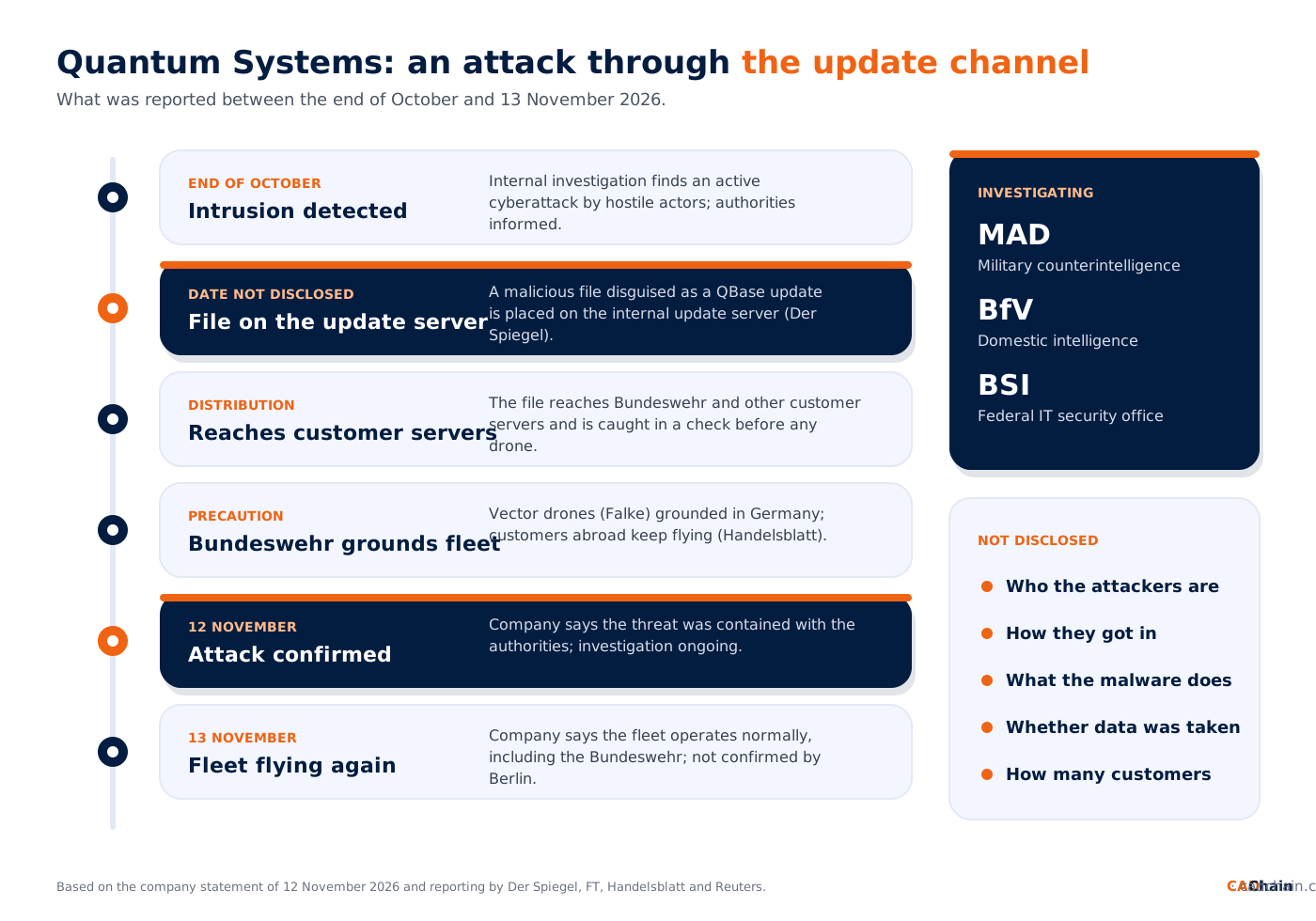
German drone maker Quantum Systems confirmed on 12 November 2026 that it had been hit by what it called "an active cyberattack by hostile actors". According to Der Spiegel, the attackers placed a malicious file on the company's internal update server, disguised as an update for its QBase ground-control software, and the file reached servers of the Bundeswehr and other customers. Germany's armed forces grounded their Quantum Systems drones as a precaution.
Quantum Systems is one of Europe's best-known deep-tech companies. Founded in 2015 in Bavaria, it builds the Vector reconnaissance drone, which the Bundeswehr flies under the name Falke, and it was valued at about 7 billion euros in a funding round this year, according to the Financial Times. It also supplies the Spanish and Dutch armed forces and Ukraine's defence forces, and it has more than 200 staff in Ukraine across three joint ventures.
The company says it found the intrusion at the end of October, contained it with the help of the authorities and reported it. On 13 November it said its fleet was flying normally again. But the case is already a textbook example of the attack every engineering company should fear most: not a stolen laptop or a leaked folder, but an attacker inside the network who can place files where customers trust them. For founders, engineering managers and IP lawyers, it raises a simple question: if someone can reach your update server, what else on your network can they reach?
TL;DR: a drone maker's update channel was used to push a malicious file to customers
Quantum Systems detected a cyberattack at the end of October 2026 and confirmed it on 12 November. Reports say a malicious file disguised as a QBase update reached Bundeswehr and other customer servers but was caught in a check before it reached any drone. The Bundeswehr grounded its fleet as a precaution; the company says the fleet is now flying again. Who did it, what the malware was meant to do and whether any data was taken have not been made public. Lesson for engineering teams: protect the release chain like a product, and protect design files and source code as if the network will one day be breached.
What happened at Quantum Systems?
The story broke on 12 November, when the Financial Times and Der Spiegel reported that the Bundeswehr had grounded its Quantum Systems drones. The same evening, the company published a statement. It said it had identified a cybersecurity incident at the end of October, that an immediate internal investigation had found an active cyberattack, and that its IT and security teams had contained the threat together with the authorities. An investigation with state authorities and internal and external experts is ongoing.
The technical details come from the press, not from the company. Der Spiegel reported that the attackers got into the corporate network and planted a malicious file on the server used to distribute updates for QBase, the Windows software used for mission planning, flight monitoring and data processing. The Financial Times reported that customers were told a malicious update file had gone out through that update server. According to Der Spiegel, the file reached servers at the Bundeswehr and other customers but was caught in a check before it got near the aircraft.
Three German agencies are investigating, according to Der Spiegel: the military counterintelligence service MAD, the domestic intelligence service BfV and the federal IT security office BSI. No attacker has been named. The company speaks only of hostile actors and says it was targeted precisely because its work is critical to its customers' security.
On 13 November, a spokesperson told Reuters that the fleet was operating normally again, including in Germany. As The Register reported, the spokesperson added: "The Bundeswehr was the only customer to ground their systems as a precaution." The German defence ministry declined to comment on the readiness of military equipment, and the Bundeswehr has not independently confirmed that flights resumed.
Why is an update server such a valuable target?
An update server is where a company tells its customers: this file is from us, you can install it. Customers' IT teams usually allow that traffic, and many products install updates with little human review. An attacker who can place a file there does not need to break into each customer one by one. The vendor's trust does the work.
That is why software supply chain attacks are so feared. In 2020, attackers inserted malicious code into updates of SolarWinds' Orion network management software, and SolarWinds said fewer than 18,000 customers installed the affected versions. That case changed how governments think about vendor software. The Quantum Systems case shows the same pattern in a newer and more sensitive industry: defence drones, where the software plans missions and processes reconnaissance data.
There is also a quieter point. To plant a file on an internal update server, an attacker needs a foothold inside the company. Reports do not say how the attackers got in, how long they were inside or what else they touched. The company has not said that any data was taken, and it has not said that none was. For a hardware company, the same network usually holds firmware and application source code, CAD models of airframes and payloads, test data, export-controlled technical data and customer project files. Our coverage of APT28 attacks on a naval shipbuilder and an aircraft engine maker and KeyDrift malware aimed at defence and satellite firms shows that state-linked groups are after exactly that kind of material.
Who targets European drone makers?
Nobody has publicly attributed this attack, and it would be wrong to guess. The background is clear, though. In July 2026, Germany's BfV warned defence companies about Russian espionage, sabotage and cyberattacks, especially those supporting Ukraine, and referred to a Russian defence ministry list naming 21 European companies that it claimed make drones for Ukraine. In October, German police arrested a suspected Russian spy over defence industry contacts, and security researchers have tracked North Korean campaigns against European drone suppliers for more than a year.
Quantum Systems is a prominent target by any measure. In October, Chancellor Friedrich Merz pledged funding for several tens of thousands of interceptor drones made in Ukraine by one of its joint ventures, and on 5 November NATO's Communications and Information Agency named it one of five suppliers for a new counter-drone marketplace, according to AeroTime. Fast growth, many partners and a high profile make a company attractive both to spies and to saboteurs.
What is known, and what is not?
Much of the public picture still rests on press reports citing unnamed sources. The table below separates what was reported from what remains open, and lists the control that matters for each part of the chain.
Keep design files protected even when attackers get inside the network. CADChain encrypts CAD files at file level, lets you grant and revoke access per user and per partner, logs every access and records ownership on a blockchain, so copied files stay locked and your ownership stays provable.
👉 See how CADChain protects CAD files
What does this mean for hardware and deep-tech companies in the EU?
Most deep-tech hardware companies now ship software too: ground stations, configuration tools, firmware, apps and cloud dashboards. That makes them software suppliers in the eyes of their customers and of the law. The Cyber Resilience Act requires manufacturers of products with digital elements to provide mechanisms to distribute updates securely, and since 11 September 2026 they must report actively exploited vulnerabilities and severe incidents, as we explained in Cyber Resilience Act reporting is live. Products developed exclusively for national security or defence are outside the CRA, but dual-use drones, survey drones and civilian software sold in the EU are not.
NIS2 is the second layer. Many manufacturers of electronics, aircraft and other transport equipment are covered as important entities and must report significant incidents, with an early warning within 24 hours. Export control is the third: drawings, models and source code for military or dual-use items are often controlled technical data, so a breach can also become an export control question. Our article on the BIS Affiliates Rule explains why CAD files count as technology under US rules.
Trade secret law is the fourth. Under the EU Trade Secrets Directive, designs and know-how only keep their protection if the holder took reasonable steps to keep them secret. Our trade secrets guide for deep tech startups explains the test. After a breach, the questions will be who could open which files, and whether you can show it.
What should engineering teams do now?
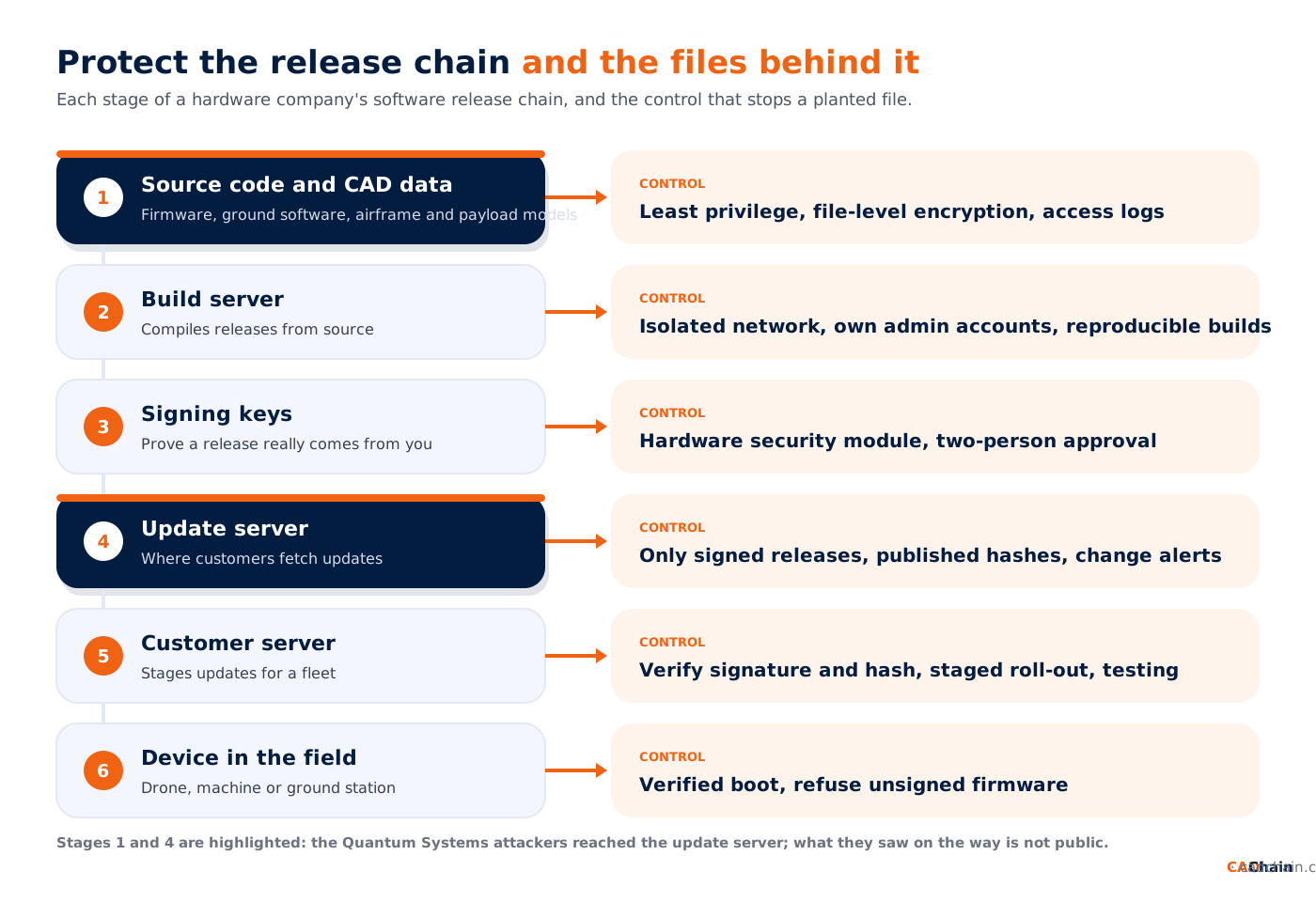
- Treat your release chain as a product. Keep build servers, signing keys and update servers apart from the office network, give them their own admin accounts and require two people to approve a release.
- Sign everything and check signatures everywhere. Sign installers, updates and firmware with keys held in a hardware security module, publish hashes, and make devices and ground software refuse unsigned or mismatched files.
- Help customers catch what you miss. The malicious file in this case was reportedly caught in a check on the customer side. Document how customers can verify your updates and offer staged roll-outs.
- Know where your crown jewels sit. List where firmware source, CAD models, test data and export-controlled files live, who can open them and whether they share a network with internet-facing servers. Our complete guide to CAD file security is a good start.
- Encrypt design files at file level. Network defences slow attackers down; CAD encryption decides whether a copied file can be opened at all.
- Log access and watch for bulk copying. Alert on unusual downloads from vaults, Git servers and file shares. See how to audit CAD file access.
- Separate partners and joint ventures. Give each partner its own accounts, folders and access rules, and share CAD files with suppliers on a need-to-know basis.
- Keep dated proof of ownership. Record when each design and release existed and who had access, so you can show what is yours and what you did to protect it.
How does this fit the bigger picture?
Our sister sites covered other ways engineering data is exposed this week:
- Firewalls as the way in. Check Point said attackers exploited its gateways between 30 October and 4 November, in one wave with a wiper. Solidboris.com explains what the Check Point firewall attacks mean for SOLIDWORKS servers, including PDM and licence servers on the same virtual host.
- Email gateways under attack. CISA added two Barracuda Email Security Gateway flaws to its exploited list on 10 November. BORIS Inventor covers what the Barracuda email gateway vulnerability means for teams that send CAD files.
- AI and IP in game studios. The GDC State of the Game Industry report, published on 12 November, lists IP protection among developers' concerns about generative AI. Blended BORIS explains what the GDC survey means for Blender game artists.
The common thread is that attackers go where trust is concentrated: firewalls, email gateways, PLM servers and, now, update servers. Our articles on supply chain attacks on CAD and PLM toolchains and on aerospace CAD file security for defence contractors go deeper into both sides.
Conclusion
The Quantum Systems attack seems to have been caught before it reached any aircraft, and the company says its fleet is flying again. That is a good outcome, and the customer-side check deserves credit. But the attackers were inside the network of one of Europe's most strategic deep-tech companies, they reached its update server, and the public still does not know what else they saw.
For every hardware startup and engineering firm, the lesson is the same. Secure the release chain so your customers' trust cannot be turned against them, and protect design files and source code so that a breach of the network is not automatically a loss of the know-how behind your product.
Make stolen design files useless and your ownership provable. CADChain gives every CAD file a verifiable ownership record, file-level encryption, granular permissions you can revoke at any time and a full access log, across CAD systems, partners and joint ventures.
👉 Protect your CAD files with CADChain
FAQ: Quantum Systems cyberattack
What happened at Quantum Systems?
The German drone maker detected a cyberattack at the end of October 2026 and confirmed it on 12 November. According to Der Spiegel, attackers placed a malicious file disguised as a QBase update on its internal update server, and the file reached servers of the Bundeswehr and other customers.
Were the drones infected?
According to reports and the company, no. Der Spiegel reported that the file was caught in a check before it reached the aircraft, and the company says there is no risk in operating its unmanned systems.
Why did the Bundeswehr ground its drones?
As a precaution. The company told Reuters that the Bundeswehr was the only customer to ground its systems and that the fleet was operating normally again on 13 November. The German defence ministry declined to comment.
What is QBase?
QBase is Quantum Systems' ground-control software, used for mission planning, flight monitoring and data processing for drones such as the Vector, which the Bundeswehr calls Falke.
Who was behind the attack?
No attacker has been named. The company speaks of hostile actors, and the MAD, BfV and BSI are investigating, according to Der Spiegel.
Was any data stolen?
That has not been made public. The company has not said that data was taken, and it has not said that none was.
What should hardware companies learn from it?
Separate and harden the release chain, sign and verify every update, help customers check updates, encrypt design files and source code at file level, log access and keep dated proof of ownership.
How does CADChain help?
CADChain encrypts CAD files at file level, so a copy taken from a breached network cannot be opened without permission. It also logs every access and records ownership on a blockchain. It works alongside network security and secure updates, not instead of them.