Headlines tell you that something happened. Technology news articles that go deep tell you why it happened, how the technology really works and what it means for your product, your data and your intellectual property. This guide lists 10 proven sources of in-depth tech journalism in 2026: long-form features, technical analysis, investigative reporting and strategy essays that founders and engineers can actually act on.
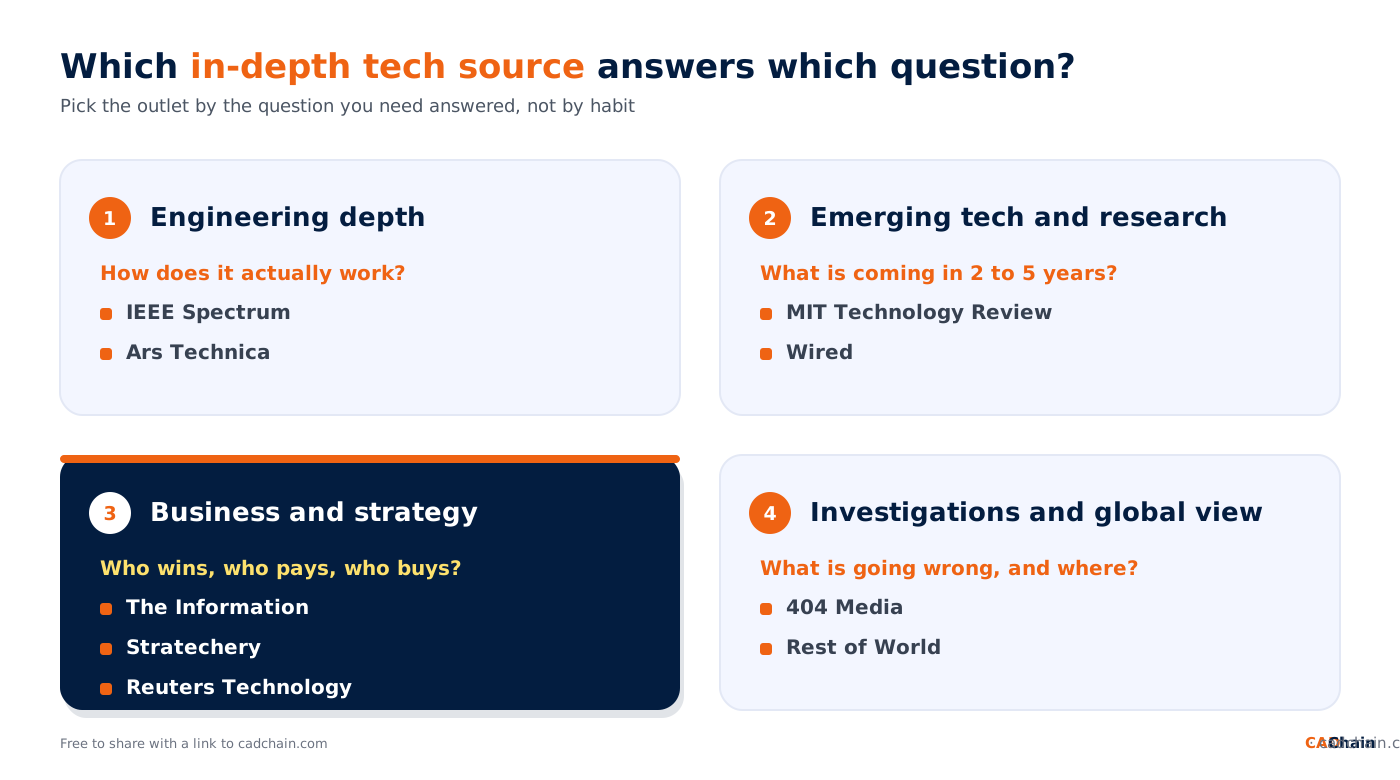
TL;DR: For in-depth technology news articles, read MIT Technology Review and Wired for emerging tech, IEEE Spectrum and Ars Technica for engineering depth, The Information, Stratechery and Reuters for the business side, and 404 Media and Rest of World for investigations and the view outside Silicon Valley. Skim headlines daily, pick two or three long reads a week, check the primary source behind the key claim and write down what it changes for your company.
Boost Your SEO by Getting Featured in Our Blogs and get a backlink.
We publish content about startups, education, tech, funding, etc. that ranks well not only in Google but also in Perplexity, ChatGPT, Grok and other AI tools.
👉 Get featured now!
This page is about depth, not speed. If you want the full map of daily news outlets, start with our guide to the top tech news sites. For new products and launch announcements, see our guide to innovation and product launch news; for aggregators and alerts, our list of trending tech news tools; and for research and lab news, our page on science and technology news.
What Makes a Technology News Article "In-Depth"?
A short news item reports an event. An in-depth technology article does more work for you. The best ones share a few traits:
- Original reporting: interviews, documents and data the reporter gathered, not a rewrite of a press release.
- Technical explanation: how the chip, model, protocol or exploit works, written so a non-specialist can follow it.
- Context: what came before, who competes and which rules apply, so you can judge how big the story really is.
- Named sources and primary documents: court filings, papers, standards and official statements you can check yourself.
- Consequences: what changes for customers, suppliers, engineers and investors.
- Corrections: a visible process for fixing mistakes, which is a good sign of a serious newsroom.
Why Founders and Engineers Need Long-Form Tech Journalism, Not Just Headlines
Decisions in a deep-tech company rarely depend on one headline. They depend on understanding a trend well enough to bet on it: which AI model class to build on, which supplier region is risky, how a court ruling changes what you can claim as your own. Long-form technology news articles give you that understanding faster than reading fifty short updates.
Engineering and IP stories are a good example. A one-line headline about a trade secret verdict says little. A deeply reported article explains what was taken, how it was proven and which controls failed. That is the kind of detail we also try to give in our analysis of the Huawei trade secrets trial and our breakdown of the Apple v. OpenAI trade secrets case. Security incidents work the same way: our deep technical dive into the Albert Heijn hack shows how much more you learn from a full reconstruction than from a breaking-news alert.
Top 10 Proven Technology News Articles Sources in 2026
Every outlet below was checked on its own website in October 2026. The list starts with a startup tool, then moves to independent newsrooms.
1. F/MS SANDBOX and PlayPal
The SANDBOX is a groundbreaking digital tool for entrepreneurs to validate their ideas and stay updated about tech trends like AI, gaming, and SaaS markets. Combined with PlayPal, the AI co-founder tailored to you, this platform integrates personalized guidance on startup ideas with the latest technology news, helping founders make smarter, informed decisions.
- Unique Selling Point (USP):
- AI-powered insights into startup building and ongoing market trends.
- Feedback loops powered by Elona Musk (AI) and critical advice from CEO Violetta Bonenkamp.
- Flexible validation process to venture into new ideas without risk.
Want to stay ahead? Use PlayPal inside the SANDBOX to understand how tech developments apply to your startup. Learn more about AI Startup Game →
2. MIT Technology Review
Founded in 1899 at the Massachusetts Institute of Technology and now run as an independent media company, MIT Technology Review covers artificial intelligence, robotics, biotechnology, climate and energy, and computing, with a strong focus on their business, social and political effects. Its yearly "10 Breakthrough Technologies" list is a useful starting point for spotting what is moving from the lab to the market.
- Best for: founders who need to judge which emerging technologies are real and how close they are to market.
- Format: features, explainers, newsletters, a print magazine and events.
- Access: paid subscription, plus email newsletters.
3. IEEE Spectrum
IEEE Spectrum is the flagship magazine of the IEEE, the engineering professional organization, and has been published since 1964. It covers technology, engineering and science through news, features, special reports, podcasts and infographics. For hardware, energy, semiconductors, robotics and aerospace teams it is often the most technically precise general publication.
- Best for: engineers and CTOs who want the mechanism, not the hype.
- Format: features, special reports, news, podcasts and infographics.
- Access: thousands of articles free with a free account; full access through IEEE membership or a subscription.
4. Ars Technica
Ars Technica, owned by Condé Nast, is known for long, technically detailed articles on hardware, software, security, science and tech policy. Its articles tend to explain the technical detail that shorter news items skip, which makes it useful for teams that ship software or devices.
- Best for: technical founders, security leads and developers.
- Format: deep dives, reviews, explainers and news analysis.
- Access: free to read; paid subscriptions remove ads.
5. Wired
Wired, also part of Condé Nast, is the classic home of long-form writing on how technology changes culture, politics and business. Its features are strongest on AI, security, privacy and the people behind big tech shifts.
- Best for: founders who need the social and ethical picture around a technology before they build on it.
- Format: long-form features, investigations, reviews and newsletters.
- Access: a limited number of free articles, then a paid subscription.
Boost Your SEO with product placement and guest blogging: get a permanent do-follow backlink and traffic
- Product Placement: Add your startup into one of our listicles.
- Guest Post: Publish an article about your startup or product in our blog
🔗 Boost SEO for your startup
6. The Information
Jessica Lessin founded The Information in late 2013 with a simple goal: deeply reported articles about the technology industry. It is funded by subscribers rather than traffic, and its reporting on AI companies, big tech strategy and deals is often picked up by other outlets.
- Best for: founders, investors and business development leads who track competitors, partners and funding.
- Format: scoops, deeply reported articles, newsletters and data projects.
- Access: paid subscription.
7. Stratechery
Stratechery is Ben Thompson's publication on the strategy and business of technology and media, and on technology's wider effects on society. Thompson worked at Apple, Microsoft and Automattic and has written Stratechery full-time since 2014. It is analysis rather than news: why a company made a move, and what it means for the market structure around it.
- Best for: founders thinking about business models, platforms and aggregation.
- Format: weekly essays and Daily Updates.
- Access: weekly articles are free; three Daily Updates a week are for Stratechery Plus subscribers.
8. Reuters Technology
The technology section of the Reuters news agency is the place to go for fact-first reporting on chips, telecoms, AI regulation, export controls and big tech business, with correspondents around the world. Its special reports and investigations add depth to the fast wire coverage.
- Best for: anyone who needs reliable facts on supply chains, regulation and global tech business.
- Format: breaking news, analysis, special reports and investigations.
- Access: a limited number of free articles each month, then a digital subscription.
9. 404 Media
404 Media is an independent, journalist-owned company founded by technology reporters Jason Koebler, Emanuel Maiberg, Samantha Cole and Joseph Cox. It publishes investigative reports, longform features and scoops on hacking, cybersecurity, cybercrime, artificial intelligence, surveillance, privacy and consumer rights.
- Best for: security, privacy and compliance teams, and founders building AI or data products.
- Format: investigations, longform features, blogs and a podcast.
- Access: some articles free; a paid membership gives unlimited access, a full-text RSS feed and an ad-free site.
10. Rest of World
Rest of World is a 501(c)(3) nonprofit publication that reports on technology and its impact on communities outside the West: Africa, Asia, China, Eastern Europe, Latin America, South Asia and the Middle East and North Africa. Beats include tech giants, electric vehicles and innovation.
- Best for: founders selling, sourcing or hiring outside Europe and North America.
- Format: reported features, investigations and newsletters.
- Access: free to read, without a paywall; funded by donations.
In-Depth Technology News Articles Sources Compared
How to Read Technology News Articles Like an Analyst
Reading more is not the goal. Reading the right articles and turning them into decisions is. A simple weekly routine works for most small teams:
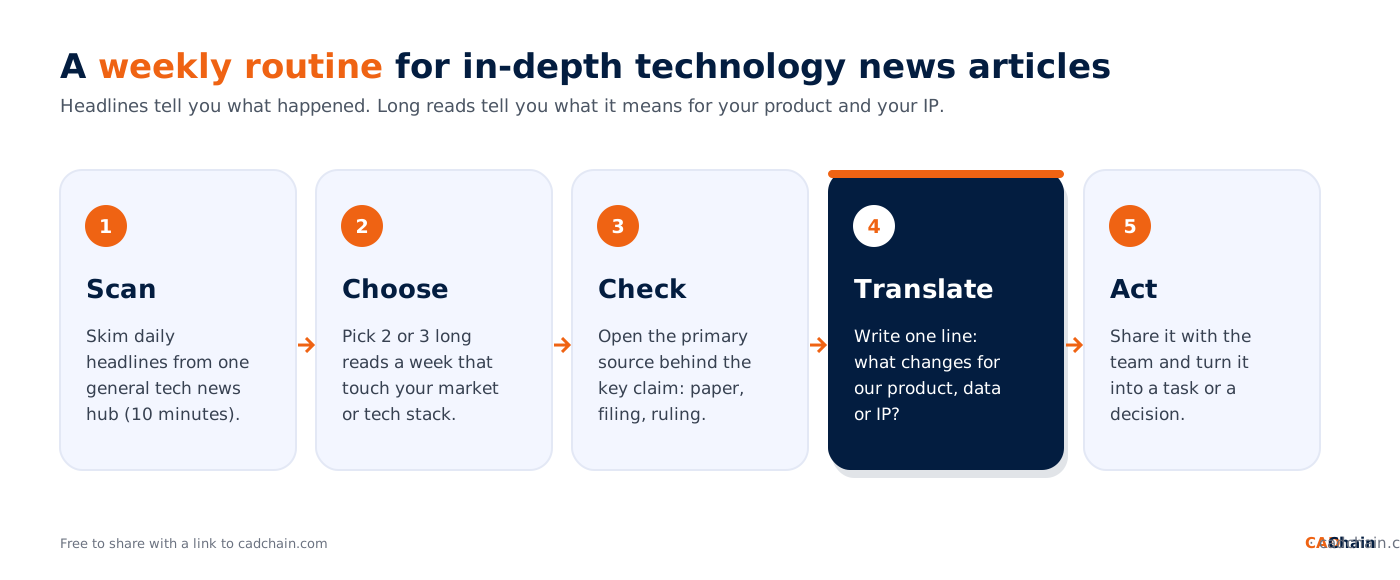
- Scan: skim headlines once a day from one general hub, such as the outlets in our top tech news sites guide.
- Choose: pick two or three long reads a week that touch your market, your tech stack or your regulation.
- Check: open the primary source behind the key claim: the paper, the court filing, the standard or the official statement.
- Translate: write one sentence on what the article changes for your product, your data or your IP.
- Act: share it in your team channel and turn it into a task, a risk note or a decision.
If a story touches your own designs or know-how, compare it with your protection setup. Our IP protection playbook for deep tech and hardware teams and our trade secrets guide for deep tech startups are good checklists to run against the lessons of a big case.
Subscribe to AI Tools for SEO Content and Keyword Research
Use powerful decision-making tools for your ranking potential like the F/MS AI SEO Tool. It helps automate SEO strategies for both traditional search engines (Google, Bing) and advanced AI sources, such as ChatGPT and Perplexity.
With its AI Writer, F/MS tools optimize practical keyword insights for startups and freelancers.
Common Mistakes When Reading Tech News Articles
- Treating a headline as the whole story: the important caveat is often in paragraph twelve.
- Over-relying on a single outlet: every newsroom has blind spots, so mix business, engineering and investigative sources.
- Skipping the primary source: numbers get rounded and quotes get shortened as a story travels.
- Reading without a question: decide what you need to know before you open ten tabs.
- Ignoring stories outside your region: suppliers, competitors and rules abroad shape your market too.
- Overlooking emerging trends, especially in AI-driven markets, until competitors have already moved.
How CADChain Uses In-Depth Tech News
At CADChain we read long-form reporting on IP theft, industrial espionage, CAD and PLM security and new EU rules for manufacturers, because those stories show where engineering data really leaks. We turn the lessons into practical guides, such as our guide to IP theft in manufacturing and our monthly deep tech startup news digest.
Protect the designs the headlines are about. CADChain gives engineering teams blockchain proof of ownership and file-level access control for CAD files, across CAD systems.
👉 See how CADChain protects CAD files
Conclusion
The difference between staying informed and staying ahead is depth. Pair a fast daily news source with a few trusted outlets for in-depth technology news articles, check the primary source behind the claims that matter and write down what each story changes for your company.
As technology accelerates in 2026, top sources for technology news articles like F/MS SANDBOX and PlayPal guide startup founders, freelancers, and entrepreneurs in navigating innovation with clarity. Combine these tools with proactive SEO and the AI-driven grant-writing tool to amplify your impact, helping businesses solve problems, optimize strategies, and capitalize on trends.
Write FREE SEO-optimized Blog Articles! Our Article Writer ensures your blog is loved by both Google and your readers, turning those clicks into customers.
👉 Write your article here
Stay updated with key tech advancements to drive smarter business outcomes. Ready to empower your startup journey? Get Started with F/MS SANDBOX Today →.
FAQ
What are technology news articles?
Technology news articles report and explain developments in technology: new products, research, security incidents, regulation and business moves. Short news items cover what happened; in-depth articles add original reporting, technical explanation and context.
Where can I read in-depth technology news articles?
Good sources in 2026 include MIT Technology Review and Wired for emerging tech, IEEE Spectrum and Ars Technica for engineering depth, The Information, Stratechery and Reuters for the business side, and 404 Media and Rest of World for investigations and global coverage.
Which tech news sources are free?
Rest of World is free and has no paywall. Ars Technica is free to read, IEEE Spectrum offers thousands of articles with a free account, and Stratechery's weekly essays are free. Wired and Reuters allow a limited number of free articles before asking you to subscribe.
What is the best source for engineers?
IEEE Spectrum, the flagship magazine of the IEEE, is written with engineers in mind. Ars Technica is a strong second for software, hardware and security.
How do I know if a technology news article is reliable?
Look for named sources, links to primary documents, a clear author byline, a visible corrections policy and a separation between news and sponsored content. Then check the key claim against the original paper, filing or statement.
How many tech articles should a founder read each week?
There is no fixed number, but a practical routine is a short daily scan of headlines plus two or three long reads a week that are directly relevant to your market or technology.
Can I use AI to write SEO-optimized articles that help my brand grow?
Most business owners don't understand how SEO works, let alone how to use AI for writing blog articles. That's why for busy business owners there's a great free tool that doesn't require much knowledge. Write articles for free
What is the best tool to simplify startup idea validation with integrated news insights?
The F/MS SANDBOX offers a unique approach for entrepreneurs to validate business ideas while staying informed about the latest tech trends. It includes personalized insights from PlayPal, an AI co-founder tool. Explore the F/MS SANDBOX
About the Author
Violetta Bonenkamp, also known as MeanCEO, is an experienced startup founder with an impressive educational background including an MBA and four other higher education degrees. She has over 20 years of work experience across multiple countries, including 5 years as a solopreneur and serial entrepreneur.
Violetta is a true multiple specialist who has built expertise in Linguistics, Education, Business Management, Blockchain, Entrepreneurship, Intellectual Property, Game Design, AI, SEO, Digital Marketing, cyber security and zero code automations. Her extensive educational journey includes a Master of Arts in Linguistics and Education, an Advanced Master in Linguistics from Belgium (2006-2007), an MBA from Blekinge Institute of Technology in Sweden (2006-2008), and an Erasmus Mundus joint program European Master of Higher Education from universities in Norway, Finland, and Portugal (2009).
She is the founder of Fe/male Switch, a startup game that encourages women to enter STEM fields, and also leads CADChain, and multiple other projects like the Directory of 1,000 Startup Cities with a proprietary MeanCEO Index that ranks cities for female entrepreneurs. Violetta created the "gamepreneurship" methodology, which forms the scientific basis of her startup game. She also builds a lot of SEO tools for startups. Her achievements include being named one of the top 100 women in Europe by EU Startups in 2022 and being nominated for Impact Person of the year at the Dutch Blockchain Week. She is an author with Sifted and a speaker at different Universities. Recently she published a book on Startup Idea Validation the right way: from zero to first customers and beyond and launched a Directory of 1,500+ websites for startups to list themselves in order to gain traction and build backlinks.