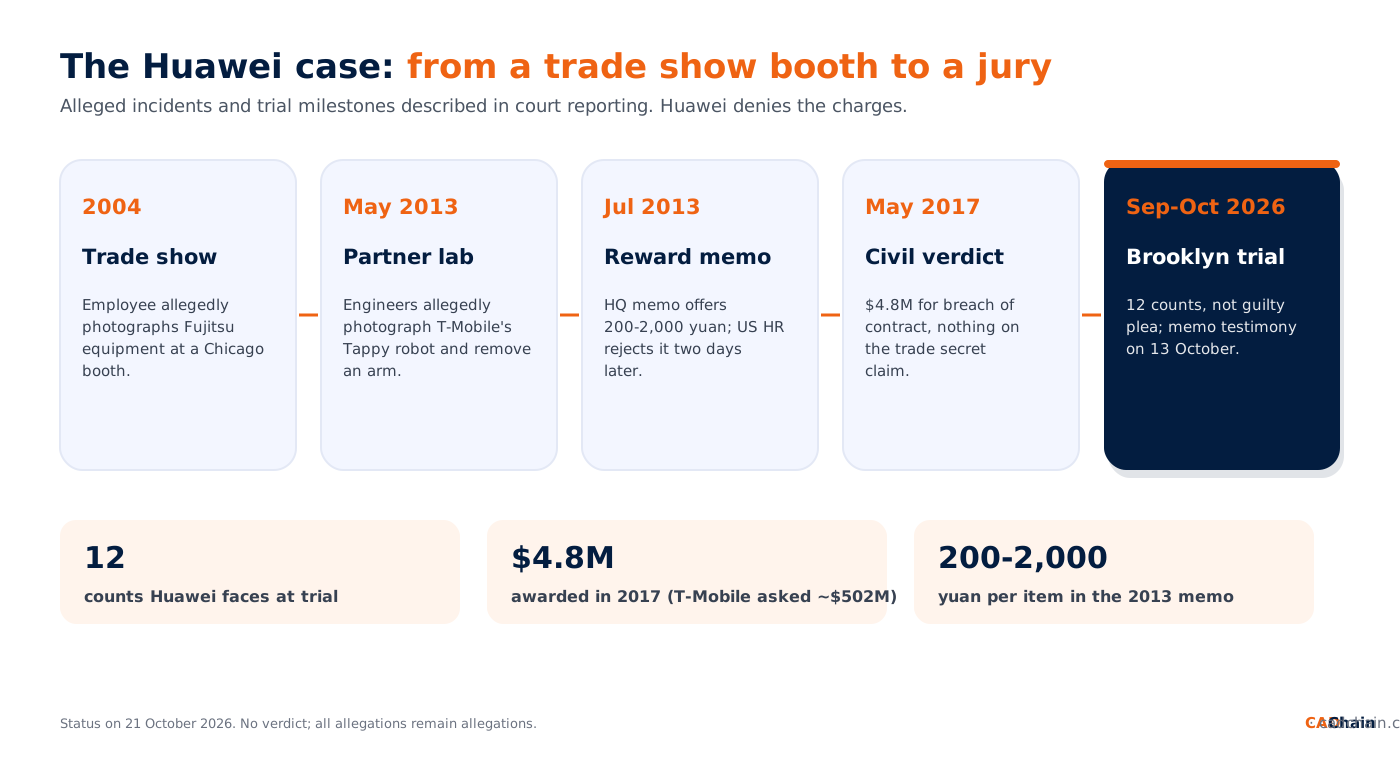
On 13 October 2026, a former employee of Huawei's US subsidiary told a Brooklyn federal jury about a July 2013 memo from Huawei headquarters that offered employees cash rewards for information about competitors. The testimony came in the racketeering and trade secret trial of Huawei Technologies, which opened in early September and is expected to run for weeks more. Huawei has pleaded not guilty and argues that the incidents prosecutors describe were the acts of individual employees, not company policy.
The case has been building for almost eight years. It combines allegations of bank fraud and Iran sanctions violations with a long list of alleged trade secret incidents, from a photographed trade show booth in 2004 to a smartphone-testing robot in a T-Mobile lab in 2013. Huawei is the only defendant. No individual is on trial.
For deep-tech founders, IP lawyers and engineering managers, the most useful part of the trial is not the geopolitics. It is the central legal question: when employees take a competitor's information, is that the company's conduct or a rogue act? The answer depends on documents, emails, training records and logs. Here is what was said in court, how the alleged incidents worked, and what engineering teams can learn about protecting their own designs and proving it when it matters.
TL;DR: the Huawei trade secrets trial in one paragraph
US prosecutors in Brooklyn accuse Huawei of a racketeering enterprise that included stealing trade secrets from competitors and business partners. Huawei denies it. On 13 October 2026, former Huawei Device USA employee Heather Campbell testified about a 10 July 2013 headquarters memo that offered rewards of 200 to 2,000 yuan for competitor information, and about a US HR email two days later that rejected the practice. The defence says such incidents were individual misconduct that the company punished. The lesson for engineering teams: trade secret cases are decided on evidence. Companies need records that show both how they protect their own designs and how they keep other people's information out.
What happened in the Huawei trial on 13 October 2026?
Heather Campbell worked for Huawei Device USA in Plano, Texas, from 2012 to 2016 as a corporate trainer. According to reporting from the courtroom, she testified that in July 2013 Huawei's in-house lawyer in the US handed her an envelope that contained a memo from the Chinese headquarters and a separate warning from the American HR director. She told the jury that she understood the memo as asking employees to steal from competitors, and that she later gave the documents to the FBI.
The memo and the response to it, as described in court, contained these elements:
- The headquarters memo, dated 10 July 2013. It offered rewards of 200 to 2,000 yuan, depending on the value and confidentiality of the information. Product roadmaps earned the highest rewards. Business documents, project quotations, distribution structures and after-sales strategies earned less. The memo also explained how to submit the information, including through encrypted communication.
- The US HR email, dated 12 July 2013. The American HR director sent a high-priority email rejecting the practice and warning that employees who took part could be disciplined or dismissed.
- Training. Huawei held compliance training on respecting third-party intellectual property in July and August 2013.
Under cross-examination, the defence pointed out that the rewards were worth only about $30 to $330 at the time, that another translation of the memo's punishment language could mean employees would not be penalised for refusing to take part, and that Campbell was not one of the original recipients. The defence also said the memo first went to about 15 to 20 sales staff, not research engineers.
What is Huawei accused of in the Brooklyn trial?
The trial is taking place in the US District Court for the Eastern District of New York before Judge Ann M. Donnelly. Jury selection began on 8 September 2026. Shortly before, prosecutors dropped two export-control counts and one trade secret allegation involving a company widely identified as Motorola. Huawei now faces 12 counts, including racketeering conspiracy, conspiracy to steal trade secrets, bank fraud and sanctions violations. It has pleaded not guilty to all of them.
In his opening, according to the International Consortium of Investigative Journalists, Justice Department lawyer Taylor Stout described a scheme lasting more than twenty years and told jurors: "Crime was an important business strategy." Prosecutors say Huawei paid employees bounties for recruiting staff from rivals who brought trade secrets with them. Defence lawyer Brian Heberlig replied that the charges are about disconnected incidents: "It's about competition, not conspiracy."
The alleged incidents named in court reporting include T-Mobile, Cisco and Fujitsu. Prosecutors expect to finish presenting their case in November, and the defence has said it needs about a month. The judge has said she hopes the trial ends by Christmas, but it could run into 2027. There is no verdict, and every allegation remains an allegation until the jury decides.
Make your designs hard to copy and easy to prove as yours. CADChain encrypts CAD files, controls who can open them, and logs every access, across CAD systems.
👉 See how CADChain works
How did the alleged trade secret incidents work?
The methods described in this case are worth studying because none of them needed hacking. They used ordinary business access: a trade show, a supplier relationship, a hiring process.
The trade show booth. According to trial coverage, a Huawei employee entered Fujitsu's booth at a 2004 trade show in Chicago and photographed networking equipment until a security guard spotted him. The defence says he acted on his own. Our article on competitor industrial espionage and CAD file theft tactics shows how often this kind of low-tech gathering is the first step.
The partner lab. In 2013, Huawei was a handset supplier to T-Mobile, and its engineers had access to T-Mobile's lab in Bellevue, Washington. Prosecutors say they photographed and measured T-Mobile's phone-testing robot, known as Tappy, and removed a part of its mechanical arm. Huawei has long said the matter was settled between the two companies.
The hire. Prosecutors say Huawei rewarded employees for recruiting people from rivals who brought confidential information with them. This is the same risk we described in the Apple v. OpenAI trade secrets case: a new hire's old files can turn the hiring company into a defendant.
What does the rogue-employee defence mean for companies?
A company can be held responsible for what its employees do in their jobs. Huawei's defence is that it did not direct these acts, that its US management rejected the 2013 memo in writing, and that it trained staff and disciplined those who broke the rules. Prosecutors argue that emails and the memo show a coordinated effort between China and the US.
Whatever the jury decides, the dispute shows that both sides build their case from records. The written HR warning and the training dates help the defence. The memo and internal emails help the prosecution. Companies that never wrote anything down would have nothing to show either way.
For any company that hires engineers from competitors, this is the practical point. A clear policy, signed declarations from new hires, training records and file access logs are what let you show that a rogue act really was rogue. Our guide to employee IP agreements for CAD files covers the paperwork side.
Why was the T-Mobile civil verdict only $4.8 million?
The Tappy incident has already been to court once. In May 2017, according to Associated Press reporting, a federal jury in Seattle found that Huawei had misappropriated T-Mobile's trade secrets and breached a supply contract. But it awarded $4.8 million for the breach of contract, found the misappropriation was not willful and malicious, and awarded nothing on the trade secret claim. T-Mobile had asked for about $502 million.
The gap is a reminder that winning on liability is not the same as recovering value. Damages depend on proving what the information was worth, what the other side gained and how it was used. That proof is much easier when the owner can show exactly which files exist, who created them, when, and who accessed them. Our article on audit trail requirements for IP litigation explains what that record needs to contain, and CAD file ownership and legal proof covers documentation for designs.
How do the alleged methods compare with the protections that work?
Each route in the Huawei allegations matches a common weak point in engineering companies.
What does this mean for CAD files and design data?
The Huawei allegations are about telecoms equipment and a test robot, but the pattern applies to every hardware company. A competitor, supplier or new hire who gets near your design data can photograph a prototype, copy an assembly or keep a drawing set. Courts then ask two questions. Did you take reasonable steps to keep the information secret? And can you prove what was taken and that it was yours?
Both questions have a technical answer. CAD files that are encrypted and open only for named users stay protected when they are copied to a USB stick or a personal cloud. A tamper-proof log of every access gives you the timeline a court needs. Our legal framework for trade secret protection of CAD designs explains why these measures count as reasonable steps, and the guide to blockchain evidence in IP litigation covers how courts treat that kind of record.
What should engineering teams do now?
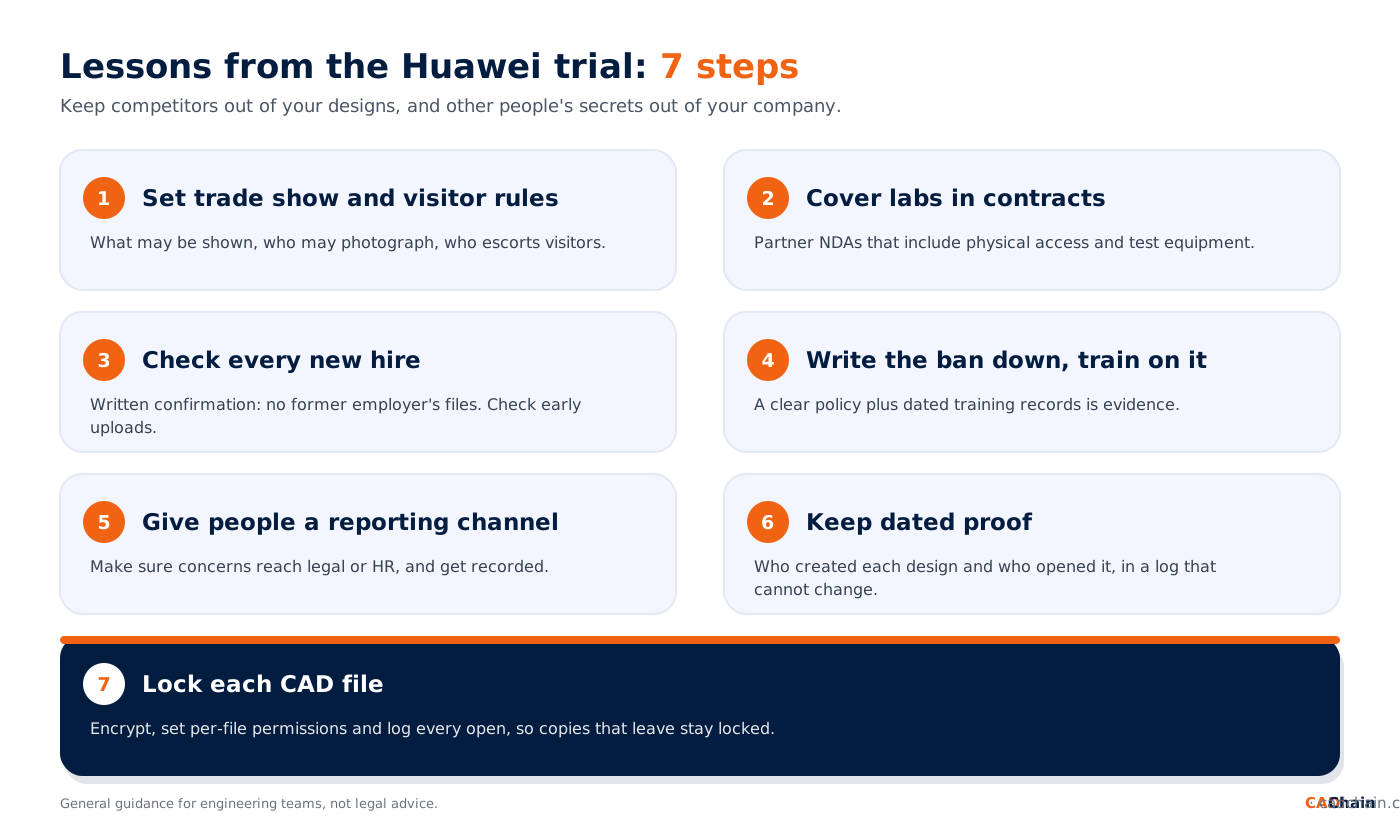
- Review your trade show and visitor rules. Decide what may be shown, who may photograph what, and who escorts visitors in labs and workshops.
- Put lab and prototype access into contracts. Supplier and partner NDAs should cover physical access, photography and test equipment, not only documents.
- Check every new hire. Ask engineers to confirm in writing that they bring no former employer's files, and check what they upload in the first weeks.
- Write the ban down and train on it. A clear policy against taking competitors' confidential information, with dated training records, is evidence you can use later.
- Give people a reporting channel. In the Huawei case, the warning came from an in-house lawyer and an HR director. Make sure employees know where to raise concerns.
- Lock your own design files. Encrypt sensitive CAD files with per-file permissions, so copies that leave the company cannot be opened without permission.
- Keep dated proof of creation and access. Record who created each design and who opened it, in a log that cannot be quietly changed.
For the full set of protections, from contracts to technical controls, see our trade secrets guide for deep-tech startups.
How does this connect to other recent cases?
The Huawei trial is one of several October 2026 cases about trade secrets and engineering data. On 19 October, the US sanctioned five China-based entities connected to a former Google engineer, which we covered in our article on PAIPA sanctions over Google AI trade secrets. Earlier in the month, a Florida jury awarded about $116.9 million in a case about drawings and 3D models, described in our article on the Joby trade secret verdict. And the risk of CAD file exfiltration by former employees remains the most common route of all.
How does this fit the bigger picture?
Our sister sites covered other changes this week.
- AI that writes CAD macros. SOLIDWORKS AI can now generate VBA macros from plain-language requests, and those macros run with the user's rights. Read what SOLIDWORKS AI macro generation means for CAD managers on solidboris.com.
- Backup tools as an attack path. A cloud backup service's app credential was abused to sign in to Microsoft 365 tenants. Our sister site explains what the backup supply chain attacks mean for Inventor teams.
- Paid and private 3D assets. Blender 5.3 adds access tokens for online asset libraries. Blended BORIS looks at what Blender online asset libraries mean for 3D artists.
Conclusion
The Huawei trial will decide whether a series of alleged incidents over more than twenty years adds up to a criminal enterprise or to the acts of individual employees. The jury has not ruled, and Huawei denies the charges.
For everyone else, the lesson is already clear. Trade secret disputes are fought with records: memos, emails, training dates, contracts and access logs. Companies that protect their designs at file level and keep dated proof of who created and opened them are in a far stronger position, whether they are the victim or the company accused of benefiting.
Protect your designs before anyone gets near them. CADChain gives engineering teams file-level access control, access logs and blockchain proof of ownership for CAD files, across CAD systems.
👉 Protect your CAD files with CADChain
FAQ: the Huawei trade secrets trial
What is the Huawei trial in Brooklyn about?
US prosecutors accuse Huawei Technologies of a racketeering enterprise that included stealing trade secrets from competitors and business partners, bank fraud and Iran sanctions violations. The trial began in September 2026 before Judge Ann M. Donnelly. Huawei has pleaded not guilty.
What did the 13 October 2026 testimony show?
A former Huawei Device USA employee described a 10 July 2013 headquarters memo offering 200 to 2,000 yuan for competitor information, and a US HR email two days later that rejected the practice and warned of discipline.
What is the rogue-employee defence?
Huawei argues that the incidents were the acts of individual employees who broke company rules and were punished, not a company strategy. Prosecutors argue that internal documents show a coordinated effort.
What happened in the T-Mobile Tappy case?
In 2017, a Seattle jury found that Huawei misappropriated T-Mobile's trade secrets and breached a contract, but awarded $4.8 million for the breach of contract and nothing on the trade secret claim. T-Mobile had asked for about $502 million.
When will the Huawei trial end?
Prosecutors expect to finish their case in November 2026, and the defence says it needs about a month. The judge hopes to finish by Christmas, but the trial could continue into 2027.
Does this case affect European companies?
The trial is a US criminal case. European companies are protected by the EU Trade Secrets Directive and national law, which also require reasonable steps to keep information secret and evidence of what was taken.
How can CAD file protection help in trade secret disputes?
Encrypted CAD files with per-file permissions stay locked when copied, and a tamper-proof access log shows who created and opened each design. That supports both the reasonable-steps test and proof of what was taken.