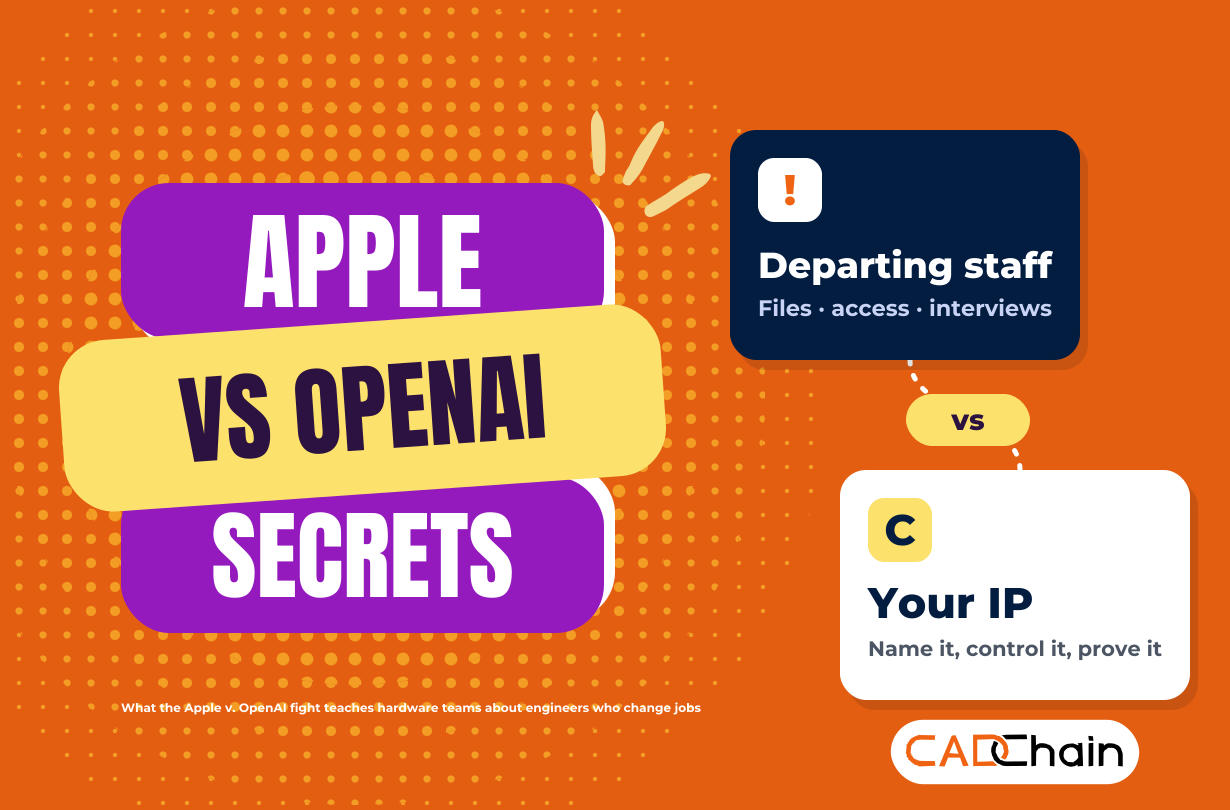
On 14 October 2026, a US federal judge in San Jose said he was "highly likely" to grant Apple a preliminary injunction in its trade secret lawsuit against OpenAI. OpenAI then agreed not to use the trade secrets Apple says former Apple engineers took with them, while the case continues. A day earlier, the same judge had ordered OpenAI to hand over records of its job interviews with former Apple staff.
The case is about hardware. Apple sued in July, claiming that OpenAI's consumer device team, built around its io hardware unit and including former Apple designers and engineers, gathered confidential information on product design, manufacturing, components, testing and the supply chain from people who had worked at Apple. OpenAI denies this firmly. On the same day as the hearing, it filed its own accusation: that an engineer who left OpenAI to return to Apple took more than 100 confidential files about an unreleased OpenAI device.
For deep-tech founders, engineering managers and IP lawyers, the case shows how engineering knowledge moves when people change jobs, and how much depends on proving which files were taken. Here is what is known, what is still open, and what hardware teams should do now.
TL;DR: Apple v. OpenAI in one paragraph
Apple accuses OpenAI, its chief hardware officer Tang Tan, its io hardware unit and former iPhone hardware engineer Chang Liu of misappropriating confidential hardware information. On 13 October, Judge Edward Davila gave Apple fast access to OpenAI's interview records for former Apple staff and ordered quick depositions. On 14 October, he said he was highly likely to grant a preliminary injunction, and OpenAI agreed not to use the information Apple claims was stolen and to collect forensic images of devices from 14 employees. OpenAI denies wrongdoing, says Apple has not named specific trade secrets, and now accuses a returning Apple engineer of taking more than 100 files. Nothing has been decided on the merits. The lesson for every hardware team: departing and arriving engineers are your biggest IP risk, and the company that can prove what it owned, who accessed it and when, is the one that gets help from the court.
What is Apple accusing OpenAI of?
Apple filed the case, Apple v. Liu, in the federal court for the Northern District of California in July 2026. The defendants are Chang Liu, a former iPhone hardware engineer; Tang Tan, a former Apple executive who is now OpenAI's chief hardware officer; OpenAI; and io Products, the hardware company OpenAI bought in 2025 for about $6.5 billion.
According to reports on the complaint, Apple says former employees used Apple laptops to download confidential material, including technical specifications, engineering presentations and project data about unannounced products. It also says OpenAI used job interviews to draw out proprietary information, that candidates were coached on what to bring, and that some were asked to bring prototypes and "design artifacts" for show-and-tell sessions. Apple further alleges that Liu used an authentication flaw to reach Apple network storage after he had left.
OpenAI rejects all of this. It argues that Apple is trying to stop people from leaving for a competitor and is treating ordinary job interviews as theft. In its motion to dismiss, it says Apple has only listed broad categories of hardware information rather than specific trade secrets. It also says Apple encouraged staff to use personal iCloud accounts for work and that an Apple authentication error left Liu with access after he left. In August, it published messages between Liu and Apple employees on its website. OpenAI has said it has "no need or desire for Apple's trade secrets."
What did the judge order this week?
On 13 October, Judge Davila granted much of Apple's request for expedited discovery, as TechCrunch reported. Apple can see OpenAI's interview materials, such as checklists, guides, scripts and records of discussions that refer to Apple technology or components, for former Apple employees who applied to OpenAI's consumer hardware and robotics groups. It also gets private messages between people named in the case and early depositions of Liu, Tan and a third former Apple employee. OpenAI has five days to produce material it has already collected and 14 days for the rest.
The judge did not give Apple everything. He refused, for now, fast access to OpenAI's own research in areas such as metal finishes and power management, and to information about what former Apple employees had built at OpenAI. Apple can narrow those requests and try again.
At the hearing on 14 October, Davila said he was highly likely to grant Apple's motion for a preliminary injunction. OpenAI then agreed voluntarily not to use the information Apple claims was stolen and to collect forensic images of devices from 14 employees that may contain Apple material, as 9to5Mac summarised. The judge can enforce that commitment. He called Apple's wish to inspect every device that might hold its secrets a "huge ask".
Why does the counter-accusation matter?
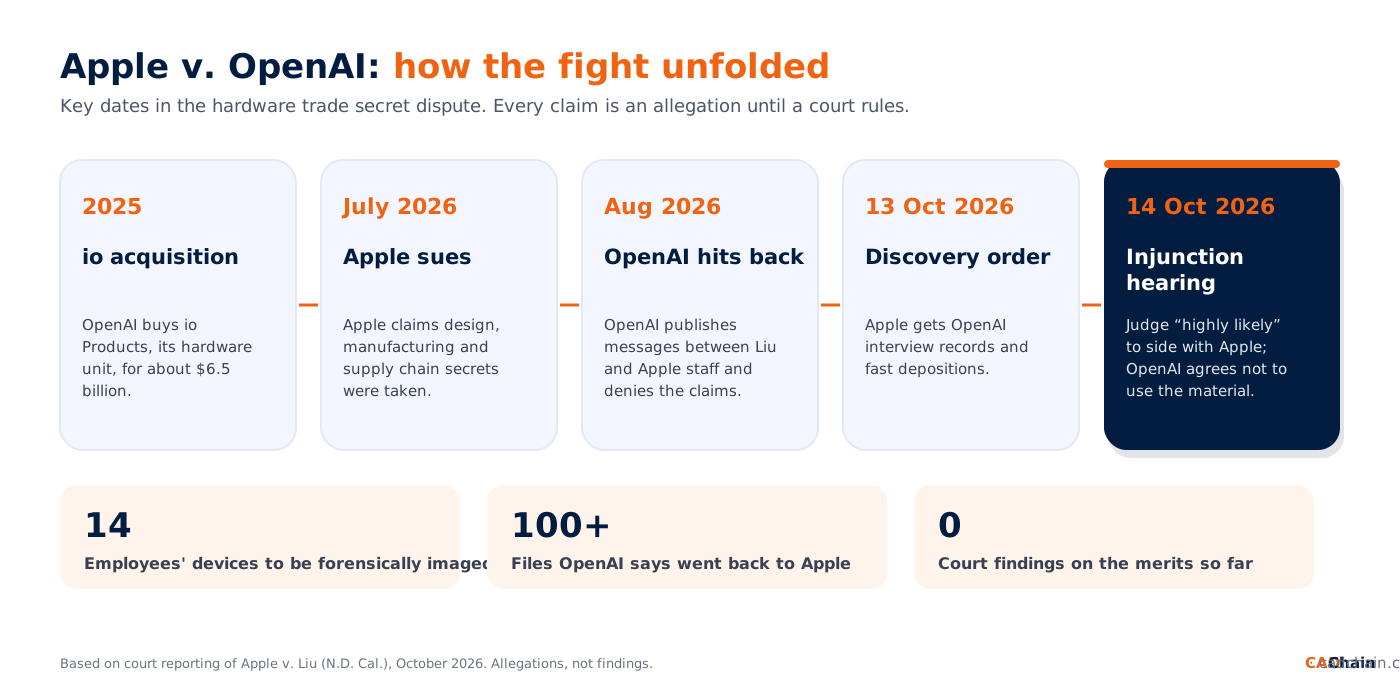
OpenAI's new filing, reported by Reuters and others, describes the same pattern in reverse. It says an engineer who had worked at Apple, joined OpenAI for about six months and then went back to Apple moved more than 100 confidential files about an unreleased OpenAI device to personal accounts, some of them on his last day, 2 June. The files allegedly included detailed images of the device, engineering data, manufacturing details and supplier information. Apple says it has procedures to stop new hires from using a former employer's information and found no evidence to support the claim.
Together, the two filings show that the risk runs in both directions. The company losing people can lose its designs, and the company hiring them can be accused of receiving designs it never asked for. We saw the same dynamic in the Joby trade secret verdict, where drawings and models shared under an NDA ended in a $116.9 million jury award.
What does this case teach hardware teams about departing engineers?
Most trade secret cases start with a person, not a hack. Our guide to former employee IP theft and CAD file exfiltration shows that the risky window is usually the weeks before and after someone resigns. The Apple case adds three details that matter for engineering teams.
- Personal accounts blur the line. Both companies point to files in personal cloud accounts. If work files live in private storage, it becomes very hard to prove later who had what and when. See cloud storage security for CAD files.
- Access that outlives the job. OpenAI says an Apple authentication error left a former engineer with access; Apple says he exploited a flaw. Either way, access was not cleanly removed. Our article on revoking CAD file access after it has been shared explains how to close that gap.
- Interviews are a leak path. Apple's claims about prototypes and design artifacts in interviews are unproven, but every hiring manager should make it clear that candidates must not bring a former employer's material. Employee IP agreements for CAD files and a written hiring policy protect both sides.
Contracts alone will not stop a file from moving. We explain why in why NDAs alone are not enough for CAD protection. What stops it, or at least proves it, is control at the level of the file and a reliable record of every access.
Keep control of your designs when people move on. CADChain adds file-level access control and blockchain proof of ownership to CAD files, so a copied file stays under your rules and every access is on record.
👉 Protect your CAD files with CADChain
Why does "name your trade secrets" decide cases like this?
OpenAI's main legal argument is that Apple has described only categories, such as design, manufacturing and testing information, instead of specific secrets. That is a common defence, and courts take it seriously. A company has to show what the secret is, that it has economic value because it is secret, and that it took reasonable steps to keep it secret. Our trade secrets guide for deep-tech startups walks through each of those tests.
For hardware companies, the secret is often inside the CAD model, the tolerance stack, the test method or the supplier list. If those files are not identified, labelled and access-controlled, it is hard to name them in court. That is why trade secret protection for CAD designs starts with an inventory, and why some teams weigh trade secrets against patents for each part of a design.
Evidence is the other half: both sides now have to reconstruct who touched which files. Companies that already keep audit trails that meet IP litigation requirements start such a dispute with facts instead of guesses.
What should hardware and deep-tech teams do now?
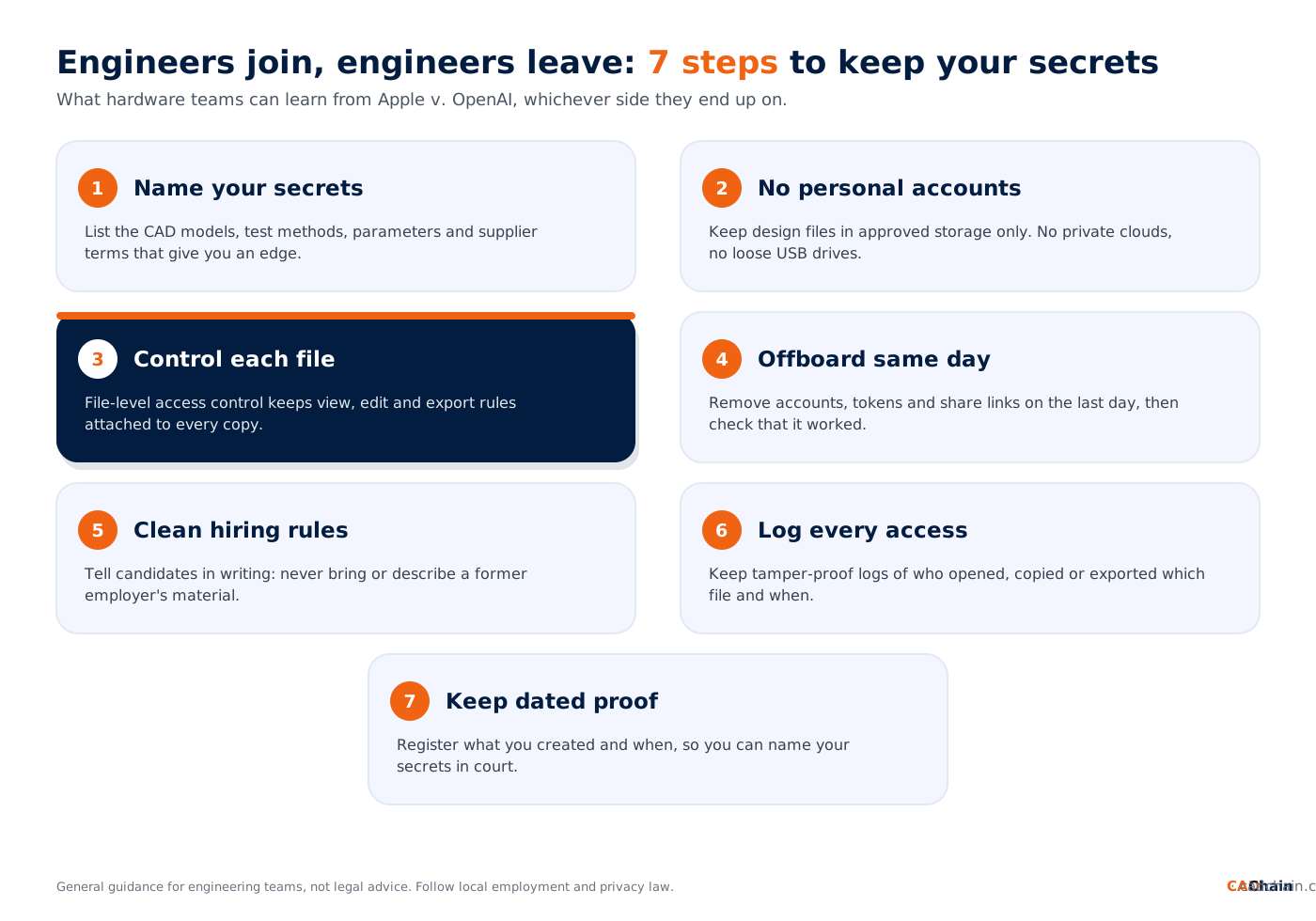
- Name your trade secrets. List the designs, models, test methods, process parameters and supplier terms that give you an edge. Mark the files and record who owns them.
- Keep work out of personal accounts. Provide approved storage and make it the only place where design files live. Block or monitor syncing to private clouds and USB drives; see USB drive CAD theft prevention.
- Control access per file, not per folder. Folder rights stop at the folder. File-level DRM keeps view, edit and export rules attached to the file wherever it goes, with permission levels set by role.
- Offboard on the same day. Remove every account, token and share link when someone gives notice or leaves, and check that it worked. Review what they downloaded in the last weeks.
- Set clean hiring rules. Tell candidates and new hires in writing not to bring or describe a former employer's confidential material, and train interviewers to stop a conversation that goes there.
- Log every access. Audit CAD file access regularly and keep logs that cannot be edited afterwards, such as tamper-proof audit trails.
- Keep dated proof of ownership. A blockchain ownership registration shows what you created and when, which helps you name your secrets and defend against claims that you took someone else's.
This is not legal advice, and monitoring in the EU must respect the GDPR. Our 8-layer IP protection playbook for hardware teams shows how the pieces fit together.
How does this fit the bigger picture?
This is the second OpenAI insider story on our site this week. Our report on the OpenAI hidden recording device case looked at a very different alleged threat, a recorder planted in a meeting room, but the lesson was similar: the most valuable information is reachable by people already inside. And our analysis of the Schneider Electric PTC acquisition explains why the platforms that hold design data are worth so much. Our sister sites covered the same theme from three other angles:
- A court ruling on 3D model files. A Suzhou court held a former R&D engineer and a competitor jointly liable after the engineer had received complete 3D model files, and dated, marked drawings decided the case. Read what the 3D model trade secret ruling means for Inventor teams on borisinventor.com.
- Ransomware groups listing CAD drawings as loot. The Interlock group claimed a US fabricator and listed CAD drawings among the stolen data. Our sister site explains what SOLIDWORKS teams should do about ransomware and CAD drawings.
- Signatures are not proof of authorship. ChatGPT was found adding real cartoonists' signatures to AI images. Blended BORIS looks at AI fake artist signatures and what 3D artists can do to keep real proof of their work.
Conclusion
Apple v. OpenAI is at an early stage. No court has found that anyone stole anything, and OpenAI is preparing its own claims. Still, within days a court opened up a rival's hiring records and secured a commitment backed by forensic imaging of 14 employees' devices.
For hardware founders and engineering managers, the practical message is clear. Your designs walk out of the door with every engineer who leaves, and new ones walk in with every engineer you hire. Name your secrets, keep them in controlled systems, protect files at the file level, remove access on the last day and keep proof of what is yours. Then, if you end up in court, on either side, you can show the facts.
Prove what is yours and control who uses it. CADChain gives engineering teams blockchain proof of ownership and file-level access control for CAD files across CAD systems.
👉 See how CADChain works
FAQ: Apple v. OpenAI trade secret case
What is Apple suing OpenAI for?
Apple claims OpenAI, its chief hardware officer Tang Tan, its io hardware unit and former Apple engineer Chang Liu misappropriated confidential hardware information on product design, manufacturing, components, testing and the supply chain. OpenAI denies the claims.
What did the judge decide on 13 October 2026?
Judge Edward Davila gave Apple expedited access to OpenAI's interview materials for former Apple employees who applied to its hardware and robotics teams, some private messages and early depositions. He denied fast access to OpenAI's own hardware research for now.
Did the court grant Apple an injunction?
At the 14 October hearing the judge said he was highly likely to grant one. OpenAI then agreed voluntarily not to use the information Apple says was taken while the case continues. No written injunction order had been reported at the time of writing.
What is OpenAI accusing Apple of?
OpenAI says an engineer who left it to return to Apple moved more than 100 confidential files about an unreleased OpenAI device to personal accounts. Apple says it found no evidence to support this.
Has anyone been found liable?
No. All claims on both sides are allegations. The court has not ruled on whether any trade secret was misappropriated.
Why does it matter that Apple must name specific trade secrets?
To win a trade secret case, a company must identify the secret, show it has value because it is secret and show it took reasonable steps to protect it. Broad categories such as design information are often challenged.
How can hardware startups protect CAD files when engineers leave?
Keep design files in approved systems, control access per file, remove all access on the last day, review recent downloads and keep tamper-proof access logs and dated proof of ownership.
Is it legal to monitor engineers' file access in the EU?
Logging access to company systems is generally allowed if it is necessary, proportionate and transparent under the GDPR and national employment law. Tell staff what is logged and take legal advice before you start.