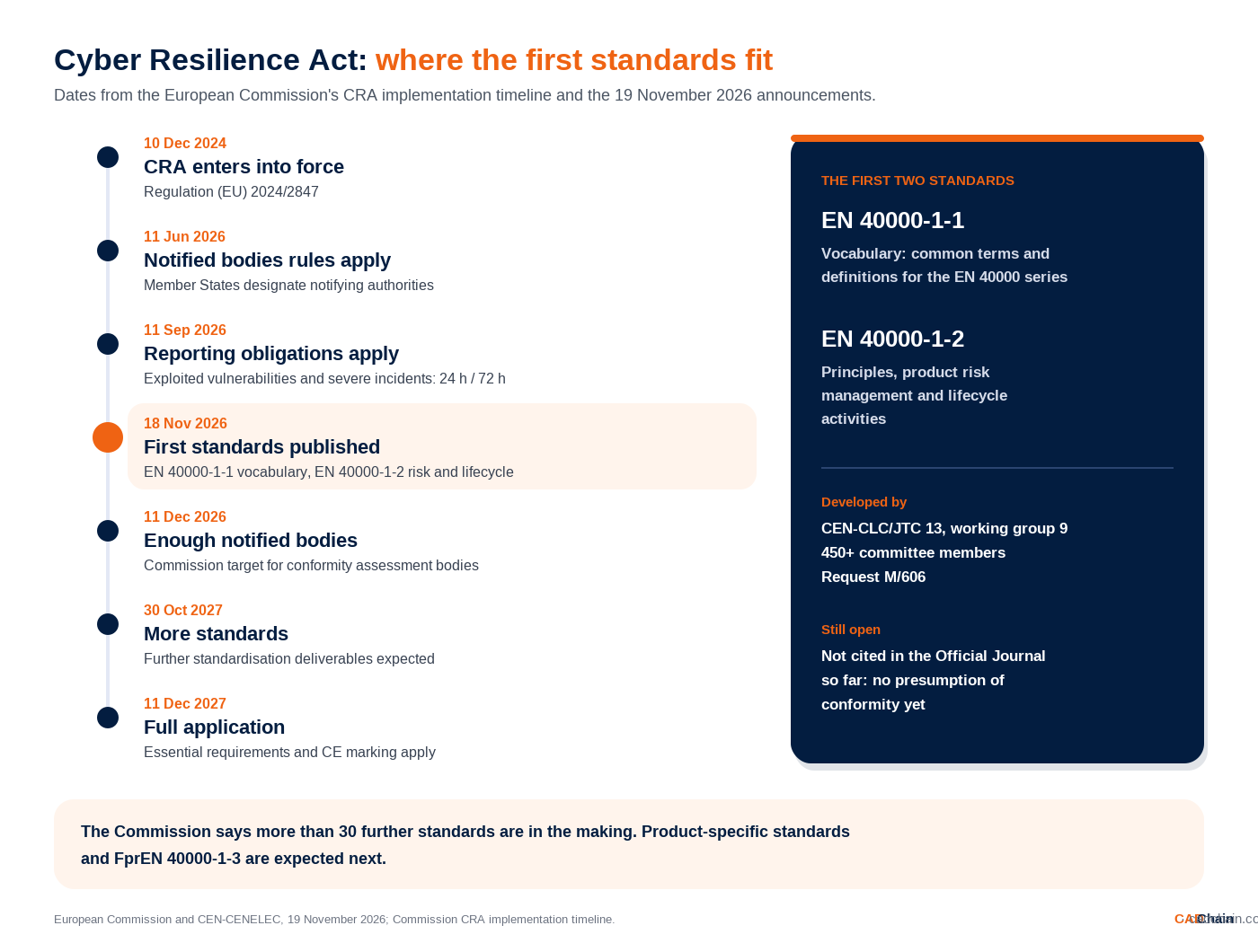
On 18 November 2026, the first European standards written to support the EU Cyber Resilience Act (CRA) were published. EN 40000-1-1 sets out the vocabulary for a new family of product cybersecurity standards, and EN 40000-1-2 sets out principles, product risk management and lifecycle activities for products with digital elements. The European Commission and the European standards bodies CEN and CENELEC announced the publication on 19 November. For manufacturers of connected hardware, firmware and software sold in the EU, it is the first concrete method for doing what the CRA already requires: assessing and managing cybersecurity risk over the whole life of a product.
The two standards were developed in the joint CEN and CENELEC technical committee CEN-CLC/JTC 13, in working group 9, which handles horizontal cybersecurity standards for products with digital elements. The Dutch standards body NEN holds the secretariat. According to CEN-CENELEC, more than 450 committee members from 28 national standardisation organisations and 17 liaison organisations took part. The work answers standardisation request M/606, which the Commission sent to CEN, CENELEC and ETSI in February 2025. The Commission says more than 30 further standards are in the making.
This matters well beyond the compliance department. The CRA turns cybersecurity into a product requirement with a CE mark attached, and the evidence a manufacturer needs to show compliance lives in its engineering data: requirements, threat models, source code, schematics, CAD models, test results, software bills of materials and update packages. The way a company protects and records that data is about to become part of how it proves its products are secure.
TL;DR: the CRA now has its first European standards, but not yet a presumption of conformity
EN 40000-1-1 (vocabulary) and EN 40000-1-2 (principles, product risk management and lifecycle activities) were published on 18 November 2026 under standardisation request M/606. They give manufacturers a common approach to identify, assess and manage cybersecurity risk from the first design decisions to the end of the support period and decommissioning. Neither announcement says they are harmonised standards cited in the EU Official Journal, which is what gives a presumption of conformity under the CRA. Reporting of actively exploited vulnerabilities and severe incidents has applied since 11 September 2026; the full CRA applies from 11 December 2027. Lesson: start using the lifecycle method now, and treat your design and security records as evidence that must be protected.
What exactly was published on 18 November 2026?
Two European Norms in a new series called EN 40000, "Cybersecurity requirements for products with digital elements":
- EN 40000-1-1, Part 1-1: Vocabulary. According to CEN-CENELEC, it establishes a common set of terms and definitions for the whole EN 40000 series, so that later product standards use the same language.
- EN 40000-1-2, Part 1-2: Principles, product risk management, and lifecycle activities. It brings together general cybersecurity principles, baseline requirements for managing cybersecurity risk and activities that cover the entire product life cycle. It is meant as the base on which more detailed requirements will be built.
The European Commission's announcement describes the scope in practical terms. The principles apply to a wide range of products with digital elements, such as connected door locks controlled through smartphone apps, routers, microprocessors and microcontrollers, and software such as operating systems, browsers and password managers. They also cover remote data processing that a product relies on, for example a cloud service that manages a smart lock remotely or stores recordings from a connected camera. Product-specific standards will follow.
The standards are not free downloads from Brussels. CEN-CENELEC says they can be obtained through national standards bodies, subject to each country's publication schedule, so the date a German, French or Dutch edition appears in a national catalogue may differ. Development was funded in part by the EU through the European Innovation Council and SMEs Executive Agency.
Do the new standards give a presumption of conformity?
Not on the information published so far. Under Article 27 of the CRA, a product that meets a harmonised standard whose reference has been published in the Official Journal of the EU is presumed to meet the essential requirements that the standard covers. Neither the Commission nor CEN-CENELEC says that EN 40000-1-1 or EN 40000-1-2 has been cited in the Official Journal, and independent CRA trackers report that no CRA harmonised standard has been cited yet.
That does not make the publication less useful. EN 40000-1-2 is the shared method that later standards will build on, and the CRA itself already requires manufacturers to carry out a cybersecurity risk assessment, document it in the technical documentation and keep it up to date during the support period. A company that adopts the lifecycle approach now will have its risk assessment in the expected shape when the product-specific and harmonised standards arrive. CEN-CENELEC says a further part, FprEN 40000-1-3, and the first product-specific standards will be published soon; the Commission's own timeline lists more standardisation deliverables for 30 October 2027.
Who has to care, and is CAD and engineering software in scope?
The CRA applies to products with digital elements made available on the EU market: hardware with software inside it and software sold as a product, including the remote data processing those products need. That covers drones, controllers, sensors, medical and industrial devices with firmware, and desktop software, including engineering applications sold to EU customers. Pure software as a service is generally outside the CRA unless it is a remote data processing solution a product needs to work, and it falls under other rules such as NIS2.
For deep-tech founders this means two roles at once. As a manufacturer, you must build and document security into your own product. As a buyer, you depend on the CAD, PLM and simulation vendors whose software holds your designs, and those vendors are manufacturers under the CRA too. The pace of their security fixes is not theoretical: this week alone we covered 16 vulnerabilities fixed in AutoCAD 2027.1 and a CVSS 10 flaw in the 3DEXPERIENCE Station Launcher App. Under the CRA, vulnerability handling of that kind becomes a legal duty for the whole support period.
Since 11 September 2026, manufacturers must already report actively exploited vulnerabilities and severe incidents through ENISA's single reporting platform: an early warning within 24 hours, a notification within 72 hours and a final report later. Our guide to Cyber Resilience Act reporting for CAD, software and hardware makers walks through those deadlines. The standards published this week are about the other half of the law: designing and maintaining the product so that there is less to report.
What does EN 40000-1-2 change in day-to-day engineering?
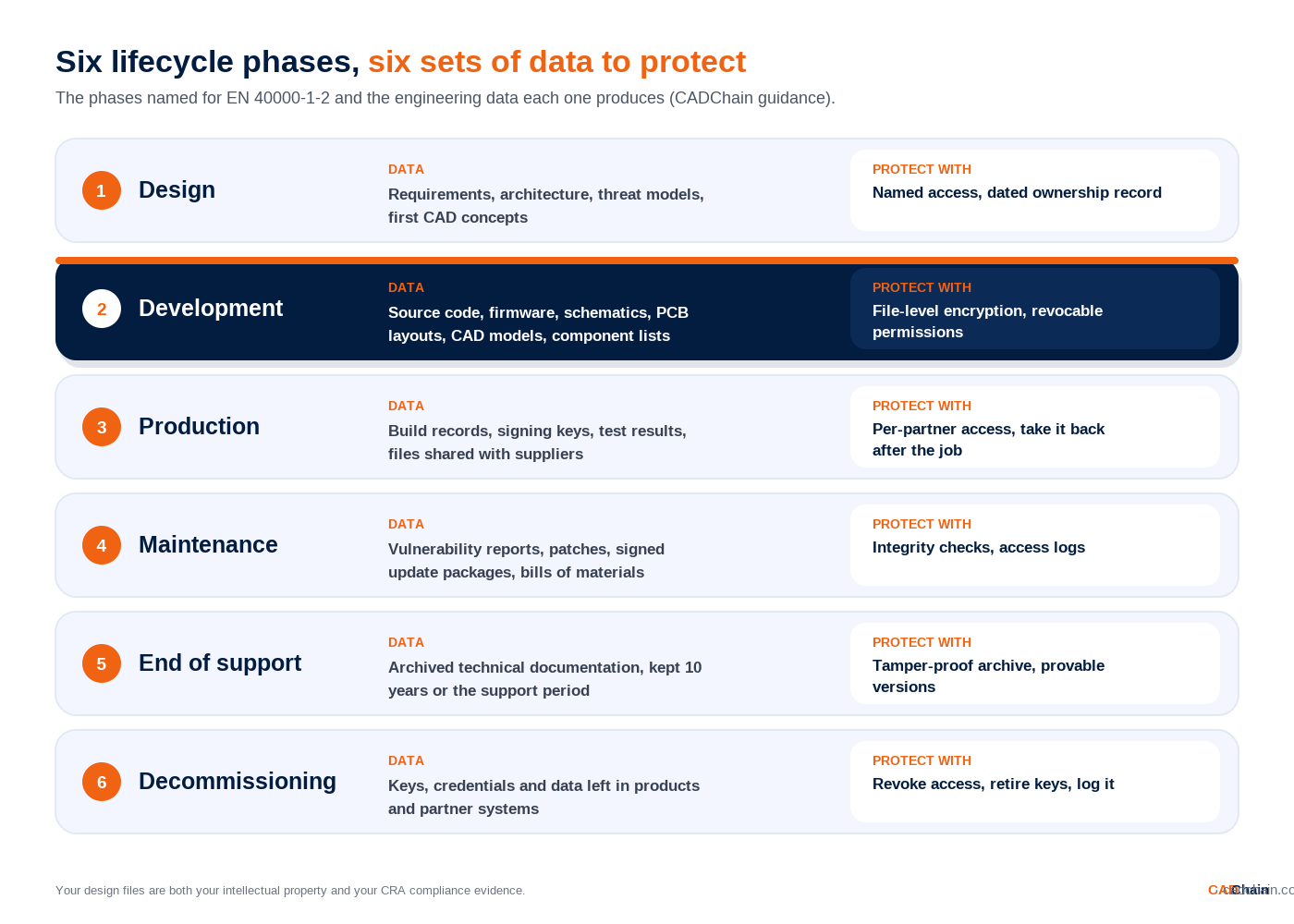
The standard frames cybersecurity as something to consider throughout the entire life cycle of a product. CEN-CENELEC describes a common approach to identify, assess and manage cybersecurity risk from the earliest design decisions through development, production, maintenance and, ultimately, the end of the product's support period and decommissioning. Each of those phases produces engineering data that the CRA expects you to keep, and that attackers and competitors would like to have.
In design, the outputs are requirements, architecture and threat models. In development, they are source code, firmware, schematics, PCB layouts and CAD models, plus the list of third-party components a manufacturer must check with due diligence. In production, they are build records, keys and test results. In maintenance, they are vulnerability reports, patches and signed update packages. The CRA asks manufacturers to keep technical documentation for 10 years after a product is placed on the market, or for the support period if that is longer, and to set a support period of at least five years unless the product is expected to be used for less.
Two lessons from recent incidents show why the records themselves need protection. The Quantum Systems update-server attack showed what happens when the release chain is the target. And as we explained in third-party software vulnerabilities in CAD workflows, plug-ins and libraries inside engineering tools widen the attack surface in ways a component list has to capture. A risk assessment that ignores who can open, change or copy design data is incomplete.
Why do design files and security records need protection under the CRA?
The CRA's essential requirements include protecting the confidentiality and integrity of data, but the technical documentation behind a product is a target in its own right. A full set of schematics, firmware source and CAD models is exactly what a competitor, a counterfeiter or a state actor would want, and a risk assessment lists a product's weaknesses in one place. If those files leak, the damage is both commercial and legal: the trade secret is gone, and a document that should prove diligence becomes a guide for attackers. Our trade secrets guide for deep tech startups explains why reasonable protection steps also decide whether a court will treat information as a trade secret at all.
Integrity matters as much as secrecy. When a market surveillance authority, a customer or a court asks what a product looked like at a given release, you need records that cannot have been changed afterwards. Tamper-proof CAD audit trails and dated ownership records give that proof. For confidentiality, CAD encryption at rest, in transit and in use and DRM access control levels for CAD files decide who can view, edit or export a model, including after it has left your network.
Supply chains make this harder. Contract manufacturers, PCB houses, test labs and certification bodies all need parts of the design. Our guide to CAD file security for supply chain collaboration covers how to share what each partner needs and take access back when the job is done.
Turn your design files into evidence you control. CADChain encrypts CAD files at file level, sets per-user and per-partner permissions you can revoke, records ownership on a blockchain and logs every access, across CAD systems.
👉 See how CADChain protects CAD files
What should manufacturers and deep-tech founders do now?
- Get the standards. Order EN 40000-1-1 and EN 40000-1-2 from your national standards body and give them to the people who own product security and technical documentation.
- Map your products to the CRA. List every product with digital elements you sell in the EU, including software and the cloud services the products need, and note which may be important or critical products with stricter conformity routes.
- Write your risk assessment in lifecycle form. Structure it by design, development, production, maintenance, end of support and decommissioning, and keep it up to date with each release.
- Set and publish support periods. Decide how long each product will receive security updates; the CRA expects at least five years unless the product is used for less.
- Build your component lists. Produce a software bill of materials for each release and check third-party components with due diligence, including libraries and plug-ins in your engineering tools.
- Rehearse reporting. Test whether you can meet the 24-hour early warning and 72-hour notification deadlines for an actively exploited vulnerability.
- Ask your CAD and PLM vendors. Request their support periods, vulnerability disclosure policies and update channels for the tools that hold your designs.
- Protect the evidence. Keep schematics, CAD models, firmware and risk assessments under file-level encryption with revocable access, dated ownership records and access logs, for at least the 10 years the CRA asks you to keep technical documentation.
How does this fit the bigger picture?
The CRA standards are one piece of a wider European push on product data and security. Our articles on the EU Data Act and trade secrets and AI Act enforcement and CAD data cover the other rules that reach manufacturers' engineering data. Our sister sites looked at related questions this week:
- Recovery depends on engineering data. An AXA XL report with Deloitte and DeNexus says a cyberattack can stop production without touching the machines, and that recovery needs configuration files, controller logic and engineering documentation. Solidboris.com explains what the OT cyber risk report means for SOLIDWORKS teams.
- Software terms change too. Autodesk is replacing its Fusion extensions with new Starter, Standard, Professional and Enterprise plans from 28 January 2027. BORIS Inventor breaks down the new Autodesk Fusion plans and what they cost.
- Proof of human work. A court in Genoa refused copyright protection for an Italian Brainrot character that a claimant said was made with a handful of generic ChatGPT prompts. Blended BORIS covers the Italian Brainrot copyright ruling.
The common thread is evidence. Whether the question is product security, recovery after an attack or who owns a design, the companies that keep dated, protected records of their engineering work are the ones that can answer it.
Conclusion
The publication of EN 40000-1-1 and EN 40000-1-2 is the moment the Cyber Resilience Act starts to have a shared engineering method behind it. The standards do not yet give a presumption of conformity, more parts are still to come and national editions will appear on their own schedules. But the direction is clear: cybersecurity is to be designed, documented and maintained across the whole product life cycle, from the first design decision to decommissioning, and the CRA's full obligations apply from 11 December 2027.
For deep-tech founders and engineering managers, the practical work starts with the data. Your design files, firmware, risk assessments and component lists are both your intellectual property and your compliance evidence. Protect who can open them, record who used them and keep proof of what existed when, and the CRA becomes a documentation exercise you can pass rather than a risk you carry.
Keep your engineering data protected and provable, from design to decommissioning. CADChain gives every CAD file file-level encryption, granular permissions you can revoke at any time, a blockchain ownership record and a full access log, across CAD systems, suppliers and partners.
👉 Protect your CAD files with CADChain
FAQ: the first Cyber Resilience Act standards
What are EN 40000-1-1 and EN 40000-1-2?
They are the first European standards published to support the Cyber Resilience Act. EN 40000-1-1 is the vocabulary for the EN 40000 series. EN 40000-1-2 covers principles, product risk management and lifecycle activities for products with digital elements. Both were published on 18 November 2026.
Who developed them?
The joint CEN and CENELEC technical committee CEN-CLC/JTC 13, working group 9, with the Dutch standards body NEN as secretariat. CEN-CENELEC says more than 450 committee members from 28 national standardisation organisations and 17 liaison organisations took part, under the Commission's standardisation request M/606.
Do they give a presumption of conformity with the CRA?
Not on the information published so far. A presumption of conformity under Article 27 of the CRA requires a harmonised standard whose reference is published in the Official Journal of the EU, and neither the Commission nor CEN-CENELEC says these two standards have been cited.
Which products do they apply to?
A wide range of products with digital elements. The Commission names connected door locks controlled through smartphone apps, routers, microprocessors and microcontrollers, and software such as operating systems, browsers and password managers, plus remote data processing a product relies on.
Where can I get the standards?
Through your national standards body. CEN-CENELEC says they are available through national catalogues, subject to the applicable national publication schedules.
What CRA dates should manufacturers know?
The CRA entered into force on 10 December 2024. Reporting obligations for actively exploited vulnerabilities and severe incidents apply from 11 September 2026. The full regulation applies from 11 December 2027.
What other standards are coming?
CEN-CENELEC says FprEN 40000-1-3 and the first product-specific standards will be published soon, with further work on vulnerability handling, generic requirements and product categories. The Commission says more than 30 standards are in the making.
How does CADChain help with CRA evidence?
CADChain encrypts CAD files at file level, sets per-user and per-partner permissions that can be revoked, records ownership on a blockchain and logs every access, so design files and records stay confidential and provable for as long as you need to keep them.