The best European alternatives to ChatGPT for business in 2027 are Mistral Vibe (formerly Le Chat) from Paris for the closest all-round replacement, Lumo by Proton and Euria by Infomaniak, both from Geneva, for private chat that is not used for training, and Langdock from Berlin for rolling out many AI models to a whole company with EU hosting. For confidential engineering data such as unreleased designs and source code, the safest European options run on your own servers: Mistral's on-premises deployment or the fully open Swiss model Apertus.
This guide compares seven European alternatives to ChatGPT for companies that handle sensitive technical data. For each one we checked, on the vendor's own website on 17 November 2026, who makes it, where the company is registered, where your prompts are processed, whether your inputs are used for training, and what it costs where a price is published. We wrote it for engineering, manufacturing and deep-tech teams, so the main question is a practical one: what can your people safely paste into an AI chat assistant, and where does it go?
TL;DR: European alternatives to ChatGPT
ChatGPT is made by OpenAI, a US company. European chat assistants: Mistral Vibe (Mistral AI, France; EU hosting by default; Pro from $14.99 a month), Lumo (Proton AG, Switzerland; zero-access encrypted chat history; Lumo Plus $9.99 a month billed yearly), Euria (Infomaniak, Switzerland; hosted only on Infomaniak's servers in Switzerland; free to start). European business platforms: Langdock (Berlin; Microsoft Azure in the EU; from €23.20 per user a month) and nele.ai (Hesse, Germany; EU servers; from €10 a month for a whole team), both of which also give access to US-made models. Specialist and self-hosted: DeepL (Cologne) for writing and translation, and Apertus (EPFL, ETH Zurich and CSCS) as a fully open model you run yourself. Rule of thumb: never paste unreleased CAD data, drawings or source code into any cloud chatbot without a written policy.
Why are European companies looking for European alternatives to ChatGPT?
The first reason is jurisdiction. Under the US CLOUD Act of 2018, US providers can be ordered to hand over data in their possession, custody or control, wherever it is stored. A European data centre run by a US company does not change who controls the data. For most marketing copy this does not matter. For a supplier working on defence, aerospace or dual-use products, it can: our guide to US export control rules for CAD files and design data explains why the nationality of a service matters as much as the location of its servers.
The second reason is training and retention. A chat assistant sees exactly what your engineers type: part numbers, tolerances, supplier prices, error logs and pieces of code. Many consumer plans may use conversations to improve models unless you opt out. Our article on uploading technical drawings to ChatGPT lists what to check before any drawing goes into a chatbot, and our trade secrets guide for deep-tech startups explains why information you share without protection can lose its legal status as a trade secret. If your team stays with ChatGPT, our guide to ChatGPT plans and prices shows which plans keep business data out of training by default.
The third reason is regulation. GDPR does not require data to stay in the EU, but personal data sent outside the EEA needs a legal basis, as our article on GDPR compliance for CAD systems in Europe explains. The EU AI Act adds duties for companies that deploy AI, and our piece on EU AI Act enforcement and AI agents shows how fast those duties are arriving. A European vendor with EU hosting and a data processing agreement makes these questions easier to answer for procurement and for your customers' audits.
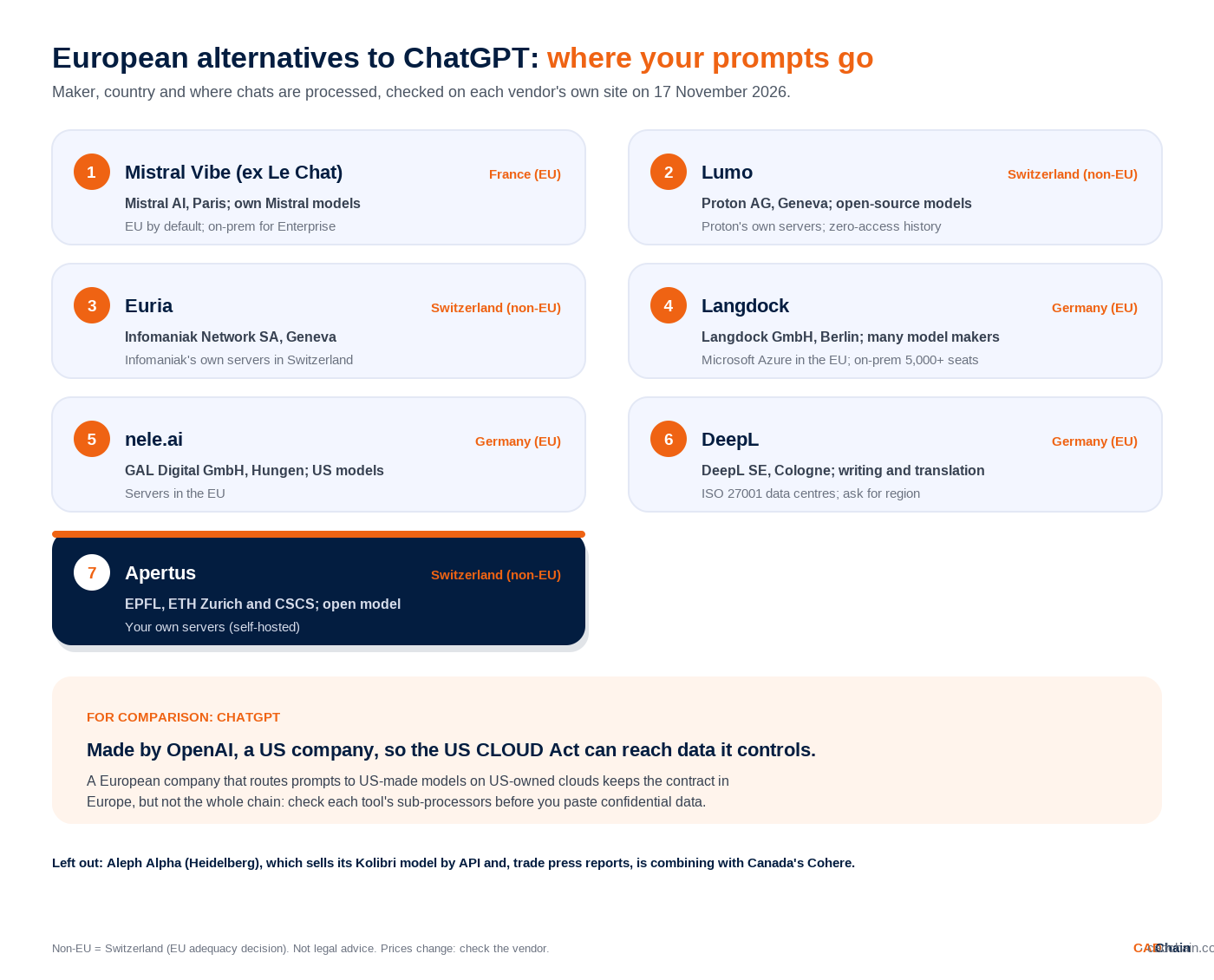
ChatGPT alternatives in Europe compared: country, owner, hosting and price
The table shows the seven picks side by side. "Where data is hosted" means where prompts are processed in normal use. Switzerland is in Europe but not in the EU; the European Commission recognises Swiss data protection as adequate, so personal data can flow there from the EU without extra safeguards.
Checked on each vendor's own website on 17 November 2026. Prices are as shown on the vendor's pricing page that day; plans change often, so check before you buy.
1. Mistral Vibe, formerly Le Chat (France): the closest European alternative to ChatGPT
Mistral AI is a French company incorporated in Paris (number 952 418 325) with its registered office at 15 rue des Halles. Its chat assistant was called Le Chat; Mistral now calls it Vibe, and says all conversations, settings and plans carried over. Vibe combines an AI chat assistant (Vibe for work) and an AI coding agent (Vibe for code) in one product.
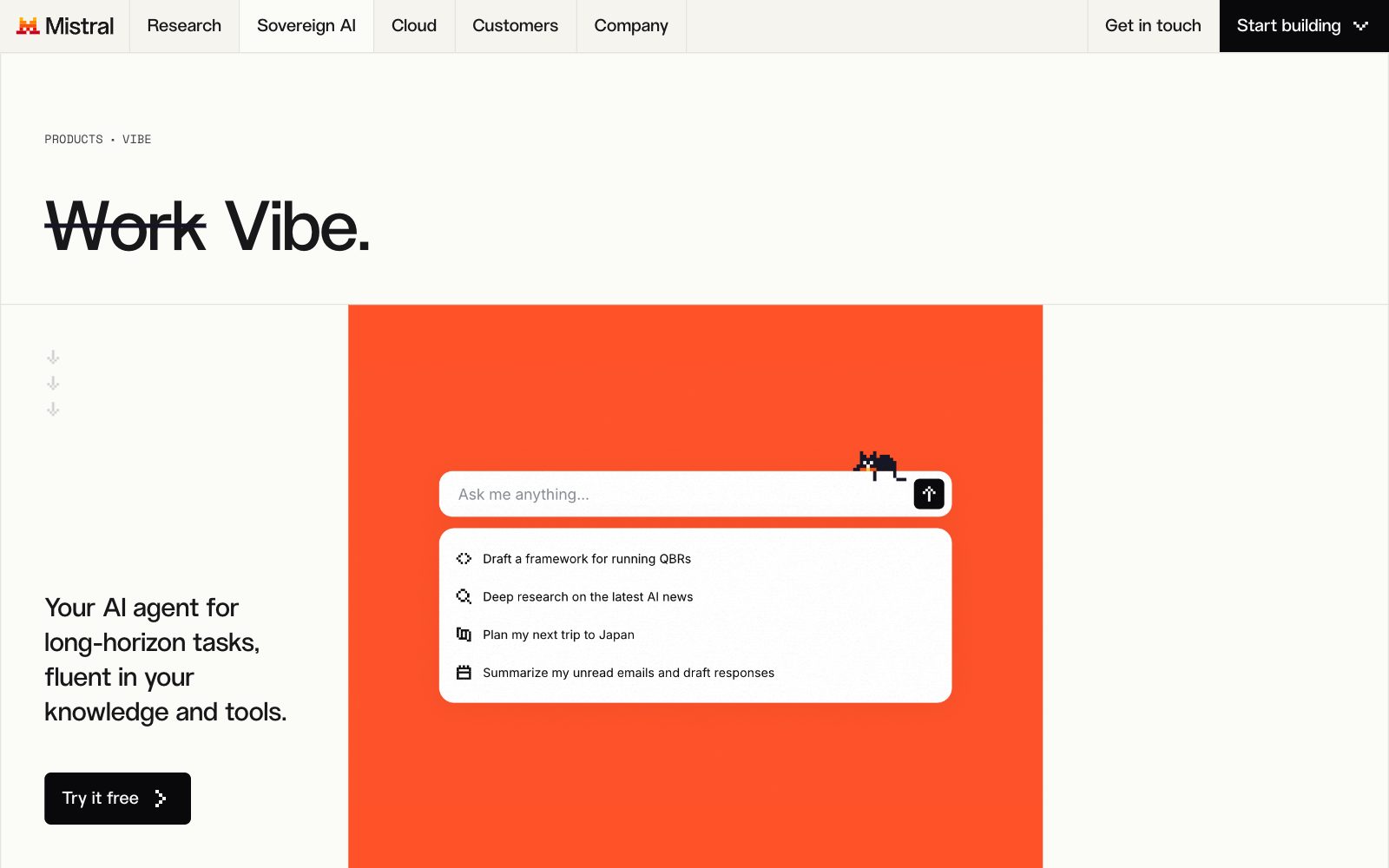
Strengths: it runs Mistral's own models, so the maker of the chat app and the maker of the model are the same European company. Vibe connects to more than 100 tools, including email, calendar, Slack, GitHub and Jira, through connectors and the Model Context Protocol (MCP), supports voice input, and its coding agent works from the command line or in VS Code, JetBrains and Zed. Mistral's help centre says that your data is hosted in the European Union by default, and in the US only if you explicitly use the US API endpoint.
Price: a free plan; Pro at $14.99 a month and Team at $24.99 per user a month, excluding tax; Enterprise on request. Limits: some features can send data temporarily outside the EU to sub-processors listed in Mistral's Trust Center, and Mistral's privacy policy says inputs and outputs may be used for training subject to your opt-out, so turn that off in your settings. Who it suits: teams that want one European assistant for writing, research and code. For confidential work: Enterprise customers can deploy Vibe on-premises, in a private cloud or on Mistral Cloud.
2. Lumo by Proton (Switzerland): the private ChatGPT alternative
Lumo is the AI chat assistant of Proton AG in Geneva, the company behind Proton Mail and Proton VPN. Proton calls it "the confidential AI chat assistant" and says it is built and based in Europe.
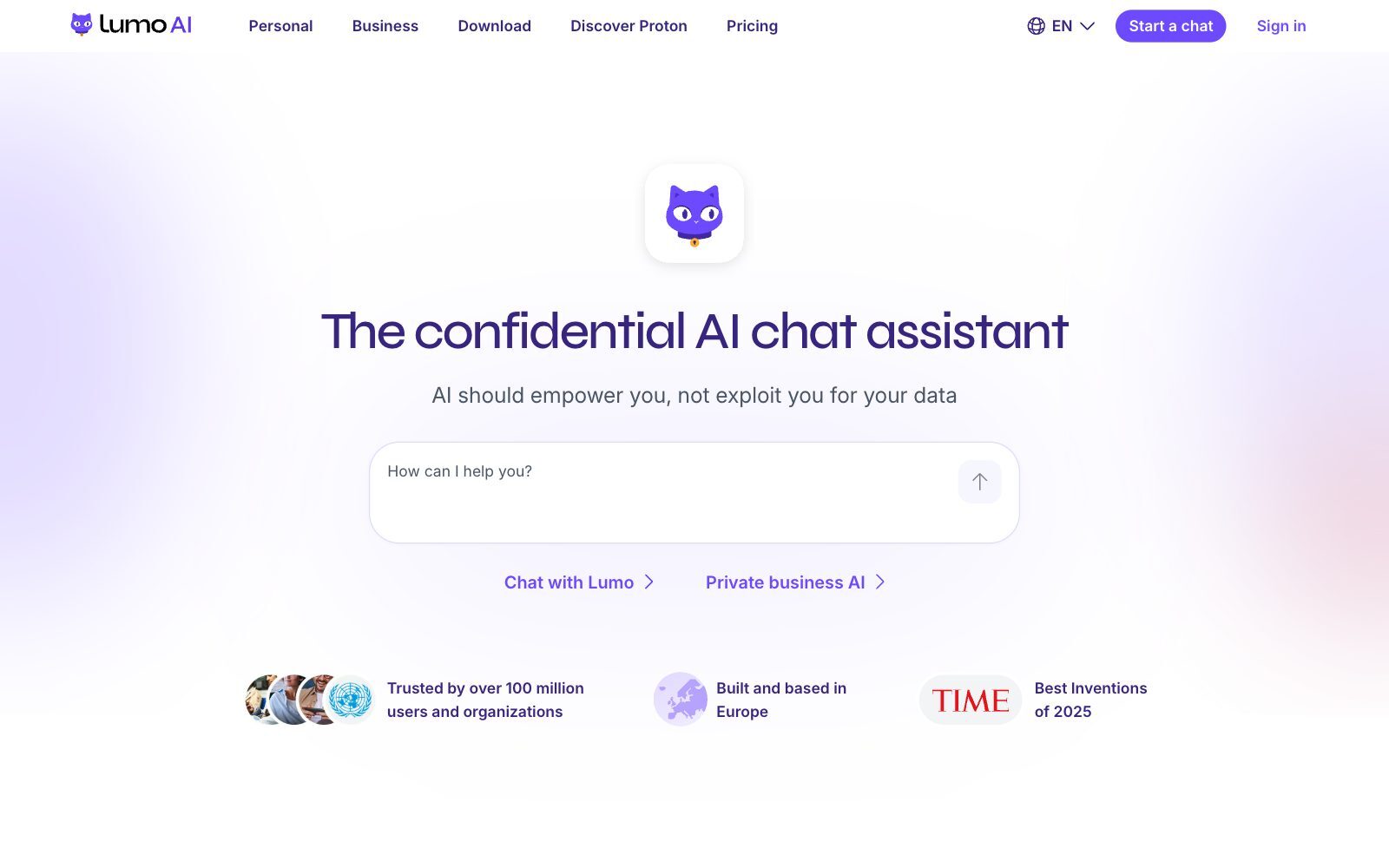
Strengths: Proton's Lumo privacy page says it keeps no logs of what you ask or what Lumo replies, that chat history on Free and Plus is stored with zero-access encryption, and that Lumo does not use your chats to train AI models. Lumo runs open-source models on Proton's own infrastructure; Proton lists Qwen 3.5, GLM 5.3 and the Swiss model Apertus 1.5 among them, and Lumo's own code is open source.
Price: free with limits, no credit card; Lumo Plus at $9.99 a month billed $119.88 a year; business plans on Proton's pricing page. Limits: some of the open models Lumo runs were developed in China, even though they run on Proton's servers; Switzerland is outside the EU; and there is no on-premises option. Who it suits: founders and small teams who want private everyday chat and already trust Proton.
3. Euria by Infomaniak (Switzerland): free sovereign AI hosted in Switzerland
Euria is the AI assistant of Infomaniak Network SA, registered in Les Acacias, Geneva. It works as a standalone app and inside Infomaniak's kSuite collaboration tools.
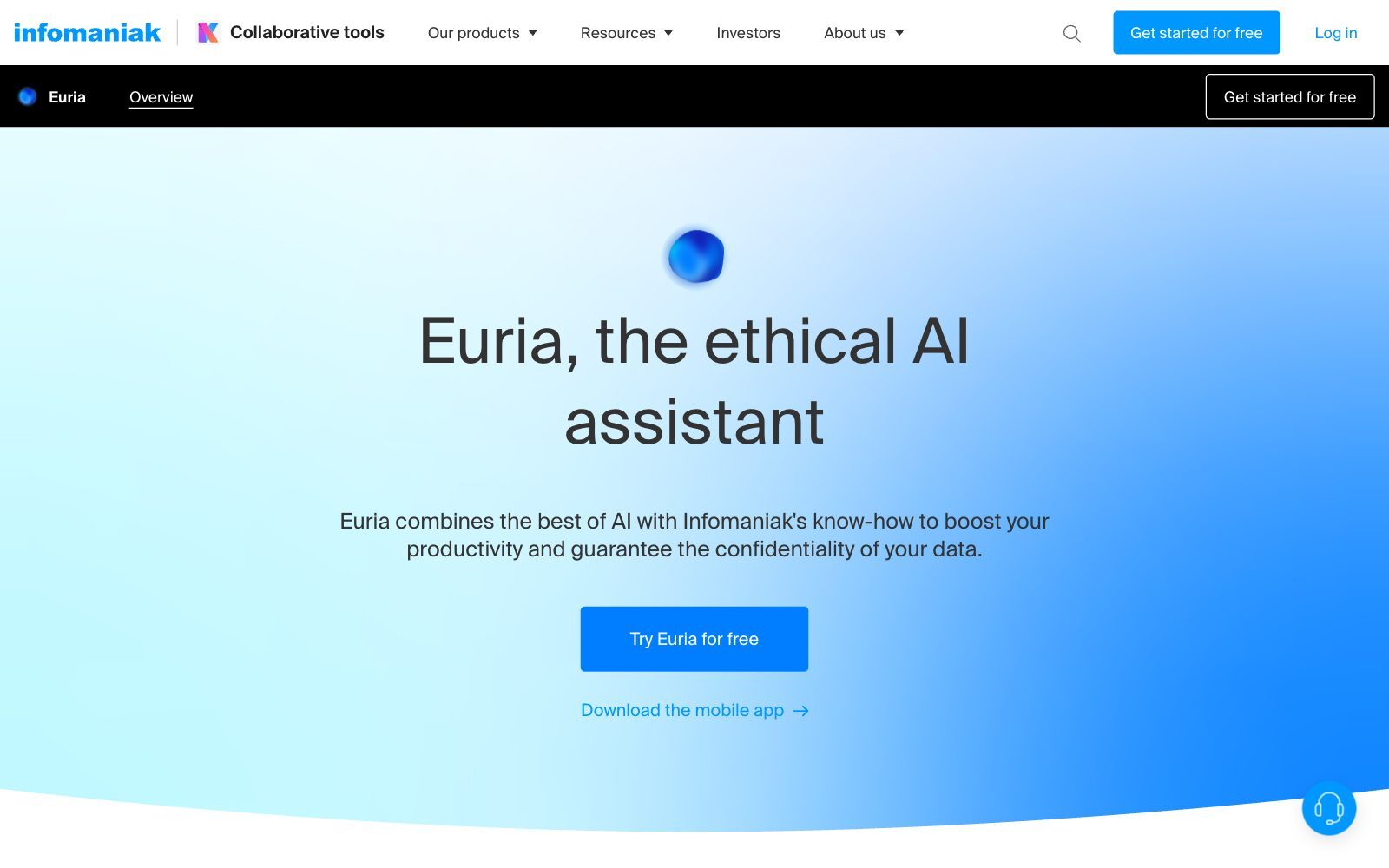
Strengths: Infomaniak says Euria is hosted exclusively on its own servers in Switzerland, relies on open-source models with no dependence on external services, and does not share information outside its infrastructure or use it to train models. It is free to start; the free kSuite plan allows two projects with five conversations each, Standard allows 10 projects and 50 conversations, and Business and Enterprise plans have no project or conversation caps. Euria also works in Infomaniak's kChat and kDrive.
Price: free to start; paid kSuite plans on Infomaniak's site. Limits: Swiss, not EU, hosting; fewer integrations than Vibe or Langdock; no on-premises option. Who it suits: small companies that want a free, privacy-first assistant, and teams moving from Google Workspace or Microsoft 365 to Infomaniak.
4. Langdock (Germany): a European AI platform for the whole company
Langdock GmbH is registered in Berlin (HRB 254499) with Lennard Schmidt and Hendrik Hofstadt as managing directors. It is not a model maker: it gives every employee one chat interface, agents and workflows on top of many models, with admin controls for IT.
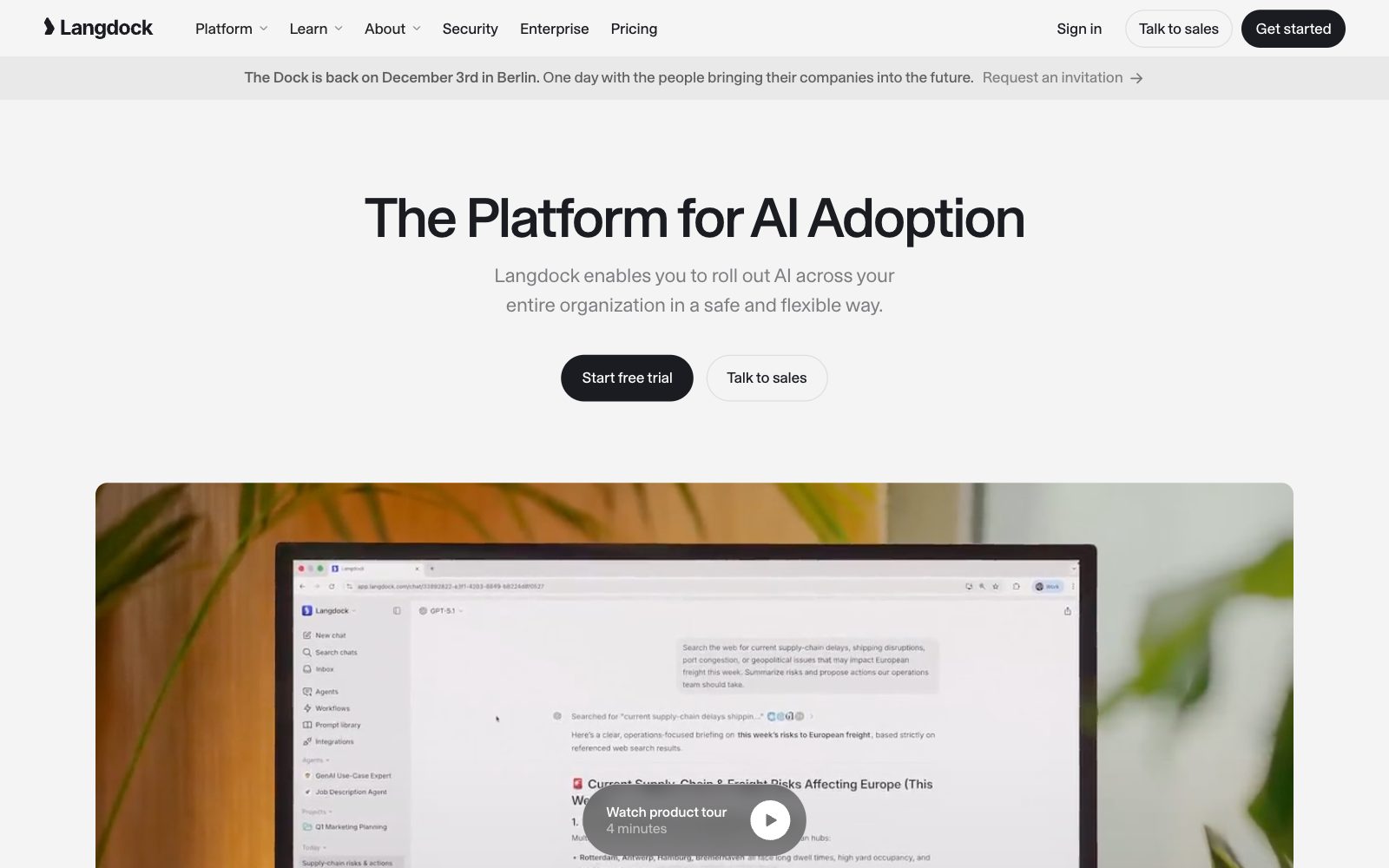
Strengths: Langdock's security page says its multi-tenant service is hosted on Microsoft Azure on servers inside the EU, that the application and most models are hosted in the EU (configurable), and that customer data is never used to train or improve AI models. It lists ISO 27001 and SOC 2 Type II. Its model list includes OpenAI GPT-5.5, Anthropic Opus 4.8 and Sonnet 4.6 and Google Gemini 3.1 Pro Preview, the last marked as global, among more than 40 models. Enterprise customers with 5,000 or more seats can run it on-premises on their own Kubernetes or in their own cloud.
Price: Core at €23.20 per user a month billed yearly (€29 monthly), Work at €31.20 (€39 monthly), Enterprise on request; 7-day free trial without a credit card. Limits: Langdock is European, but Microsoft Azure is a US-owned cloud and many of its models come from US companies, so the CLOUD Act question is reduced, not removed. Who it suits: mid-sized and large companies that want one governed AI workspace with a choice of models.
5. nele.ai (Germany): usage-based AI for small and medium businesses
nele.ai is made by GAL Digital GmbH, registered in Hungen in Hesse (HRB 8432, Gießen district court), with Daniel Gal and Kristian Kraft as managing directors. Like Langdock, it is a European interface to models from other makers.
Strengths: nele.ai says all data and application components are hosted on servers in the European Union, that your inputs are not used to train the models, and that personal data can be pseudonymised before it is sent, on request. Pricing is by usage with no per-user cost: the smallest plan is €10 a month for 1,000 credits for the whole team, and the vendor gives about 100 employees starting with 40,000 credits and one knowledge base at €319.95 a month as an example. There is a 7-day trial.
Limits: nele.ai names OpenAI, Microsoft Azure and Anthropic as model providers, all US companies. Who it suits: German-speaking SMEs that want a simple, GDPR-minded way to give staff access to leading models without paying per seat. (We left out a homepage screenshot because a support chat window covered part of the page.)
6. DeepL (Germany): European AI for writing and translating technical documents
DeepL SE is registered in Cologne (HRB 104617) with Jaroslaw Kutylowski as CEO. DeepL is not a general chatbot; we include it because translating and polishing text is one of the most common reasons teams paste documents into ChatGPT.
Strengths: DeepL says Pro subscribers' content is stored only as long as technically needed and is never used to train its AI models, and that processing happens in ISO 27001-certified data centres. Business plans include DeepL Write, its AI writing assistant, and DeepL Voice translates conversations in real time. DeepL is also available inside Microsoft Copilot, ChatGPT and Claude through MCP.
Price: Individual at €7.49 a month, Team at €24.99 and Business at €49.99 per user a month, billed yearly (German prices including VAT); Enterprise on request. Limits: no open-ended chat or research, and DeepL's pages do not name the data-centre countries, so ask. Who it suits: engineering companies that translate manuals, specifications, contracts and supplier correspondence.
7. Apertus (Switzerland): a fully open model you run on your own servers
Apertus is a fully open foundation model developed by the Swiss AI Initiative, a collaboration between EPFL, ETH Zurich and the Swiss National Supercomputing Centre (CSCS), with Swisscom as a strategic partner. Its makers say the training data, code, weights, methods and alignment principles are all documented and reproducible.
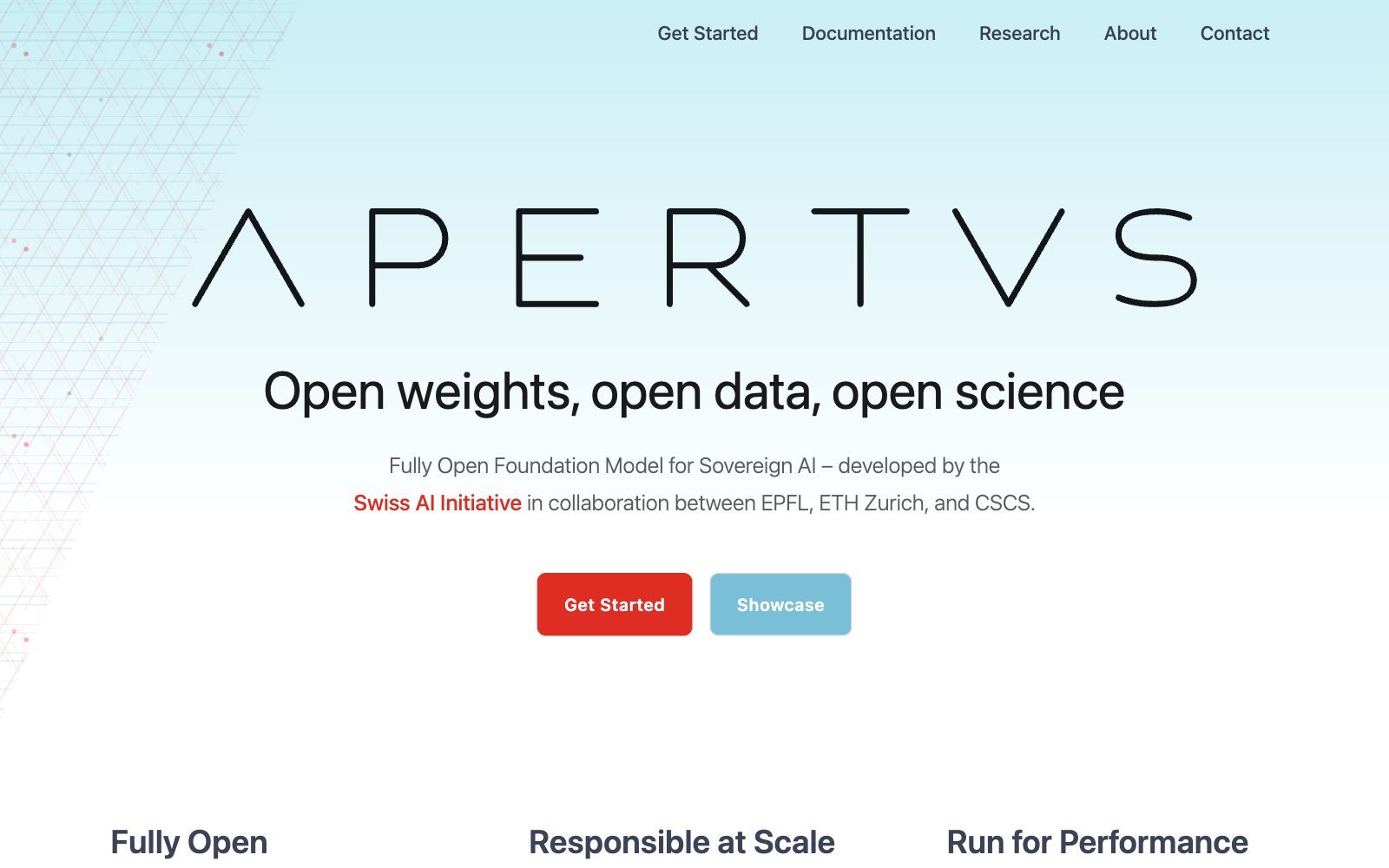
Strengths: Apertus comes in 8-billion and 70-billion-parameter sizes and was trained on more than 1,000 languages; the newest version, Apertus 1.5, adds multimodal input, reasoning and a longer context. Because you run it yourself, prompts and documents never leave your own infrastructure, which is the only setup we would trust with unreleased designs or export-controlled data. Proton's Lumo also uses Apertus 1.5, so you can try it there first.
Price: free; you pay for GPUs and the people to run it. Limits: it is a model, not a finished business app: you need a chat front end, user management and someone to maintain it. Who it suits: deep-tech, defence and R&D teams with an IT department and data that must stay in-house.
We left out Aleph Alpha from Heidelberg: it now sells its Kolibri model to enterprises through an API rather than a chat assistant, and trade press reports that it is combining with Canada's Cohere. We also left out tools whose owner, headquarters or hosting we could not confirm on their own websites in this run. If you are building AI into your own product rather than choosing a chat app, our guide to European alternatives to the OpenAI API compares the Kolibri API with Mistral, Scaleway, OVHcloud and other EU-hosted LLM APIs.
How to choose a European ChatGPT alternative for your business
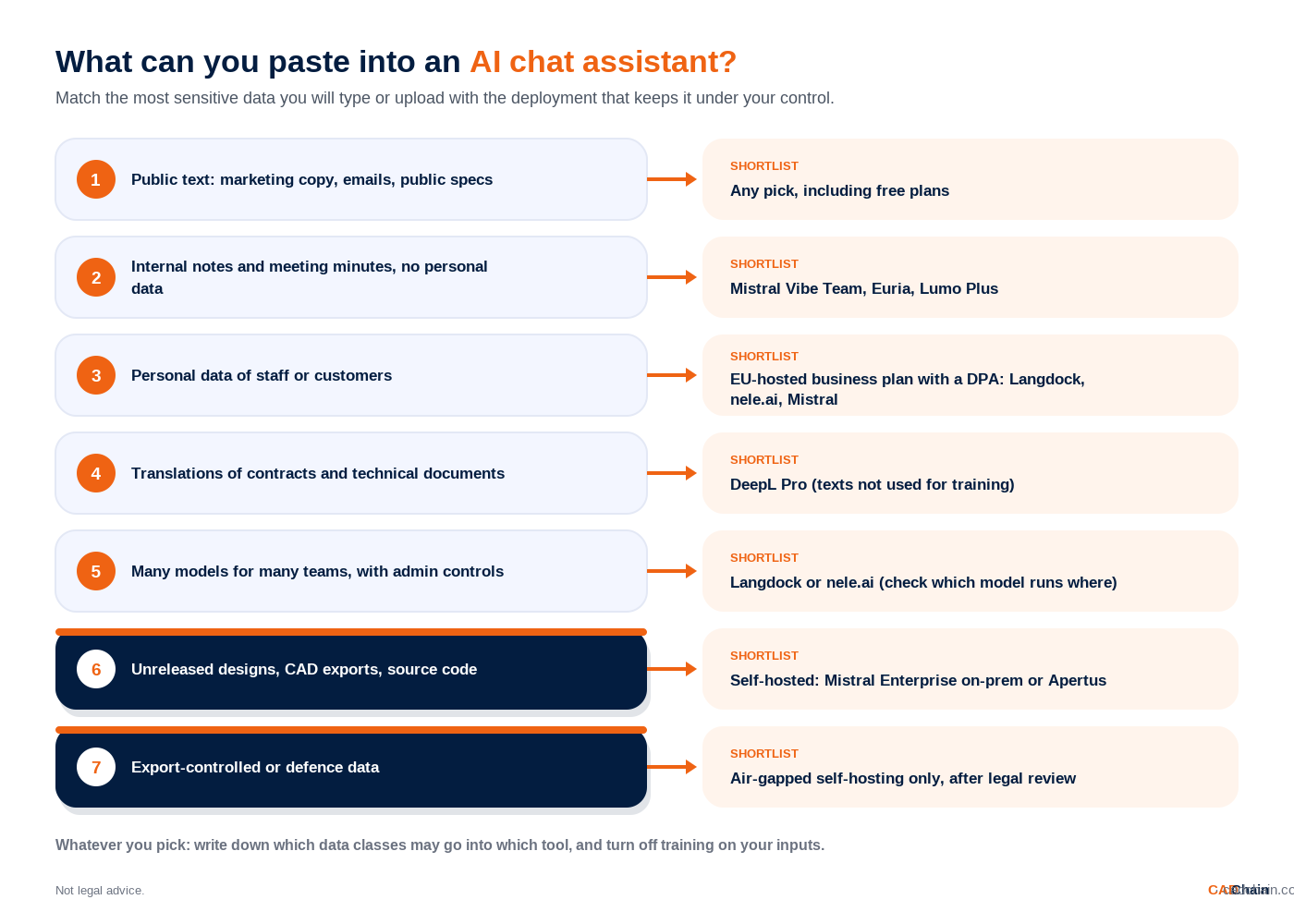
Start with the most sensitive data your staff will type or upload, not with the features. If it is public or internal text with no personal data, any of the seven will do, and Mistral Vibe is the closest to ChatGPT in features. If it includes personal data, choose an EU-hosted business plan with a data processing agreement and training switched off: Mistral, Langdock and nele.ai offer this. If you want privacy for a small team at low cost, Lumo and Euria are the simplest.
Then ask who runs the model. Langdock and nele.ai are European companies, but they route many prompts to US-made models on US-owned clouds, which is fine for most work but not for data covered by export rules. For unreleased CAD data, drawings, simulation results and firmware, use a self-hosted model such as Apertus or Mistral's on-premises deployment, or keep that data out of AI chat altogether. If you are still comparing global tools, our earlier list of ChatGPT online alternatives covers the wider market.
AI agents raise the stakes because they act on files, not just text. Our report on the AI code theft lawsuit over Claude Code and Codex shows how quickly confidential code can leave a company through an AI tool, and machine learning in CAD explains where AI is entering design software itself.
Whatever assistant you choose, the files behind the prompts still travel: CAD models go to suppliers, prototypes go to manufacturers, and drawings get attached to emails. Our complete guide to CAD file security and our rules for sharing CAD files with contractors cover the files that leave the building. If your company labels and encrypts those files with Microsoft Purview, our guide to European alternatives to Microsoft Purview compares European tools that protect CAD and IP files.
Keeping engineering data European? Protect the CAD files themselves. CADChain is our own product. It protects CAD files at file level: you decide who can open a model and for how long, you can revoke access after a project ends, every access is logged, and ownership is recorded on a blockchain. That control stays with the file whichever AI tool, cloud or supplier it meets.
👉 See how CADChain protects CAD files
Migration checklist: moving your team from ChatGPT to a European alternative
- Write a one-page AI use policy. List data classes (public, internal, personal, confidential, export-controlled) and which tool each may go into.
- Export what you need from ChatGPT. Save useful prompts, custom instructions and project files before you cancel; plan to rebuild custom GPTs as agents or assistants in the new tool.
- Check the contract, not the homepage. Ask for the data processing agreement, the list of sub-processors and the hosting region, and confirm in writing that training on your inputs is off.
- Run a two-week pilot. Give 5 to 10 people the same real tasks in two candidate tools and compare answer quality, speed and cost per user.
- Set up single sign-on and admin controls. Business plans of Mistral, Langdock and DeepL offer team administration; make sure leavers lose access the day they leave.
- Keep sensitive files out of chat. Use CAD encryption or file-level access control for models that carry real IP, and read our article on the EU Data Act and trade secrets before sharing product data with any new service.
- Review every six months. Plans, prices, models and owners change fast in AI, as Le Chat's renaming to Vibe and the Aleph Alpha deal show.
This is the third article in our series on European alternatives to US software for engineering and deep-tech companies. The first two cover European alternatives to AutoCAD and European simulation alternatives to Ansys.
FAQ: European alternatives to ChatGPT
Is there a European alternative to ChatGPT?
Yes. The closest is Mistral Vibe, formerly Le Chat, from Mistral AI in Paris. Lumo by Proton and Euria by Infomaniak, both from Geneva, focus on privacy; Langdock and nele.ai from Germany give companies EU-hosted access to many models; DeepL from Cologne covers writing and translation; and Apertus is a fully open Swiss model you can run yourself. All seven were checked on their own websites on 17 November 2026.
What happened to Mistral Le Chat?
Mistral renamed Le Chat to Vibe. Mistral says all conversations, settings and plans carried over, and Vibe now combines the chat assistant with a coding agent.
What is the best EU alternative to ChatGPT for business?
For one European assistant with its own models, Mistral Vibe Team or Enterprise. For a company-wide platform with many models, admin controls and EU hosting, Langdock. For small teams on a budget, nele.ai's usage-based plans or the free Euria.
Which ChatGPT alternatives in Europe do not train on your data?
Lumo, Euria, Langdock, nele.ai and DeepL Pro all say they do not use your inputs to train models. Mistral's privacy policy lets you opt out of training on your inputs and outputs. With a self-hosted model such as Apertus, nothing leaves your servers.
Is Mistral AI European?
Yes. Mistral AI is a French company incorporated in Paris with its registered office at 15 rue des Halles. Its help centre says data is hosted in the European Union by default.
Can I use a European AI chat assistant for confidential CAD and engineering data?
Only with care. Cloud assistants with EU hosting reduce the risk but do not remove it. For unreleased designs, drawings and source code, use a self-hosted model on your own servers, set a written policy for what may be pasted, and protect the CAD files themselves with file-level access control.