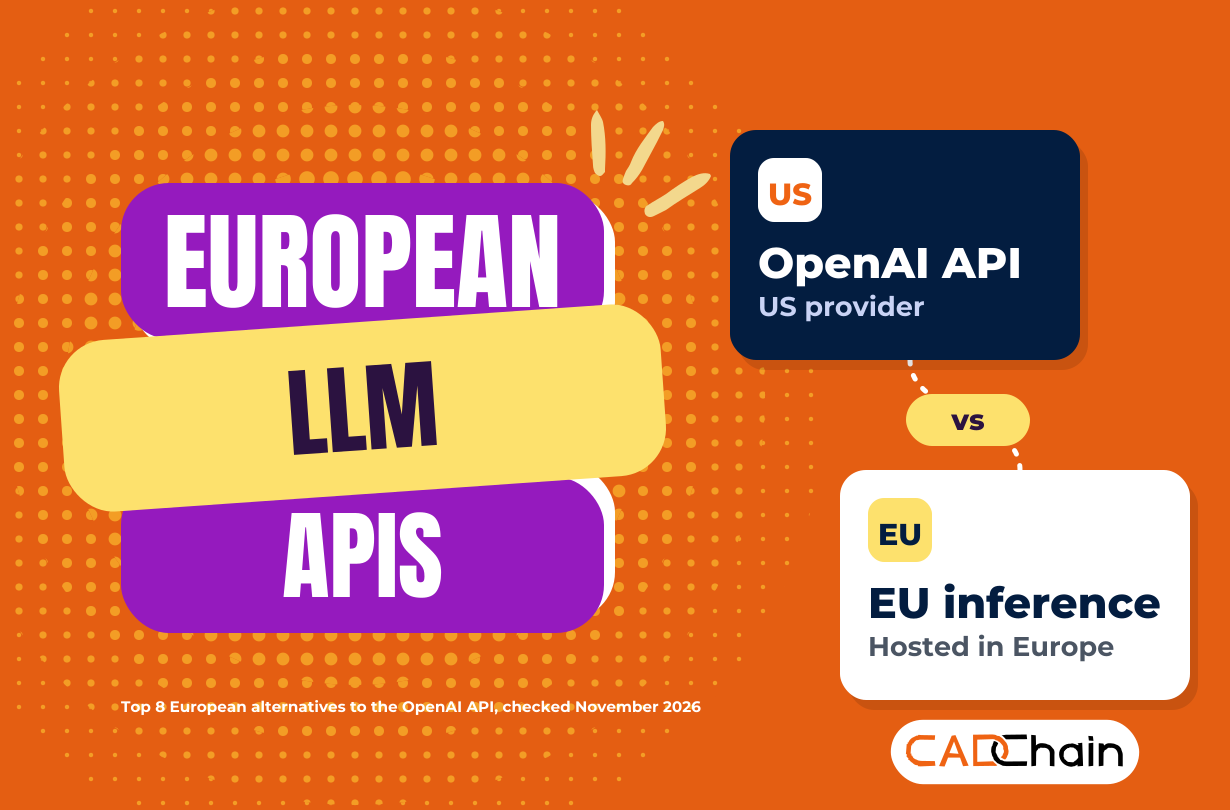
The best European alternative to the OpenAI API in 2027 is Mistral AI from Paris, the only European company here that builds frontier models and sells them through its own API, with data hosted in the European Economic Area by default. If you want a drop-in replacement for OpenAI SDK code, Scaleway and OVHcloud (France) and IONOS and STACKIT (Germany) serve open-weight models such as gpt-oss, Mistral Small, Qwen and Llama through OpenAI-compatible APIs from European data centres, often for a few cents per million tokens.
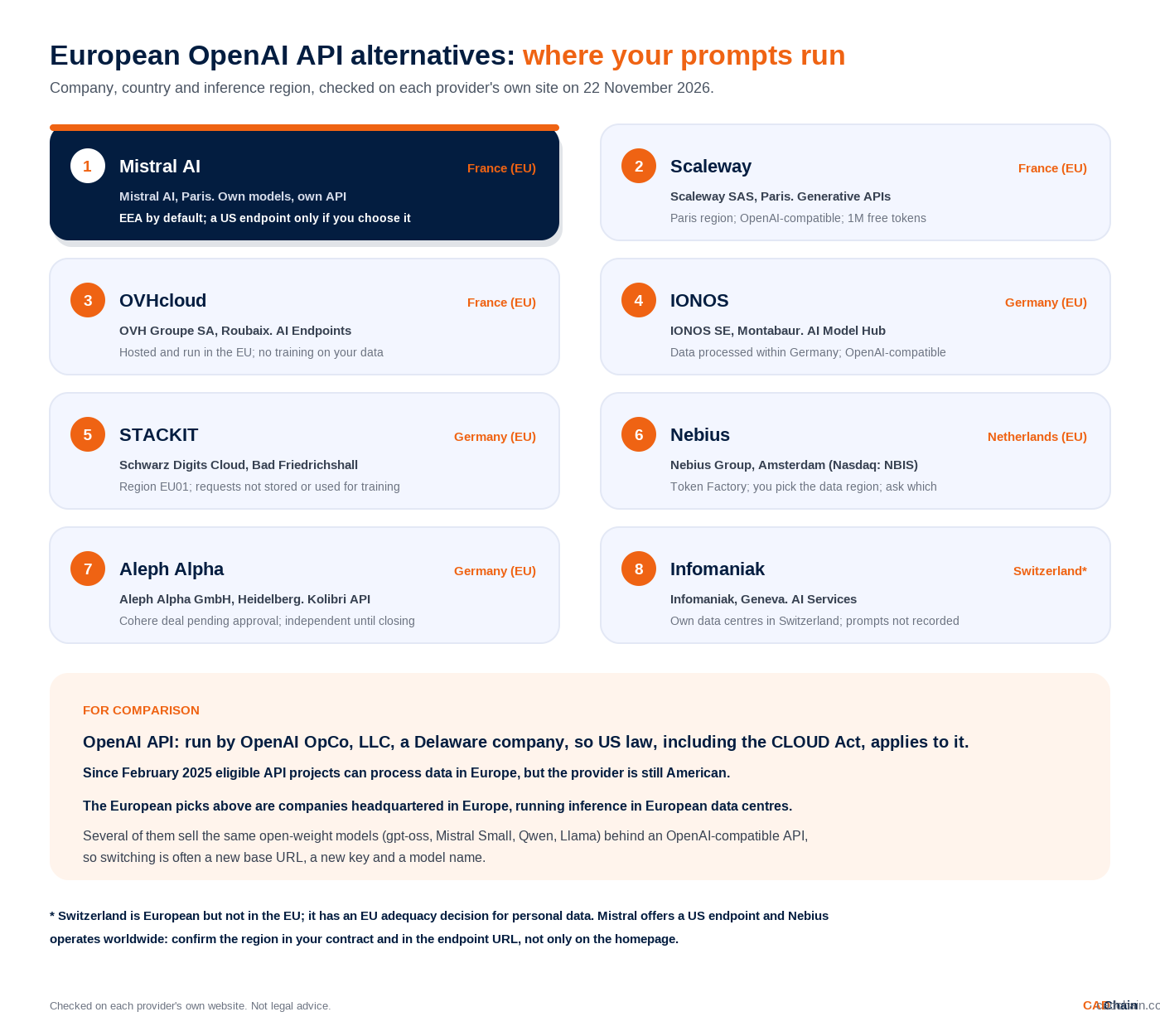
This guide compares eight European alternatives to the OpenAI API for start-ups and engineering teams that build AI features into their products: chat, agents, retrieval over documents, code assistants and data extraction. For each provider we checked, on its own website on 22 November 2026, which company you contract with, where your prompts are processed, whether it trains on your data, how close its API is to OpenAI's, and what it charges.
TL;DR: European alternatives to the OpenAI API
Best European models: Mistral AI (France), EEA hosting by default, Mistral Large from $0.50 per million input tokens. Drop-in OpenAI-compatible APIs: Scaleway (Paris region, 1 million free tokens), OVHcloud AI Endpoints (hosted in the EU, gpt-oss-120b from €0.08 per million input tokens), IONOS AI Model Hub (data processed in Germany) and STACKIT AI Model Serving (requests not stored or used for training). Fine-tuning and dedicated endpoints: Nebius Token Factory (Netherlands). German-language sovereign model: Aleph Alpha Kolibri, but note its pending deal with Canada's Cohere. Swiss hosting: Infomaniak (Switzerland is not in the EU). Never paste unreleased designs or export-controlled data into any hosted API: self-host open weights for that.
Why are European companies looking for alternatives to the OpenAI API?
The first reason is jurisdiction. OpenAI's terms are an agreement with OpenAI OpCo, LLC, a Delaware company. Since February 2025, eligible API customers can create projects that process data in Europe, with zero data retention for eligible endpoints, and that solves much of the data residency question. It does not change who runs the service: under the US CLOUD Act, US authorities can require a US provider to hand over data in its possession or control, wherever the data is stored. Many European legal teams therefore prefer a provider outside that law's reach.
The second reason is GDPR transfers. Sending personal data to a US provider currently relies on the EU-US Data Privacy Framework, which has been challenged in court, while its two predecessors, Safe Harbor and Privacy Shield, were struck down by the Court of Justice of the EU in 2015 and 2020. A European provider with European hosting keeps the transfer question off the table. Our article on EU AI Act enforcement and AI agents explains the next layer of rules that applies once your product calls a model, and the EU Data Act and trade secrets covers what manufacturers should keep in mind when product data flows to new services.
The third reason is intellectual property. Prompts carry code, specifications and the logic of your product. Our reports on the AI code theft lawsuit involving Claude Code and Codex, on secrets leaked through AI coding tools and on the Apple v. OpenAI trade secrets case show how easily confidential material moves once AI is in the workflow. And if your product contains dual-use technology, its design data can be controlled technology, so read our explainer on the BIS affiliates rule and design data before any of it reaches a model.
OpenAI API alternatives in Europe compared: country, owner, hosting and price
The table uses the same columns as every article in this series. France, Germany and the Netherlands are in the EU; Switzerland is European but not in the EU and has an EU adequacy decision for personal data. Prices are per million tokens, input / output, for one example model, excluding VAT.
Checked on each provider's own website on 22 November 2026. Prices exclude VAT and appear only where the provider's page showed them that day. Mistral lists prices in US dollars, Infomaniak in Swiss francs.
1. Mistral AI (France): the closest European alternative to the OpenAI API
Mistral AI is a French company with its registered office at 15 rue des Halles in Paris. It trains its own models, both open-weight and commercial, and sells them through its API and the Mistral Studio console. Its help centre says data is hosted in the European Economic Area by default; inference runs in the United States only if you explicitly use its US endpoint.
Strengths: Mistral is the one pick that competes with OpenAI on the models themselves, not just on hosting. Its line-up includes Mistral Large 4, an open-weight multimodal general model, Mistral Medium and Small for most tasks, an OCR service for documents and the Voxtral speech models. Pricing is per million tokens: its own FAQ gives Mistral Large at $0.50 input and $1.50 output, with batch processing at half price and cached input up to 90% cheaper. Open weights let you move the same model to your own servers later. Limits: some features send data to sub-processors outside the EU under Standard Contractual Clauses; Enterprise customers can switch some of them off. Mistral has its own API and SDKs, so test your client library rather than assuming a one-line swap. Who it suits: start-ups that want a European model vendor with strong models, and enterprises that may need a private deployment later. Migration notes: map each OpenAI model to a Mistral model and re-run your evaluation set before switching traffic.
2. Scaleway Generative APIs (France): an OpenAI-compatible API hosted in Paris
Scaleway SAS, registered in Paris, sells Generative APIs as a serverless, pay-per-token service in its Paris region, plus dedicated deployments for predictable throughput. Its page says the APIs are designed to work out of the box with OpenAI libraries and LangChain, and that Scaleway does not collect, read, reuse or analyse your inputs, prompts or outputs.
Strengths: every new customer gets 1 million free tokens. Public prices on 22 November 2026 included gpt-oss-120b at €0.15 input and €0.60 output, Mistral Small 3.2 at €0.15 and €0.35, and Mistral Medium 3.5 at €1.50 and €7.50 per million tokens, alongside Qwen, Llama 3.3, Gemma, DeepSeek and embedding models. A Batches API lowers the price for work that does not need an instant answer. Limits: no frontier model of its own; one region for the serverless service. Who it suits: developers who want the shortest path off OpenAI: change the base URL and key, pick a model, done. Migration notes: test function calling and structured output per model, because support differs between models, not between providers.
3. OVHcloud AI Endpoints (France): the cheapest public prices, hosted in the EU
OVHcloud's parent, OVH Groupe SA, is based in Roubaix, France. Its AI Endpoints service gives one API for more than 20 open-weight models, including language, speech, document and image models. The product page says the service is hosted and run in the European Union, that your data is never used to train its models, and that it keeps only what is strictly necessary for billing.
Strengths: the lowest list prices we found: on its Irish price page, gpt-oss-120b cost €0.08 input and €0.40 output, Mistral Small 3.2 €0.09 and €0.28, and gpt-oss-20b €0.04 and €0.15 per million tokens, excluding VAT, with a few small models free. The API follows the OpenAI standard, so OVHcloud says you can switch providers without rewriting code. It promises 99.5% availability, 400 requests per minute per project, a batch mode in beta at half price, and ISO 27001, SOC 2 Type II and HDS certification. Limits: no proprietary flagship model. Who it suits: cost-sensitive start-ups and teams already on OVHcloud. Migration notes: start with the same model family you plan to keep, such as gpt-oss or Mistral Small, so prompts need little rework.
4. IONOS AI Model Hub (Germany): open models with data processed in Germany
IONOS SE, registered in Montabaur, offers the AI Model Hub as part of IONOS Cloud. Its documentation says all data processing complies with German and European data protection rules and that your data is processed within Germany. Models are reached through an OpenAI-compatible API, with vector databases for retrieval-augmented generation.
Strengths: clear euro prices on its German page: gpt-oss-120b at €0.15 input and €0.65 output, Mistral Small 24B at €0.10 and €0.30, and Qwen3-Coder-Next at €0.15 and €0.80 per million tokens, plus embeddings, rerankers, OCR and FLUX image generation. IONOS also runs a cloud start-up programme. Limits: no free token allowance on the product page; a smaller catalogue than the hyperscalers. Who it suits: German companies and public bodies that need a German provider with German processing in one contract. Migration notes: create an authentication token in IONOS access management and use it as the API key in your OpenAI client.
5. STACKIT AI Model Serving (Germany): sovereign LLM inference from the Schwarz Digits cloud
STACKIT is the cloud of Schwarz Digits Cloud GmbH & Co. KG in Bad Friedrichshall, Germany. Its AI Model Serving runs shared open-source models such as gpt-oss, Qwen and Gemma, and its FAQ says it provides an OpenAI-compatible API, does not store any customer data from requests, and does not train any models with your data.
Strengths: a strong no-retention statement and public prices in region EU01: gpt-oss-20b at €0.15 input and €0.25 output, and gpt-oss-120b, Gemma 4 31B and Qwen3.6 27B at €0.45 and €0.65 per million tokens. Tutorials cover LangChain, RAG, vision and OpenCode. Limits: the models are shared by all customers, so check the rate limits, and prices are higher than OVHcloud's for the same model. Who it suits: companies already on STACKIT or looking for a German hyperscaler with sovereignty commitments. Migration notes: set the STACKIT base URL and auth token in any OpenAI-compatible client and check the rate limits for shared models.
6. Nebius Token Factory (Netherlands): fine-tuning and dedicated endpoints at scale
Nebius describes itself as the AI cloud company, headquartered in Amsterdam and listed on Nasdaq under NBIS. Token Factory is its inference platform: open-weight models through an OpenAI-compatible API for inference and fine-tuning, with dedicated endpoints for steady traffic. Its trust centre says it operates under the GDPR as an EU data processor and keeps customer data in the geographic region the customer chooses.
Strengths: the most complete platform here for teams that want to fine-tune open models on their own data and serve them at volume, with datasets, supervised fine-tuning and dedicated endpoints documented in one place. Limits: Nebius operates worldwide, and the Token Factory pages we could read did not show which regions each model runs in, nor prices, because its console blocked automated access. Ask for an EU region in writing. Who it suits: AI start-ups with enough traffic to justify fine-tuned or dedicated models. Migration notes: the official quickstart uses the standard OpenAI Python and JavaScript clients with a Nebius base URL.
7. Aleph Alpha Kolibri (Germany): a German-language sovereign model, with a deal to watch
Aleph Alpha GmbH is registered in Heidelberg. Its new model, Kolibri, has been available since 3 October: a mixture-of-experts model with 78 billion parameters and about 3 billion active per token, trained in Europe, with a tokenizer optimised for German and about 23% German pre-training data. It is offered by API through a sign-up and as weights on Hugging Face, designed for infrastructure the customer controls.
Strengths: documented training-data governance, including checks of every third-party dataset and a block list of more than 4.5 million URLs. Limits: Aleph Alpha's own announcement says it has agreed with Cohere, a Canadian company, to build a transatlantic sovereign AI company; the deal awaits regulatory approval, and Aleph Alpha operates independently until it closes. No public API prices. Who it suits: public administration and German industry that need German-language reasoning and a model they can run themselves. Migration notes: plan for self-hosting if ownership matters to you, because the weights stay usable whatever happens to the company.
8. Infomaniak AI Services (Switzerland): open models in Swiss data centres
Infomaniak is an independent Swiss cloud company with its headquarters in Geneva and a branch in Zurich. Its AI Services run open-source models through OpenAI-compatible APIs in its own data centres in Switzerland, and it says queries are neither recorded nor used to train models. Switzerland is not in the EU, so this is the non-EU pick.
Strengths: 1 million free credits to start, then pay as you go, with prices in Swiss francs such as Mistral Small 4 at CHF 0.20 input and CHF 0.75 output per million tokens, Gemma 4 31B at CHF 0.20 and CHF 0.40, and the Swiss open model Apertus 70B at CHF 0.70 and CHF 2.50. It also offers embeddings, rerankers, Whisper transcription and image generation. Limits: no custom fine-tuning, a payment card is needed to confirm your identity, and prices are in CHF. Who it suits: Swiss companies and anyone who prefers Swiss hosting; the same company's Euria assistant featured in our European alternatives to ChatGPT. Migration notes: point your OpenAI client at Infomaniak's endpoint and pick from its model list.
How to choose an EU alternative to the OpenAI API
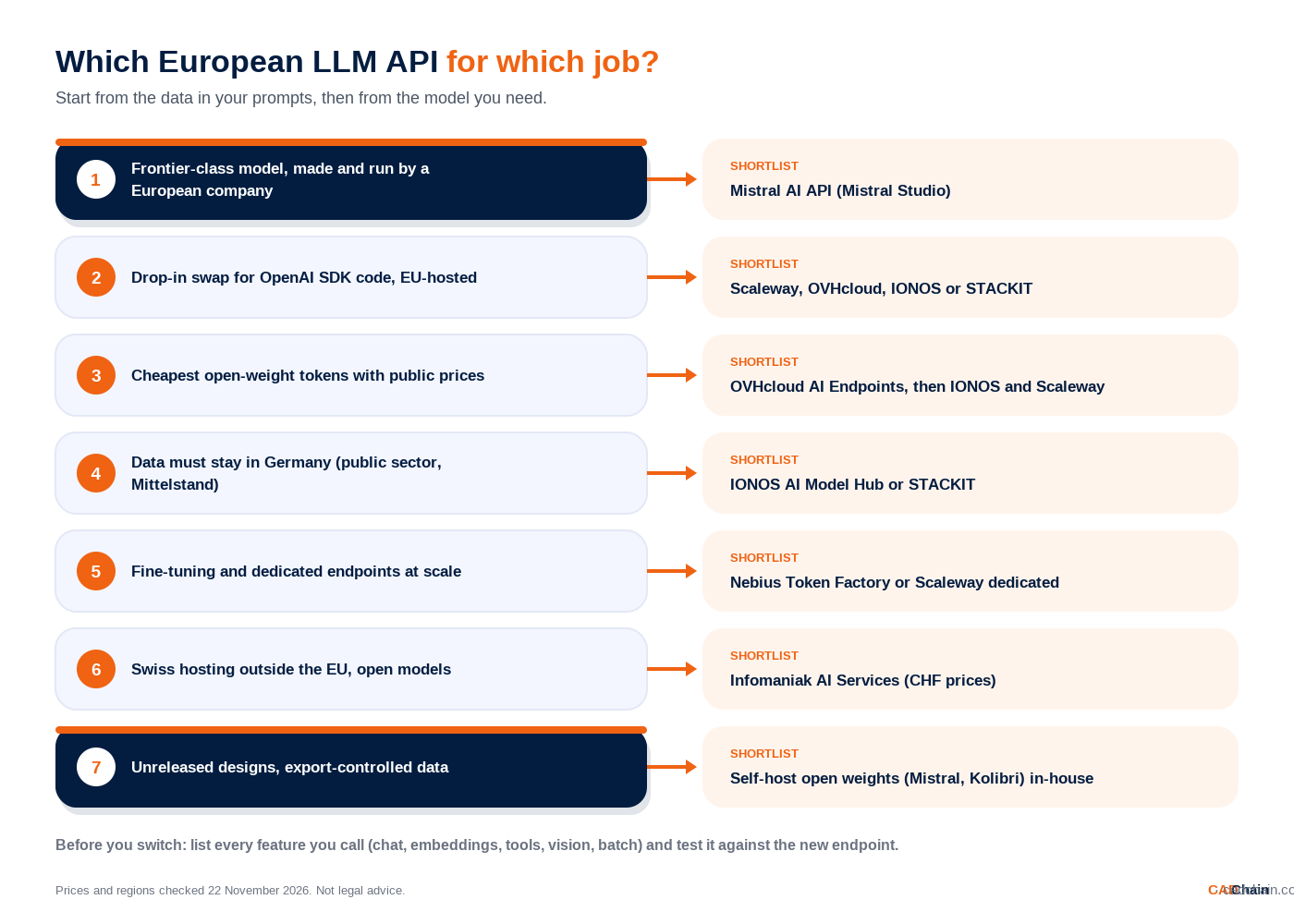
Start from what your prompts contain and from the model quality you need, not from the cheapest token. These questions narrow the list quickly: If you first want to try OpenAI's own tools, our guide to the OpenAI Playground and what replaced OpenAI Labs shows where each one lives in 2026.
- Do you need a frontier model, or is a strong open model enough? For hard reasoning and coding, test Mistral first. For classification, extraction, summaries and RAG, open models such as gpt-oss-120b or Mistral Small on Scaleway, OVHcloud, IONOS or STACKIT are often enough, and far cheaper.
- Must data stay in one country? IONOS processes data in Germany; Scaleway serves from Paris; Infomaniak from Switzerland. Ask the others for the exact region in the contract.
- Does the provider keep or train on prompts? OVHcloud, STACKIT, Scaleway and Infomaniak say plainly that they do not. Get it in the data processing agreement whatever the homepage says.
- Will you fine-tune? Nebius Token Factory is built for it; Infomaniak does not offer it.
- Could the owner change? Aleph Alpha's pending deal with Cohere is a reminder to prefer open weights you can self-host for anything business-critical.
Our hands-on notes on GPT-6.2 Astra for engineering work and Claude Fable 5.2 for CAD and hardware show the kind of tests worth running before you commit, and our overview of the top AI labs explains who builds which models. If you are comparing global chat tools rather than APIs, our list of ChatGPT online alternatives covers that wider market.
Migration checklist: moving from the OpenAI API to a European provider
- Inventory your calls. List every endpoint you use (chat, embeddings, tools, vision, batch, fine-tuning) with monthly token volumes.
- Build an evaluation set. Collect 50 to 200 real prompts with good answers and score each candidate model on them before you switch.
- Swap the client settings. For OpenAI-compatible providers, change the base URL, API key and model name; keep a feature flag so you can roll back.
- Re-embed your documents. Embeddings from different models are not interchangeable, so rebuild your vector index with the new provider's embedding model.
- Check the contract. Ask for the data processing agreement, sub-processor list, hosting region and retention period, and confirm in writing that prompts are not used for training.
- Classify what may be sent. Keep trade secrets, unreleased CAD data and export-controlled technology out of hosted APIs; our trade secrets guide for deep-tech start-ups helps you draw that line.
- Review every six months. Models, prices and owners change fast in AI, as the Aleph Alpha deal and OpenAI's own data residency changes show.
Your prompts are only part of your IP. Protect the files too. CADChain is our own product. It protects CAD files at file level: you decide who can open a model and for how long, revoke access when a project ends, log every access and record ownership on a blockchain. That control stays with the file whichever AI tool, cloud or supplier it reaches. Read our complete guide to CAD file security and our rules for sharing CAD files with contractors.
👉 See how CADChain protects CAD files
This is the eighth article in our series on European alternatives to US and other non-European software for engineering and deep-tech companies. Earlier parts cover AutoCAD, Ansys simulation, Xometry and Protolabs, Fusion 360, Microsoft Purview for CAD and IP files and JLCPCB and PCBWay. For why European AI talent and start-ups keep moving to the US, read our analysis of OpenClaw's US migration.
FAQ: European alternatives to the OpenAI API
What is the best European alternative to the OpenAI API?
Mistral AI from France, because it builds its own frontier and open-weight models and hosts data in the European Economic Area by default. If you only need open models behind an OpenAI-compatible API, Scaleway, OVHcloud, IONOS and STACKIT are simpler drop-in options.
Is there an OpenAI-compatible API hosted in the EU?
Yes. Scaleway Generative APIs (Paris), OVHcloud AI Endpoints (EU), IONOS AI Model Hub (Germany), STACKIT AI Model Serving (region EU01) and Nebius Token Factory all advertise OpenAI-compatible APIs, so most code needs only a new base URL, key and model name. Infomaniak offers the same from Switzerland.
Does OpenAI offer EU data residency for the API?
Yes, since February 2025 eligible API customers can create projects with Europe as the region, with zero data retention for eligible endpoints. OpenAI OpCo, LLC is still a US company, which is why some European teams choose a European provider instead.
Which European LLM APIs do not train on my data?
OVHcloud says AI Endpoints data is never used to train its models; STACKIT says it does not store request data or train models with it; Scaleway says it does not collect, read, reuse or analyse your prompts and outputs; Infomaniak says queries are neither recorded nor used for training. Confirm the same in your data processing agreement.
What is the cheapest European alternative to the OpenAI API?
On 22 November 2026, OVHcloud AI Endpoints had the lowest public prices we found, for example gpt-oss-120b at €0.08 per million input tokens and €0.40 per million output tokens, excluding VAT. Scaleway and Infomaniak add 1 million free tokens or credits to start.
Can I self-host a European model instead of using an API?
Yes. Mistral publishes open-weight models such as Mistral Large 4, and Aleph Alpha publishes Kolibri on Hugging Face under its licence. Self-hosting is the safest choice for unreleased designs, source code and export-controlled data, because prompts never leave your infrastructure.