
On 16 November 2026, the US Court of Appeals for the Sixth Circuit upheld a $13.2 million jury verdict that Ford must pay InterMotive, a small maker of vehicle control modules, for misappropriating a trade secret that InterMotive had shared with Ford in 2012 while the two companies worked on a joint product. The published opinion, written by Judge Eric Clay for a panel with Chief Judge Raymond Kethledge and Judge Andrew Nalbandian, rejected every argument raised by Ford and by InterMotive and affirmed the district court in full.
The case is a textbook example of the risk every hardware start-up and supplier takes when it shows its technology to a much larger partner. InterMotive gave Ford a specification and a working prototype under a confidentiality agreement. Ford ended the project in early 2013, and in 2016 announced its own module with the same name and the feature InterMotive considered its secret. It took a trial in 2023 and an appeal decided in 2026 to settle who was right.
For founders, engineering managers and IP lawyers, the opinion is useful for three reasons. It shows that a company's own later product does not automatically give its secret away. It confirms that the party who took the secret can be made to hand over all the profits it cannot explain away. And it shows how little a contract claim alone was worth in this case: the jury found that Ford breached the confidentiality agreement and awarded one dollar.
TL;DR: the Sixth Circuit kept InterMotive's $13.2 million trade secret award against Ford
In Ford Motor Co. v. InterMotive, Inc., Nos. 25-1971/1985, decided 16 November 2026, the court affirmed a 2023 jury verdict under the Michigan Uniform Trade Secrets Act. InterMotive had shared a specification and a prototype of an Upfitter Interface Module with Ford in December 2012 under a confidentiality agreement. The jury awarded $13,209,300, equal to Ford's profits on its own modules, and the district court added $3,011,092 in prejudgment interest. The appeals court held that InterMotive's own 2014 product did not necessarily reveal the secret, and that Ford, not InterMotive, had to prove which part of its profits came from something else. The breach of contract claim, by contrast, produced nominal damages of $1.
What did the Sixth Circuit decide in Ford v. InterMotive?
The Sixth Circuit's opinion, recommended for publication, resolves Ford's appeal and InterMotive's cross-appeal from the Eastern District of Michigan, where Judge Terrence Berg presided over a two-week jury trial from 18 October to 1 November 2023. The appeal was argued on 22 October 2026, and the decision was filed 25 days later.
Ford raised two issues and lost both:
- The secret was still a secret. Ford argued that InterMotive gave the idea away itself when it released another product, the Programmable Relay Power Center, in 2014, two years before Ford's own module. The court said the jury was entitled to believe InterMotive's expert that this product worked differently and would have been hard to reverse-engineer.
- The damages stand. Ford argued that InterMotive should have had to split Ford's profits between the protected feature and everything else in the module, as in patent cases. The court approved the district court's approach: InterMotive had to show sales caused by the misappropriation, then the burden moved to Ford to prove deductions and other sources of profit.
InterMotive's cross-appeal failed too. The court agreed that the separate $349,867 Lanham Act award for unfair competition would have paid InterMotive twice for the same profits, refused to raise that award to $15 million, held that Michigan law does not allow disgorgement of profits as a remedy for breach of contract, and upheld the exclusion of an implied contract theory that InterMotive had not clearly pleaded.
How did a supplier's prototype become a $13.2 million case?
InterMotive was founded in 1996 by Greg Schafer, who had worked at Ford as a design engineer and field service engineer. It designs electronic control systems for commercial vehicles. Its Upfitter Interface Module plugs into a partly finished vehicle, reads signals on the vehicle's Controller Area Network (CAN) and uses them to control equipment that specialty builders add, from work truck beds to ambulance lights, without cutting into factory wiring.
According to the opinion, the relationship ran like this:
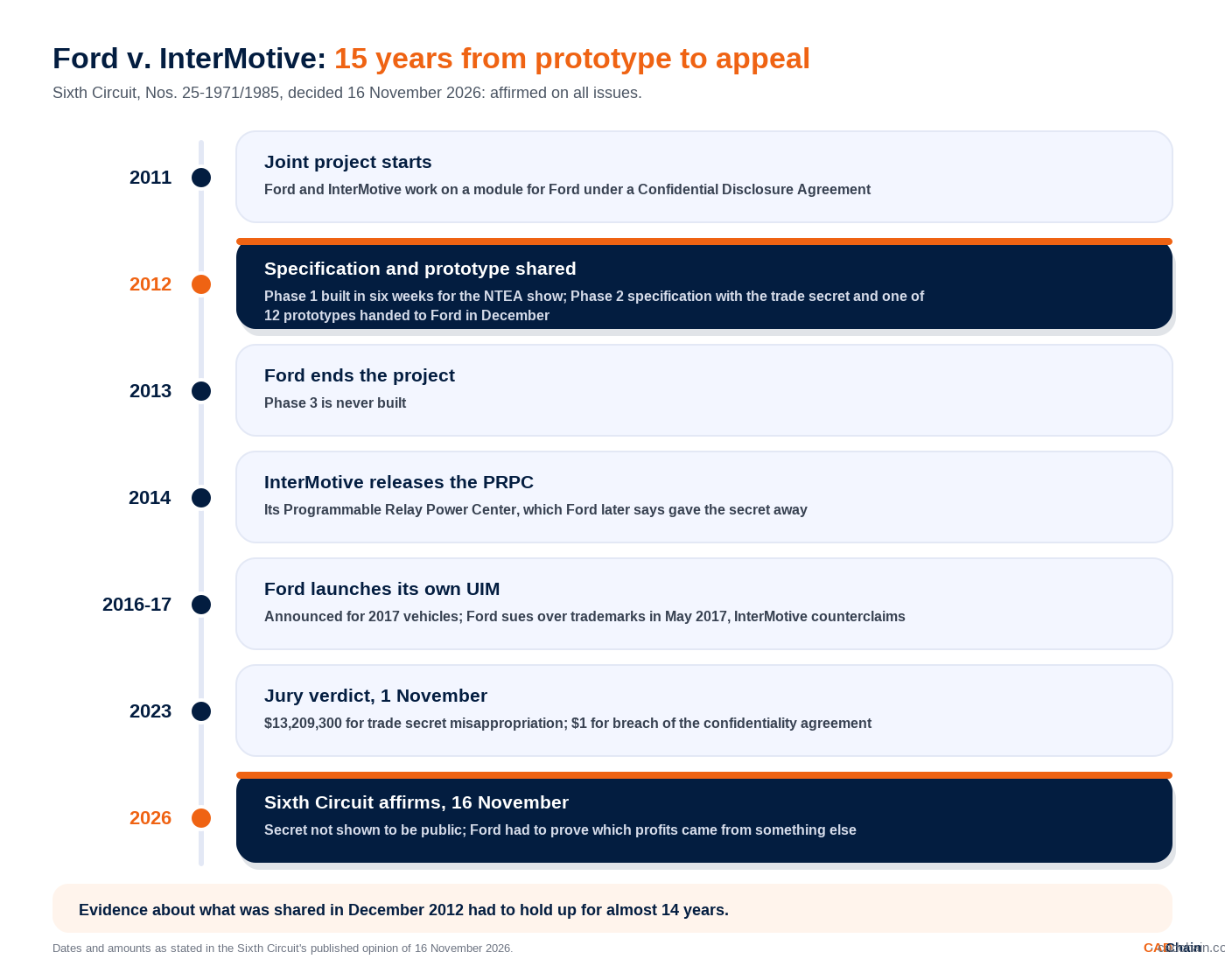
- 2011: Ford and InterMotive start working together on a module designed for Ford. Their talks are covered by a Confidential Disclosure Agreement.
- Early 2012: a three-phase project. InterMotive builds the Phase 1 module in six weeks so Ford can show it at the NTEA Work Truck Show, where Ford presents it to a room of about 400 people.
- March to December 2012: InterMotive writes the Phase 2 specification, which contains the trade secret, and hands it to Ford under the agreement in December 2012. It makes 12 Phase 2 prototypes and leaves one with Ford after a demonstration.
- Early 2013: Ford tells InterMotive it will not go ahead. Phase 3 is never built.
- 2016: at the same trade show, Ford announces that several 2017 vehicles will offer its own "UIM". InterMotive raises its concerns, and Ford responds by suing InterMotive over trademarks in May 2017. InterMotive counterclaims for trade secret misappropriation and more.
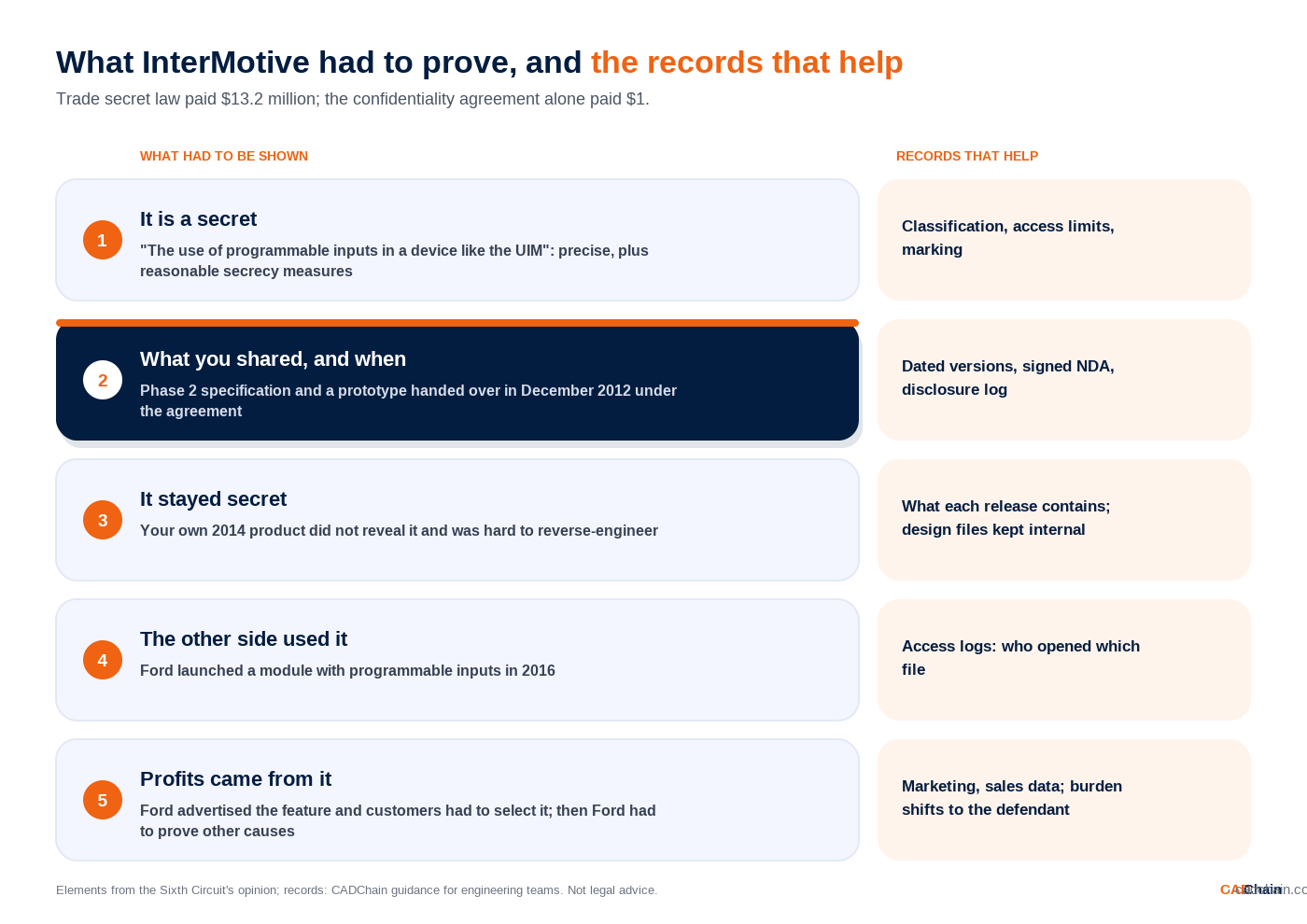
The trade secret, as the judge defined it for the jury, was "the use of programmable inputs in a device like the Upfitter Interface Module." That is a narrow, specific claim about a design choice, not a broad idea. Defining it this way helped InterMotive survive Ford's argument that the concept was already public. Our guide to the legal framework for trade secret protection of CAD designs explains why a precise definition matters so much.
Why did InterMotive's own product not destroy the secret?
This is the part of the opinion most relevant to engineering teams. A trade secret only exists while the information is not generally known and not readily ascertainable by proper means, such as studying a product on the market. Ford said InterMotive's Programmable Relay Power Center, sold from 2014, used programmable inputs openly, so by 2016 there was nothing left to steal.
InterMotive's expert, Professor Juan Pimentel, told the jury that this product was much bigger, could not connect directly to a CAN bus and needed a second module to do what the UIM did. He said it was extremely hard to work out how it was made and that he had heard no evidence that Ford had reverse-engineered it. He also drew the line that matters in many engineering disputes: standard protocols such as CAN are public, but, in his words, "the way you use a CAN bus in a specific design such as this one for a specific end user, that is confidential."
Ford pointed to other witnesses who said reverse engineering would not be difficult. The appeals court did not pick a side. It said that on a motion for judgment as a matter of law it cannot weigh evidence, and the jury was allowed to believe InterMotive's expert. It repeated an older Sixth Circuit line: not all trade secrets become plainly visible merely by looking at the units.
The practical point: what you sell and what you know are different things. A product on the market can reveal its outside shape and some functions while its design logic, parameters, firmware and the reasons behind each choice stay in your files. Those files are where the value is, and where protection has to start. The same theme ran through the $116.9 million Joby verdict over air data probe drawings and 3D models and the Insulet v. EOFlow case over Omnipod CAD files. Solidboris.com covered the oral argument in Ford v. InterMotive and what it means for SOLIDWORKS teams in October.
Why did Ford have to give up all of its module profits?
Under the Michigan Uniform Trade Secrets Act, damages can include the unjust enrichment caused by misappropriation. The jury awarded $13,209,300, which the opinion notes was exactly the figure Ford's own damages expert gave for Ford's worldwide profits on 92,360 modules. InterMotive's expert had put Ford's North American module profits at $15,913,350.
Ford wanted a patent-style rule: the owner of the secret must isolate the value of the secret feature from everything else in the product. The Sixth Circuit said no. It approved a burden-shifting approach that profit awards in copyright and trademark cases also use: the owner proves the sales caused by the misappropriation, and the defendant must then prove costs, deductions and any part of the value that came from something else. The reason is practical. The company that used the secret holds the sales data, the cost data and the knowledge of why customers bought, and it has every incentive to bring that evidence forward.
On the facts, InterMotive showed that Ford advertised its module by highlighting programmable inputs, and a witness testified that a Ford customer "has to specifically select that feature" because it was not part of any package. That was enough for the jury to find that every module Ford sold was bought for the protected feature.
The table below shows what each claim produced, from verdict to appeal.
Share prototypes and specifications without losing control. CADChain encrypts CAD files at file level, gives each partner named access you can revoke at any time and records every open, so you can prove exactly what you shared, with whom and when.
👉 Protect your CAD files with CADChain
What does a $1 contract award tell hardware founders?
It is the most striking number in the case. The jury agreed that Ford breached the Confidential Disclosure Agreement, and awarded one dollar as instructed. InterMotive tried to recover Ford's profits under the contract too, but the court held that Michigan law separates contract damages, which compensate a loss, from restitution of the other side's gains. Without a statement from a Michigan court that disgorgement is available for breach of contract, a federal court would not create that remedy.
So the money came from trade secret law, and trade secret law only works if you can show three things: that the information was secret and you took reasonable steps to keep it so, what exactly you handed over and when, and that the other side used it. An NDA helps with the second point, but as our article on why NDAs are not enough to protect CAD files explains, it does not stop a file from being copied, forwarded or reused after the project ends.
The implied contract theory shows the same gap from another angle. InterMotive argued that by accepting a sample marked "CONFIDENTIAL", Ford implicitly promised to keep it confidential. The theory never reached the jury because the court found it had not been clearly pleaded. Marking matters, but a label on a box or a PDF is a weak control on its own. It works best combined with technical limits on who can open the files and a record of every access, as in tamper-proof CAD audit trails.
There is a time lesson as well. The specification changed hands in December 2012, Ford's product appeared in 2016, the lawsuit started in 2017 and the appeal was decided in November 2026. Evidence about who received what had to survive almost 14 years. Our guide to legal proof of CAD file ownership covers which records hold up over that kind of period.
What should engineering teams do now?
- Define your trade secrets precisely. Write down the specific design choices, parameters or methods you consider secret, the way the court defined "the use of programmable inputs in a device like the Upfitter Interface Module", and link each one to the files that contain it. Our trade secrets guide for deep-tech start-ups has a template.
- Share in layers. Give a large partner what it needs for the current phase, not the full specification and firmware. Show behaviour before you hand over design logic.
- Keep a disclosure log. For every specification, model and prototype you hand over, record the version, the date, the recipients and the agreement that covers it.
- Check your NDA's term and remedies. Know when confidentiality duties end, what happens to your files after the project stops and whether the contract gives you any remedy beyond nominal damages.
- Control access at file level. Use view, edit, print and export permissions with expiry dates so a partner's access ends when the project ends, even for copies already downloaded.
- Review your own product releases. Before you launch, check what the product, manuals and marketing reveal about techniques you want to keep secret, so a later dispute cannot claim you published them.
- Remember that knowledge outlasts projects. Ford's module appeared three years after the project ended. People who saw your files may still use what they learned, or take it to a new employer; see what the Apple v. OpenAI case teaches about engineers who change employers.
- Keep evidence for a decade or more. Store access logs, file versions and agreements where they cannot be altered, and where they will still be readable when a case reaches trial years later.
How does this fit the bigger picture?
Supplier relationships are where technology most often leaks, whether through a partner's later product, as here, or through process logs left in equipment being sold to a foreign buyer. Our sister sites covered three related angles this week:
- Suppliers as the way in. An Intel 471 report found manufacturing was the sector most targeted by ransomware and extortion claims from January to October 2026. Solidboris.com explains how initial access brokers sell entry into manufacturing supply chains.
- Remote management as a risk. GL.iNet says an attacker exploited a flaw in its cloud management service to install malware on some routers and KVM devices. BORIS Inventor covers what the GL.iNet KVM attack means for CAD workstations and server racks.
- Consent for creative work. Australian creators launched the Not AI's To Take campaign, asking that AI companies get permission before training on their work. Blended BORIS looks at the campaign and the class action being investigated.
Conclusion
Ford v. InterMotive ends, at least at the appeals court level, with a clear message for big companies and small suppliers alike: technology shared in confidence during a joint project does not become free to use when the project ends, and a company that later profits from it can be made to give those profits back. The opinion does not say whether Ford will ask for a rehearing or go to the Supreme Court, and no statement from Ford appeared in the sources we read.
InterMotive won because it could show what its secret was, that it handed it over under a confidentiality agreement, that its own product did not give it away and that Ford's sales depended on it. In the words of its trial lawyer Jake Grove in the firm's announcement, "Being smaller does not mean you are powerless." For hardware teams, the lesson is to make that kind of proof part of everyday work, long before anyone thinks of a court.
Keep proof of every design you share. CADChain gives every CAD file file-level encryption, granular permissions you can revoke at any time, a blockchain ownership record and a full access log, across CAD systems, suppliers and partners.
👉 Protect your CAD files with CADChain
FAQ: Ford v. InterMotive and the $13.2 million trade secret verdict
What did the Sixth Circuit decide in Ford v. InterMotive?
On 16 November 2026, in Nos. 25-1971/1985, the court affirmed the district court on every issue raised by both sides, leaving in place a $13,209,300 jury award for trade secret misappropriation under Michigan law and the district court's other rulings.
What was InterMotive's trade secret?
As defined for the jury, "the use of programmable inputs in a device like the Upfitter Interface Module", a vehicle control module that reads CAN data and controls equipment added by specialty vehicle builders. InterMotive shared it with Ford in a Phase 2 specification and prototype in December 2012.
Why did Ford argue the secret was no longer secret?
Ford said InterMotive's own Programmable Relay Power Center, released in 2014, publicly disclosed the use of programmable inputs before Ford launched its module in 2016. The jury accepted expert testimony that the product worked differently and would have been hard to reverse-engineer, and the appeals court let that finding stand.
How was the $13.2 million calculated?
It equals the figure Ford's own expert gave for Ford's worldwide profits on 92,360 modules. Once InterMotive showed sales caused by the misappropriation, Ford had the burden to prove deductions or other sources of profit, and the jury awarded the full amount.
Is there interest on top of the award?
Yes. The district court awarded $3,011,092 in prejudgment interest on the trade secret award, and the Sixth Circuit affirmed. The opinion does not state a final total including post-judgment interest or costs.
Why did the breach of contract claim produce only $1?
The jury awarded nominal damages of $1 as instructed. InterMotive wanted Ford's profits under the contract, but the court held that Michigan law does not allow disgorgement of profits as a remedy for breach of contract.
Can Ford still appeal?
Ford could ask the Sixth Circuit for rehearing or petition the US Supreme Court. As of 24 November 2026, we found no public statement from Ford about its next step.
How can CADChain help suppliers in a similar position?
CADChain does not replace an NDA or a lawyer. It gives each CAD file file-level encryption, access for named partners that you can revoke, and a timestamped record of every share and open, so you can limit what a partner keeps and prove later what you disclosed and when.