On 11 November 2026, prosecutors in Seoul indicted seven current and former staff of a factory automation supplier, and the company itself, over an alleged attempt to move Samsung Display's LCD process technology to China. According to the indictment, four employees hid compressed log files from production equipment that Samsung Display was about to sell, in folders its data wipe would not touch. Three former executives are separately accused of using Samsung SDS source code for years after their licence ended.
The case was announced by the No. 1 Serious Crime Prosecution Division of the Seoul Eastern District Prosecutors' Office, led by chief prosecutor Lee Han-ul. All seven were indicted without detention under Korea's Industrial Technology Protection Act, its Unfair Competition Prevention and Trade Secret Protection Act and its Copyright Act. The supplier is identified only as "Company A" in Korean reporting, and the Chinese companies involved have not been named. The defendants have not been convicted, and their response to the charges has not been reported.
The case is unusual because nobody broke into anything. The alleged leak route ran through two ordinary business moments that every manufacturer goes through: selling used production equipment, and ending a software licence with a supplier. For founders, engineering managers, IP lawyers and security teams, it is a clear example of how process know-how can sit outside the places you protect, on machine control PCs and in a partner's code base, and how a trusted supplier with on-site access is in the best position to take it.
TL;DR: a supplier allegedly tried to take process data out inside machines being sold
Prosecutors say four employees of a factory automation supplier compressed log files from the control PCs of LCD production equipment at Samsung Display's Asan plant three times between September and December 2020, and hid them in Windows system folders that the pre-sale data wipe skipped. The logs held 8th-generation LCD process conditions such as temperature, pressure and gas flow rates. Samsung Display engineers found the files and the attempt failed. Three former executives are also accused of using Samsung SDS factory automation source code after their resale contract ended in May 2019, in 43 projects worth about KRW 36.9 billion. Lesson: decommissioned machines and expired licences are exits for know-how. Inventory the data, wipe and verify, supervise supplier access, and control files at file level so access can end when the contract does.
What happened at Samsung Display's Asan plant?
Company A develops, installs and maintains factory automation systems for display and semiconductor makers, and was a Samsung Display supplier. In 2020, its staff carried out on-site inspections of LCD production equipment at Samsung Display's plant in Asan, South Chungcheong Province, which was due to be sold. According to Financial News, the inspections covered the equipment's network configuration and operating condition.
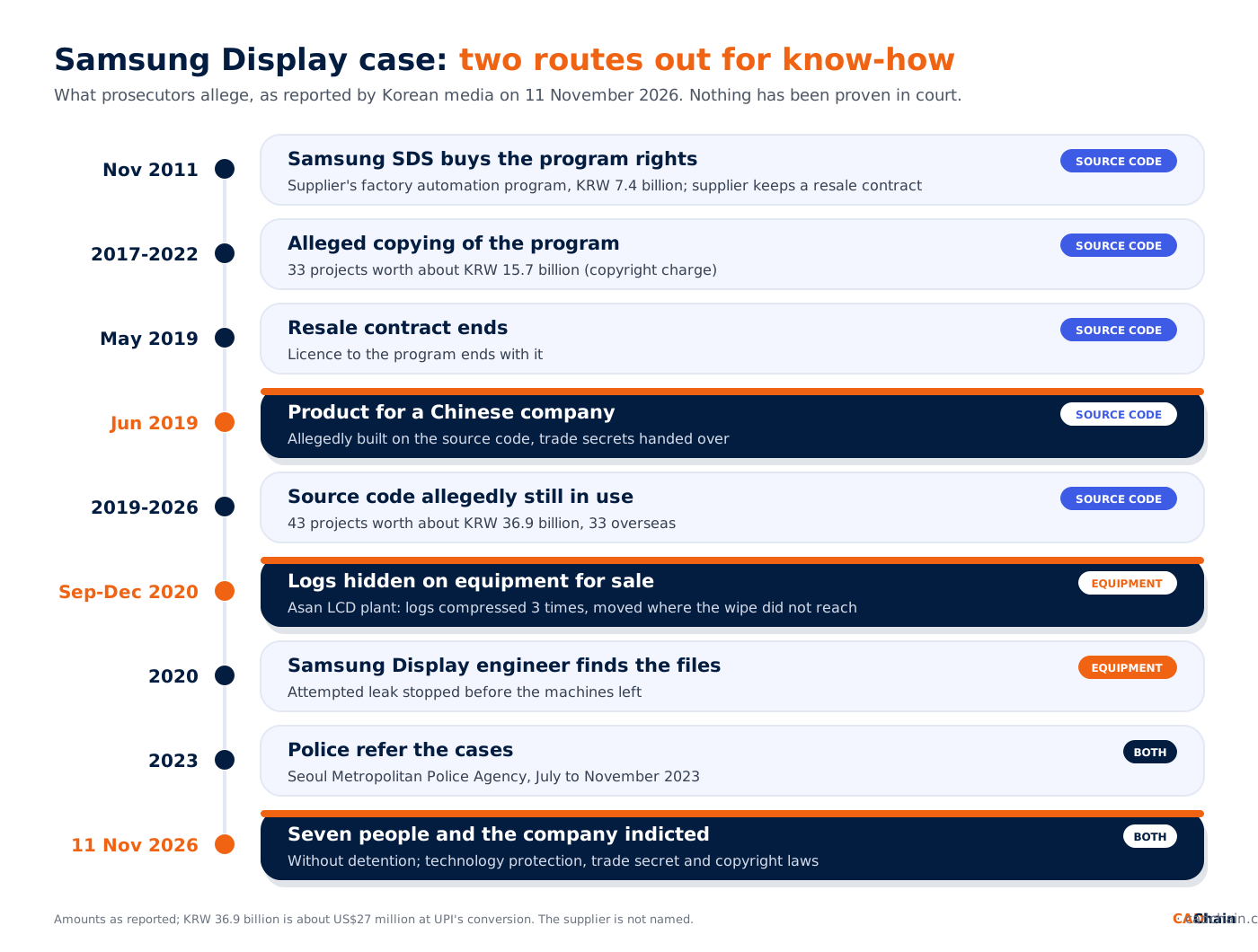
Prosecutors say that on three occasions between September and December 2020, four of the supplier's employees, including a 52-year-old executive director, compressed log files stored on the control PCs of photo, sputter and CVD equipment. When Samsung Display started what Korean reports call the "neutralization" of the equipment, deleting technical information and blocking recovery before the sale, the files had already been moved into Windows system folders and other locations that the deletion did not cover.
The logs held the process conditions for 8th-generation LCD panels, including temperature, pressure, gas flow rates and equipment operation data. Prosecutors classed this information as national core technology and a trade secret. The alleged plan was to take the files out with the sold equipment and use them to relocate and modify the machines and to build factory automation systems for a Chinese display maker. A Samsung Display engineer found the hidden files during checks, so the transfer failed.
In its statement, quoted by the Seoul Economic Daily, the prosecution said manufacturing and operating information left on equipment must be protected when that equipment is sold, because competitors could use it to cut the time and cost of building production lines. It added: "We will respond firmly to high-tech crimes."
What is the Samsung SDS source code part of the case?
The second part of the indictment is about software. In November 2011, Samsung SDS bought the economic rights to the copyright in Company A's factory automation program, and related rights, for KRW 7.4 billion (about US$5.5 million at UPI's conversion). Company A kept working with the program under a resale contract. That contract was terminated in May 2019.
Prosecutors say the company kept using the source code anyway. According to the indictment as reported, it was used in 33 overseas projects worth about KRW 32.1 billion between June 2019 and March 2026, including for Chinese display makers, and in 10 domestic projects worth about KRW 4.8 billion between April 2020 and December 2023. That is 43 projects worth about KRW 36.9 billion. In June 2019, a former chief executive and a former vice president allegedly developed a product that a Chinese company could run on its own, based on the source code, and handed source code containing trade secrets to that company.
A separate copyright charge covers alleged copying and modification of Samsung SDS programs in 33 projects worth about KRW 15.7 billion between August 2017 and June 2022. Reports differ slightly on the three executives: Nocut News describes a former CEO aged 67 and a former vice president aged 59, while Financial News and UPI refer to two former chief executives and a former vice president.
How was the case found, and why did it take six years?
The equipment part was caught by Samsung Display itself. Its engineers checked the machines during the inspection period and found the concealed files, which is why prosecutors describe it as an attempted leak. The Seoul Metropolitan Police Agency referred the related cases to prosecutors in stages between July and November 2023. Prosecutors then spent about three more years on supplementary investigation, including searches of Company A's offices and questioning of suspects and witnesses, before announcing the indictments.
Six years between the act and the indictment is not unusual for technology leak cases in Korea. It also shows why evidence matters: the case rests on what Samsung Display could show about the files, where they were and who put them there. Our article on the LG Chem trade secret leak shows how much the courts rely on access records, and the Samsung DRAM leak to CXMT shows how Korean courts treat national core technology once a leak is proven.
Why do sold machines and expired licences leak know-how?
Process knowledge does not only live in drawings and specifications. A production machine records it every time it runs: recipes, setpoints, temperatures, pressures, gas flows, alarm histories and tuning values. Much of that ends up on the control PC, the HMI, the PLC program and in backups made by the supplier who maintains the line. For a competitor building a similar line, those logs can be worth more than the hardware, because they show the settings that actually work.
When a machine is sold, moved to another plant or returned at the end of a lease, all of that leaves with it unless someone removes it. Samsung Display did wipe the equipment. The alleged weak point was that the people helping to prepare the machines knew where the wipe would not look. Our guide to industrial equipment design protection covers the same problem from the machine builder's side.
Licences have the same exit problem in a different form. Once a supplier has your source code, design files or models on its own systems, the end of a contract does not remove them. Only technical controls that end access, and audits that check it, can do that. Our articles on time-based expiry of CAD file access and smart contracts for CAD licensing explain how to tie access to the term of an agreement.
End access to design files when the contract ends. CADChain encrypts CAD files at file level, lets you grant and revoke access per user and per partner, sets expiry dates and logs every access, with ownership recorded on a blockchain, across CAD systems and suppliers.
👉 See how CADChain protects CAD files
What does this mean for European manufacturers?
The legal labels differ, but the logic carries over to Europe. Under the EU Trade Secrets Directive, process data is only protected if the holder took reasonable steps to keep it secret. A documented wipe procedure, supplier contracts that cover data on equipment, and logs that show who touched what are exactly the kind of evidence a court will ask for. Our trade secrets guide for deep tech startups and the article on the legal framework for CAD trade secrets explain what counts.
Korea treats certain technologies as national core technology, and taking them abroad is a criminal matter in its own right. Europe has no single equivalent, but export control rules on dual-use technology apply to technical data as well as hardware, and some production equipment and its process data fall under them. China is also tightening its own trade secret rules, as our article on China's draft trade secret sanctions rules explains, which matters for European companies that sell used lines or run plants there. Our guide to offshore manufacturing security covers how to share files across borders without losing control of them.
What should engineering teams do now?
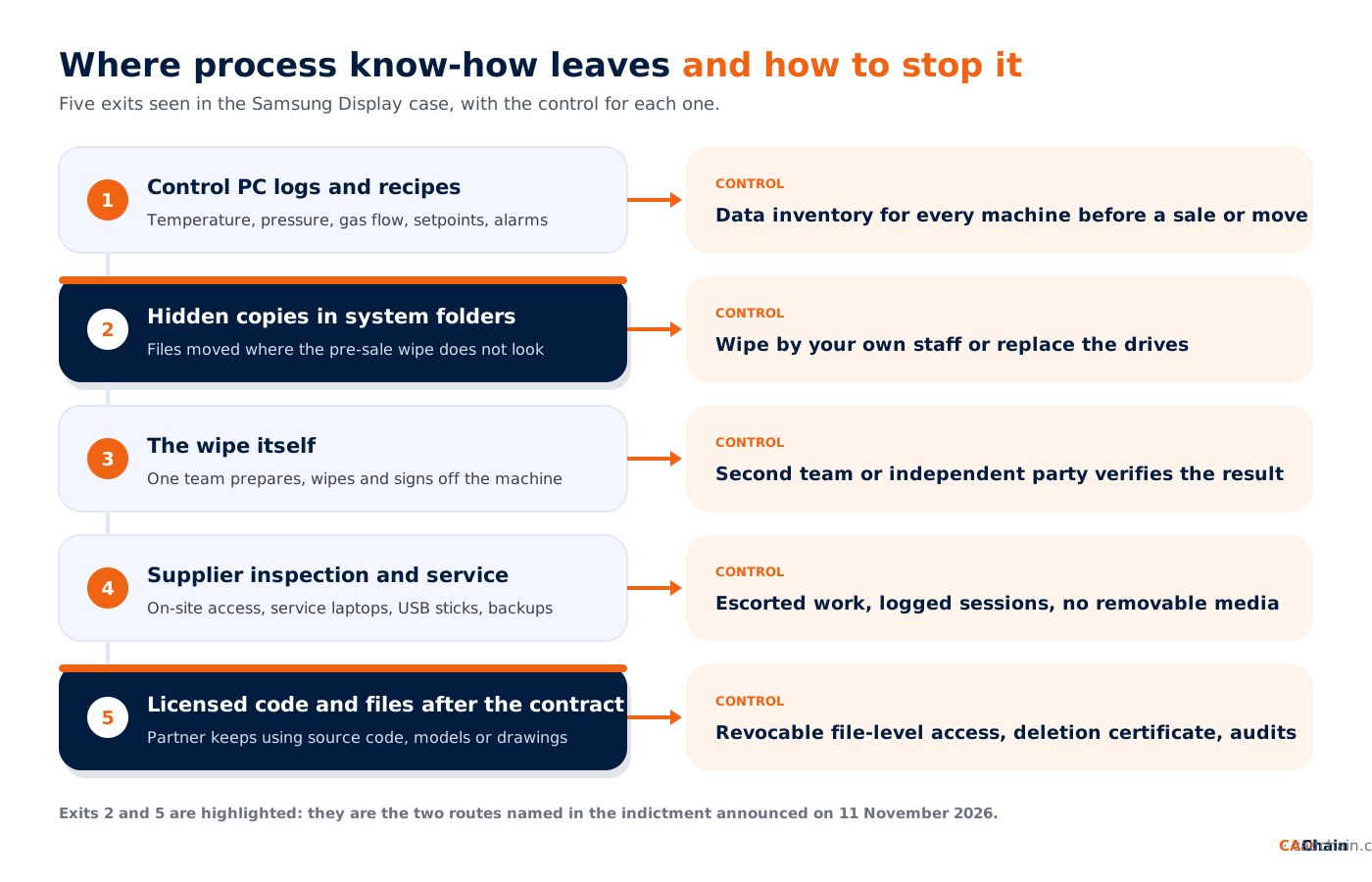
- Make a data inventory for every machine. List what each control PC, HMI, PLC and data logger stores, including logs, recipes, backups and system folders, before a sale, move or lease return is planned.
- Wipe with your own people and check the result. Do not let the supplier who prepares the machine for sale also run the deletion. Have a second team or an independent party verify that the drives are clean, or replace the drives entirely.
- Supervise supplier access. Escort on-site work on equipment that holds process data, log remote sessions, and ban removable media and personal laptops during inspections. Our article on controlling files beyond first-level partners covers the wider supplier chain.
- Write data clauses into equipment and service contracts. Cover data left on machines, return or deletion of logs and backups, and audit rights, both for buyers of used equipment and for maintenance suppliers.
- Treat licence end as a security event. When a software or design licence ends, revoke access, ask for a written deletion certificate, and check later that the code or files are not still in use.
- Protect design and process files at file level. Use file-level CAD encryption and DRM access levels for view, edit and export, so files shared with partners stop opening when access is revoked.
- Log access and keep the records. Cases like this one take years. Keep access logs long enough to prove who had what, and read our guide on how to audit CAD file access.
- Prepare a dated proof of ownership. Record when your process data and designs were created and by whom, so you can show they are yours when a copy turns up elsewhere. Our complete guide to CAD file security explains the options.
How does this fit the bigger picture?
Trusted access, from partners, tools and service providers, is a recurring theme this week on our sister sites too:
- Remote support tools as a way in. Huntress and ConnectWise reported attacks that used a ScreenConnect extension to run commands as SYSTEM on managed PCs. BORIS Inventor explains what the ScreenConnect attacks on MSPs mean for Inventor workstations and Vault servers looked after by outside support providers.
- Pirated CAD software and stolen logins. Gemini was tricked into pointing users to a site for cracked SOLIDWORKS, and an infostealer study linked pirated software to stolen company access. Solidboris.com covers why cracked SOLIDWORKS is a security and legal risk.
- Who owns what you upload. World Labs opened its Atlas world model to everyone, and its terms give it a licence over inputs and outputs, including for training. Blended BORIS explains what the World Labs Atlas terms mean for Blender artists.
The common thread is that know-how leaves through people and partners who were let in on purpose. Our guides on IP theft in manufacturing and how employees accidentally leak CAD files cover the most common routes, and view-only CAD access for vendors shows how to give suppliers what they need without handing over editable files.
Conclusion
If the prosecutors are right, Samsung Display's process know-how nearly left its Asan plant inside the machines it was selling, hidden by the supplier staff who were helping to prepare them. The company's own data wipe was not enough on its own; what stopped the leak was an engineer who checked again. The source code charges show the other side of the same problem: the end of a contract did not end the use of what had been shared.
For engineering companies, the lesson is to treat every exit, a machine sale, a lease return, a licence end or a supplier change, as a moment when know-how can leave. Know where the data sits, delete it with your own people, verify the result, and keep design and process files under file-level control, so that access ends when the relationship does and you can prove what was yours.
Make your design files provably yours and revocable at any time. CADChain gives every CAD file a verifiable ownership record, file-level encryption, granular permissions you can revoke at any time and a full access log, across CAD systems, suppliers and partners.
👉 Protect your CAD files with CADChain
FAQ: Samsung Display technology leak
What happened in the Samsung Display case?
On 11 November 2026, the Seoul Eastern District Prosecutors' Office indicted seven current and former staff of a factory automation supplier, and the company, without detention. Four employees are accused of hiding LCD process log files on equipment Samsung Display was selling, in an attempt to take them to China in 2020. Three former executives are accused of misusing Samsung SDS source code.
What data was in the log files?
According to prosecutors, the logs on the control PCs of photo, sputter and CVD equipment held process conditions for 8th-generation LCD panels, such as temperature, pressure, gas flow rates and equipment operation data. Prosecutors classed it as national core technology and a trade secret.
How were the files hidden?
Prosecutors say the employees compressed the log files three times between September and December 2020 and moved them to Windows system folders and other places that Samsung Display's pre-sale data deletion did not cover, so they would leave with the equipment.
Did the leak succeed?
No. A Samsung Display engineer found the hidden files during checks of the equipment, so prosecutors treat it as an attempted leak.
What is the Samsung SDS part of the case?
Samsung SDS bought the rights to the supplier's factory automation program in 2011 for KRW 7.4 billion. The supplier used it under a resale contract that ended in May 2019, but allegedly kept using the source code in 43 projects worth about KRW 36.9 billion through March 2026, and gave source code to a Chinese company.
Have the defendants been convicted?
No. They have been indicted, not convicted, and their response has not been reported. The supplier and the Chinese companies have not been named in reports.
What should manufacturers learn from it?
Treat equipment sales, relocations, lease returns and licence ends as exits for know-how. Inventory the data on each machine, wipe it with your own staff and verify the result, supervise supplier access, write data clauses into contracts and keep access logs.
How does CADChain help?
CADChain encrypts CAD files at file level, sets per-user and per-partner permissions with expiry dates, logs every access and records ownership on a blockchain. Files shared with a supplier stop opening when access is revoked. It complements, and does not replace, careful wiping of machines and supplier controls.