On 19 October 2026, the US State Department sanctioned five China-based companies and funds connected to Linwei Ding, the former Google software engineer convicted in January of stealing Google's AI trade secrets. The targets include the startup Ding founded and the venture capital firm that gave it seed money. It is only the second time the US has used the Protecting American Intellectual Property Act (PAIPA), and the first time against entities in China.
Most trade secret cases end with a verdict against the person who took the files. This one goes further. The sanctions reach the company that was built on the stolen knowledge and the investor that backed it, including two of its funds and a company owned by one of them. In other words, the US government is now treating the people who profit from stolen technology as targets in their own right, not only the employee who copied it.
For deep-tech founders, investors and engineering managers, the case is a useful map of how trade secret theft actually happens: an insider with legitimate access, a simple way around data loss prevention, a new startup and an investor ready to fund it. Here is what was announced, how the theft worked, what the sanctions mean, and what hardware and AI teams should do to protect their own design data.
TL;DR: the PAIPA sanctions in one paragraph
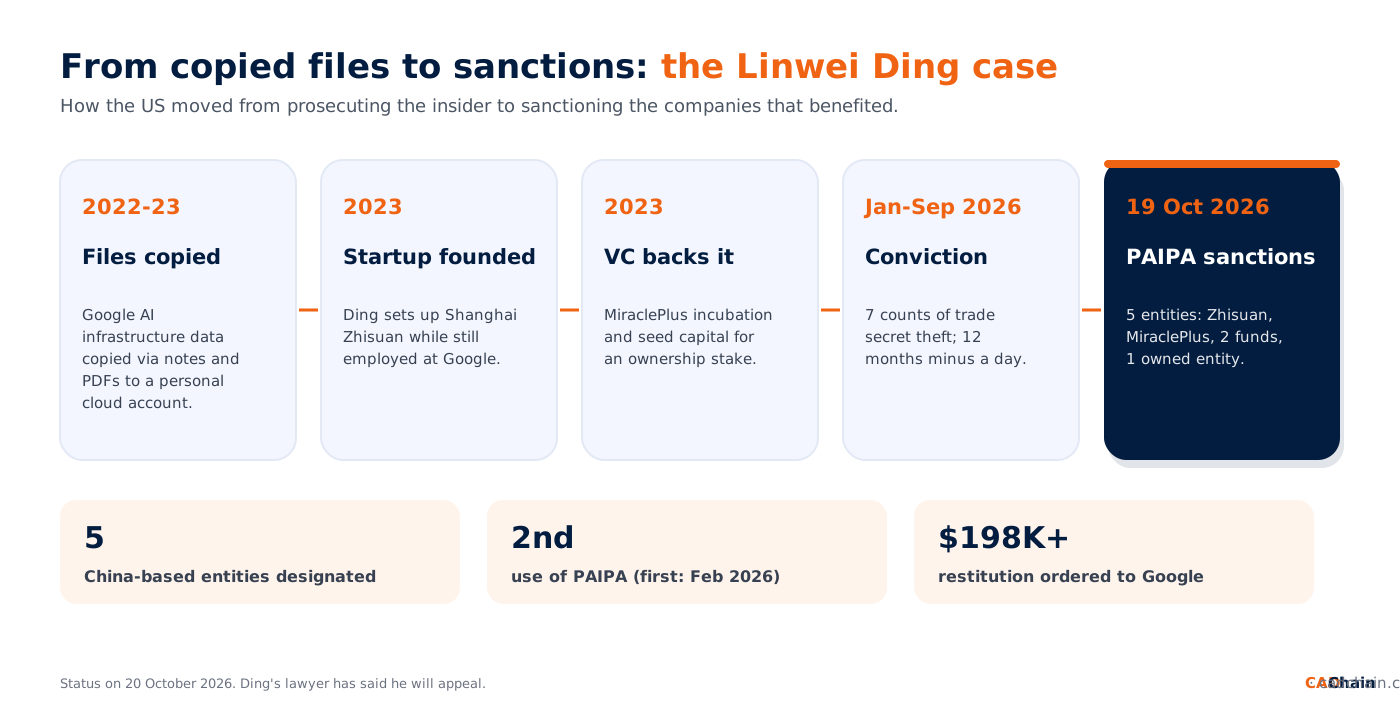
On 19 October 2026, the State Department designated Shanghai Zhisuan Technology (the startup Linwei Ding founded in 2023), the Beijing venture firm MiraclePlus, two MiraclePlus funds and an entity owned by one of them under the Protecting American Intellectual Property Act. A US jury convicted Ding on 29 January 2026 of seven counts of theft of trade secrets over thousands of pages of Google AI infrastructure information. The first PAIPA designations, in February 2026, targeted a Russian exploit broker. The lesson for engineering teams: trade secret theft now carries sanctions risk for the companies and investors that benefit, and the strength of your case still depends on how well you protected the files in the first place.
What did the State Department announce on 19 October 2026?
In a press statement, State Department spokesman Tommy Pigott said the department was sanctioning five entities connected to Ding under PAIPA in connection with the theft of trade secrets from US persons. He added: "This theft of trade secrets is a serious threat to U.S. economic, foreign policy, and national security interests." The statement says the designations follow an investigation of Ding by the Justice Department and the FBI.
The five designated entities, as listed in the State Department fact sheet, are:
- Shanghai Zhisuan Technology Co Ltd (Zhisuan), established by Ding in 2023 and marketed as able to build a software platform that accelerates machine learning workloads, including training large super intelligence models on supercomputing chips.
- Qiji Chuangtan Beijing Investment Management Co Ltd (MiraclePlus), a China-based venture capital firm that runs two startup camps a year and gave Zhisuan seed capital in exchange for an ownership stake.
- Beijing Qiji Chuangtan Phase I Venture Capital Center Limited Partnership, a fund managed by MiraclePlus, established in 2020.
- Beijing Qiji Chuangtan Phase II Venture Capital Center Limited Partnership, a second MiraclePlus fund, established in 2022.
- Beijing Qiji Chuangtan Zhiyuan Enterprise Management Center Limited Partnership, wholly owned by the Phase I fund.
According to the fact sheet, Ding applied to the MiraclePlus incubation programme on behalf of Zhisuan, pointing to his experience with Google's technology and internal systems and claiming that Zhisuan could replicate Google's AI infrastructure. The State Department says he then used the MiraclePlus stage to present Zhisuan and his ability to adapt that technology to China's national conditions.
What is PAIPA and why does this action matter?
The Protecting American Intellectual Property Act was signed into law in January 2023. It requires the US government to identify and sanction foreign persons that have knowingly engaged in, or benefited from, significant theft of trade secrets of US persons, where the theft threatens US national security, foreign policy or economic health. It also covers those who financially or materially supported the theft, and entities they own or control.
The first designations came on 24 February 2026, when the State Department, together with the Treasury, sanctioned one individual and two entities linked to Operation Zero, a Russia-based buyer of hacking tools. That action followed the guilty plea of an Australian national who stole proprietary cyber tools from a US company and sold them to Operation Zero for cryptocurrency.
The 19 October action is the second, and it is different in an important way. This time the targets are a startup and its investors: the company that hoped to commercialise the stolen know-how and the venture firm that funded it. The fact sheet uses the statute's own language. Zhisuan is described as having knowingly engaged in or benefited from significant theft of trade secrets, while MiraclePlus is described as having provided significant financial, material or technological support. The funds are included because MiraclePlus owns or controls them.
The fact sheet lists the sanctions that apply by their section numbers in the statute. According to news reports summarising them, they include an asset freeze, limits on loans from US financial institutions, bans on certain foreign exchange and banking transactions, and restrictions on US investment in the companies. The State Department notes that designated parties can apply for delisting.
Make your design files hard to copy in the first place. CADChain encrypts CAD files, controls who can open them, and logs every access, across CAD systems.
👉 See how CADChain works
How did the Google trade secret theft happen?
The case history is a textbook insider scenario. Ding joined Google in 2019 and worked on software for the infrastructure that lets Google's supercomputing data centres train large AI models. According to the Justice Department's 2024 charges, as reported by TechTarget, he copied data from Google source files into the Apple Notes app on his Google-issued MacBook, converted the notes to PDF files and uploaded them to a personal Google Cloud account. Prosecutors said this method helped him avoid detection by Google's data loss prevention systems. The indictment counted more than 500 unique files uploaded between May 2022 and May 2023.
Meanwhile, prosecutors said, Ding secretly affiliated himself with China-based technology companies and founded Zhisuan while still employed at Google. He also allegedly asked a colleague to scan his access badge so that he appeared to be working from a Google office while he was in China. He resigned in December 2023 and was arrested in March 2024 at his home in California.
In January 2026, a jury in San Francisco convicted him of seven counts of theft of trade secrets and seven counts of economic espionage. On 20 August 2026, the judge set aside the economic espionage convictions, finding that the evidence was not enough to prove that Ding intended to benefit the Chinese government. The trade secret convictions stand. On 1 September, he was sentenced to 12 months minus one day in prison, two years of supervised release and more than $198,000 in restitution to Google. Prosecutors had asked for 70 months, and his lawyer has said he will appeal.
One detail matters for every company that holds trade secrets. At trial, according to news reports, Ding's defence argued that Google had not done enough to protect the information and that documents available to thousands of employees could not be trade secrets. The jury did not accept that argument, but it shows where the fight happens in these cases: whether the owner took reasonable measures to keep the information secret. Our trade secrets guide for deep-tech startups explains why that test decides so many cases.
Why should deep-tech founders and investors care?
Founders who hire from big tech or competitors. A new hire who brings a former employer's files can turn your company into the beneficiary of theft. For foreign companies, the risk now includes sanctions, not only lawsuits. The Apple v. OpenAI trade secrets case shows how quickly a hiring decision becomes a court fight, even inside the United States.
Investors and incubators. MiraclePlus was sanctioned for supporting a startup whose pitch, according to the State Department, was built on replicating a former employer's technology. Investors who fund hardware and AI startups have a new reason to ask where the core technology came from, who owns it and what evidence supports that.
Companies whose engineers move on. If your design files, models or simulation data walk out with a departing engineer, sanctions will not get them back. Criminal cases take years, and in this one the sentence was a fraction of what prosecutors sought. Prevention and evidence are still your best defence. Our article on preventing CAD file exfiltration by former employees covers the practical steps.
How do the possible consequences of trade secret theft compare?
The Ding case shows several layers of consequences, each with a different target and timeline.
What does this mean for CAD and engineering data?
The stolen material in the Ding case was about AI chips and data centre software, not CAD models. But the method would work just as well on a drawing package or a 3D assembly. An engineer with legitimate access copied information into a format the company's tools did not watch, then moved it to a personal account. Network monitoring missed it until other signals appeared.
Engineering files are even easier to move. A STEP export, a PDF drawing set or a screen recording of a CAD session can leave the company without triggering anything. That is why perimeter tools and data loss prevention alone are not enough for design data. Protection has to travel with the file: encryption, per-file permissions, and a log of every open that holds up as evidence.
Evidence matters as much as prevention: dated records of who created a design, who accessed it and when. Our guide to audit trail requirements for IP litigation explains what that record should contain.
What should engineering teams do now?
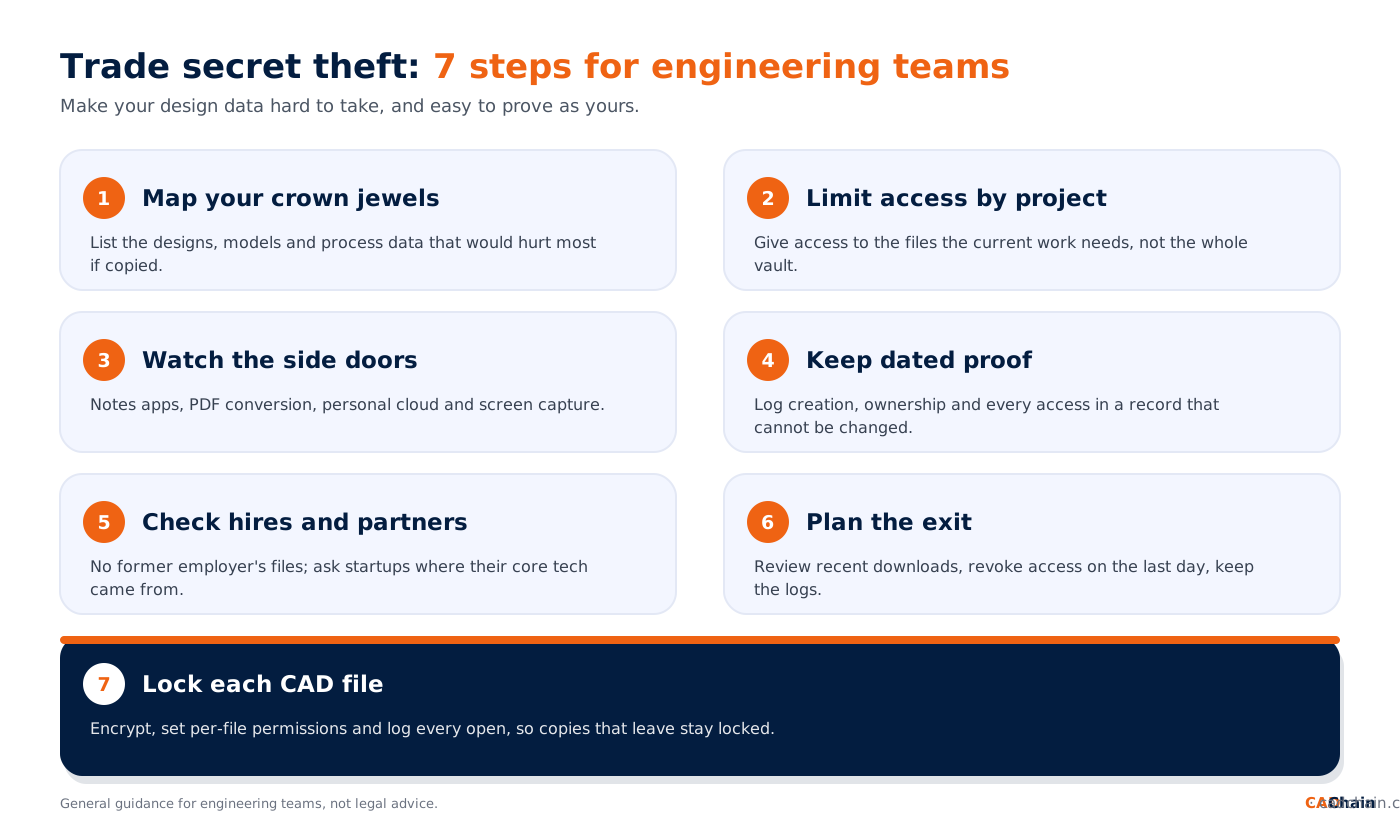
- Map your crown jewels. List the designs, models, source code and process data that would hurt most if a competitor had them, and where each one lives.
- Limit access by project. Give engineers access to the files their current work needs, not the whole vault, and review it when roles change.
- Watch the side doors. Note-taking apps, PDF conversion, personal cloud accounts and screen capture are the routes that ordinary monitoring misses.
- Protect at file level. Encrypt sensitive CAD files with per-file permissions, so a copy that leaves the network still cannot be opened without permission.
- Keep dated proof. Record creation, ownership and every access in a log that cannot be quietly changed. That record supports both trade secret claims and patent work.
- Check new hires and new partners. Ask new engineers to confirm they bring no former employer's files, and ask startups you invest in or buy from where their core technology came from.
- Plan the exit. When an engineer resigns, review recent downloads and uploads, revoke access on the last day and keep the logs.
For the full set of layers, from contracts to technical controls, see our 8-layer IP protection playbook for deep tech and hardware teams.
How does this connect to other recent cases?
October 2026 has been a busy month for insider and state-linked threats to engineering data. In early October, a federal jury in Florida awarded about $116.9 million in a case about drawings and 3D models, covered in our article on the Joby trade secret verdict. An OpenAI engineer was charged after a hidden recording device was found, which we covered in what the case teaches deep-tech teams about insider threats. The crackdown on North Korean remote IT workers showed how a fake hire gets the same legitimate access, and the advisory on China-linked hackers for hire targeting critical manufacturing described the outside route: stolen passwords instead of a job badge.
How does this fit the bigger picture?
Our sister sites covered other changes this week.
- AI agents with long-running tasks. Dassault Systèmes is presenting agentic Virtual Companions, including LEO for SOLIDWORKS, at NVIDIA GTC Berlin. Read what LEO agentic AI means for SOLIDWORKS users on solidboris.com.
- Unsupported operating systems. The first year of commercial Windows 10 Extended Security Updates ended on 13 October 2026, while Inventor 2027 needs Windows 11. Our sister site explains what the end of Windows 10 ESU Year 1 means for Inventor teams.
- AI and copyrighted characters. A new report found that every AI model it tested produced protected characters. Blended BORIS looks at the Midjourney copyright lawsuits and what they mean for 3D artists.
Conclusion
The 19 October sanctions mark a change in how the US responds to trade secret theft. Besides the employee who copied the files, the government has now designated the startup built on that knowledge and the venture firm that funded it.
But sanctions come after the damage is done, and they do not return a single file. The protections that work are the ones you set up before anyone leaves: limited access, file-level control and a reliable record that the design is yours. In the Ding case, the defence argued that the owner had not protected its information well enough. Make sure nobody can say that about yours.
Protect your designs before they leave the building. CADChain gives engineering teams file-level access control, access logs and blockchain proof of ownership for CAD files, across CAD systems.
👉 Protect your CAD files with CADChain
FAQ: PAIPA sanctions and trade secret theft
What did the US announce on 19 October 2026?
The State Department sanctioned five China-based entities connected to former Google engineer Linwei Ding under the Protecting American Intellectual Property Act: his startup Shanghai Zhisuan Technology, the venture firm MiraclePlus, two MiraclePlus funds and an entity owned by one of them.
What is PAIPA?
The Protecting American Intellectual Property Act, signed into law in January 2023, requires sanctions against foreign persons that have engaged in or benefited from significant theft of US trade secrets, and against those who supported them or are owned or controlled by them.
Is this the first time PAIPA has been used?
No. The first designations were made on 24 February 2026 against Operation Zero, a Russia-based buyer of hacking tools, and related parties. The October action is the second, and the first aimed at entities in China.
What was Linwei Ding convicted of?
A jury convicted him in January 2026 of seven counts of theft of trade secrets and seven counts of economic espionage. The judge later set aside the espionage counts. He was sentenced on 1 September 2026 to 12 months minus one day in prison and more than $198,000 in restitution.
Does PAIPA protect European companies?
No. PAIPA covers trade secrets of US persons. European companies rely on the EU Trade Secrets Directive and national law, which also require reasonable steps to keep information secret.
How does file-level CAD protection help against insider theft?
Encrypted CAD files with per-file permissions stay locked when copied, access can be revoked when someone leaves, and every open is logged, which gives you both prevention and evidence.