TL;DR: what are intellectual patent rights?
A patent is an intellectual property right that lets you stop others from making, using, selling or importing your invention, usually for up to 20 years from the filing date. In return, you publish exactly how the invention works. Patent rights are territorial: a European patent does not protect you in the US, and the other way round.
To get one, an invention must be new, inventive and industrially applicable, and you must file before you disclose it publicly. This guide explains what patent rights cover, the types of patents, how to file in Europe, the US and through the PCT, what it costs in 2026, who owns an invention, how to enforce and license a patent, and when a trade secret is the smarter choice.
Key takeaways
- A patent is a right to exclude, not a right to use. You can own a patent and still infringe someone else's.
- File before you pitch, publish or demo. Europe has no general grace period, so your own blog post or trade-show booth can destroy novelty.
- Your first filing sets a priority date. You then have 12 months to file abroad, or up to 30–31 months via the PCT.
- In Europe, the Unitary Patent covers 18 EU countries with one renewal fee, and the Unified Patent Court can enforce it in all of them at once.
- Ownership is not automatic for founders: get written assignments from co-founders, employees and contractors.
- Patents are expensive to get and enforce. For know-how that cannot be reverse-engineered, a well-protected trade secret can be the better option.
What are patent rights?
Patent rights are the exclusive rights a state grants to the owner of an invention. For a limited time, the owner can stop anyone else from making, using, offering for sale, selling or importing the patented product, or from using the patented process and selling what it directly produces. The deal is simple: the public gets a full description of the invention, and the inventor gets a temporary monopoly to earn back the investment.
"Intellectual patent rights" is not a legal term on its own. People use it to mean patents as one of the intellectual property rights, alongside trade secrets, copyright, design rights and trade marks. For the full picture of how these fit together, see our guide to intellectual property law.
What does a patent actually give you?
- The right to exclude: you can sue infringers, ask for an injunction, claim damages or an account of profits, and ask customs to seize infringing imports.
- An asset: you can sell, license or pledge a patent. Investors and acquirers count patents in due diligence.
- Not a right to use: a patent does not let you sell your own product if it also uses someone else's patented feature. That is why freedom-to-operate checks matter.
- Limited in time and place: normally 20 years from filing, and only in the countries where it is granted and kept in force.
How long do patent rights last?
A standard (utility) patent lasts up to 20 years from the filing date, provided you pay the renewal or maintenance fees. Medicines and plant protection products can get up to five extra years through a supplementary protection certificate (SPC) in Europe or a patent term extension in the US. US design patents last 15 years from grant, and utility models in countries such as Germany and China last 10 years. Once a patent expires or lapses, anyone may use the invention.
Types of patents and patent-like rights
What can be patented?
Almost any technical solution to a technical problem can be patented, from a sensor housing to a battery chemistry, a manufacturing process or a machine-learning method with a measurable technical effect. To be granted, an invention must pass four tests:
- Novelty: it was not disclosed anywhere in the world before your filing date, in any form, by anyone, including you.
- Inventive step (non-obviousness): it would not have been obvious to a skilled person in the field, given everything already known.
- Industrial application (utility): it can be made or used in some kind of industry.
- Sufficient disclosure: the application explains the invention well enough for a skilled person to carry it out.
What cannot be patented?
Under Article 52 of the European Patent Convention, discoveries, scientific theories, mathematical methods, aesthetic creations, business methods, presentations of information and computer programs are excluded as such. The words "as such" matter: software that produces a further technical effect, for example controlling a machine or making a computer process data more efficiently, can be patented in Europe. Methods of medical treatment and plant or animal varieties are also excluded.
In the US, laws of nature, natural phenomena and abstract ideas are excluded under the Supreme Court's Alice test. The USPTO has recently become friendlier to software and AI claims: in late 2025 it designated Ex parte Desjardins as precedential, confirming that a concrete improvement to how a machine-learning model works is not an abstract idea. Courts still apply Alice, and the Patent Eligibility Restoration Act (PERA) introduced in May 2025 had not become law at the time of writing.
Can AI be named as an inventor?
No. Patent offices and courts in the UK, EU and US have all rejected AI systems as inventors, most famously in the DABUS cases. In November 2025 the USPTO replaced its 2024 guidance and now treats AI as a tool, like lab equipment: a human who conceives the invention using AI is the inventor. For deep-tech teams this means documenting who came up with each inventive idea and how AI tools were used. More on this in generative AI and CAD IP.
Patents vs other intellectual property rights
Patents are only one tool. Most hardware and deep-tech companies combine several rights, and choose for each piece of know-how which one fits best.
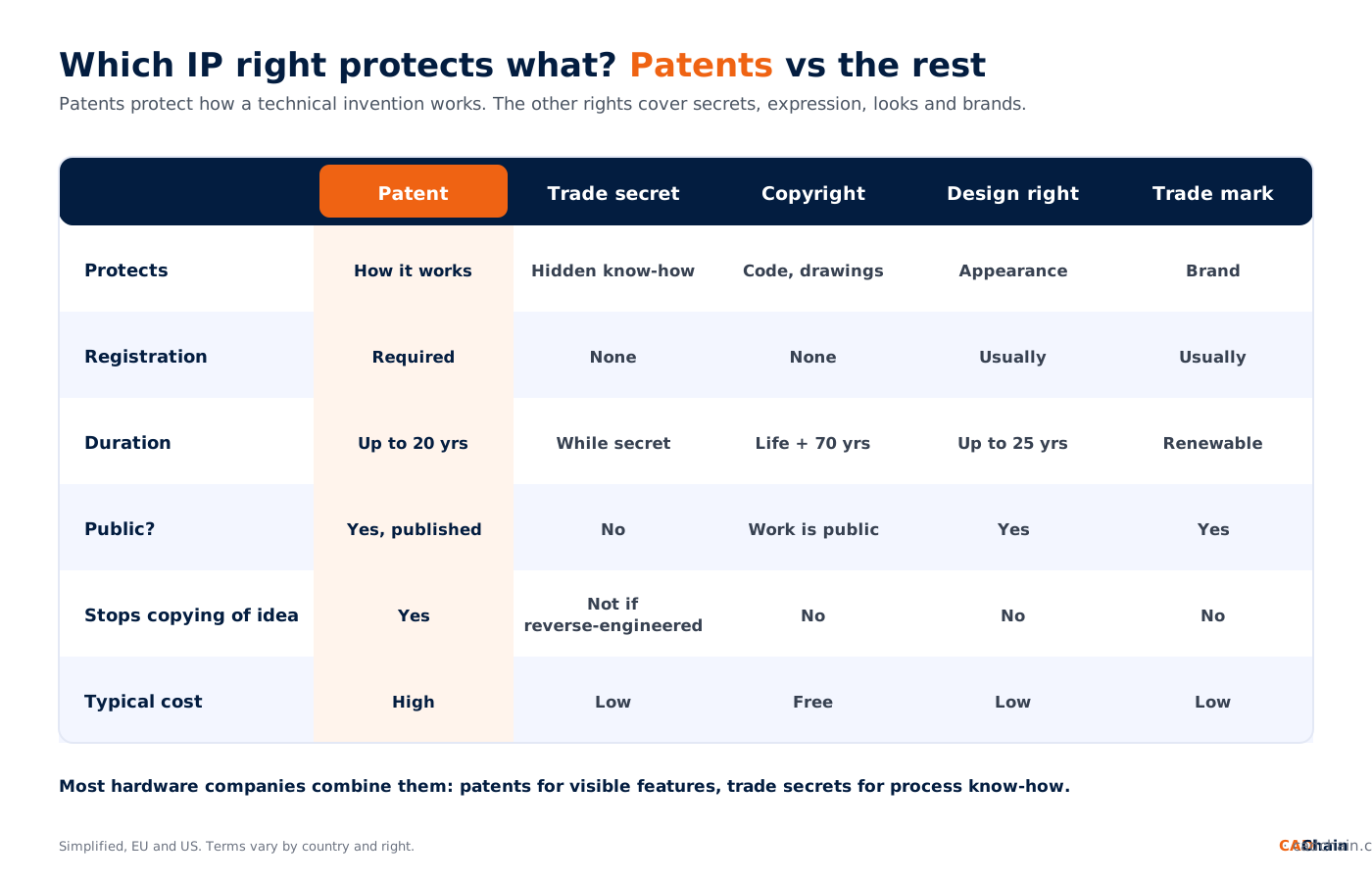
For a deeper comparison, read our trade secrets guide and trade secrets vs patents for CAD designs.
How to get a patent: step by step
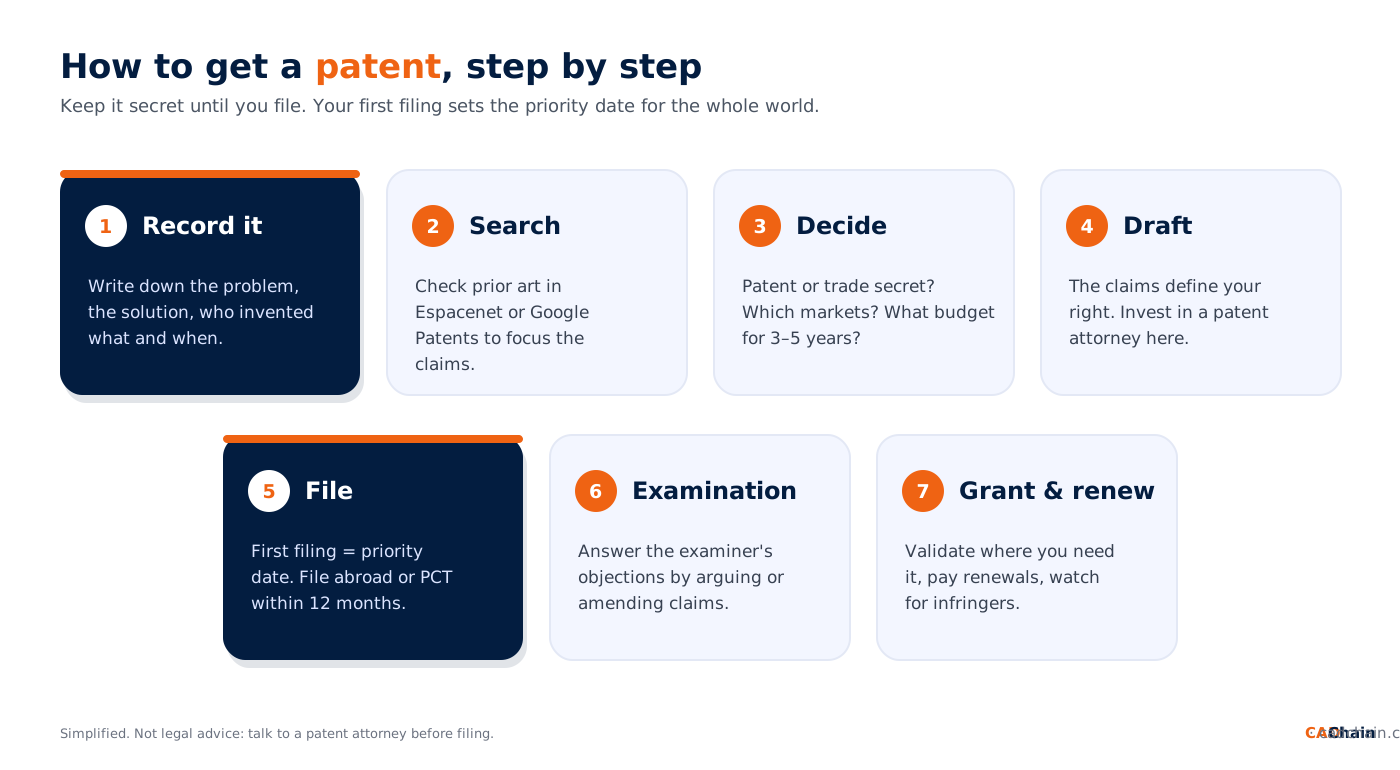
- Record the invention. Write down what the problem was, how you solved it, who contributed which idea, and when. Keep dated CAD versions, test results and lab notes.
- Keep it confidential. Do not publish, pitch publicly, post on social media or show it at a fair before filing. Use NDAs for necessary disclosures, knowing their limits.
- Search the prior art. Free databases such as Espacenet and Google Patents show whether something similar exists and help you focus the claims.
- Decide the strategy. Which features to patent, which to keep secret, which markets matter, and what the budget is over the next 3–5 years.
- Draft the application. The claims define your right. A patent attorney's drafting is usually the largest cost, and the best investment.
- File and claim priority. Your first filing sets the priority date. Within 12 months, file abroad or a PCT application that claims it.
- Examination and grant. The office searches, objects, and you amend or argue. Once granted, validate the patent in the countries you need and pay renewals.
Patent timeline: from first filing to national phase
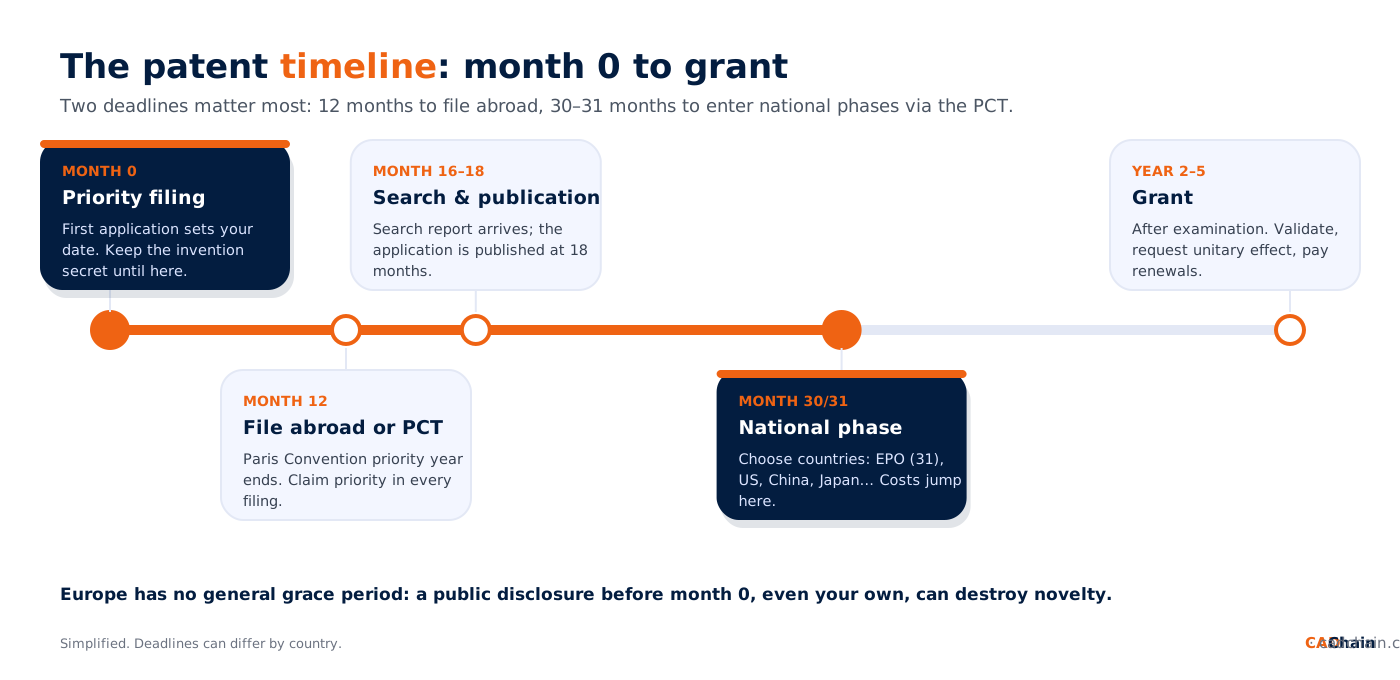
Under the Paris Convention, you have 12 months from your first filing to file in other countries and keep the same priority date. The Patent Cooperation Treaty (PCT) lets you file one international application, covering more than 150 countries, and delay the choice of countries until month 30 (31 at the EPO). The application is published at month 18. Grant usually takes 2–5 years, depending on the office and how often you need to respond.
Grace periods: why Europe is strict
The European Patent Office applies absolute novelty: any public disclosure before the filing date, including your own, can be used against you. The only exceptions are very narrow (evident abuse and certain official exhibitions). The US gives inventors a 12-month grace period for their own disclosures, and Japan and Korea have similar rules, but relying on them loses you Europe. The safe rule: file first, talk later.
Where to file: national, European, Unitary or PCT?
The Unitary Patent started on 1 June 2023 and is gaining ground fast: in 2025, 28.7% of European patents granted were turned into Unitary Patents, and the rate among SMEs, universities and research bodies reached 48.3%. Countries such as Spain and Poland are outside the system, and Ireland has not yet ratified, so you still validate there separately. Our overview of IP laws by country compares the main jurisdictions.
How much does a patent cost in 2026?
Official fees are only part of the cost. Attorney fees for drafting and responding to examiners, translations and renewals usually add up to much more over the life of a patent. Typical official fees in 2026:
EPO fees rose by about 5% on 1 April 2026; check the EPO and USPTO fee schedules before you budget. EU-based SMEs can claim back part of the cost through the EUIPO SME Fund: in 2026 it reimburses 75% of EPO filing and search fees (up to €1,000) and 50% of the legal costs of a European application (up to €1,500), while funds last.
Patent box: lower tax on patent income
Many countries tax profits from patented inventions at a reduced rate, for example the Dutch innovation box (9%) and the UK patent box (10%). For a deep-tech company with licensing or product revenue, this can change the business case for patenting.
Who owns a patent? Inventors, employers and founders
The inventor is whoever conceived the inventive idea. The owner is often someone else, and getting this wrong is one of the most common problems investors find in due diligence.
- Employees: in most of Europe, inventions made in the course of normal duties belong to the employer (for example under the Dutch Patents Act and the UK Patents Act 1977). Under Germany's Employee Inventions Act the employee must report the invention, the employer can claim it, and the employee is entitled to reasonable compensation.
- United States: employees own their inventions unless they assign them. Use a present assignment ("hereby assign") in employment contracts; a promise to assign in the future was not enough in Stanford v. Roche (2011).
- Contractors and freelancers: they usually own what they invent unless the contract assigns it to you. This includes CAD designers and engineering agencies.
- Co-founders: ideas developed before the company existed belong to the founders personally. Assign them to the company at incorporation.
- Universities: research spin-outs usually license or buy patents from the university's technology transfer office.
Ownership disputes are decided on evidence: who created what, and when. Read CAD file ownership: legal proof and documentation for what that evidence looks like in practice.
How to use and enforce patent rights
Licensing and selling
A licence lets someone use your invention in return for royalties or a fee, exclusively or non-exclusively, worldwide or per territory or field. Many deep-tech startups earn their first revenue this way. Patents can also be sold, pledged as security, or pooled with others. Standard-essential patents must be licensed on fair, reasonable and non-discriminatory (FRAND) terms; the EU withdrew its proposed SEP Regulation in February 2025. For how to value patents and other IP, and use them to raise finance, see our guide to intellectual property as a business asset.
Freedom to operate
Before you launch a product, check that it does not infringe someone else's patents in your target markets. A freedom-to-operate (FTO) search focuses on granted and pending claims in force in those countries, and is separate from the novelty search you do before filing.
Infringement and enforcement
If someone uses your patented invention without permission, you can send a warning letter, negotiate a licence, or sue for an injunction and damages. In Europe, the Unified Patent Court can grant an injunction covering all 18 Unitary Patent countries in one case, usually within about a year. Hundreds of infringement actions have been filed there since 2023, most of them in the German local divisions. In the US, cases go to federal district courts or the International Trade Commission.
Expect a counter-attack on validity: competitors can file an opposition at the EPO within nine months of grant, a revocation action at the UPC, or an inter partes review at the USPTO. Strong evidence and well-kept records help on both sides. See blockchain evidence in IP litigation and audit trails for IP litigation.
Limits on patent rights
- Prior user rights: someone who was already using the invention in good faith before your filing date may be allowed to continue, in that country.
- Research and experimental use: many countries allow use for experiments on the invention itself.
- Exhaustion: once you sell a patented product in the EEA, you cannot control its resale there.
- Compulsory licences: governments can force a licence in special cases. The EU adopted a Union-wide compulsory licensing regulation for crises (Regulation 2025/2645) in December 2025.
Patent or trade secret? A strategy for deep-tech startups
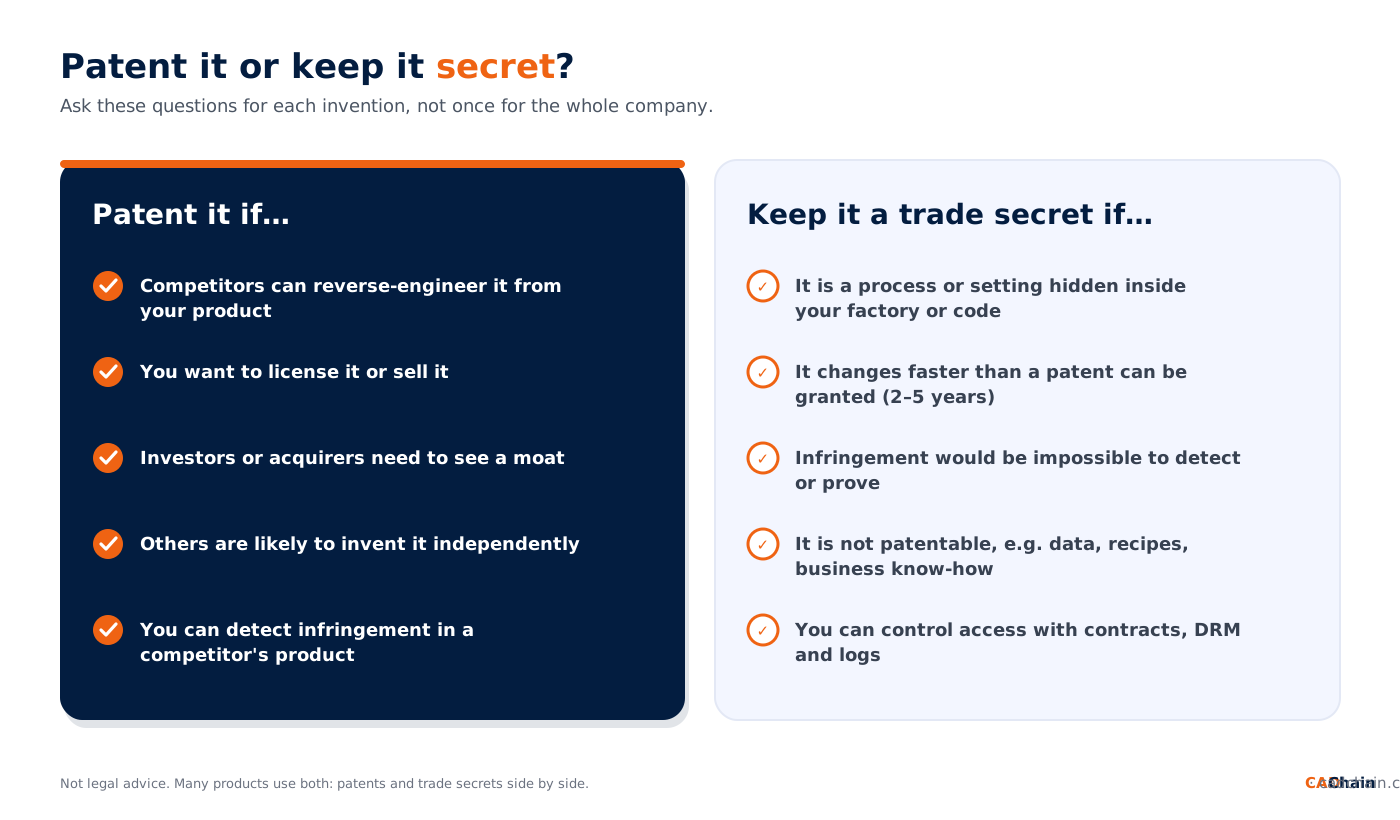
Patent the inventions competitors could copy by taking your product apart, the ones you want to license, and the ones investors will ask about. Keep as trade secrets the know-how that stays invisible in the product, such as process parameters, tuning data and supplier settings, and anything that changes faster than a patent can be granted. Startups that apply for patents or trade marks early are up to 10.2 times more likely to secure funding, according to an EPO and EUIPO study, and SMEs that own IP rights earn 44% more revenue per employee.
Common patent mistakes founders make
- Publishing or pitching before filing, which kills novelty in Europe.
- Filing a rushed, thin application that cannot support strong claims later.
- Missing the 12-month priority deadline or the 30-month PCT deadline.
- Forgetting assignments from co-founders, students, contractors or the university.
- Patenting what nobody will copy, and leaving the real know-how unprotected.
- Not budgeting for renewals, translations and enforcement.
Patents are one layer of a wider plan; our IP protection playbook shows how they fit with secrecy, contracts, access control and evidence.
Patents, CAD files and proof of invention
For hardware teams, the invention lives in CAD models, drawings and simulation files long before anyone writes a patent claim. Those files matter in three ways:
- Before filing: they must stay confidential. A model sent to a supplier without protection can become prior art or a copy. Digital rights management (DRM) keeps control after the file is shared.
- Proving who invented what: dated version histories show which engineer created which feature, which settles inventorship and entitlement disputes. See using DRM audit trails as patent evidence.
- Defending yourself: if a competitor patents something you were already using, tamper-proof records of your earlier designs support a prior-use defence or an invalidity attack.
BORIS by CADChain protects the designs behind your patents inside your CAD software. Every version gets a blockchain-timestamped certificate of ownership, so you can prove what you created and when, and DRM controls who can open, edit and share each file with suppliers before and after you file.
👉 See how BORIS protects your CAD designs
For more on the design-file side, read protecting CAD intellectual property.
Patent statistics (2026)
Demand keeps growing on both sides of the Atlantic: the EPO Technology Dashboard 2025 and WIPO's World Intellectual Property Indicators 2025 both show record filings, led by computer technology and digital communication.
Conclusion
Patent rights give you a strong but temporary monopoly in exchange for telling the world how your invention works. For deep-tech and hardware companies they are worth it when competitors could otherwise copy your product, when you want to license, and when investors need to see a moat. The rules that matter most are simple: keep the invention secret until you file, secure ownership in writing, mind the 12- and 30-month deadlines, and keep dated evidence of your design work. Combine patents with trade secrets and file-level protection, and your know-how is covered whether it is published or not.
This is general information, not legal advice. Talk to a qualified patent attorney before filing.
This is general information, not legal advice. Talk to a qualified patent attorney before filing.
FAQ: intellectual patent rights
What are intellectual patent rights?
Patent rights are the intellectual property rights that let the owner of an invention stop others from making, using, selling or importing it, normally for up to 20 years from filing, in the countries where the patent is granted.
What are the 3 requirements for a patent?
The invention must be new, involve an inventive step (be non-obvious), and be capable of industrial application. The application must also describe it clearly enough for a skilled person to carry it out.
How long does a patent last?
Up to 20 years from the filing date for utility patents, if renewal fees are paid. US design patents last 15 years from grant, and utility models usually 10 years.
How much does it cost to get a patent?
Official fees start at about $2,000 at the USPTO (less for small and micro entities) and several thousand euros at the EPO through to grant. Attorney fees, translations and renewals usually cost more than the official fees.
Can I patent an idea?
No. You can patent a concrete technical solution that is described well enough to be carried out, not an abstract idea, business concept or scientific discovery.
Is there a worldwide patent?
No. Patents are national or regional. A PCT application lets you file once and keep options open in more than 150 countries for up to 30 or 31 months, but each country still grants its own patent.
What is the difference between a patent and a trade secret?
A patent is public and protects the invention for up to 20 years even against independent inventors. A trade secret stays confidential and lasts as long as it is kept secret, but it gives no protection against reverse engineering or independent discovery.
Can I talk about my invention before filing a patent?
Only under a confidentiality agreement. Public disclosure before filing can destroy novelty, especially in Europe, which has no general grace period.
Can software be patented?
In Europe, software is patentable when it has a further technical effect beyond normal computer operation. In the US, software claims must pass the Alice test; claims to concrete technical improvements are more likely to be allowed.
Who owns a patent made by an employee?
In most European countries the employer owns inventions made in the course of the employee's normal duties, sometimes with a right to compensation. In the US you need a written assignment.
What is the Unitary Patent?
A European patent with unitary effect in 18 EU countries, granted by the EPO since June 2023. It has one renewal fee and is enforced at the Unified Patent Court.
Can an AI system be an inventor?
No. Only natural persons can be inventors in Europe, the UK and the US. A person who conceives an invention with the help of AI tools can be named as the inventor.