TL;DR: what are intellectual property rights?
Intellectual property rights (IPRs) are legal rights that let the owner of an invention, creative work, design, brand or trade secret stop others from using it without permission, for a limited time and in a limited territory. The main types are patents, copyright, trademarks, design rights and trade secrets, plus specialist rights such as database rights and plant variety rights.
Most guides stop at the list. This one looks at IP rights from the owner's side: what each right actually lets you stop, what it cannot stop (reverse engineering, independent creation, resale, repairs, research use), who holds the rights by default, and how rights move through assignments, licences and joint projects.
Key takeaways
- An IP right is a right to exclude, not a right to use. A patent lets you stop others; it does not guarantee you can sell your own product.
- Each right covers a different list of acts: copying for copyright, making and selling for patents, confusing use of a sign for trademarks, unlawful acquisition for trade secrets.
- Every right has built-in limits. Trade secrets do not stop reverse engineering, copyright does not stop independent creation, and no right stops the resale of genuine goods.
- Default ownership rules often favour the creator, not the company. Joint ownership is risky, and the rules differ sharply between the US, the UK and Germany.
- Rights become money when they move: assignments and licences. The EU's new technology licensing rules (Regulation 2026/877) apply from 1 May 2026 to 2038.
What are intellectual property rights?
Intellectual property rights are the legal rights given to people and companies over the creations of their minds. They usually give the owner an exclusive right to use the creation for a set period, and the power to stop others from doing so without permission. The Universal Declaration of Human Rights recognises the protection of the moral and material interests of authors and inventors (Article 27), and the WTO's TRIPS Agreement sets minimum standards for IP rights in every WTO member.
For a business, intellectual property rights are what turn knowledge into something you can own, license, sell and enforce. Without them, an invention, a CAD model or a brand can be copied by anyone the moment it becomes visible. For the legal system behind these rights, see our guide to intellectual property law; for the business side, see intellectual property as a business asset.
IP rights in simple terms: a fence, not a key
The easiest way to understand an IP right is as a fence around your creation. It marks out an area and lets you keep others out. It does not give you a key to anything: a patent on your improved drone motor does not let you sell the drone if someone else owns a patent on its battery system. That is why companies check their freedom to operate as well as their own rights.
Economic rights and moral rights
IP rights have two sides. Economic rights let you make money from a creation by controlling copying, sales, licensing and use. Moral rights, which exist for authors under copyright, protect the personal link between creator and work: the right to be named as author and to object to distorting changes. In much of the EU, moral rights stay with the author and cannot be transferred, even when the economic rights are sold.
Types of intellectual property rights
These rights are used on a huge scale. According to WIPO's IP Facts and Figures 2025, 3.7 million patent applications were filed worldwide in 2024, 19.7 million patents were in force and 93.2 million trademark registrations were active. For two of these rights in depth, read our guides to patent rights and trade secrets.
Examples of intellectual property rights in one product
Intellectual property rights rarely work alone. Take a connected industrial sensor developed by a hardware startup. One product can carry six different rights at the same time:
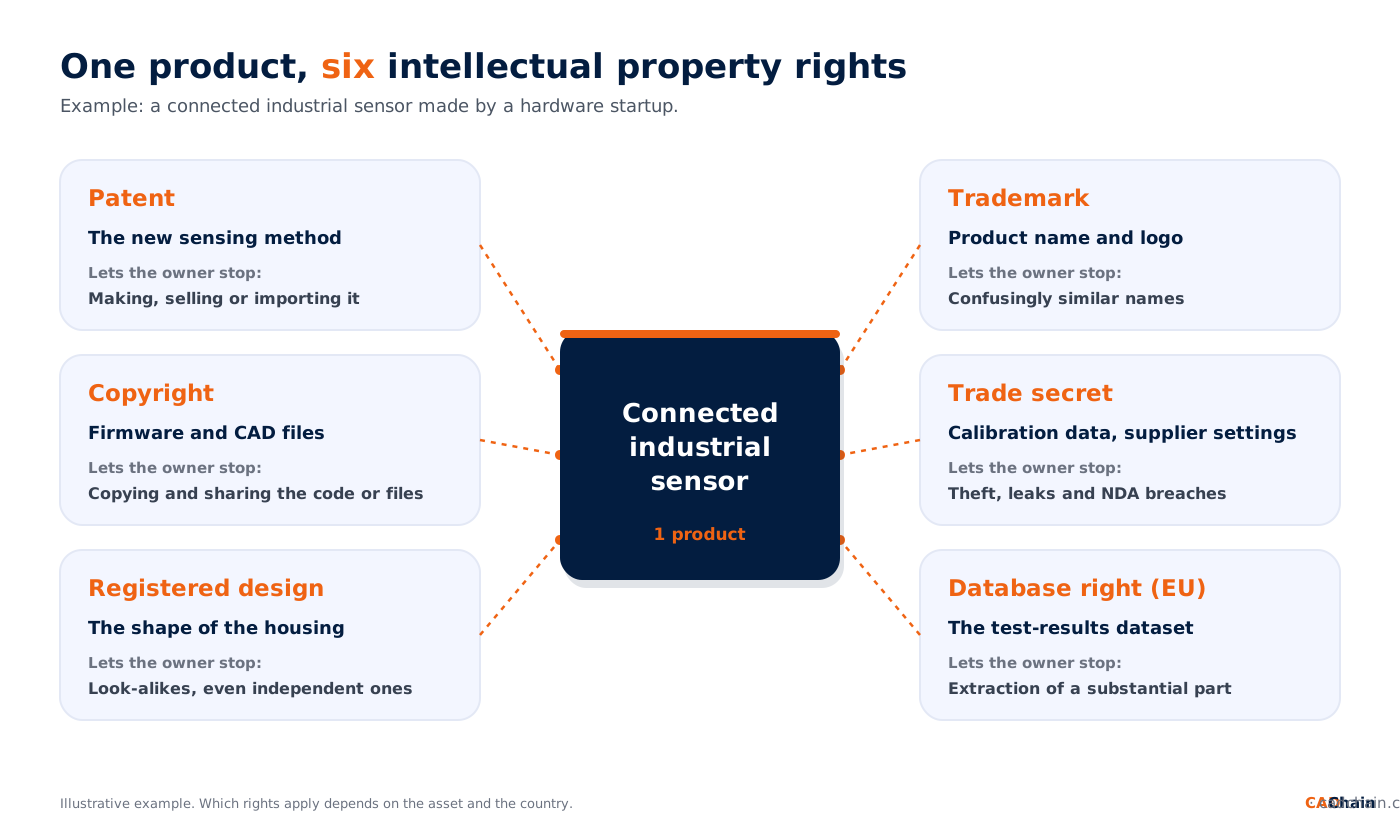
This stacking is why strong IP positions are built per asset, not per product. The trade secrets vs patents decision for CAD designs is usually the first choice to make.
What each intellectual property right lets you do
Every right comes with its own list of exclusive acts. Knowing the list tells you what counts as infringement, and what does not.
Patent rights
A patent lets the owner stop others from making, offering, selling, using, importing or stocking the patented product, and from using a patented process or selling its direct product. In Europe the Unified Patent Court Agreement also covers indirect infringement: supplying key components to someone who will use them to put the invention into effect. Patents work even against a competitor who invented the same thing independently.
Copyright
Copyright lets the author or owner control reproduction, distribution and communication to the public, including making a work available online, plus adaptation of software. It protects the expression, not the idea: the CAD file and the code are protected, but the function of the part and the algorithm behind the code are not. Independent creation of a similar work is not infringement.
Trademark rights
A registered trademark lets the owner stop others from using an identical sign for identical goods, or a similar sign where customers could be confused. Marks with a reputation get wider protection against free-riding and dilution. Trademarks protect the brand, not the product: a competitor can sell the same product under a different name.
Design rights
A registered design lets the owner stop making, offering, marketing, importing, exporting or using any product with the same overall impression. Since the EU design reform of May 2025, this also covers creating, downloading, sharing or distributing a file that lets someone 3D-print the design, which matters for any company that shares CAD data. An unregistered EU design only protects against deliberate copying, for three years.
Trade secret rights
Trade secret law does not give exclusive ownership. Under the EU Trade Secrets Directive, it lets the holder act against unlawful acquisition, use or disclosure: theft, breach of an NDA, or use by someone who knew the information was taken. It can also stop the sale of goods that significantly benefit from a misused secret.
What intellectual property rights cannot stop
This is where owners get caught out. Every IP right has exceptions written into the law, and some of the most common business situations fall inside them.
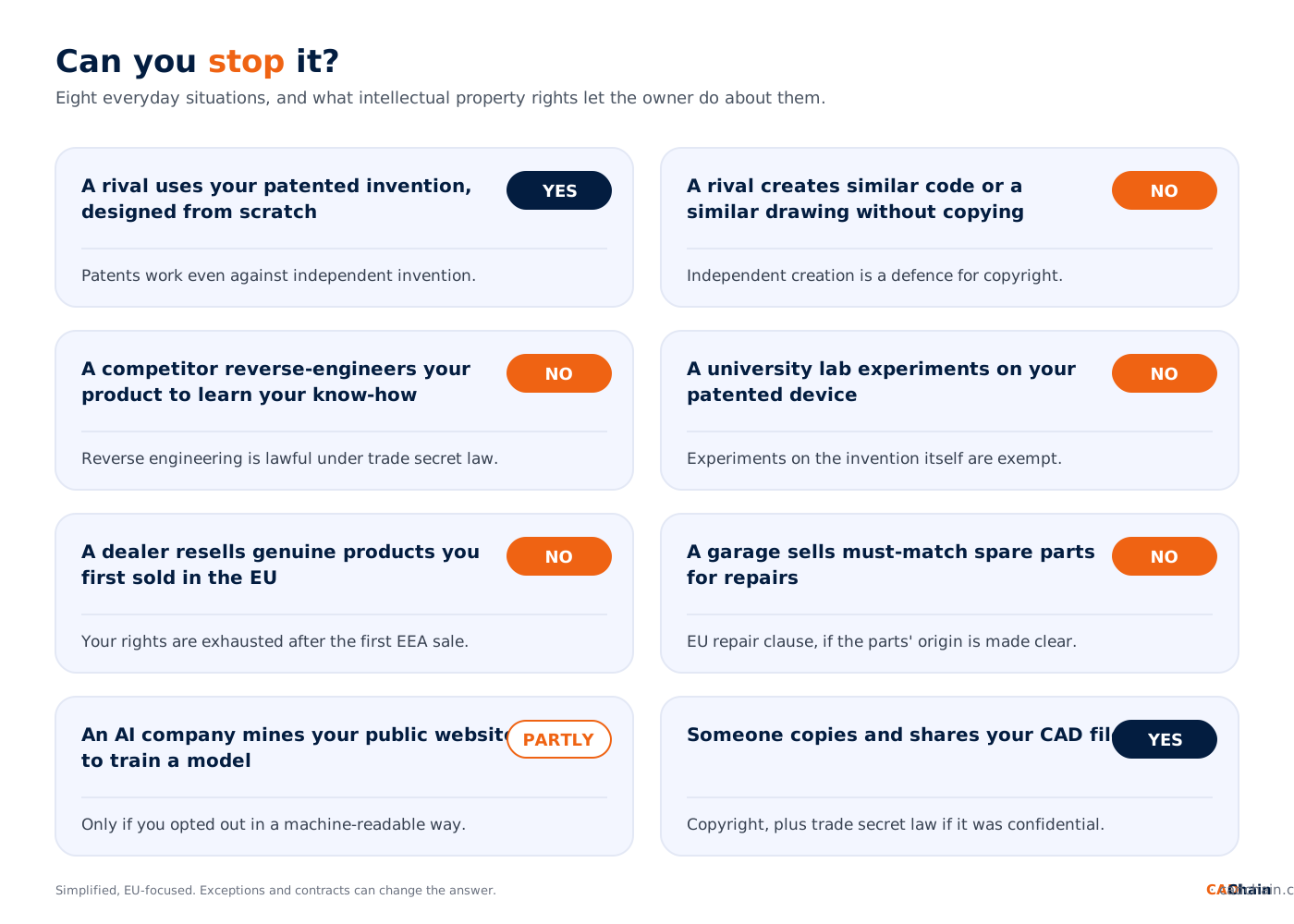
The main exceptions, right by right
- Patents: private non-commercial use, experiments on the invention, regulatory testing for medicines (Bolar), breeding, and prior use by someone who was already using the invention before your filing date. The limits are listed in Article 27 of the UPC Agreement. Governments can also grant compulsory licences, and the EU adopted a Union-wide crisis compulsory licensing regulation in December 2025.
- Copyright: the EU has a closed list of exceptions (quotation, teaching, private copying in many countries, text and data mining). The US uses a flexible four-factor fair use test instead. For software, users may decompile code where needed for interoperability, and the functionality of a program is not protected.
- Trademarks: others may use your mark honestly to describe their own goods, for example "compatible with" or "spare part for", and may use their own name or descriptive terms. They may not suggest a commercial link that does not exist.
- Designs: private, experimental and teaching uses are free, and the reformed EU law adds referential use, comment, critique and parody. Member states must put the repair clause into national design law by 9 December 2027, with a transition until 2032 for older designs.
- Trade secrets: independent discovery, reverse engineering of a product on the market, and use of general skills and experience by former employees are all lawful.
Two practical lessons follow. First, decide early which right fits each asset: a process that can be reverse-engineered from the product is a poor trade secret. Second, use contracts and technical controls to close the gaps the law leaves open. Our IP protection playbook shows how to layer them.
Who owns intellectual property rights?
The law gives IP rights to the creator first, then shifts them to employers and buyers through statute and contract. Getting this wrong is the most common problem investors find in due diligence.
Ownership disputes are decided on evidence of who created what and when. See CAD file ownership: legal proof and documentation and employee IP agreements for CAD teams.
Joint ownership: the default trap
When two parties own the same patent without a written agreement, national default rules decide who can do what, and they differ sharply:
A US co-owner can license your joint patent to your biggest competitor; a UK co-owner can block every licence you want to grant. Avoid joint ownership where you can, for example by splitting results by field or by giving one party ownership and the other a licence. Where you cannot, sign a joint ownership agreement covering use, licensing, costs, enforcement and exit.
How IP rights move: assignments and licences
IP rights create value when they move to someone who can use them. There are two basic tools: an assignment transfers ownership, and a licence gives permission to use while the owner keeps title.
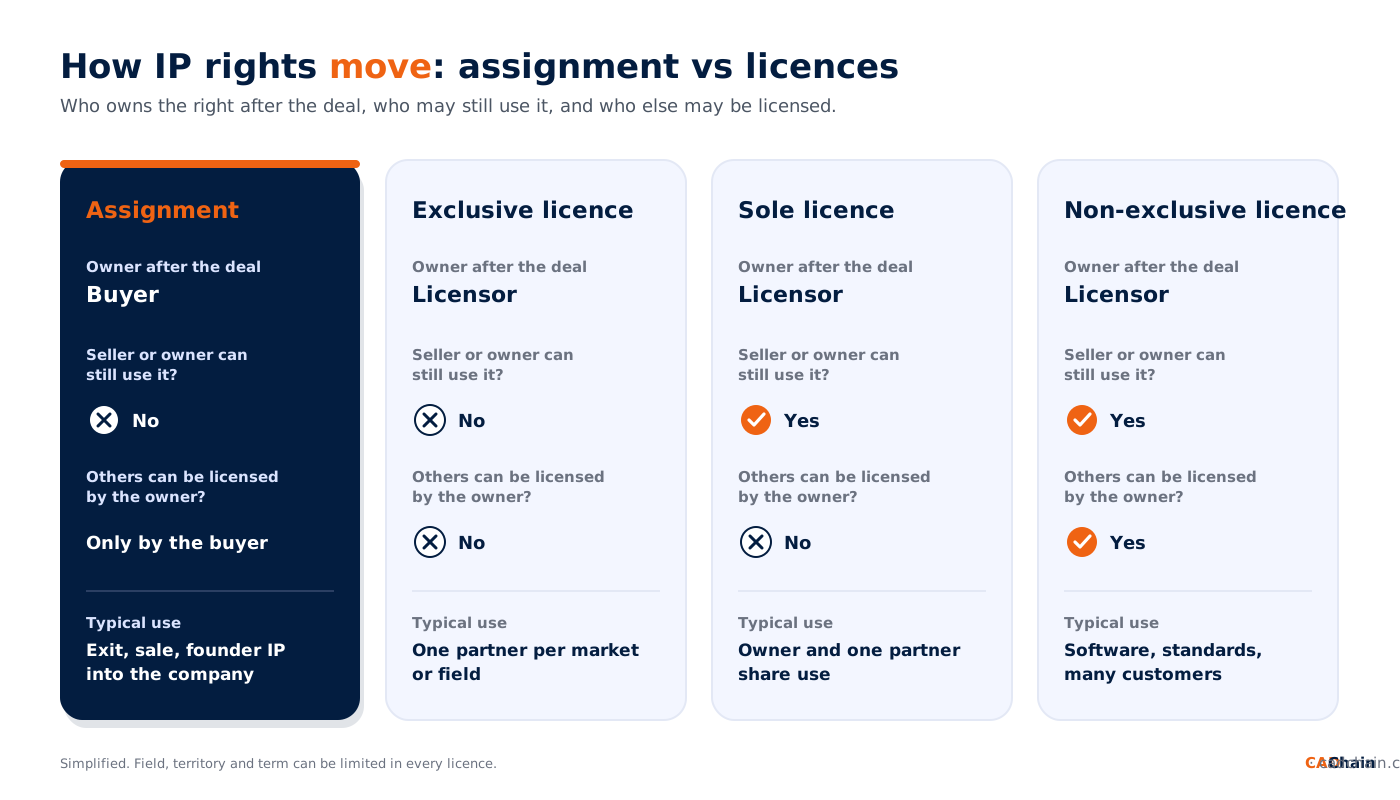
Assignments of registered rights should be recorded at the patent or trademark office, and in many countries they must be in writing and signed. Exclusive licensees can often sue infringers themselves; non-exclusive licensees usually cannot.
EU licensing rules in 2026
Licences can restrict competition, so EU competition law applies to them. The Commission adopted a revised Technology Transfer Block Exemption Regulation (EU) 2026/877 in April 2026. It applies from 1 May 2026 until 30 April 2038 and gives a safe harbour to patent, know-how, design and software copyright licences between companies below set market shares: 20% combined for competitors and 30% each for non-competitors. Price fixing and certain market-sharing clauses are never covered, and exclusive grant-backs and no-challenge clauses must be assessed on their own. New guidance covers data licensing and licensing negotiation groups. Agreements that met the old rules have until 30 April 2027 to comply.
What to put in an IP licence
- Scope: which rights, which products, which field of use, which territory, exclusive or not.
- Money: upfront fee, royalty rate and base, minimums, audit rights.
- Improvements: who owns improvements each side makes, and whether they are licensed back.
- Enforcement: who may sue infringers, who pays and who keeps damages.
- Confidentiality and security: how know-how and files are shared, stored and returned.
- Term and termination: duration, change of control, insolvency, and what happens to stock and files at the end.
IP rights in collaborations and EU-funded projects
Joint development, supplier projects and EU grants are where IP rights most often get tangled. The standard vocabulary helps:
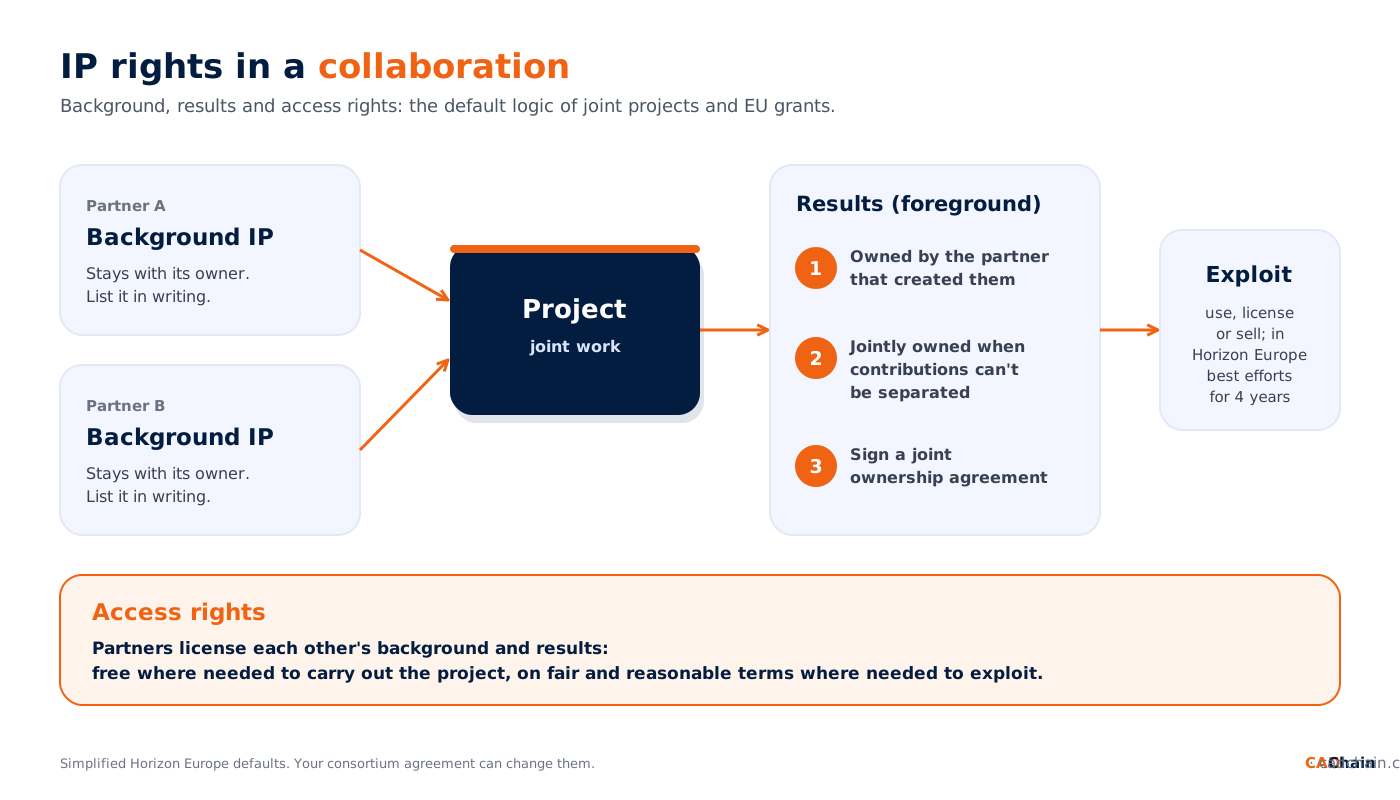
- Background IP: what each party brings into the project. It stays with its owner, and the parties list it in writing.
- Foreground IP or results: what is created during the project.
- Access rights: licences the partners give each other to use background and results, either to carry out the project or to exploit the results afterwards.
Horizon Europe sets clear defaults. Results belong to the beneficiary that generated them, and are jointly owned when contributions cannot be separated. Partners must grant each other access rights: free of charge where needed to carry out the project, and on fair and reasonable terms where needed to exploit their own results. Beneficiaries must use their best efforts to exploit their results for up to four years after the project ends, and some calls let the funding body object to transfers or exclusive licences outside the EU. The consortium agreement is where startups protect their position: list your background carefully, exclude what you do not want to share, and agree on joint ownership terms.
Supplier and customer projects need the same discipline. Before you send drawings for a request for quotation, agree who owns tooling, design changes and improvements, and limit what the supplier may do with your files. The limits of NDAs for CAD protection explain why a contract alone is rarely enough.
How to get, keep and enforce IP rights
IP rights are territorial, so you need protection in each market that matters. Our overview of IP protection laws by country compares the main jurisdictions. When it comes to enforcement, the party with the better records usually wins: see blockchain evidence in IP litigation and legal steps after CAD theft.
IP rights and AI
AI changes who can hold rights, not what rights exist. Only humans can be inventors or authors in the EU, the UK and the US, so record the human contribution to AI-assisted designs and code. Under the EU AI Act, general-purpose AI providers must respect text and data mining opt-outs and publish a summary of their training content. More in generative AI and CAD IP.
Intellectual property rights in CAD files and engineering data
A CAD model is a dense bundle of IP rights: copyright in the file, design rights in the shape it describes, patents on the mechanism, and trade secrets in tolerances, materials and process notes. That bundle is only as strong as two things: proof that you created it, and control over who uses it.
Licence terms on paper say what a supplier may do with your files. Digital rights management (DRM) turns those terms into technical rules: view-only access for vendors, time-limited sharing and the ability to revoke access to CAD files when a project ends. That is the difference between holding a right and being able to exercise it.
BORIS by CADChain protects the IP rights in your CAD designs from inside your CAD software. Every design version gets a blockchain-timestamped certificate of ownership, so you can prove authorship and the date of creation, and DRM lets you share files under the exact rights you grant: view, edit, time limit or revoke.
👉 See how BORIS protects your CAD designs
Intellectual property rights statistics (2026)
Conclusion
Intellectual property rights are not trophies; they are tools with a precise scope. Each one lets you stop certain acts and leaves others free. Know which right covers which asset, what it can and cannot stop, and who really owns it. Then make your rights move: license them, share them under control in collaborations, and keep the evidence that lets you enforce them. That is how IP rights turn into protection and revenue rather than paperwork.
This is general information, not legal advice. Talk to a patent attorney or IP lawyer about your specific situation.
This is general information, not legal advice. Talk to a patent attorney or IP lawyer about your specific situation.
FAQ: intellectual property rights
What are intellectual property rights in simple words?
They are legal rights that let you stop others from using your inventions, creative works, designs, brands or confidential know-how without permission, for a limited time and in the countries where the rights apply.
What are the main types of intellectual property rights?
Patents, copyright, trademarks, design rights and trade secrets. Utility models, database rights, plant variety rights, geographical indications and chip topography rights are more specialised.
What are examples of intellectual property rights?
A patent on a sensing method, copyright in firmware or a CAD model, a registered design for a product's housing, a trademark for a product name, and a trade secret for calibration data.
What is the difference between intellectual property and intellectual property rights?
Intellectual property is the creation itself, such as an invention or a brand. Intellectual property rights are the legal titles that protect it, such as a patent or a trademark registration.
Do IP rights let me use my own invention?
Not necessarily. An IP right lets you exclude others. Your product may still infringe someone else's rights, which is why freedom-to-operate checks exist.
Can someone legally copy my product?
Sometimes. Reverse engineering is lawful for trade secrets, independent creation is lawful for copyright, and anything not covered by a valid right in that country can be copied.
Who owns IP created by a contractor?
Usually the contractor, unless a written agreement assigns the rights to you. Paying for the work is not enough.
What is the difference between a licence and an assignment?
An assignment transfers ownership of the right. A licence only gives permission to use it, while the owner keeps title.
What happens to IP rights in a joint project?
Each partner usually keeps its background IP and owns the results it creates. Results created together may be jointly owned, so agree on ownership and access rights in writing before work starts.
How long do intellectual property rights last?
Patents up to 20 years, registered designs up to 25 years, copyright for the author's life plus 70 years, and trademarks and trade secrets potentially indefinitely.