On 21 October 2026, the Court of Appeal of the Unified Patent Court (UPC) revoked most of Agfa's European patent on a method for inkjet decorating natural leather, after Gucci showed that a wallet from its own earlier "Flora" range already revealed the method to anyone who analysed it in a lab. The court also confirmed that Gucci does not infringe the small part of the patent that survives, and ordered Agfa to pay the costs of both instances.
The dispute is about leather, but the rule applies to every product that leaves a factory. A manufacturing method becomes public, and can no longer be validly patented, once a product made with it is on the market and a skilled person could work out the method by analysing that product with ordinary tools. Nobody needs a particular reason to run that analysis.
For deep-tech founders, engineering managers and IP counsel, that sharpens an old question: should a process be patented or kept secret, and can you prove years later what you made, when and how? Below: what the court decided, what it means for hardware teams in Europe, and what to record now.
TL;DR: Agfa v. Gucci, UPC Court of Appeal, 21 October 2026
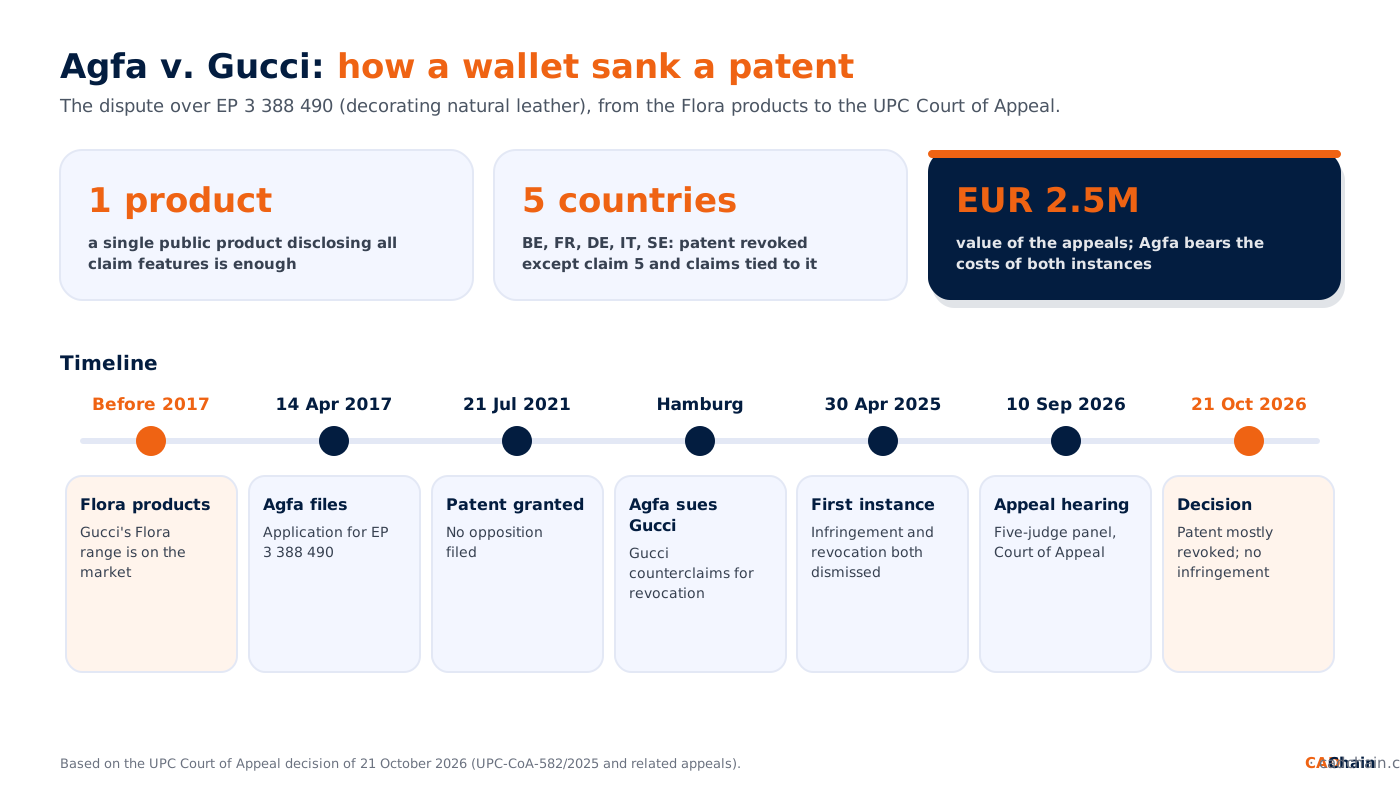
Agfa sued Gucci for infringing EP 3 388 490, a patent on decorating leather with a base coat and pigmented UV curable inkjet inks. Gucci counterclaimed that the patent was invalid because its own Flora products, on the market before the patent was filed in April 2017, used the same method. The Hamburg Local Division had rejected both sides in April 2025. On appeal, the Court of Appeal held that standard lab analysis of a Flora wallet revealed every feature of the main claim, so the method was already public. Most of the patent was revoked, Gucci does not infringe what is left, and Agfa pays all costs. Lesson: what your product reveals under analysis is public, and proof of what you made and when decides cases.
What did the UPC Court of Appeal decide?
The Court of Appeal decision of 21 October 2026 settles ten linked appeals between Agfa NV, a Belgian maker of industrial inkjet inks and printers, and nine Gucci companies, including Guccio Gucci S.p.A. and Marbella Pellami S.p.A. A five-judge panel led by Court of Appeal President Klaus Grabinski decided it.
- Infringement: Agfa loses. Agfa's appeal against the dismissal of its infringement action was rejected.
- Validity: the patent mostly falls. The court set aside the Hamburg decision that had kept the patent intact. The patent is revoked for Belgium, France, Germany, Italy and Sweden except for claim 5 combined with claim 1, claim 9 combined with claim 1, and claims 6, 7 and 8 insofar as they depend on claim 5.
- No infringement of what survives. Agfa did not show that Gucci's inks contain the 1 to 20 percent of polyfunctional monomers or oligomers that claim 5 requires.
- Costs: Agfa pays for both instances. The value of the appeals was set at EUR 2.5 million.
The Court of Appeal is the UPC's highest instance. The patent was also in force in Spain and the United Kingdom, which are outside the UPC, so this decision does not cover them.
How could a Gucci wallet invalidate an Agfa patent?
Under Article 54 of the European Patent Convention (EPC), the state of the art includes everything made available to the public, including "by use", before the filing date. Agfa filed its application on 14 April 2017. The Hamburg Local Division had already found that Gucci's Flora products were on the market before that date, and the Court of Appeal agreed. It also noted that one product is enough: the claimed subject matter is not new if a single publicly available product directly and unambiguously discloses all claim features.
The question was whether a decorated wallet discloses how it was decorated. The court's answer, in its first headnote, is that a manufacturing method of a publicly used product is made public if a skilled person could establish the method without undue burden by analysing the product's composition. Agfa argued that nobody would have had a reason to analyse a fashion wallet for photoinitiators. The court rejected that outright: "There is no support in the EPC for an additional requirement that the skilled person would need particular reasons for analysing the product."
The second headnote limits what the analysis must reveal: enough for a skilled person to carry out the claimed method with common general knowledge, but not features outside the claim. So it did not matter that the lab reports gave no pigment quantities, because the claim specifies none.
What did the lab analysis reveal?
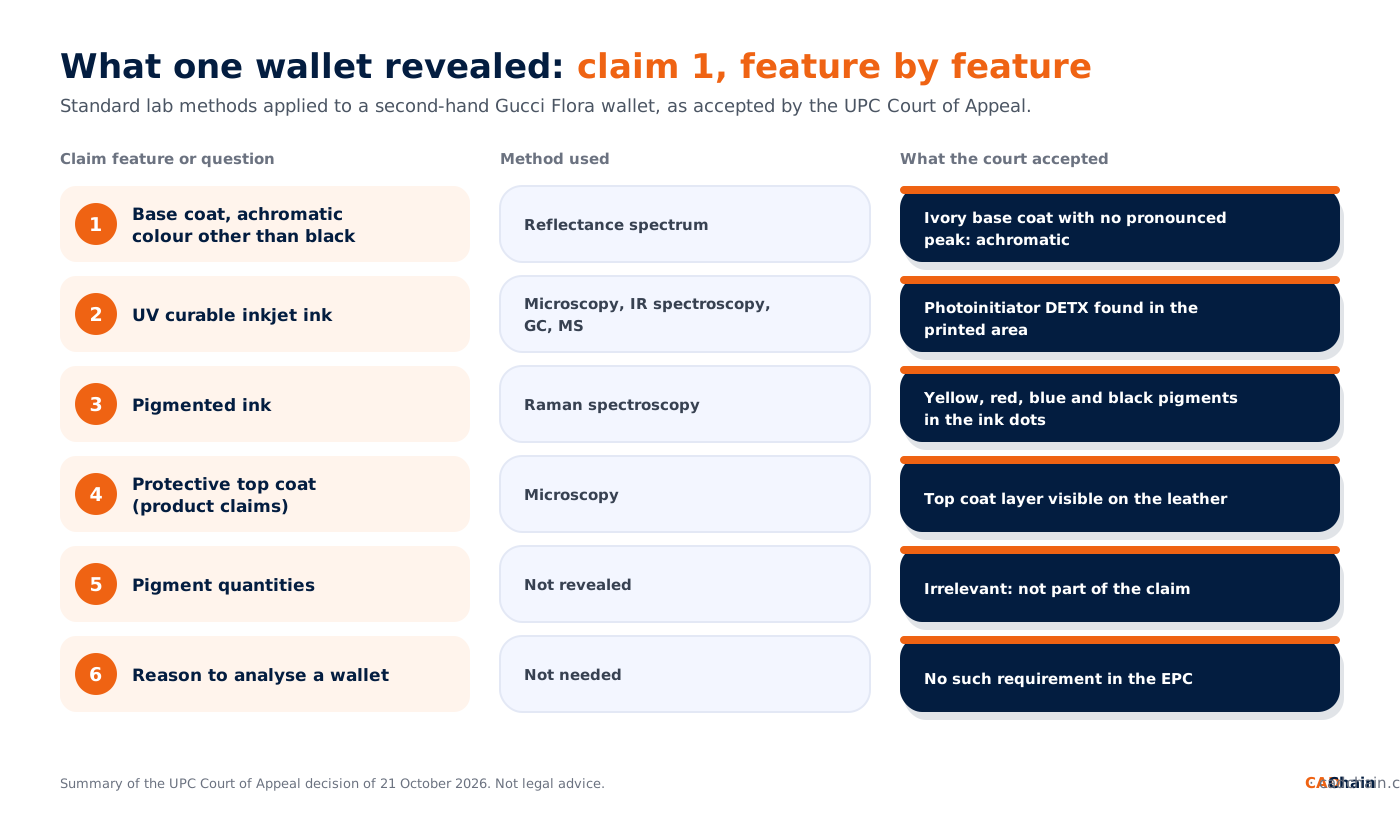
This part shows how far ordinary analysis can go. Gucci's experts tested a second-hand Flora wallet and other Flora products, and the court accepted that their findings matched each disputed feature of claim 1.
- The base coat colour. The wallet's ivory base coat had a reflectance spectrum without the pronounced peak typical of a chromatic colour. The court held that an off-white base coat can be "achromatic" in the sense of the patent, and that Hamburg had read the claim too narrowly.
- UV curable ink. Using microscopy, infrared spectroscopy, gas chromatography and mass spectrometry, an expert found the photoinitiator DETX (2,4-diethylthioxanthone) in the printed area and concluded that a UV curable inkjet ink had been used.
- Pigmented ink. A Raman spectroscopy report found yellow, red, blue and black pigments in the ink dots, by comparing the spectra with public reference databases.
- The top coat. A microscopy report showed a protective top coat, which also took out the product claims.
Two details stand out. Gucci showed every technique was common general knowledge by citing an introductory analytical chemistry textbook for engineering students. And the court gave more weight to the expert who worked blind: Dr Clayton got no information about the process or inks and was told not to read the patent, while another expert who had internal Gucci information was seen as less representative of what an outsider could do.
Why does this matter beyond leather?
Because most engineered products carry traces of how they were made. Coatings, adhesives, alloys, composites, surface treatments and additive manufacturing all leave evidence that a competent lab can read. Three points follow.
- Shipping a product can publish your process. If the process can be read from the product with standard methods, putting the product on the market makes the process part of the state of the art. Under the EPC there is no general grace period for your own disclosures, so a patent filed after launch may be invalid because of your own product.
- A secret process may not stay secret. Under the EU Trade Secrets Directive (2016/943), studying, disassembling or testing a product that has been made available to the public is a lawful way to acquire information, unless a valid duty restricts it. What a lab can read from your product is weak ground for a trade secret.
- Earlier products are a strong defence against a process patent, whoever sold them, if you can prove what was sold, when, and how it was made.
Our guides to what patents protect and what they cost and to trade secrets for deep-tech startups cover the basics. The ruling adds a concrete test: what could a skilled outsider learn from the finished product with ordinary lab tools?
Patent, trade secret or publication: how should you protect a process?
Sort the know-how behind each process into what can be read from the product and what cannot. If a competent lab can identify it, the realistic choices are to patent it before launch or to accept that it becomes public. Process parameters, tooling settings, inspection criteria and test data that leave no trace can be kept as trade secrets, with access control and records showing you treated them as secret. And remember enforcement: Agfa could not prove what was inside Gucci's inks, so a process patent that can only be checked inside a competitor's plant may be costly to use.
We compared these routes in trade secrets vs patents for CAD designs and our 8-layer IP protection playbook. And as we explain in why NDAs are not enough for CAD protection, no confidentiality clause stops anyone analysing a product bought on the open market.
Prove what you designed and when. CADChain registers CAD files with blockchain timestamps, encrypts them at file level and logs every access, so your design history is ready when a patent, prior-use or trade secret dispute starts.
👉 See how CADChain records design ownership
Why do dated records decide cases like this?
Gucci won because it could prove that the Flora products were on the market before 14 April 2017, and what they were made of. Agfa lost on claim 5 because it could not prove what was inside Gucci's inks. The side with evidence won.
Records matter for secret prior use too. It does not invalidate a patent, but under Article 28 of the UPC Agreement, anyone with a prior use right under national law in a UPC country keeps that right against a European patent there. National rules usually require proof of use, or serious preparations, before the other party's filing or priority date. That proof is often dated drawings, models, process files and test records.
This is where engineering records become legal evidence. Our guides to CAD file ownership and legal proof requirements, audit trail requirements for IP litigation and using DRM audit trails as patent evidence explain what courts look for, and tamper-proof audit trails and blockchain evidence in IP litigation show how a timestamp ties a file to a date. A timestamp cannot prove a sale; invoices and samples do that.
Dates also decided a recent US case: in Insulet v. EOFlow, a $452 million trade secret verdict over CAD files was reversed on appeal as time-barred, based on dates in emails and a prospectus. And our report on the EPO technology transfer study found that IP co-ownership is a frequent source of friction for European research spin-offs.
What should engineering and IP teams do now?
- List your key processes and ask what an outsider could learn from the finished product with standard tools such as microscopy, spectroscopy or CT scanning.
- File before you disclose any process that is readable from the product and worth patenting. That means before the first sale, sample shipment, trade fair or public demo, since the EPC has no general grace period.
- Keep only unreadable know-how as trade secrets, and protect it properly: access control, need-to-know sharing, confidentiality terms and records. See our legal framework for trade secret protection of CAD designs.
- Keep a launch file for each product: first sale date, catalogue entries, invoices, retained samples and the exact specification, materials and process revision used at the time.
- Timestamp design and process files at each release, so you can show what existed on which date. This supports both a prior use defence and any national prior use right.
- Check your own history when a competitor's process patent worries you: older products may already disclose the claimed method.
- Brief experts blind and document the chain of custody of samples; the court preferred the expert who worked without internal information.
- If you own process patents, plan for enforcement: decide which dependent claims you will defend, and how you could prove infringement without access to the other side's plant.
See also our IP protection strategies for mechanical engineering firms, blockchain ownership registration for designs and what to record for AI-generated inventions.
How does this fit the bigger picture?
This week our sister sites looked at related questions of control, proof and responsibility.
- Liability for digital files. Germany's new Product Liability Act applies from 9 December 2026 and treats software and digital manufacturing files as products. Read what the new product liability rules mean for Inventor files on borisinventor.com.
- Platform terms and your models. Sketchfab's Terms of Use of 27 October 2026 changed the contracting company but kept its promise not to license uploads for generative AI datasets. Blended BORIS explains what the Sketchfab terms change means for 3D artists.
- Security around design data. A critical Node.js flaw known as Node2Shell is on the CISA list of exploited vulnerabilities, and Dassault Systèmes is checking its products. Our sister site covers what the Node2Shell vulnerability means for SOLIDWORKS teams.
Conclusion
A second-hand wallet, a few standard lab techniques and a textbook were enough to show that Agfa's patented method had been public before Agfa filed. The court did not ask whether anyone had a reason to look, only whether a skilled person could have found out.
For hardware teams the message is simple. Decide what to patent and what to keep secret based on what your products reveal. File before you ship. And keep dated, reliable records of what you designed, made and sold, because this case was decided by the side that could prove its history.
Turn your design history into evidence. CADChain gives engineering teams blockchain proof of ownership, file-level encryption, per-file permissions and access logs for CAD files, across CAD systems, partners and suppliers.
👉 Protect your CAD files with CADChain
FAQ: the Agfa v. Gucci UPC prior use ruling
What did the UPC Court of Appeal decide on 21 October 2026?
It rejected Agfa's infringement appeal against Gucci and revoked most of Agfa's patent EP 3 388 490 for Belgium, France, Germany, Italy and Sweden, because Gucci's earlier Flora products already disclosed the claimed leather printing method. Claim 5 and a few related claims survive, and Gucci does not infringe them.
What is public prior use?
Prior art under Article 54(2) EPC. If a product made with a method was public before the filing date and a skilled person could work out the method by analysing it without undue burden, the method is no longer new.
Does someone need a reason to analyse the product?
No. The Court of Appeal held that the EPC contains no requirement that the skilled person had particular reasons to analyse the product.
Can a process that is visible in the product be a trade secret?
It is risky. Under the EU Trade Secrets Directive, testing or disassembling a product made available to the public is a lawful way to acquire information unless a valid duty restricts it.
Does the ruling cover Spain and the UK?
No. It covers the UPC countries where the patent was in force. Spain and the United Kingdom are outside the UPC system.
How can CADChain help?
CADChain timestamps CAD files on a blockchain, encrypts them at file level and logs every access, so teams can show which design and process files existed on which date and who used them. It does not replace invoices, samples or legal advice.