On 17 November 2026, the Paris Local Division of the Unified Patent Court (UPC) found all contested claims of French company KeeeX's European patent EP 2 949 070 invalid and dismissed its infringement case against Adobe, OpenAI, Truepic and the Coalition for Content Provenance and Authenticity (C2PA). KeeeX had argued that C2PA, the open standard behind "Content Credentials" on AI images, copied its method for proving that a digital file has not been changed. It must now pay the defendants' legal costs.
It was the first serious patent attack on the technology that OpenAI, Adobe and others use to label AI-generated and edited images. KeeeX, based in Marseille, sells software that embeds integrity, source and date proofs inside ordinary files and anchors their fingerprints on a blockchain. At its peak, its damages claim against the four defendant groups was in the billions of euros.
For deep-tech founders, IP lawyers and engineering managers, the ruling carries three lessons. A patent on a broad idea such as fingerprinting a file is only as strong as its novelty against everything published before it. The UPC is not a global court, and a loss is expensive. And the ability to prove that a file is unchanged is not the same as being able to prove that a design is yours, or to control who uses it.
TL;DR: the UPC rejected a patent on embedded file fingerprints, and the loser pays
On 17 November 2026, the UPC Paris Local Division found all contested claims of KeeeX's patent EP 2 949 070 ("Verification process of the integrity of numerical data bloc") invalid for added matter or lack of novelty, according to JUVE Patent, and dismissed KeeeX's claim that the C2PA provenance standard used by Adobe, OpenAI and Truepic infringed it. KeeeX, which had first sought EUR 5.6 billion in material damages, must bear all legal costs, with an interim provision of EUR 300,000. An appeal is possible. Lesson: file fingerprints prove integrity, not ownership. Keep dated ownership records and control access to the files themselves.
What did the Unified Patent Court decide on 17 November 2026?
The decision came from a four-judge panel of the Paris Local Division: presiding judge and judge-rapporteur Camille Lignières, legally qualified judges Carine Gillet and Peter Tochtermann, and technically qualified judge Alessandro Sanchini. The case was heard in French. As JUVE Patent reported on the day of the decision, the panel found all contested claims of EP 2 949 070 invalid, either because they contained added matter, meaning subject matter that went beyond the patent application as filed, or because they lacked novelty.
Because the claims were invalid, the court dismissed KeeeX's infringement claims against all defendants and did not reach the question of damages. The defendants were Adobe, OpenAI, the content authenticity company Truepic, and the C2PA together with the Joint Development Foundation, the non-profit that hosts it. Each had filed a counterclaim for revocation of the patent. Under UPC rules, a successful counterclaim revokes the patent for the UPC countries in which it is in force, which in this case are eight states.
The outcome had been signalled at the oral hearing on 6 October 2026, when the presiding judge said that the defendants had raised "very serious arguments" against the patent's validity. The court had admitted eleven auxiliary requests, fallback versions of the claims. The written decision was not available to us when we published, so we do not know which prior art the court relied on.
What did the KeeeX patent cover, and why did it target C2PA?
EP 2 949 070 B1 was originally filed by Aix-Marseille Université and the French national research centre CNRS. Its claims, as summarised in the case reports, describe a way to verify the integrity and authenticity of a block of digital data by inserting a digital fingerprint directly into the file and later recalculating the fingerprint to compare the two. During the case, one question was whether "digital fingerprint" meant only a hash, the short code calculated from a file's contents, or also covered digital signatures.
KeeeX's commercial product follows the same idea. According to its website, KeeeX Fusion adds integrity, source and date metadata inside files, timestamps them, anchors their fingerprints on a blockchain (Bitcoin by default) and lets anyone check a file with a free verifier.
The Coalition for Content Provenance and Authenticity works in a related way. Its specification, first released in December 2021, defines Content Credentials: cryptographically signed metadata records, called manifests, that travel with an image, video or document and describe where it came from and how it was edited. A verifier recalculates the file's hash, compares it with the signed hash in the manifest and checks the signer's certificate. Adobe uses Content Credentials in Firefly, and OpenAI has added C2PA metadata to images made with its image models since early 2024. KeeeX argued that the standard reproduced the teachings of its patent. With the claims gone, that argument fell away.
What did KeeeX ask for, and what will it pay?
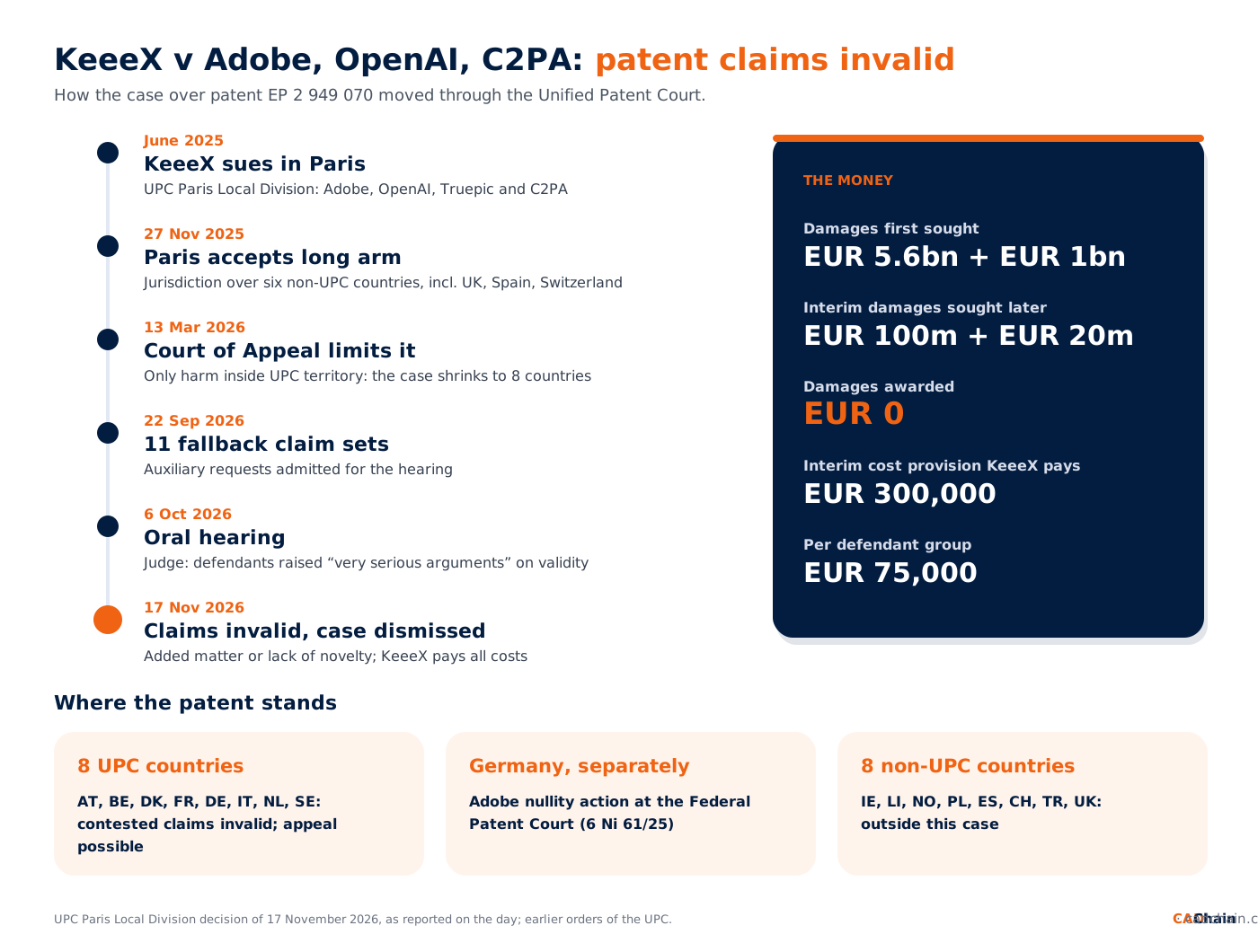
KeeeX filed its infringement action in June 2025. According to JUVE Patent, it initially sought EUR 5.6 billion in material damages and EUR 1 billion in non-material damages. It later reduced its request to EUR 100 million and EUR 20 million as interim damages. None of this was awarded.
The UPC applies a loser-pays rule. KeeeX must bear all legal costs, and the panel set an interim cost provision of EUR 300,000, or EUR 75,000 for each of the four defendant groups. The court took into account that KeeeX is a small enterprise and that the defendants' positions overlapped.
An appeal to the UPC Court of Appeal in Luxembourg is possible. KeeeX had not announced its next step when we published. A separate nullity action that Adobe brought against the German part of the patent is pending at the German Federal Patent Court under case number 6 Ni 61/25.
Why did the Court of Appeal limit the case to UPC countries?
EP 2 949 070 is in force in 16 countries. Eight of them take part in the UPC: Austria, Belgium, Denmark, France, Germany, Italy, the Netherlands and Sweden. The other eight do not: Ireland, Liechtenstein, Norway, Poland, Spain, Switzerland, Turkey and the United Kingdom.
On 27 November 2025, the Paris Local Division accepted jurisdiction over alleged infringement in Switzerland, Spain, the UK, Ireland, Norway and Poland, relying on the European Court of Justice's BSH v Electrolux judgment, which allows some cross-border patent claims to be brought in the court of the defendant's home country. On 13 March 2026, the UPC Court of Appeal reversed that order. Where jurisdiction rests on the place of the harm, it said, the court "has jurisdiction only to hear claims for damage caused within its territory". KeeeX had not explained in its statement of claim why the court should rule on harm outside UPC territory.
For founders, the message is practical: the UPC can give a patent owner a single judgment for many European countries, but only if the jurisdiction is argued properly from day one. We saw the court's reach in the other direction in Agfa v. Gucci at the UPC, where selling a product made a manufacturing method public and sank a patent.
What does the ruling mean for deep-tech founders with patents?
Broad ideas are fragile. Hashing a file and storing the result so that changes can be detected is a long-established technique in computer security. Founders should test the novelty of their core claims against the widest possible prior art before they enforce them against companies with large legal budgets. Our guide to what patents protect, how to get one and what it costs covers the basics.
Cost risk is real. The UPC's loser-pays rule means that a failed case costs more than the claimant's own lawyers. University spin-offs that license patents from research institutions should plan for this. Our article on the EPO technology transfer study 2026 looks at how European spin-offs manage patents from their universities.
Patents are not the only option. Some inventions, especially processes that cannot be seen from the product, are better kept as trade secrets. Our comparison of trade secrets and patents for CAD designs and our trade secrets guide for deep tech startups explain the trade-offs. Even a patent strategy is a secret worth protecting, as the case of Samsung's former IP chief showed.
Prove that your designs are yours, and keep control of who opens them. CADChain records ownership of CAD files on a blockchain with a dated, verifiable trail, encrypts files at file level and lets you grant and revoke access per user and per partner, across CAD systems.
👉 See how CADChain protects CAD files
Does a file fingerprint prove that a design is yours?
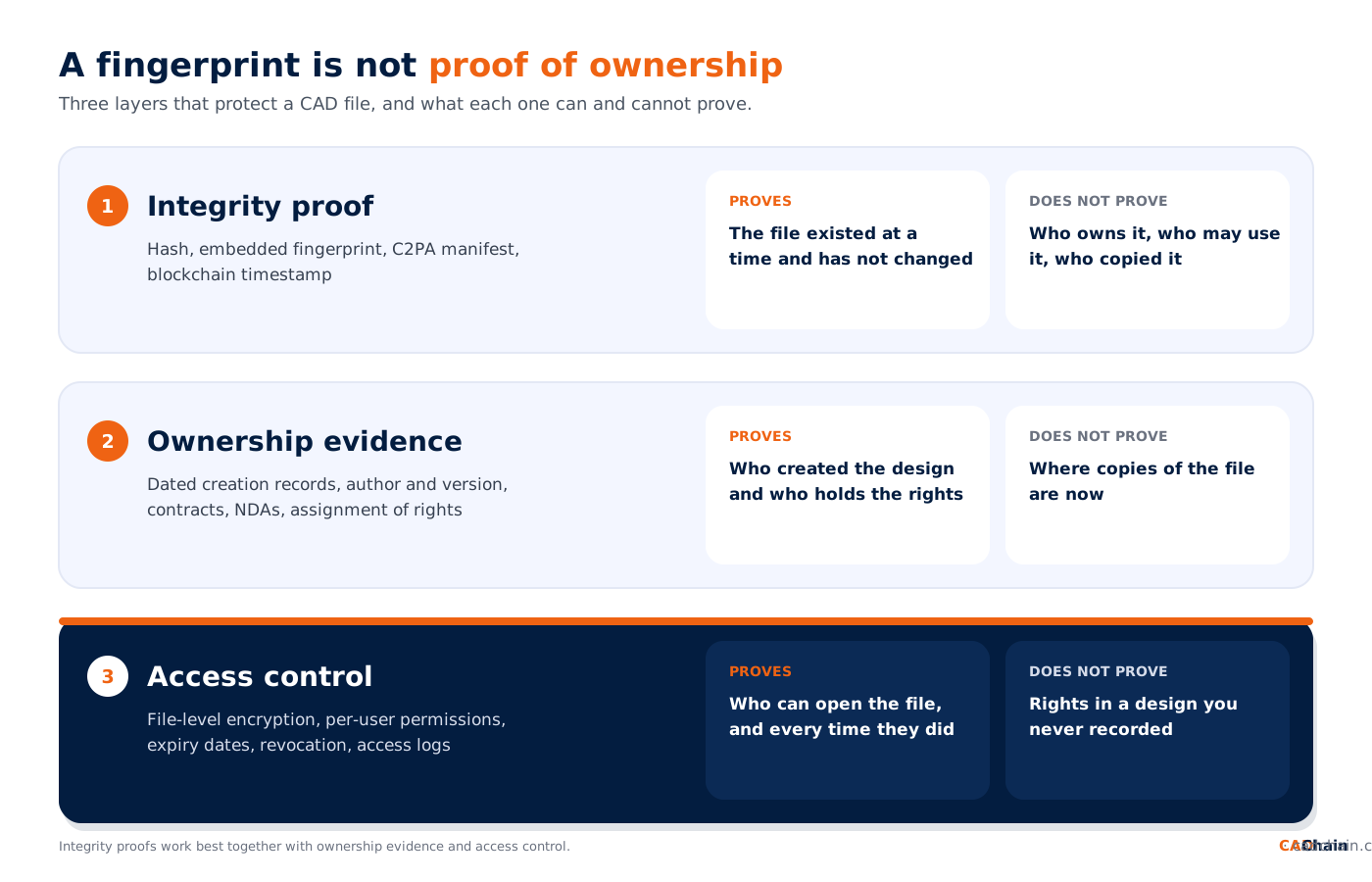
No, and this is the most useful lesson for engineering teams. A fingerprint embedded in a file, a C2PA manifest or a blockchain timestamp can show that a file existed at a certain moment and has not changed since. It cannot, on its own, show who created the design, who was allowed to use it, or who has copied it. A copy of a fingerprinted file is a perfect copy, and metadata can be stripped when a file is saved by a tool that does not support it.
In an IP dispute over a CAD model, courts look at the whole story: who created the design and when, under which contract, who had access and what they did with it. That is why integrity proofs work best as one layer among several. Our guides to legal proof of CAD file ownership, blockchain evidence in IP litigation and tamper-proof CAD audit trails explain what evidence holds up.
The ruling also does not make blockchain timestamps or embedded proofs less useful. What fell was one company's exclusive claim to a general method, not the method itself. Our explainer on blockchain ownership registration for CAD designs shows how a dated record of creation is made, and digital watermarking for CAD geometry covers marks that survive inside the model itself.
What should engineering teams and founders do now?
- Separate integrity from ownership. Use hashes, signatures or timestamps to show that a file is unchanged, and keep separate, dated evidence of who created the design and who holds the rights.
- Record creation as it happens. Register important designs at the moment they are created, with author, date and version, rather than reconstructing the history once a dispute starts.
- Check your rights chain. Make sure employment contracts, contractor agreements and university licences assign the rights in designs and inventions to the company. Spin-offs should read their licence terms on enforcement and costs.
- Test patent claims before you enforce them. Commission an independent validity search against prior art from adjacent fields before sending a demand or filing a case, especially against a standard.
- Plan for the UPC's rules. Budget for the loser-pays risk, argue jurisdiction for every country in the statement of claim, and decide early which non-UPC countries need national actions.
- Decide patent or trade secret per invention. Processes that cannot be reverse engineered from the product may be better protected as trade secrets, with access limits that show reasonable steps.
- Control the files themselves. Use file-level CAD encryption and permissions you can revoke, so that a copy of a model is not automatically a usable model.
- Treat provenance labels as one signal. Content Credentials on images and documents help show where a file came from, but a missing label does not prove a fake and a valid label does not prove the content is true.
How does this fit the bigger picture?
Who owns digital work, and who controls access to it, runs through this week's stories on our sister sites:
- AI training and copyright. A car-photo company has sued ByteDance in California, alleging that 7,095 of its images were copied and used for the Seedream image models. Blended BORIS explains what the EVOX v. ByteDance Seedream lawsuit means for 3D artists.
- Partners with access. Infoblox is investigating unauthorised access to company information through a compromised SharePoint data migration vendor. Solidboris.com looks at what the Infoblox breach teaches SOLIDWORKS teams about migration partners.
- Software that runs as SYSTEM. Autodesk fixed a flaw in its installer that could let a local user gain SYSTEM rights. BORIS Inventor explains the Autodesk Installer privilege escalation and what Inventor teams should update.
The common thread is that proving where a file came from is only part of protecting it. Our articles on generative AI and CAD IP and blockchain versus traditional DRM for CAD explain how the pieces fit together.
Conclusion
The UPC's Paris Local Division has ended, at first instance, a case that could have put a price on the provenance labels that major AI and creative software companies now attach to images. KeeeX lost on validity, infringement and costs, although an appeal is still possible and the German part of the patent is under separate attack.
For deep-tech founders, the ruling is a reminder to test broad patents hard before enforcing them and to respect the UPC's limits and costs. For engineering teams, it is a reminder that a fingerprint shows a file is unchanged, not that the design is yours. Keep dated ownership records, choose the right form of protection for each invention, and keep control over who can open your most valuable CAD files.
Make your design files provably yours and revocable at any time. CADChain gives every CAD file a verifiable ownership record, file-level encryption, granular permissions you can revoke at any time and a full access log, across CAD systems, suppliers and partners.
👉 Protect your CAD files with CADChain
FAQ: the KeeeX C2PA patent ruling
What did the UPC decide in KeeeX v Adobe and OpenAI?
On 17 November 2026, the Paris Local Division of the Unified Patent Court found all contested claims of KeeeX's patent EP 2 949 070 invalid for added matter or lack of novelty, dismissed the infringement claims against Adobe, OpenAI, Truepic, C2PA and the Joint Development Foundation, and ordered KeeeX to bear the legal costs.
What is EP 2 949 070 about?
The patent, titled "Verification process of the integrity of numerical data bloc" and originally filed by Aix-Marseille Université and CNRS, describes verifying a block of digital data by inserting a digital fingerprint into the file and later recalculating it for comparison.
What is C2PA?
The Coalition for Content Provenance and Authenticity is a project of the Joint Development Foundation that publishes an open standard for Content Credentials: signed metadata that records where an image, video or document came from and how it was edited. Adobe and OpenAI use it to label generated and edited images.
How much did KeeeX claim and how much does it pay?
KeeeX first sought EUR 5.6 billion in material and EUR 1 billion in non-material damages, later reduced to EUR 100 million and EUR 20 million as interim damages. It received nothing and must bear all legal costs, with an interim provision of EUR 300,000.
Does a hash or blockchain timestamp prove I own a CAD design?
Not on its own. It proves that a file existed at a certain time and has not changed. Ownership also needs dated records of who created the design, contracts that assign the rights, and evidence of who had access.
How does CADChain help?
CADChain records the ownership of CAD files on a blockchain, encrypts files at file level, sets per-user and per-partner permissions with expiry dates and logs every access, so you can show a design is yours and control who uses it.