On 22 October 2026, the European Patent Office (EPO) published its largest study yet of Europe's technology transfer offices, the university units that protect research inventions and turn them into licences and spin-offs. Patent filings by European research institutions fell in 2025 after almost two decades of growth, around 90% of the 809 offices studied are small, and 40.7% of patents owned directly by European universities lapse within ten years, compared with 26.3% in the US.
The 98-page report, Europe's technology transfer landscape, was produced by the EPO Observatory on Patents and Technology with ASTP, Europe's knowledge transfer association, and Fraunhofer ISI. It combines EPO patent data, an analysis of academic inventions, survey answers from more than 800 European technology transfer offices (TTOs) and interviews with 22 technology transfer professionals. EPO President António Campinos put the message in one line: "Technology transfer is a competitiveness issue."
For deep-tech founders, this is not an abstract policy paper. Most European spin-offs start with a licence or an assignment from a university, a public research organisation or a research hospital. The study shows where that process slows down: thin teams, tight patent budgets, shared ownership between several institutions and negotiations that start without agreed terms. Each of those problems lands on a founder's desk, usually in the first funding round. Here is what the study found and what to prepare.
TL;DR: the EPO technology transfer study, October 2026
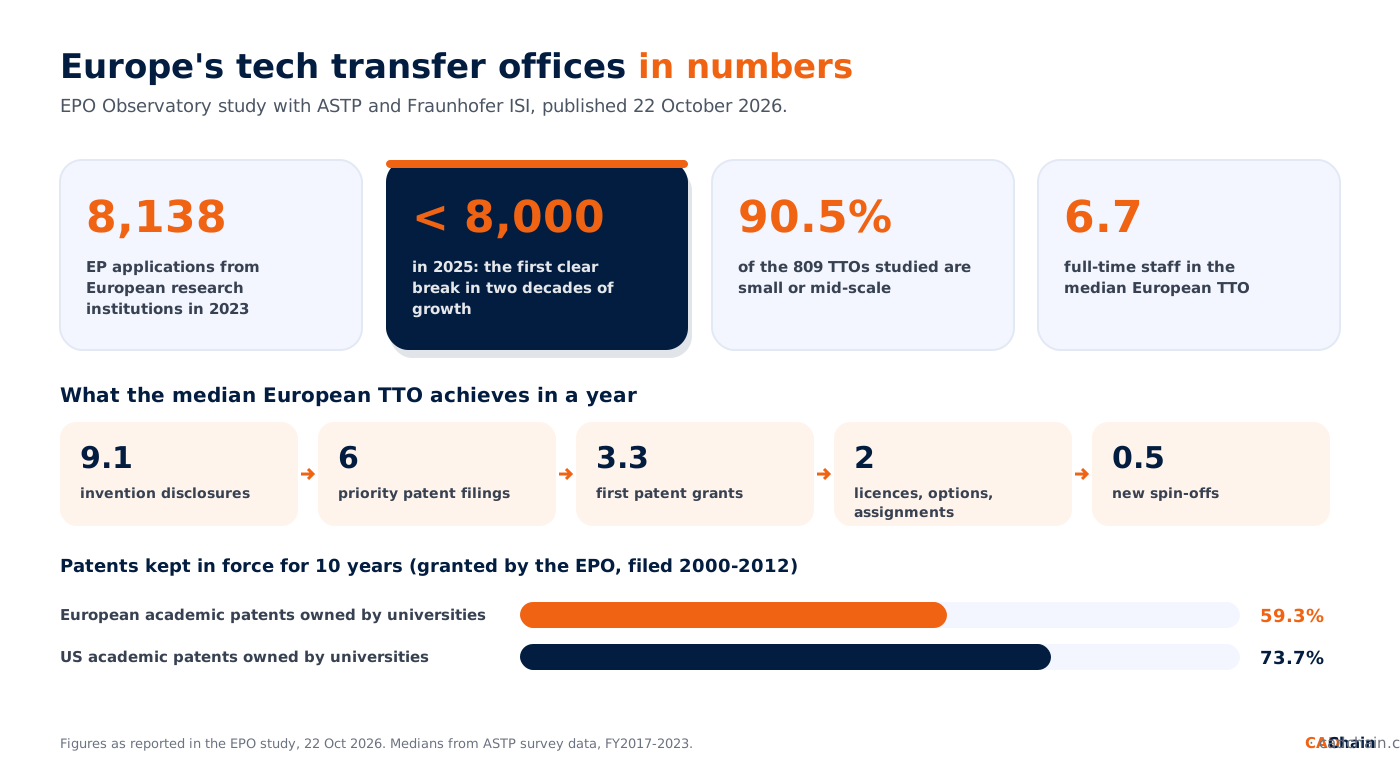
European research institutions filed fewer than 8,000 European patent applications in 2025, down from 8,138 in 2023. They now own more of their inventions directly, and in 2025 they accounted for 34% of European-origin applications in biotechnology, 29% in quantum technologies and 26% in pharmaceuticals. Around 90% of the 809 TTOs analysed are small or mid-scale. The median office has 6.7 full-time staff and creates about one new spin-off every two years. Small offices handle individual inventions as well as large ones, but larger teams are linked to more spin-offs and licences. In interviews, 19 of 22 offices named IP co-ownership or negotiation as a problem. For founders, the practical lesson is to settle who owns what, including CAD files, drawings and know-how, before money and partners arrive.
What did the EPO technology transfer study find?
The EPO announcement of 22 October 2026 describes the study as the most comprehensive assessment so far of how well Europe moves research into the market. The main findings fall into four groups.
- Growth in academic patenting has stalled. European patent applications with at least one European university, public research organisation (PRO) or research hospital as applicant rose from 3,235 in 2006 to 8,138 in 2023. In 2025 they fell below 8,000, a share of 9.1% of applications from European entities.
- Universities own more of their inventions. Academic patents rose from about 5% of European patents in 2000 to 9% in 2020, close to the US level of about 9.5%. By 2020, around half of European academic patents were filed by the universities themselves rather than by companies or other organisations.
- Many of those patents are dropped early. Of directly owned European academic patents filed between 2000 and 2012 and granted by the EPO, 59.3% were kept in force for at least ten years. For US academic patents, the figure was 73.7%.
- Most offices are small. Of the 809 TTOs analysed, 732 (90.5%) are small or mid-scale. The median office employs 6.7 full-time equivalents and serves roughly 108 researchers per staff member.
The study does not say why filings fell in 2025, although several offices described pressure on patent budgets. It treats patent maintenance as a signal of value, not proof of commercial success.
Why do small tech transfer offices matter to spin-off founders?
Because the size of the office shapes how fast and how well a deal gets done. The median European TTO receives about nine invention disclosures a year, files six priority patent applications, gets 3.3 first patent grants, signs two licences, options or assignments and creates 0.5 new spin-offs. One interviewed office had five people for a research organisation with around 100,000 researchers.
Small offices are not worse at handling a single case: for six of eight output measures per invention, there was no significant difference. Per staff member, large offices produce more on all eight measures because specialists handle more cases.
Capacity still seems to matter. Across 256 offices with full data, a doubling of TTO staff was associated with about 53% more new startups, 36% more new spin-offs and 21% more licences, options and assignments, after controlling for research spending, disclosures and country. The study calls these associations, not causes. For a founder, a small office may have the will but not the hours or investor contacts to move quickly, so preparation on your side helps.
Where do university spin-offs get stuck?
The 22 interviews show a chain of problems rather than one bottleneck. All 22 offices raised proof-of-concept funding and long development timelines; 17 treated proof-of-concept funding as a key issue. Twenty raised a lack of investor or growth capital, and 13 raised founder commitment or continuity. Uncertainty often remains in prototypes, engineering work and manufacturing validation long after the first result.
Ownership is the other recurring friction. Legal or regulatory fragmentation was raised by 20 of the 22 offices, and IP co-ownership or negotiation difficulties by 19, eight of which saw it as a key issue. Shared ownership is common in multi-partner research, and several organisations must then align approvals before a technology can move. The offices said the real cost is avoidable uncertainty: unclear ownership, several approval layers and negotiations without agreed parameters, just when the team carries the most risk.
The spin-off data matches this picture. Of the 4,150 European spin-offs with filings at the EPO identified through the EPO's Deep Tech Finder, 65.8% are at an early growth stage, 17.5% at breakout, 4.3% at late growth and 12.4% have been acquired.
Proof of who created each design, from the lab onwards. CADChain registers CAD files on a blockchain with tamper-proof timestamps, encrypts them and logs every open, edit and export, so spin-offs, universities and partners can see who made what and when.
👉 See how CADChain works
Who owns the CAD files, prototypes and know-how?
Patents get most of the attention in technology transfer, but they are rarely the whole asset. The report notes that licences, options and assignments are used to transfer patents, software and know-how, that transfer often happens through joint development, prototypes and follow-on projects, and that fields such as software may rely on protection other than patents. In hardware spin-offs, much of the value sits in CAD models, drawings, simulation set-ups, process parameters and lab notes, often protected, if at all, as trade secrets.
Investors will ask in due diligence: which CAD files were made in the lab and which after founding? Did a PhD student, an industry partner or a second institution contribute? Does the licence cover the 3D models, or only the patent claims? Can the company prove when its own versions were made? Our guide to legal proof of CAD file ownership explains what evidence courts and investors look for, and trade secrets versus patents for CAD designs covers which route suits which asset.
National rules add another layer. The report notes that most European countries have abolished the professor's privilege, under which researchers rather than institutions own their inventions. Denmark abolished it in 2000 and Italy in late 2023; Sweden remains the main European country that keeps it. Some universities also apply their own joint or case-by-case rules, so the answer differs by country and institution.

Will Europe make spin-off deals simpler?
Several countries are trying. The report describes standard deal terms or model agreements in the Netherlands, Denmark, Ireland, Germany (an IP Deal Database and the voluntary German Spin-off Framework) and France (licence negotiation guidelines published in 2026). An EU Blueprint for IP licensing and spin-off creation, under the Lab to Unicorn initiative, is described as forthcoming, with no date given.
The study's six takeaways ask governments and institutions to treat TTOs as strategic actors, fund capacity including IP budgets, and share expertise through networks such as ASTP and the PATLIB centres. Universities also lead Unitary Patent uptake: 67.9% in the first half of 2026, against 42.5% for all European applicants.
What should deep-tech founders and engineering teams do now?
- Build an asset register on day one. List every patent, application, CAD model, drawing, code base, dataset and process document the company relies on, with who created it, where and when.
- Separate lab work from company work. Mark which files came from the university or research partner and which were made after founding. Keep dated versions so the line is provable.
- Get the licence to cover more than patents. Ask that the agreement names know-how, software, CAD files and test data, and says who owns improvements and new designs.
- Map every co-owner early. If two institutions, an industry partner or a funding programme contributed, find out now who must approve the deal. This is where 19 of 22 offices reported friction.
- Check the patents are alive. Confirm renewal fees are paid and decide who pays them after the licence, especially for patents filed by smaller offices with tight budgets.
- Use national standard terms as a starting point. Ask your TTO whether Dutch, Danish, Irish, German or French model terms apply. It shortens negotiation.
- Share designs at file level. When you send models to industrial partners, contract manufacturers or co-researchers, share only what each needs, with view, print and export rights set per file and an access log.
- Keep evidence ready for due diligence. Timestamped records of creation and access answer investors' questions and help in any dispute.
For more detail, see our guides to the 8-layer IP protection playbook for deep-tech teams, intellectual property law for deep-tech founders, what patents protect and what they cost, blockchain ownership registration for designs, using audit trails as evidence for patent applications, smart contracts for CAD licensing, employee IP agreements for CAD files, why NDAs alone are not enough, time-limited CAD sharing for project work and tamper-proof CAD audit trails. On European funding, we looked at how grant dependence hurts deep-tech founders. Recent cases show what weak records cost: the $116.9M Joby v. Aerosonic verdict and the Insulet v. EOFlow ruling on Omnipod CAD files. Yesterday we covered China's draft trade secret sanctions rules.
How does this fit the bigger picture?
This week our sister sites looked at the same question from the software side: who controls engineering data and the tools around it.
- Platform growth. Dassault Systèmes reported Q3 2026 revenue up 5% at constant currency, with 3DEXPERIENCE revenue up 25% and cloud revenue up 14%. Read what Dassault Systèmes Q3 2026 results mean for SOLIDWORKS users on solidboris.com.
- Tool security. Autodesk published advisories on 27 October for four high-severity Fusion desktop flaws, fixed in the 21 October update. Our sister site explains what the Fusion security advisories mean for Inventor CAD managers.
- Training data and ownership. An open-source image-to-3D model was trained on about two million curated 3D assets without naming the sources. Blended BORIS looks at what the Hi3D AI 3D model generator means for 3D artists.
Conclusion
The EPO study shows a European research system that owns more of its inventions than ever, but often lacks the people, money and clear rules to move them to market. Filings dipped in 2025, many university patents lapse early, most transfer offices are small and shared ownership slows deals down. Now it is documented with data from more than 800 offices.
Founders cannot fix national policy or a university's budget. They can make their own deal easier: know exactly which assets the company needs, who created them, who co-owns them and how they are shared. Clear, dated proof of ownership turns a slow negotiation into a checklist.
Keep control of every design you take from lab to market. CADChain gives deep-tech and engineering teams file-level encryption, per-file permissions, access logs and blockchain proof of ownership for CAD files, across CAD systems, research partners and suppliers.
👉 Protect your CAD files with CADChain
FAQ: the EPO technology transfer study
What did the EPO publish on 22 October 2026?
A 98-page study called Europe's technology transfer landscape, produced by the EPO Observatory with ASTP and Fraunhofer ISI. It assesses how European research institutions turn research into patents, licences and spin-offs.
What is a technology transfer office?
A unit at a university, research organisation or research hospital that identifies inventions, protects the IP and connects researchers with companies and investors.
Did academic patent filings fall?
Yes. European patent applications with at least one European research institution as applicant fell below 8,000 in 2025, down from 8,138 in 2023. The study does not establish the cause.
How do European and US university patents compare?
Only 59.3% of directly owned European academic patents were kept in force for ten years, against 73.7% for US academic patents.
Are small technology transfer offices less effective?
Not per invention. For six of eight measures there was no significant difference. Larger teams are associated with more spin-offs and licences, but not causally.
What slows down spin-off deals most?
In interviews, all 22 offices raised proof-of-concept funding and long timelines, 20 raised legal or regulatory fragmentation and 19 raised IP co-ownership or negotiation difficulties.
What should a spin-off founder prepare?
An asset register, a clear split between lab work and company work, a list of co-owners and dated records of who created and accessed each file.
How can CADChain help?
CADChain encrypts CAD files, sets per-file permissions for each partner, logs every access with blockchain timestamps and registers proof of ownership, so a spin-off can show what it owns and who had access.