On 26 October 2026, China's Ministry of Commerce (MOFCOM) published draft rules that would let it investigate and sanction foreign companies, organisations and individuals that infringe Chinese trade secrets when the conduct harms or threatens China's sovereignty, security or development interests. The possible measures include trade and investment bans, entry restrictions, cancelled work permits and fines. Public comments are open until 24 November 2026.
The draft is short: ten articles on three pages, titled Special Provisions on Protecting Chinese Trade Secrets. It does not change how ordinary trade secret disputes are handled in Chinese courts. Instead, it adds an administrative, sanctions-style tool run by MOFCOM, similar in spirit to the trade countermeasures China has built up over the past few years. The rules would take effect on the day they are promulgated.
The timing matters. One week earlier, on 19 October, the US State Department sanctioned five China-based entities under the Protecting American Intellectual Property Act over the theft of Google AI trade secrets, and MOFCOM said the next day that China would take necessary measures. For European deep-tech and engineering firms, the question is practical: what does this mean for the design data, joint projects and people that move between Europe and China? Here is what the draft says, what it leaves open and what to do before the comment period ends.
TL;DR: China's draft trade secret sanctions rules, October 2026
MOFCOM published a ten-article draft on 26 October 2026. It applies when a foreign entity infringes Chinese trade secrets in international business and the conduct harms, or poses a real threat to, China's sovereignty, security or development interests. MOFCOM could investigate, decide on the facts it has if the company does not cooperate, and impose trade, investment, entry, work permit and fine measures. Comments close on 24 November 2026. Key terms are undefined: what counts as a Chinese trade secret, how large fines can be and how long investigations take. No company has been named. For European engineering firms with China suppliers, partners, staff or customers, the safe response is the same as for any trade secret risk: know which design data is whose, keep dated proof and control access at the file level.
What did China's Ministry of Commerce publish?
The MOFCOM notice of 26 October 2026 was issued by the ministry's Department of Treaty and Law. It says the draft aims to safeguard national sovereignty, security and development interests and to protect the legitimate rights of Chinese rights holders. The legal bases named are the Foreign Trade Law and the Anti-Unfair Competition Law, among others. Comments can be sent by fax, email or letter until 24 November 2026.
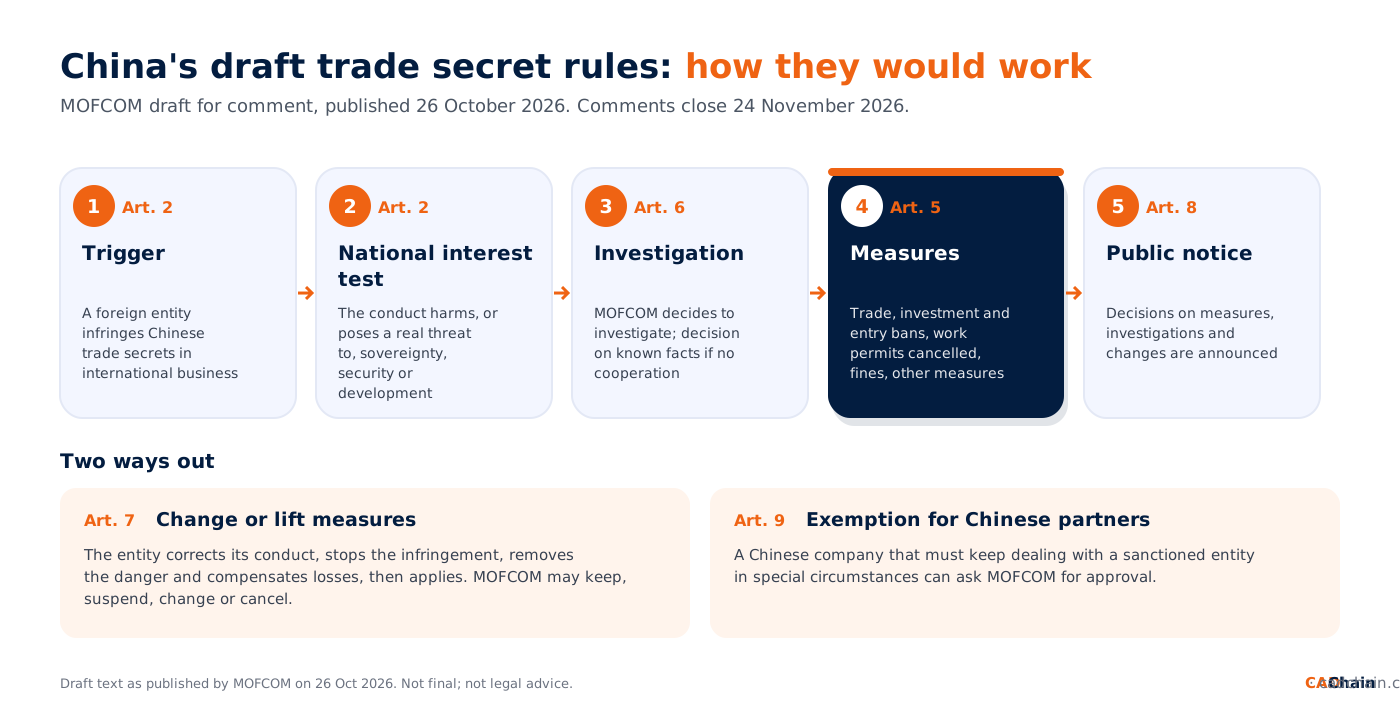
The core of the draft is Article 2. The rules apply when a foreign entity, in international economic, trade and related activities, carries out acts that infringe Chinese trade secrets and those acts either endanger China's national sovereignty, security or development interests, or pose a real threat to them. Article 3 defines a foreign entity as a foreign company, other organisation or individual. A rights holder is the owner of a trade secret and anyone the owner has licensed to use it.
So the draft is not a general trade secret law. A routine dispute over a stolen drawing would still go to court. The new tool is for cases touching national interests, but the draft does not say where that line sits, and "development interests" is a broad phrase.
What could MOFCOM do to a foreign company?
Article 5 lists the measures. MOFCOM could decide on one or more of them:
- Trade bans. Restrict or prohibit the entity's China-related import and export of goods and technology and its international trade in services, and ban exports of relevant items to it.
- Investment bans. Restrict or prohibit new investment in China.
- Entry bans. Restrict or prohibit entry into China of its personnel and means of transport.
- Work and residence. Restrict or cancel work permits and the right to stay or reside in China for its personnel.
- Fines. Fines "according to the seriousness" of the case. No amount, formula or maximum is given.
- Other necessary measures. An open-ended catch-all.
Under Article 6, MOFCOM decides whether to investigate. The foreign entity must cooperate, answer questions and hand over materials, and it may present its side. If it does not cooperate or obstructs the investigation, MOFCOM may decide on the facts it already has. Any company, organisation or individual may report a foreign entity to MOFCOM. Decisions are published (Article 8).
There is a way out. Under Article 7, a sanctioned entity that corrects its conduct, stops the infringement, removes the danger and compensates for losses can apply to have the measures changed or lifted. MOFCOM can then maintain, suspend, change or cancel them. Article 9 lets Chinese companies ask MOFCOM for permission to keep dealing with a sanctioned entity in special circumstances.
Is this a reply to the US PAIPA sanctions?
Possibly, but nobody official has said so. On 19 October 2026, the US State Department sanctioned five China-based entities under the Protecting American Intellectual Property Act (PAIPA), in connection with the case of former Google engineer Linwei Ding, who was convicted of stealing AI trade secrets. We explained that case in our article on the PAIPA sanctions over Google AI trade secrets. On 20 October, a MOFCOM spokesperson rejected the US allegations, said Chinese firms had been unfairly stigmatised and warned that China would take necessary measures.
Law firm commentary is split on how direct the link is. Baker McKenzie wrote that the draft appears to be a direct response to the US action. Other analysts caution against assuming a simple cause and effect and point out that China has been adding legal tools against foreign entities for some time, including a revised Foreign Trade Law in force since March 2026. Chinese state media also noted that there was no official indication the draft responds to the US move.
Chinese experts quoted by state media framed it differently. Hu Qimu, a professor at Huaqiao University, told the Global Times that foreign companies doing normal, lawful business would not face restrictions, and that "strengthening trade secret protection is consistent with China's commitment to high-level opening-up." Whatever the motive, the result is the same: trade secrets are now part of the sanctions toolbox on both sides of the Pacific.
What does the draft leave unclear?
Ten short articles leave a lot of room. Aaron Wininger of Schwegman Lundberg & Woessner, writing on China IP Law Update, lists several open questions. The table below sets out what the text says and what it does not.
A broad trigger, an undefined object of protection and few procedural limits give the ministry wide discretion. For a company that might end up on the receiving end, the best defence is evidence that is ready before anyone asks.
Proof that a design is yours, ready before anyone asks. CADChain registers CAD files on a blockchain with tamper-proof timestamps, encrypts them and logs every open, edit and export, so you can show who created a design, who received it and when.
👉 See how CADChain works
Which European companies could be exposed?
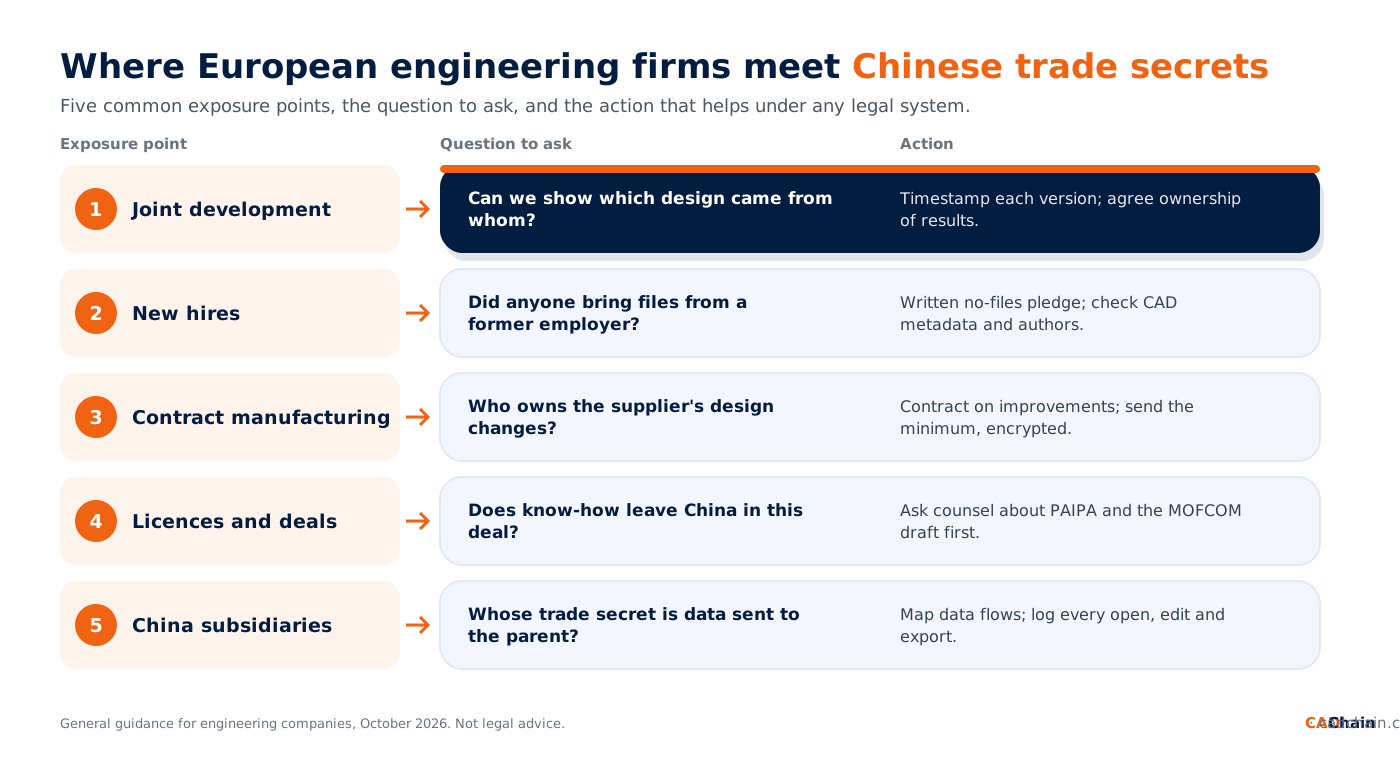
The draft names no targets, and no investigation has been announced. Based on the text alone, the risk is highest where Chinese and foreign know-how meet and where ownership could later be disputed. For engineering and deep-tech companies, that usually means one of these situations:
- Joint development with Chinese partners. When a European firm and a Chinese firm design together, it can be hard to show later which drawing, parameter or process came from whom.
- Hiring engineers from Chinese companies. A new hire who brings files from a former employer creates the classic trade secret case, in either direction.
- Contract manufacturing and tooling in China. Suppliers often improve a design during production. Who owns those changes is a frequent source of conflict.
- Licensing or buying Chinese technology. Acquisitions and licences that move know-how out of China are exactly the kind of deal that touches development interests.
- R&D centres and subsidiaries in China. Data that moves from a Chinese entity to a European parent may raise the question of whose trade secret it is.
In each case, the same weakness shows up: missing proof of who created what, when, and who had access. That is a problem under any legal system. Our guide to IP protection laws by country and our article on protecting CAD files in offshore manufacturing cover the basics. Recent cases show how much depends on it: in the Samsung DRAM leak to CXMT and the Huawei trade secrets trial, the evidence trail decided what could be proven.
What should European engineering companies do now?
- Map your China touchpoints. List every Chinese supplier, partner, customer, subsidiary, licensor and recent hire who has handled design data, in either direction.
- Record the origin of each design. For every important part, assembly and process, keep dated evidence of who created it and when. Blockchain timestamps and signed version histories make this hard to dispute.
- Write ownership into contracts. Joint development, tooling and supply agreements should say who owns improvements, what each side brings in and what must be returned or deleted at the end.
- Run clean onboarding. New engineers from any competitor, Chinese or not, should confirm in writing that they brought no files. Check new CAD files for foreign metadata, authors and company names.
- Share the minimum, at file level. Send single parts, simplified models or neutral exports instead of full assemblies. Give each partner access only to what they need, for as long as they need it.
- Log every access. An access log that shows who opened, printed or exported a file, and when, is your best answer if anyone ever claims you took something.
- Check sanctions exposure in deals. Before acquiring Chinese technology, licensing it out or hiring a team, ask counsel how both the US PAIPA regime and this draft could apply.
- Consider commenting. Industry associations and companies can comment until 24 November 2026. Clear definitions, time limits and fine caps are in everyone's interest.
For more detail, see our guides to trade secrets for deep-tech startups, the legal framework for CAD trade secrets, legal proof of CAD file ownership, tamper-proof CAD audit trails, blockchain evidence in IP litigation, preventing former employee IP theft, why NDAs alone are not enough, view, edit, print and export permissions and protecting consumer electronics designs against knockoffs. Our 8-layer IP protection playbook puts these steps in order. This month we also covered the advisory on China-linked hackers for hire targeting manufacturing, the EU Data Act trade secrets debate, the Insulet v. EOFlow ruling on Omnipod CAD files and the Russian spy case in Germany's defence supply chain.
How does this fit the bigger picture?
Our sister sites covered other recent decisions that turn on the same question: who owns engineering data, and who can prove it.
- Chinese courts and hired engineers. China's courts already award large sums in trade secret cases. Our sister site explains why hiring a rival's engineer cost a machine maker 381.63 million yuan in the Jingdiao case.
- Drawings versus 3D models. A Canadian court found that a SolidWorks model of functional valves did not infringe copied drawings. Read what GE Renewable v. Canmec means for SOLIDWORKS teams on solidboris.com.
- Proof of authorship. A Frankfurt court rejected an "it was AI" defence against a songwriter. Blended BORIS looks at what the Frankfurt AI copyright ruling means for artists who need to prove authorship.
Conclusion
China's draft is short, broad and still only a draft. It does not replace ordinary trade secret law, it names no targets and its key terms are open. But it shows where policy is heading: trade secrets are becoming a matter for sanctions and national security, not only for courts. With the US using PAIPA and China preparing its own tool, a company that works across both can face questions from either side.
European engineering firms cannot control how governments use these powers. They can control their own evidence. Knowing which design came from whom, sharing only what each partner needs and logging every access turns a political risk into a question of facts, and facts are much easier to defend.
Keep control of every CAD file you share. CADChain gives engineering teams file-level encryption, per-file permissions, access logs and blockchain proof of ownership for CAD files, across CAD systems, suppliers and partners.
👉 Protect your CAD files with CADChain
FAQ: China's draft trade secret sanctions rules
What did MOFCOM publish on 26 October 2026?
A ten-article draft called Special Provisions on Protecting Chinese Trade Secrets. It would let the Ministry of Commerce investigate and sanction foreign entities that infringe Chinese trade secrets when the conduct harms or threatens China's sovereignty, security or development interests.
When do the rules take effect?
Not yet. The text is a draft for public comment until 24 November 2026. The final rules would take effect on the day they are promulgated, and no date has been announced.
What sanctions are possible?
Restrictions or bans on China-related trade in goods, technology and services, bans on exports to the entity, limits on new investment in China, entry bans, cancelled work and residence permits, fines and other necessary measures.
Does it replace China's normal trade secret law?
No. Ordinary disputes still go through the courts under the Anti-Unfair Competition Law. The draft adds an administrative tool for cases linked to national interests.
Is it a response to the US PAIPA sanctions?
Some law firms think so, because it came a week after the US sanctioned five China-based entities on 19 October 2026. Others caution against a direct link, and there is no official statement saying so.
Could a European company be affected?
The draft applies to any foreign company, organisation or individual, but it names no targets. Exposure is highest in joint development, contract manufacturing, licensing, acquisitions and hiring involving Chinese partners.
What is the most useful step to take now?
Build dated evidence of who created each important design, who received it and when, and limit partner access to the files they need. That helps in any trade secret dispute, under any legal system.
How can CADChain help?
CADChain encrypts CAD files, sets per-file permissions for each partner, logs every access with blockchain timestamps and registers proof of ownership, so you can show what is yours and who had access.