On 22 October 2026, the Seoul High Court reduced the prison sentence of a former Samsung Electronics engineer, identified by the surname Jeon, from seven years to five. Jeon was convicted of helping leak Samsung's DRAM manufacturing process technology to CXMT, China's largest memory chipmaker. The court said the leak caused irrecoverable damage to Samsung, but gave weight to Jeon's limited role, his testimony in related trials and his apology.
Prosecutors say a group of former Samsung staff helped CXMT build its DRAM production around Samsung's process recipe, a plan of more than 600 manufacturing steps. Part of that recipe did not leave Samsung as a file. According to Korean reporting, it left as handwritten notes in a notebook, and later as photos and paper printouts.
For deep-tech founders, engineering managers and IP lawyers in Europe, the case is a useful reminder. The most valuable engineering knowledge is often a process, a recipe or a set of drawings, and it can leave a company through people, paper and phone cameras as easily as through a USB stick. Here is what the court decided, how the leak happened and what engineering companies should do.
TL;DR: Samsung DRAM leak to CXMT, appeal ruling of 22 October 2026
The Seoul High Court cut former Samsung engineer Jeon's sentence from seven to five years for the overseas leak of national core technology under Korea's Industrial Technology Protection Act. The leaked material was Samsung's DRAM process recipe plan, which a colleague reportedly copied by hand before leaving. A Korea JoongAng Daily analysis of 20 years of chip leak rulings found that 75% of cases were linked to China and that the average prison term was about two years and seven months. Lesson for engineering teams: control who can see the full recipe, limit printing and screen capture, log every access to design files, and keep evidence you can use in court.
What did the Seoul High Court decide?
According to Seoul Economic Daily's report on the appeal ruling, Criminal Division 3 of the Seoul High Court overturned the seven-year sentence from the first trial and sentenced Jeon to five years in prison. The charge was overseas leakage of national core technology under the Act on Prevention of Divulgence and Protection of Industrial Technology. The first-instance court, which ruled in April 2026, had found that the leaked DRAM process technology qualified as national core technology and that Jeon took part in the conspiracy.
The appeal court agreed that the offence caused irrecoverable damage to Samsung and threatened Korea's industrial competitiveness. It reduced the sentence because Jeon was not directly involved in developing the technology, admitted the charges on appeal, showed remorse and testified as a witness in related trials in a way that helped establish the facts. In a related trial, a former Samsung department head surnamed Kim, who also moved to CXMT, was sentenced to six years and four months in a retrial after the case was sent back to a lower court.
How did Samsung's DRAM process reach CXMT?
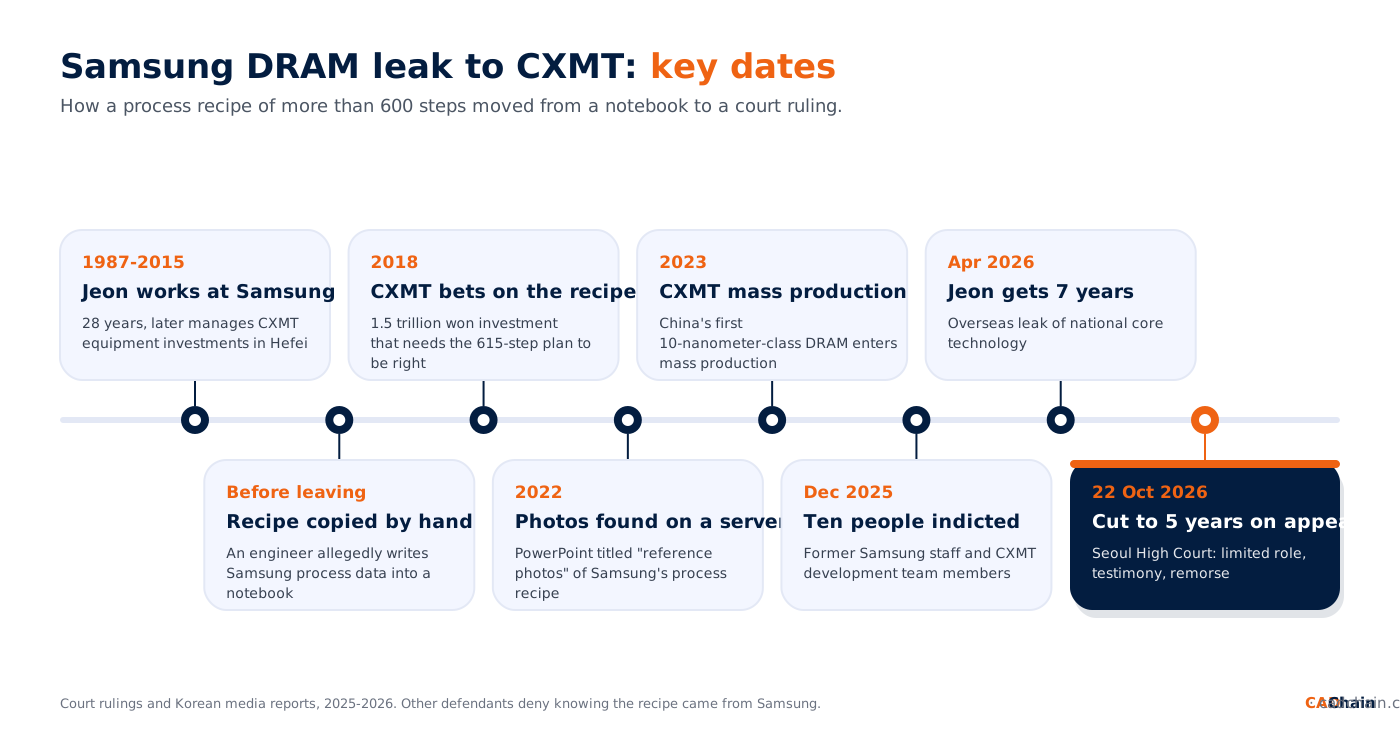
Korean media have reported the background in detail. Jeon joined Samsung in 1987 and left in 2015 after 28 years. At CXMT he managed equipment investments for the company's DRAM project in Hefei. Prosecutors say he received about 2.9 billion won, roughly 2 million US dollars, over about six years, including a signing bonus and stock options. Former Samsung engineers were reportedly offered at least twice their previous after-tax pay.
The leak itself, as reported by Korea JoongAng Daily, worked like this:
- The notebook. A process architecture engineer surnamed Park, who had worked on Samsung's 18-nanometer DRAM process, allegedly copied process information by hand into a notebook before leaving Samsung. He is presumed to be in China.
- The recipe. The notes reportedly helped CXMT put together its process recipe plan quickly. The plan has 615 steps. In 2018, CXMT committed to a 1.5 trillion won investment that depended on that plan being right the first time.
- The cover. CXMT used the code name "Yellow Mountain" for Samsung. Some Korean engineers were hired through a fertiliser company set up by CXMT, or travelled to Hefei through other cities.
- The evidence. In 2022, investigators searching a server found a PowerPoint file titled "reference photos" with photos of Samsung's 18-nanometer process recipe. According to Jeon, Park blamed the leak on the photos and paper printouts.
CXMT began mass production of China's first 10-nanometer-class DRAM in 2023. Prosecutors, who indicted ten people in the case in December 2025, argue that this progress is hard to explain without Samsung's process roadmap. At his appeal hearing on 9 September 2026, Jeon apologised to Samsung for the first time. "I was 100 percent sure it was Samsung's PRP," he said, referring to the process recipe plan. Most other defendants say they did not know the plan came from Samsung.
Why did the court reduce the sentence?
Korean courts weigh the harm of a leak against each defendant's role and conduct. The appeal court accepted that Jeon did not develop the technology and that his cooperation helped in related trials, where he testified in August that CXMT's leadership wanted Samsung's process recipe from the start.
The reduction also fits a wider pattern. Korean prison terms for technology leaks are short compared with the damage claimed. Korea JoongAng Daily analysed every semiconductor leak ruling of the past 20 years under the three relevant laws. Its analysis of 24 chip leak cases and 90 defendants found:
- 18 of 24 cases, or 75%, were linked to China, and 82 of 90 defendants, or 91.1%.
- 44 defendants (48.9%) went to prison, 44 received suspended sentences, one was fined and one was acquitted.
- The average prison term was about two years and seven months. Only three defendants received more than five years.
Notes and photos are hard to stop. Files are not. CADChain encrypts CAD files, sets per-file permissions for viewing, editing, printing and export, and logs every open, across CAD systems.
👉 See how CADChain works
Is the Samsung case part of a wider wave of chip technology leaks?
Yes. On 14 October 2026, a week before the appeal ruling, prosecutors in Daejeon indicted three former employees of a mid-sized Korean chip test equipment maker. Seoul Economic Daily reported that they allegedly took probe card design drawings and other key materials, moved to an overseas competitor for double their salaries, and used the materials to make and supply probe cards abroad between November 2023 and February 2026. The victim estimates it could lose 40 billion won in annual revenue.
It was the first case in which Korea's new technology police at the Ministry of Intellectual Property detained a suspect over an overseas leak. Earlier cases show the same pattern. In the SK hynix and Mujin Electronics case, 15 cleaning-process blueprints were taken in 2019, and Mujin exported seven cleaning machines worth about 37.7 billion won to CXMT. In another case, an employee posted technical materials about an SSD controller on a personal blog 289 times before being caught.
How do the recent Korean chip leak cases compare?
The table summarises the cases mentioned in Korean court reporting this year.
What is Korea changing in the law?
Pressure for tougher penalties is growing. A revised Criminal Act took effect on 13 September 2026 and extends the espionage offence from North Korea to all foreign states. On 31 August 2026, a People Power Party lawmaker proposed a further amendment that would raise the minimum espionage sentence from three years to ten and explicitly cover leaks for the benefit of foreign companies and national core technologies. A Democratic Party lawmaker proposed a special act on 24 August with fines of up to 10 billion won for individuals and 20 billion won for companies. Both are proposals, not law. The August bill cites 143 core and industrial technology cases transferred overseas from 2020 to June 2026, with estimated damages above 23 trillion won.
What does the Samsung case mean for engineering companies outside Korea?
Most European engineering firms will never face a rival offering their staff double pay and a cover company. But the mechanics of the Samsung leak are ordinary. A recipe could be read in full, copied by hand, photographed and printed, and the evidence surfaced only years later, on a server abroad.
That is the same pattern we described in our guide to former employee IP theft and CAD file exfiltration, and in recent cases closer to home: the Apple v. OpenAI trade secrets case about engineers who change jobs, the Huawei trade secrets trial and its rogue-employee defence and the US sanctions over the Google AI trade secrets case, where a convicted engineer moved files through notes and personal cloud storage.
Three lessons stand out. First, Jeon's defence argued that a Samsung developer could not easily rebuild the recipe from memory alone. That argument cuts both ways. If memory is not enough, the real risk is the copy: the notebook, the photo, the printout, the export. Those are the channels a company can control. Our article on screenshot and screen recording threats to CAD IP covers the camera and screen side, and the guide to DRM access levels for view, edit, print and export shows how to separate them per file.
Second, need-to-know matters more than perimeter security. Park had legitimate access to the process he worked on. Splitting the recipe so few people see all of it, and watermarking what they see, makes copying harder and tracing easier. Our article on digital watermarking for CAD geometry explains how.
Third, evidence wins cases. Korean investigators needed a server search abroad and witness testimony to prove where the recipe came from. In the EU, the Trade Secrets Directive protects information only if the owner took reasonable steps to keep it secret. Access logs, permissions and dated proof of who created which file are part of those steps, as our guides to the legal framework for CAD trade secret protection and how to audit CAD file access explain. For companies that make parts or run processes abroad, the guide to offshore manufacturing and CAD security adds the cross-border view.
What should engineering teams do now?
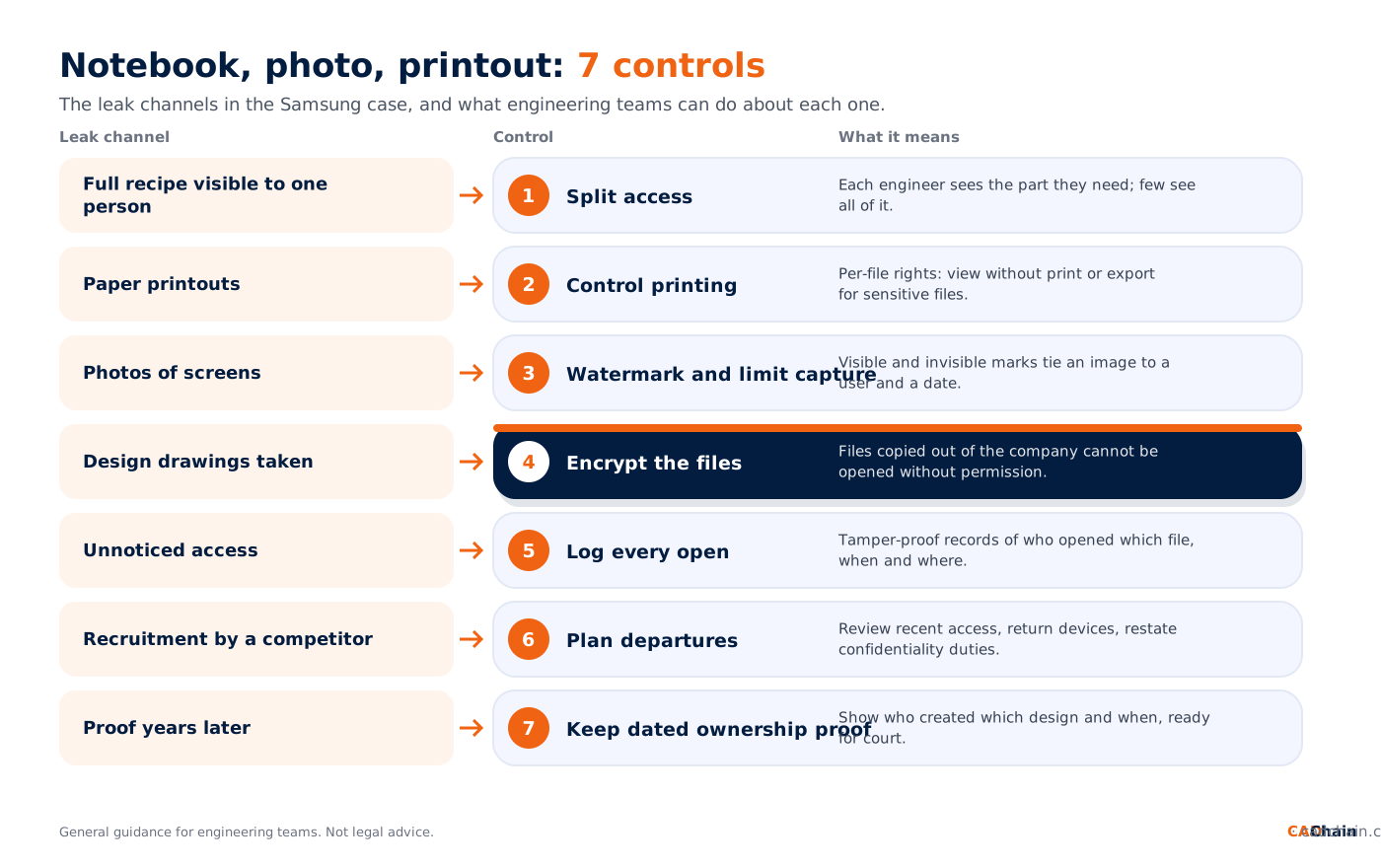
- Name your recipes. List the process plans, design drawings, test methods and parameter sets that would let a competitor skip years of trial and error. Treat them as trade secrets in writing.
- Split access. Give each engineer the part of the recipe they need. Few people should be able to open the complete set.
- Control print, export and capture. Set per-file rights so that sensitive documents and CAD files can be viewed without being printed, exported or screen-captured.
- Watermark what people see. Visible and invisible watermarks tie a photo or printout back to a user and a date.
- Log every access. Keep tamper-proof records of who opened which file, when and from where, and review unusual patterns before people leave.
- Plan departures. Exit interviews, reminders of confidentiality duties, device returns and a review of recent file access should be standard, especially when someone joins a competitor.
- Keep dated proof of ownership. When a dispute starts years later, proof of who created which design and when is what lawyers need first.
For a broader framework, see our guide to trade secrets for deep tech startups.
How does this fit the bigger picture?
Our sister sites covered other developments this week.
- New ways for design data to leave a company. Autodesk's October 2026 Fusion update adds copying designs across hubs in the browser, with referenced designs copied too. Read what the Fusion October 2026 update means for Inventor teams on borisinventor.com.
- Who can open your files. SOLIDWORKS for Makers requires its October platform update from 25 October, and native files made with it are watermarked and cannot be opened in commercial versions. Our sister site explains what the SOLIDWORKS for Makers update means for freelancers and hand-offs.
- Copying a character, not a style. The illustrator of The Gruffalo is considering legal action over ChatGPT copies of the Gruffalo characters. Blended BORIS looks at what the Gruffalo AI dispute means for 3D character artists.
Conclusion
The Seoul High Court's ruling on 22 October 2026 cut Jeon's sentence to five years, but it confirmed the core finding: Samsung's DRAM process recipe was national core technology, and leaking it to CXMT caused irrecoverable damage. The case shows how a process recipe of more than 600 steps, copied by hand and photographed, can end up at the centre of a competitor's production, as prosecutors allege.
Korea is now pushing for tougher penalties, but punishment comes years after the damage. For engineering companies anywhere, the practical answer is to make copying harder, make every access visible and keep proof that will stand up in court. That starts with the files themselves.
Make every design file traceable. CADChain gives engineering teams file-level access control, access logs and blockchain proof of ownership for CAD files, so leaks are harder and evidence is ready.
👉 Protect your CAD files with CADChain
FAQ: Samsung DRAM leak to CXMT
What did the Seoul High Court decide on 22 October 2026?
It reduced the sentence of former Samsung engineer Jeon from seven years to five years in prison for leaking Samsung's DRAM process technology to CXMT, citing his limited role, his testimony in related trials, his admission on appeal and his remorse.
What technology was leaked to CXMT?
Samsung's DRAM process recipe plan, a detailed plan of more than 600 manufacturing steps for its 18-nanometer, 10-nanometer-class DRAM. Korean courts classified it as national core technology.
How was the Samsung process recipe leaked?
According to Korean reporting, a former Samsung process engineer copied process information by hand into a notebook before leaving. Investigators later found a PowerPoint file of photos of the recipe on a server, and the leak was also linked to paper printouts.
How long are prison terms for chip technology leaks in Korea?
A Korea JoongAng Daily analysis of 24 cases over 20 years found that about half of 90 defendants went to prison, for an average of about two years and seven months.
Is Korea making penalties tougher?
A revised Criminal Act extending espionage to all foreign states took effect on 13 September 2026. Proposals for a ten-year minimum sentence and higher fines have not passed yet.
Can file-level protection stop handwritten notes?
Not on its own. It limits who sees the full recipe, blocks printing, export and screen capture where needed, and logs every access, so copying is harder and evidence easier to find.
How does CADChain help against insider leaks?
CADChain encrypts CAD files, sets per-file permissions, logs every access and records blockchain proof of ownership, so companies can limit who sees sensitive designs and prove what happened if a dispute starts.