South Korea's Supreme Court has ruled that money a former LG Chem expert received before he leaked polyolefin elastomer (POE) production secrets to a Chinese company's partner can still be confiscated as criminal proceeds. The ruling by the court's Third Division, reported on 4 November 2026, overturned an appeal decision that had dropped the confiscation, and sent that question back to the Seoul High Court. The engineer's three-year prison sentence stands.
The case is small in money terms: about 45 million won paid in ten instalments between October 2023 and February 2024. But the legal point is large. The appeal court had refused to confiscate the money because most of it arrived before the actual leaks and some of it paid for meetings and answers to technical questions. The Supreme Court said timing alone does not decide whether money is payment for a crime, and that activities serving the same purpose as the leak count too.
For engineering companies the facts matter even more than the legal test. What left LG Chem was not a database dump. It was photos of a production conditions table and of a process flow diagram the engineer drew from material he had been told to delete or return when he resigned. That is the kind of leak file-level controls alone cannot stop, and it is worth studying closely.
TL;DR: Korea's top court follows the money in a trade secret leak
A former LG Chem POE expert, who resigned in January 2024, kept trade secret material the company had asked him to delete or return, and sent photos of it to a business partner of a Chinese petrochemical company on 30 January and 28 February 2024. He received about 45 million won in ten payments from October 2023, mostly before the leaks. The trial court jailed him for three years and confiscated the money; the appeal court kept the sentence but dropped the confiscation. The Supreme Court reversed that part: payments made before a leak, and payments for meetings that served the same goal, can all be confiscated. Lesson for engineering teams: the riskiest window is the months before an expert leaves, and the leak may be a phone photo, not a file.
What did Korea's Supreme Court decide?
According to the Seoul Economic Daily's report on the ruling, the Supreme Court's Third Division, with Justice Lee Sook-yeon as the reporting justice, overturned the appeal ruling on confiscation and remanded the case to the Seoul High Court. The defendant, identified only as A, had been convicted of disclosing trade secrets abroad under Korea's Unfair Competition Prevention and Trade Secret Protection Act and of occupational breach of trust.
The court applied Korea's law on the concealment of criminal proceeds. Its reasoning, as reported by several Korean outlets, has three parts. First, whether money counts as criminal proceeds depends on whether it was paid as consideration for the criminal act. Second, the fact that a payment came before or after the act is not, on its own, a reason to deny that link. Third, when part of what was paid for is not itself a crime, such as attending meetings or answering questions, the whole sum can still be confiscated if those acts were incidental to, and served the same purpose as, the leak.
The court also explained why it matters. As reported by eToday, it said that protecting Korean companies' trade secrets and the international competitiveness of domestic industry requires more than strict punishment: confiscating criminal proceeds is needed to remove, at the root, the economic incentive to leak. The exact pronouncement date and case number were not published in the reports we checked.
How did the POE production secrets leave LG Chem?
POE is a polymer used in car parts, electrical wiring and solar modules. LG Chem's lawyers told the trial court that the company is the only Asian producer with its own POE technology and the second largest in the world after ExxonMobil, which explains why the know-how was worth chasing.
The defendant was a long-serving technical expert who had worked on POE plant expansion and production, had led a production team and had received a commendation from the Prime Minister. Korean reports describe the sequence like this:
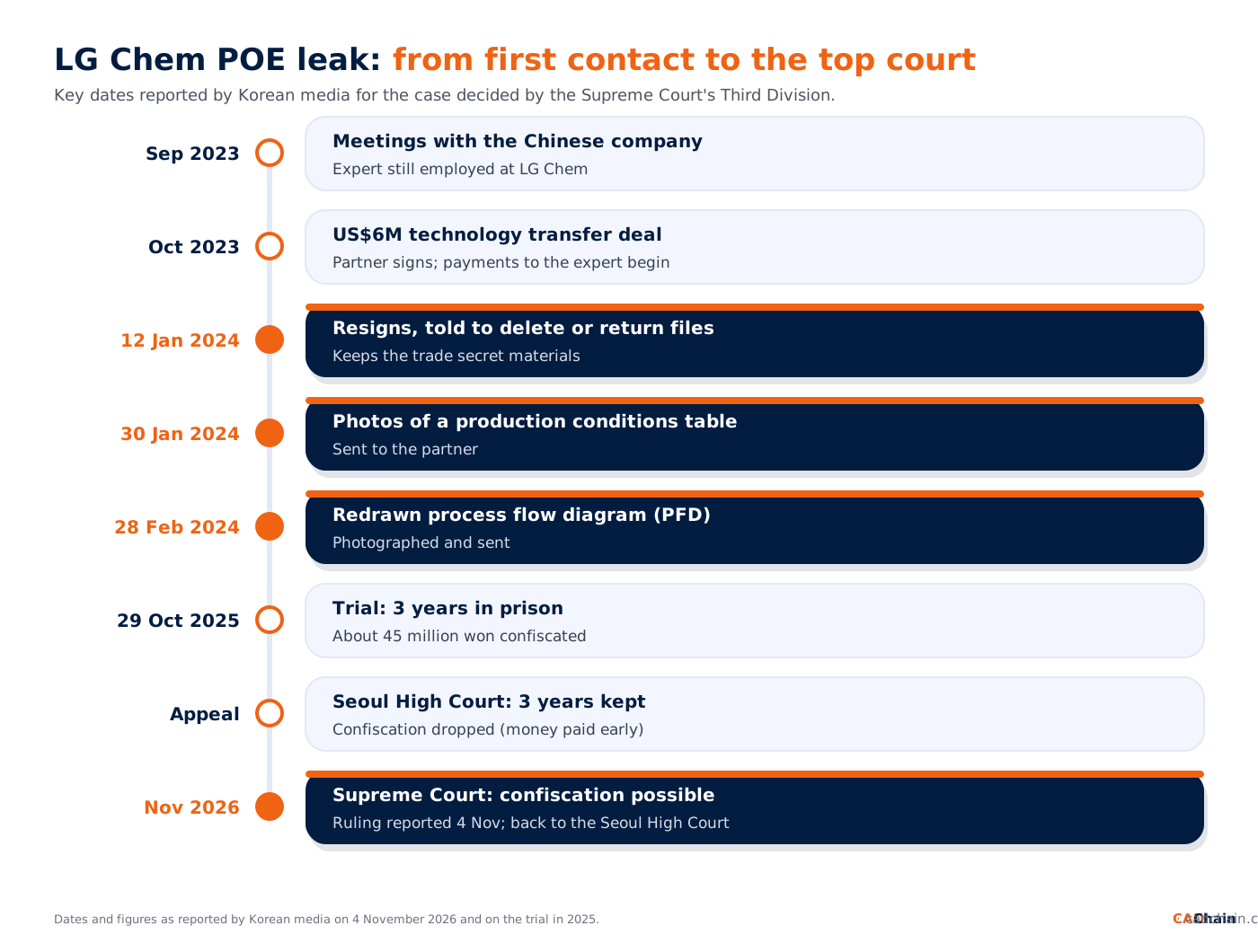
- September 2023: while still employed, A met staff of Liaoning Dingjide, a Chinese petrochemical company looking for POE experts.
- October 2023: B, the head of a partner company, signed a US$6 million technology transfer agreement with the Chinese company through a US entity he runs. The same month, payments to A started and, according to Hankyung's coverage of the trial, A began searching a large volume of internal POE documents.
- October to December 2023: technical questions and answers with the Chinese side, and further meetings.
- 12 January 2024: A resigned. LG Chem asked him to delete or return the materials. He kept them.
- 30 January 2024: A sent B photos of a POE production conditions table.
- 28 February 2024: using the material he had kept, A drew a POE process flow diagram, photographed it and sent it to B.
The plan reportedly covered 10 to 12 transfers, of which only two or three took place. The leak was caught because LG Chem noticed abnormal access to A's POE technical files and reported it to the police. The Seoul Metropolitan Police Agency investigated, and Korean reporting credits the fast start of that investigation with stopping much of the core technology from reaching China.
Why did the appeal court drop the confiscation?
The Seoul Central District Court's 28th Criminal Division sentenced A to three years in prison on 29 October 2025 and ordered him to forfeit about 45 million won, the total of 30.5 million won and US$10,188 he received from B in payments described as salary. Both defendants were taken into custody after the verdict.
The Seoul High Court kept the three-year term but ordered no confiscation. Its reasoning was that most of the money arrived before the leaks, that A also did other things for it, such as meeting Chinese officials and answering technical questions, and that there was no basis for calculating which share paid for the crime. The Supreme Court rejected that approach, and the High Court must now decide the confiscation again.
The case fits a pattern we have followed closely. In the Samsung DRAM leak to CXMT, an appeal court cut a former engineer's sentence, and in the case of Samsung's former IP chief jailed on appeal, the court treated patent analyses as trade secrets too. Korean courts are now looking hard at both the people and the money.
What does the ruling mean outside Korea?
The ruling applies Korean law, so it does not bind courts in Europe or the US. Its value is the reasoning. Leaks of engineering know-how are rarely a single act: there are introductions, consulting fees, meetings, "advisory" contracts and only then the transfer of files or drawings. Courts that look only at the moment of transfer can miss most of the deal. The Korean court looked at the whole arrangement.
In the EU, the Trade Secrets Directive (EU) 2016/943 sets civil rules, and criminal penalties stay national. Under the directive, information is only a trade secret if its holder took reasonable steps under the circumstances to keep it secret, and damages can take account of the unfair profits the infringer made. Our explainer on trade secret protection for CAD designs sets out what reasonable steps look like for engineering files, and our trade secrets guide for deep tech startups covers the basics.
Geopolitics adds pressure. China's commerce ministry has published draft rules on trade secret sanctions against foreign entities, so European engineering companies face trade secret risk from both directions.
Why were photos enough to move the know-how?
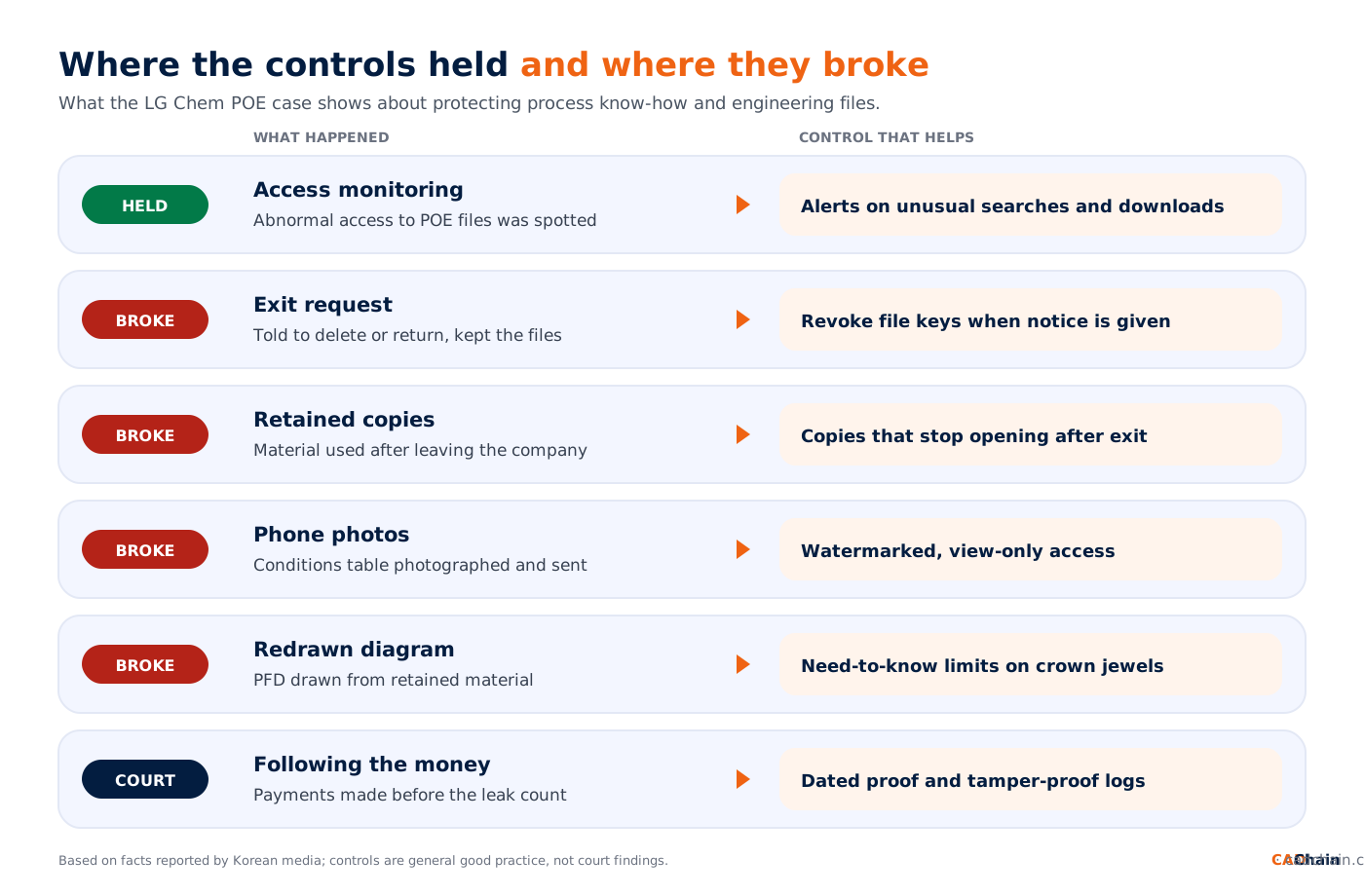
Process know-how is compact. A production conditions table is one page of temperatures, pressures, ratios and timings. A process flow diagram shows how a plant fits together. Neither needs a big file transfer, and both can be photographed with a phone or redrawn from memory. Encryption and access rights protect the file, but once an authorised person can see the content, a camera can copy it.
That is why the strongest protection is layered. Our guide to screenshot and screen recording threats to CAD IP explains how visible watermarks, view-only modes, limits on what each person can open and training reduce the risk, and why no tool removes it. What file-level control does add is evidence: who opened which drawing, when, and how often. That is exactly what tipped off LG Chem, and it is what prosecutors and courts rely on later.
The other weak point is the exit. LG Chem asked the engineer to delete or return the materials, and he kept them. A request is not a control. Access that can be revoked after a file has been shared and copies that stop opening when the person leaves remove that option. Our article on former employee IP theft and CAD file exfiltration lists the warning signs in the months before someone resigns.
What should engineering teams do now?
- List your crown jewels. Production conditions, process flow diagrams, recipes, tolerances and test data deserve the same protection as CAD models. Mark them and limit who can open them.
- Watch the months before departures. In this case, contact with the other side started months before the resignation. Alerts on unusual searches and downloads are cheap compared with litigation.
- Turn exit requests into exit controls. Revoke access to sensitive files when notice is given, not on the last day, and document what was returned and deleted.
- Plan for the camera. Use watermarked, view-only access for the most sensitive drawings so a photo can be traced back to a person and a time.
- Keep evidence that courts accept. Tamper-proof audit trails and records of legal proof of CAD file ownership show what you owned, who saw it and when.
- Follow the money in investigations. Consulting fees, advisory contracts and "salaries" from third parties before someone leaves are part of the picture, as this ruling shows.
- Do not rely on contracts alone. NDAs are not enough for CAD protection; they work best alongside technical controls.
- Brief engineers on job offers. Explain what they may and may not take or discuss, as the Apple v. OpenAI trade secrets case shows for engineers who change jobs.
Know who opens your most sensitive engineering files. CADChain records ownership of CAD files on a blockchain, encrypts files at file level, lets you set and revoke permissions for every user and logs each access, across CAD systems.
👉 Protect your CAD files with CADChain
How does this fit the bigger picture?
Trade secret theft by insiders sits next to outside attacks on the same engineering data, a link we explored in our piece on competitor industrial espionage and CAD file theft tactics. Our sister sites covered related stories this week:
- Remote access as the way in. SonicWall fixed an SSL-VPN flaw that lets valid credentials bypass SAML login and MFA, and CISA added it to its exploited list. Solidboris.com explains what the SonicWall VPN vulnerability means for SOLIDWORKS data behind the VPN.
- Engineers' machines as the target. Binance said its October incident began on engineers' computers, through a tampered tool installation and a fake recruiter's coding test. BORIS Inventor covers what the Binance hack teaches Inventor and Vault teams about workstations.
- Creative works and AI training. Elvis Presley rights holders and Eminem's publisher sued the AI music company Suno on 6 November. Blended BORIS explains what the Suno lawsuits mean for 3D artists.
Conclusion
The LG Chem POE case shows how engineering know-how really leaves a company: through months of contact, payments labelled as salary, materials kept after resignation and a few phone photos. Korea's Supreme Court has now made clear that money paid before the leak, and money paid for meetings that served the same goal, can be taken away.
For engineering teams, the practical message is to protect process documents like CAD models, close access before people leave, plan for photos, and keep evidence that shows who saw what and when. Courts can remove the profit from a leak, but only companies can make the leak harder in the first place.
Close the gaps before an expert walks out. CADChain gives every CAD file a verifiable ownership record, file-level encryption, granular permissions that you can revoke and a full access log, so you keep control of your designs and the evidence to back it up.
👉 See how CADChain protects CAD files
FAQ: LG Chem trade secret leak and the Supreme Court ruling
What did Korea's Supreme Court decide in the LG Chem POE case?
The Supreme Court's Third Division, in a ruling reported on 4 November 2026, held that money a former LG Chem expert received before leaking POE production secrets can be confiscated as criminal proceeds. It overturned the appeal court's decision not to confiscate and sent that question back to the Seoul High Court. The three-year prison sentence stands.
What technology was leaked?
Production know-how for polyolefin elastomer (POE), a polymer used in car parts, electrical wiring and solar modules. The leaked material included photos of a production conditions table and of a process flow diagram the engineer drew from retained material.
Who received the information?
B, the head of a partner company, who had signed a US$6 million technology transfer agreement with Liaoning Dingjide, a Chinese petrochemical company, in October 2023.
How much money was involved?
The engineer received about 45 million won in ten payments between October 2023 and February 2024: 30.5 million won and US$10,188, described as salary and other payments.
Why does it matter that the money was paid before the leak?
The appeal court treated early payments as hard to link to the crime. The Supreme Court said timing alone does not break the link, and that payments for supporting acts such as meetings with the same goal can be confiscated in full. That makes it harder to disguise payment for a leak as consulting fees or salary.
How was the leak discovered?
LG Chem noticed abnormal access to the engineer's POE technical files and reported it to the police, according to Korean reporting on the trial. Only two or three of a planned 10 to 12 transfers took place.
Can file-level DRM stop someone photographing a drawing?
No tool can stop a camera pointed at a screen. Watermarked, view-only access makes photos traceable, need-to-know limits reduce what one person can see, and access logs show who opened which file and when, which is how this leak was detected.
How does CADChain help protect process and design documents?
CADChain records ownership of CAD files on a blockchain, encrypts files at file level, lets you set and revoke permissions per user and logs every access. It does not replace legal advice, contracts or exit procedures.