On 27 October 2026, the Seoul High Court upheld a three-year prison sentence for Ahn Seung-ho, who ran Samsung Electronics' IP Center until 2019, for using a leaked internal Samsung patent report in a US patent lawsuit against his former employer. The court revoked his bail and he was taken into custody in the courtroom. Two co-defendants, both former Samsung patent staff, received heavier sentences than at first instance.
The leaked document was not a chip design or a process recipe. It was an internal analysis of another company's patents: Samsung's own view of whether those patents were valid, what prior art it had found, and how it planned to respond. The court held that this kind of document is a trade secret, even though the patents it discusses are public.
That matters for every company that holds patents, licenses technology or defends itself against patent claims. Freedom-to-operate studies, claim charts, design-around analyses and licensing strategy often sit in shared folders and IP management tools with weaker controls than the CAD vault. Below: what the court decided, how the report leaked, what a US court said about the same facts, and what IP, legal and engineering teams should do now.
TL;DR: Samsung's former IP chief, Seoul High Court, 27 October 2026
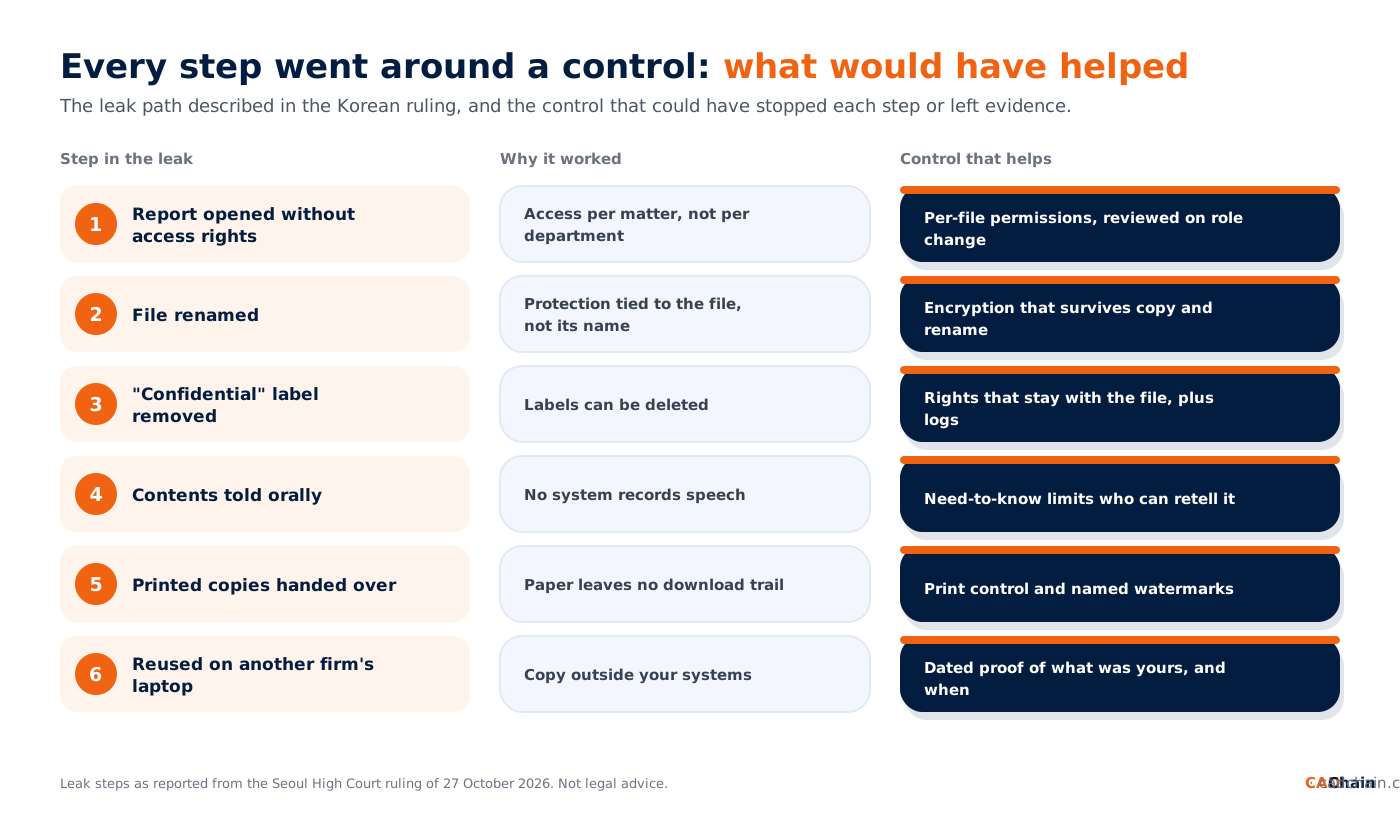
Ahn Seung-ho led Samsung's IP Center from 2010 to 2019, then founded Synergy IP, a patent assertion company. In 2021 Synergy IP and US audio patent owner Staton Techiya sued Samsung in Texas. A Samsung IP employee had passed Ahn an internal report on the Techiya patents, with Samsung's validity assessment, prior art and response strategy. A US judge threw out the patent case in May 2024 for unclean hands. A Seoul court sentenced Ahn to three years in February 2026, and the appeal court has now confirmed it, revoked his bail and raised the sentences of two co-defendants. Lesson: patent analyses and litigation strategy are trade secrets, and the people who know them best are your own IP staff.
What did the Seoul High Court decide?
Criminal Division 3 of the Seoul High Court, presided over by Judge Lee Seung-han, decided case 2026No636 on 27 October 2026, as Korea's Law Times reported. It rejected the appeals of both Ahn and the prosecutors and confirmed the conviction under Korea's Unfair Competition Prevention and Trade Secret Protection Act.
- Ahn Seung-ho, former head of Samsung Electronics' IP Center: three years in prison, as at first instance. His bail was revoked and he was detained in court.
- A former Samsung Electronics IP Center employee who leaked the report: three years, up from two years at first instance. Taken into custody.
- A former head of a Samsung Display patent filing group, tried in the same case: four years and forfeiture of 532,610,000 won (about 530 million won). Taken into custody.
Korean media reported that the court pointed to the betrayal of an employer for personal gain and to the fact that the two co-defendants had not adequately compensated the damage. The first-instance ruling came from the Seoul Central District Court on 11 February 2026, when prosecutors had asked for seven years and Ahn stayed free on bail. Korean reports said the defendants had seven days to appeal to the Supreme Court; no appeal had been reported when we published.
Why is a patent analysis a trade secret?
Ahn's defence argued that the report could not be a trade secret, because it discussed patents that anyone can read. The court disagreed. The patents are public; Samsung's assessment of them is not. The report contained Samsung's view on the validity of the Techiya patents, the results of its prior-art searches and its response strategy. The court found that this information was not easily available outside Samsung, that access to it was limited to authorised people, and that it had economic value because it would give the other side an advantage in negotiations.
Those are the three classic tests of a trade secret, and they match the definition in the EU Trade Secrets Directive (2016/943): secret, commercially valuable because it is secret, and subject to reasonable steps to keep it secret. A European court would likely ask the same questions. Our guide to trade secrets for deep-tech startups explains the tests, and what patents protect and what they cost covers the other side of the coin.
Ahn also argued that he was simply exercising the rights of a patent holder. The court rejected that too: passing Samsung's internal analysis and strategy to a foreign company was not a legitimate use of patent rights. It found intent to gain an improper benefit or to harm Samsung, for example by pushing it into unfavourable licence terms. The ruling does not stop anyone from asserting a valid patent. It stops them from doing so with the defendant's stolen playbook.
How did the report leak?
According to the Law Times report on the appeal ruling, the IP Center employee obtained the report without access rights. To hide the leak, he changed the file name and removed the "Confidential" marking. In August 2021 he first told Ahn what was in it, then handed over printed copies. Ahn passed them to Cho, a former Samsung in-house patent attorney who worked with him at Synergy IP. Investigators later found an analysis file on Cho's laptop that, the court found, had been prepared with reference to the Samsung report.
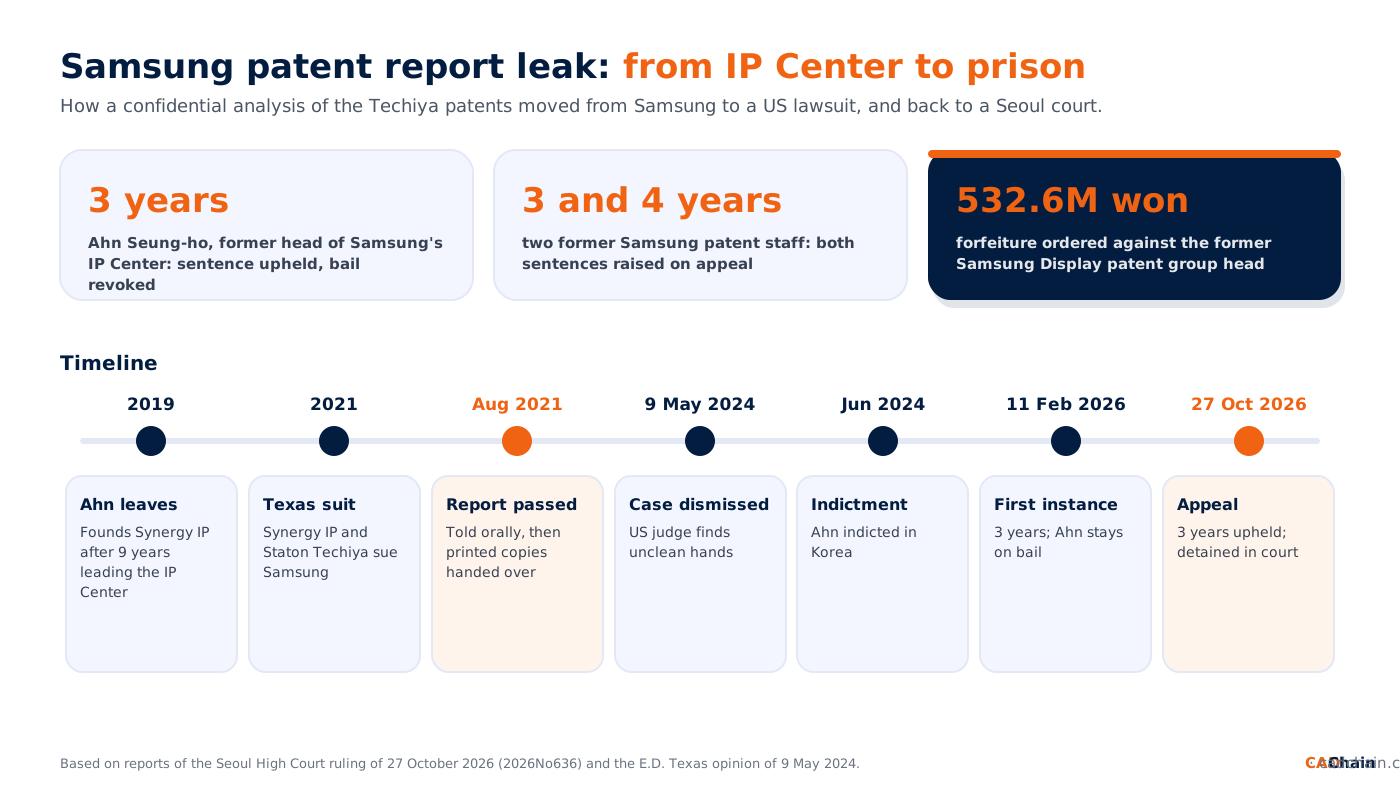
Every step in that chain beat a different control. Access rights were bypassed. The file was renamed, so a search for the original name would miss it. The confidentiality label was deleted, so anyone who saw the copy had no warning. The content moved by word of mouth and on paper, which no download log records. And the final use was a new file on another company's laptop. A label or a folder permission protects a document only while it stays where it was created. That is why we argue in CAD encryption vs access control that protection should travel with the file.
What did the US court say about the same facts?
In 2021, Synergy IP and Staton Techiya sued Samsung in the Eastern District of Texas over 14 audio patents. After a bench trial on Samsung's unclean hands defence, Judge Rodney Gilstrap ruled on 9 May 2024 that the patents could not be enforced against Samsung in that case and dismissed it. He found that Ahn and Cho had obtained confidential and privileged Samsung documents, relying in part on evidence from the Korean criminal investigation.
The ABA Journal quoted the opinion as finding a scheme that was "dishonest, unfair, deceitful and repugnant to the rule of law". The judge also noted that thumb drives and external storage devices disappeared before forensic examination, and that recordings seized in Korea showed the two men discussing ways to subvert discovery. He sent the opinion to bar disciplinary authorities in New York and California. Techiya said it had no knowledge of the misconduct and disputed the findings; Bloomberg Law later reported that Samsung and Techiya had settled.
Two lessons follow. A misused trade secret can cost the patent owner the whole case, even an owner who says it did not know. And the Korean criminal evidence helped decide the US civil case, so a leak investigation in one country can shape litigation in another.
Which documents in your company are like the Samsung report?
Most deep-tech and hardware companies hold documents of the same kind. They are often treated as legal paperwork rather than core IP, so they get less protection than CAD models or source code.
Design-around studies and claim charts are full of engineering content: CAD screenshots, cross-sections, tolerances and test data. That makes them both legal and technical secrets. Our legal framework for trade secret protection of CAD designs and 8-layer IP protection playbook show how to treat them.
Protect the files behind your patents. CADChain encrypts CAD files at file level, sets per-file permissions and logs every access, so design-around studies, prototypes and disclosure drawings stay protected wherever they are copied.
👉 See how CADChain protects CAD files
Why are IP and legal staff a special insider risk?
Ahn knew exactly what Samsung's IP Center held, because he had run it for nine years. The employee who leaked the report knew where to look and how to hide it. People in IP and legal roles see the most sensitive strategy documents in the company, often across many projects, and they keep that knowledge when they leave. Some go on to work for patent assertion companies, competitors or law firms on the other side.
The same pattern appears in engineering cases we have covered. In the Samsung DRAM leak to CXMT, a handwritten notebook and printouts carried process know-how out of the company. In the Huawei trade secrets trial, the case turned on what a company knew about one employee's conduct. And Apple v. OpenAI shows how quickly a job change turns into a dispute over files. Our guide to former employee IP theft covers the basics, as do our articles on employee IP agreements and why NDAs are not enough.
The same week brought a second Samsung case. The Seoul Economic Daily reported that Seoul prosecutors had indicted a university researcher under Korea's Industrial Technology Protection Act for moving Samsung EUV process data for unreleased chips to a personal cloud account during an industry-academia project in which he had employee-level access. Samsung reportedly detected the transfer quickly, and the court rejected an arrest warrant because he cooperated. Research partners, like IP staff, sit inside the trust boundary. Our report on the EPO technology transfer study looks at how European spin-offs and universities share IP.
What should IP, legal and engineering teams do now?
- Classify IP work products as trade secrets. List FTO and validity opinions, prior-art results, claim charts, design-around studies and licensing strategy, and give them the same protection level as your most important CAD models.
- Limit access per matter, not per department. An IP team member does not need every dispute file. Grant access per case and review it when people change roles.
- Use protection that cannot be stripped by renaming. Labels and file names are easy to remove. File-level encryption and permissions that travel with the file still apply after a copy, a rename or an upload.
- Control printing and screenshots for the most sensitive documents, and watermark what you do print with the user's name and the date.
- Log every access and keep the logs. Courts in Korea and the US relied on forensic evidence. Our guide to audit trail requirements for IP litigation explains what holds up.
- Handle departures of IP and legal staff carefully. Remove access on the last day, remind them in writing of confidentiality and professional duties, and check for unusual access in the weeks before they leave.
- Watch for your own documents in disputes. If a claimant seems to know your internal positions, preserve evidence early and ask counsel about remedies such as unclean hands or a disqualification motion.
- Keep dated proof of what you created and when. Timestamped records of designs and analyses help show what was yours, as we describe in CAD file ownership and legal proof requirements.
How does this fit the bigger picture?
This week our sister sites looked at other ways design data can slip out of a company's control.
- The VPN as an entry point. CISA added two more Ivanti Connect Secure flaws to its list of exploited vulnerabilities on 30 October 2026, after attacks that harvested credentials from the appliances. Read what the Ivanti Connect Secure zero-day chain means for SOLIDWORKS teams on solidboris.com.
- Actions that leave no log. A VMware ESX flaw that lets an administrator act without the actions being recorded is now on the same CISA list. Our sister site explains what the VMware ESXi logging flaw means for Inventor and Vault servers.
- Proof of what is real. Etsy's AI policy of 22 October 2026 requires sellers to show at least one unedited photo of the actual item. Blended BORIS covers what the Etsy AI policy means for Blender sellers.
Conclusion
Samsung's former IP chief is in prison because a report about other people's patents was treated, correctly, as Samsung's secret. The document was renamed, stripped of its label, retold and printed before it reached a US courtroom, and every one of those steps went around a control that lived outside the document.
For deep-tech companies the message is simple. Patent strategy is IP too. Protect the analyses, studies and drawings behind your patents as carefully as the designs themselves, keep logs that will stand up in court, and plan for the day your best-informed IP person leaves.
Make your design files carry their own protection. CADChain gives engineering and IP teams blockchain proof of ownership, file-level encryption, per-file permissions and access logs for CAD files, across CAD systems, partners and suppliers.
👉 Protect your CAD files with CADChain
FAQ: Samsung's former IP chief and the leaked patent report
What did the Seoul High Court decide on 27 October 2026?
It upheld the three-year prison sentence of Ahn Seung-ho, former head of Samsung Electronics' IP Center, for trade secret offences, revoked his bail and had him detained. It raised the sentences of a former Samsung IP Center employee to three years and of a former Samsung Display patent group head to four years, with forfeiture of about 530 million won.
What was the leaked document?
An internal Samsung report on the Techiya audio patents, with Samsung's assessment of their validity, prior-art search results and its response strategy.
How can an analysis of public patents be a trade secret?
The patents are public, but the owner's assessment and strategy are not. The court found the report was not easily known outside Samsung, access was limited, and it had economic value in negotiations.
What happened to the US patent lawsuit?
Judge Rodney Gilstrap of the Eastern District of Texas found unclean hands and dismissed Staton Techiya and Synergy IP's suit against Samsung in May 2024. Bloomberg Law later reported that Samsung and Techiya settled.
Is the Seoul ruling final?
Not necessarily. Korean media reported a seven-day window to appeal to the Supreme Court. No appeal had been reported when this article was published.
Would the same documents be protected in the EU?
Likely, if they meet the Trade Secrets Directive tests: secret, valuable because secret, and protected by reasonable steps. Access limits, marking and logs help prove the last point.
How can CADChain help?
CADChain encrypts CAD files at file level, applies per-file permissions, logs every access and timestamps files on a blockchain, so drawings and models used in patent work stay protected after copying. It does not replace legal advice.