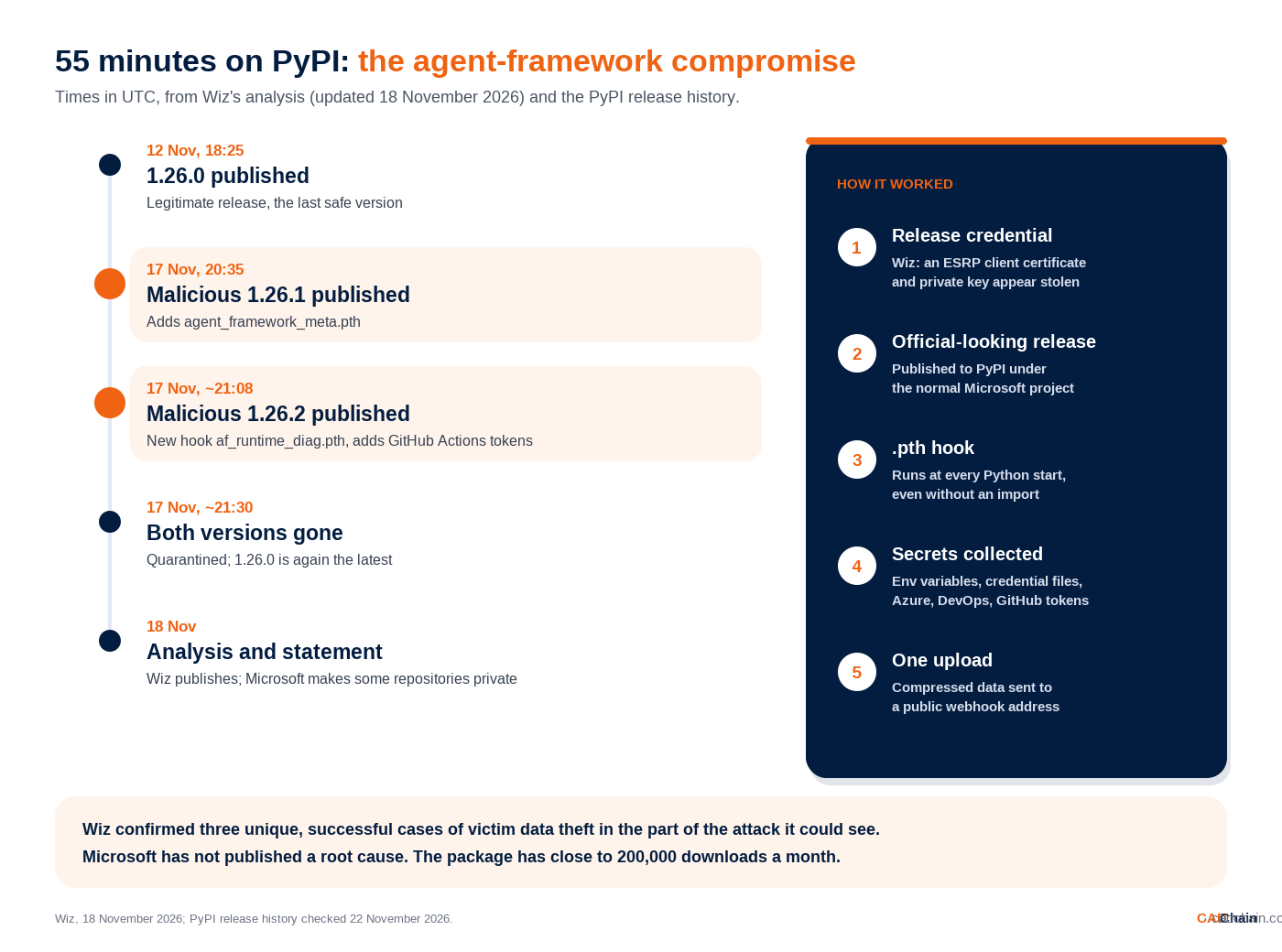
On the evening of 17 November 2026, two malicious versions of agent-framework, Microsoft's official Python package for building AI agents, were published to PyPI under Microsoft's own name. Versions 1.26.1 and 1.26.2 went live at 20:35 and about 21:08 UTC and were gone from the index by about 21:30 UTC. In those 55 minutes, anyone who installed or upgraded the package received a credential stealer that ran every time Python started. Cloud security company Wiz, which analysed the releases, says the attacker appears to have used a stolen client certificate and private key for Microsoft's own release pipeline.
The package is not obscure. Wiz counts close to 200,000 downloads a month, or about 41,000 a week, and it is the entry point for developers who build AI agents on Microsoft's stack. The malicious releases did not change the framework itself: according to a Cloud Security Alliance research note, they kept the normal dependency on agent-framework-core 1.26.0, so code using the package kept working while the hidden payload collected cloud, build pipeline and registry credentials and sent them to the attacker.
For engineering companies this is not a story about one Python library. More and more design teams run Python scripts and AI agents next to their CAD, PLM and simulation data: to automate drawings, generate reports, query part libraries or connect a model to a vault. The machines and build runners that run those scripts usually hold the keys to the storage, repositories and pipelines where the company's designs live. A package that was official, published through the vendor's normal release system and still malicious is exactly the case most software policies do not cover.
TL;DR: an official Microsoft package was turned into a credential stealer for 55 minutes
Malicious agent-framework 1.26.1 (20:35 UTC) and 1.26.2 (about 21:08 UTC) were published to PyPI on 17 November 2026 and removed by about 21:30 UTC. Each added a .pth file that runs at every Python start, even if agent-framework is never imported, and collected secrets from environment variables, credential files, Azure managed identities, Azure DevOps and, in 1.26.2, GitHub Actions. Wiz says the attacker appears to have used a stolen client certificate and private key for Microsoft's Engineering System Release Pipeline (ESRP); Microsoft has not published a root cause. Wiz found three confirmed cases of victim data being stolen in the part of the attack it could observe. The last safe version is 1.26.0. Lesson: a trusted publisher is not proof of a trusted file, and every machine that runs build or agent code should hold as few keys to your design data as possible.
What happened to Microsoft's agent-framework package on 17 November 2026?
The legitimate version 1.26.0 of agent-framework was published on 12 November 2026 at 18:25 UTC. Five days later, two versions that Microsoft had not released appeared on PyPI under the same project:
- 1.26.1, published at 20:35 UTC on 17 November. It added a file called agent_framework_meta.pth and a module whose file _telemetry.py held the stealer.
- 1.26.2, published at about 21:08 UTC. A repacked version that restored the normal start-up code, moved the hook to a new file called af_runtime_diag.pth and added theft of GitHub Actions identity tokens.
- Both removed by about 21:30 UTC. Wiz's analysis says both versions were quarantined. On 22 November, the PyPI project page lists 1.26.0 from 12 November as the latest release, and neither malicious version appears in the release history.
The trick that made the payload dangerous is a Python feature most developers never think about. Files ending in .pth inside a Python environment's site-packages folder are processed every time the interpreter starts, and a line in them can import code. So the stealer did not wait for anyone to use the AI framework. Any Python process started in an environment where the bad version was installed ran it: a test suite, a notebook, a build step, a CAD automation script. The code disguised itself as a "runtime diagnostics hook" and forked into the background so the user saw nothing.
How could an attacker publish under Microsoft's name?
This is the part that should worry every software and hardware company. According to Wiz, the attacker appears to have compromised a client certificate and private key for Microsoft ESRP, the Engineering System Release Pipeline that Microsoft uses to sign and publish this package. Wiz could follow part of the operation because the attacker's own tooling reported its progress to the same web address the stealer used for stolen data. Its first publishing attempt, from an AWS address, was rejected by IP filtering on the release pipeline. A second attempt from IP space owned by Microsoft succeeded. How the credentials were obtained is not known.
The Register reported a different possibility, citing researchers at OX Security who suspected compromised administrator credentials in Microsoft's GitHub organisation. A GitHub issue opened on the project describes a "likely compromised upload credential". Microsoft has confirmed neither account. In a statement to The Register on 18 November, a Microsoft spokesperson said: "We have made some repositories private while we investigate malicious content." The company added that its priority is to protect customers and the broader ecosystem. As of 22 November we found no root-cause report from Microsoft's security response centre.
Wiz also noted that the attacker's tooling identified itself as Cairn, an open-source AI penetration testing framework, and that the attacker tested the stealer on their own machine first. We have written before about attackers using AI agent frameworks for espionage against semiconductor and defence targets. The new element here is the target: not a company's servers, but the release machinery that thousands of companies trust automatically.
What did the stealer take?
Wiz's analysis lists what the two versions collected and sent out in one compressed upload:
- Secrets in environment variables whose names contain words such as TOKEN, SECRET, PASSWORD, KEY, AZURE, AWS, GITHUB, OPENAI, HF_, NPM, PIP and NUGET, plus secret-looking values read from up to 300 other running processes.
- Credential files: Azure CLI sessions, npm and pip configuration, .netrc, stored Git credentials, Docker logins, Hugging Face tokens, Azure DevOps build agent credentials, and .env and JSON files under /app and /workspace. Version 1.26.1 read up to 60 files, 1.26.2 up to 80.
- Fresh cloud identity tokens: Azure managed-identity tokens for 12 services, including Azure Resource Manager, Microsoft Graph, Key Vault, Storage, Azure AI and Machine Learning, Container Registry and Azure DevOps, plus Azure DevOps pipeline identity tokens.
- GitHub Actions tokens (1.26.2 only): in workflows allowed to request identity tokens, it asked for tokens that can be exchanged for Azure access.
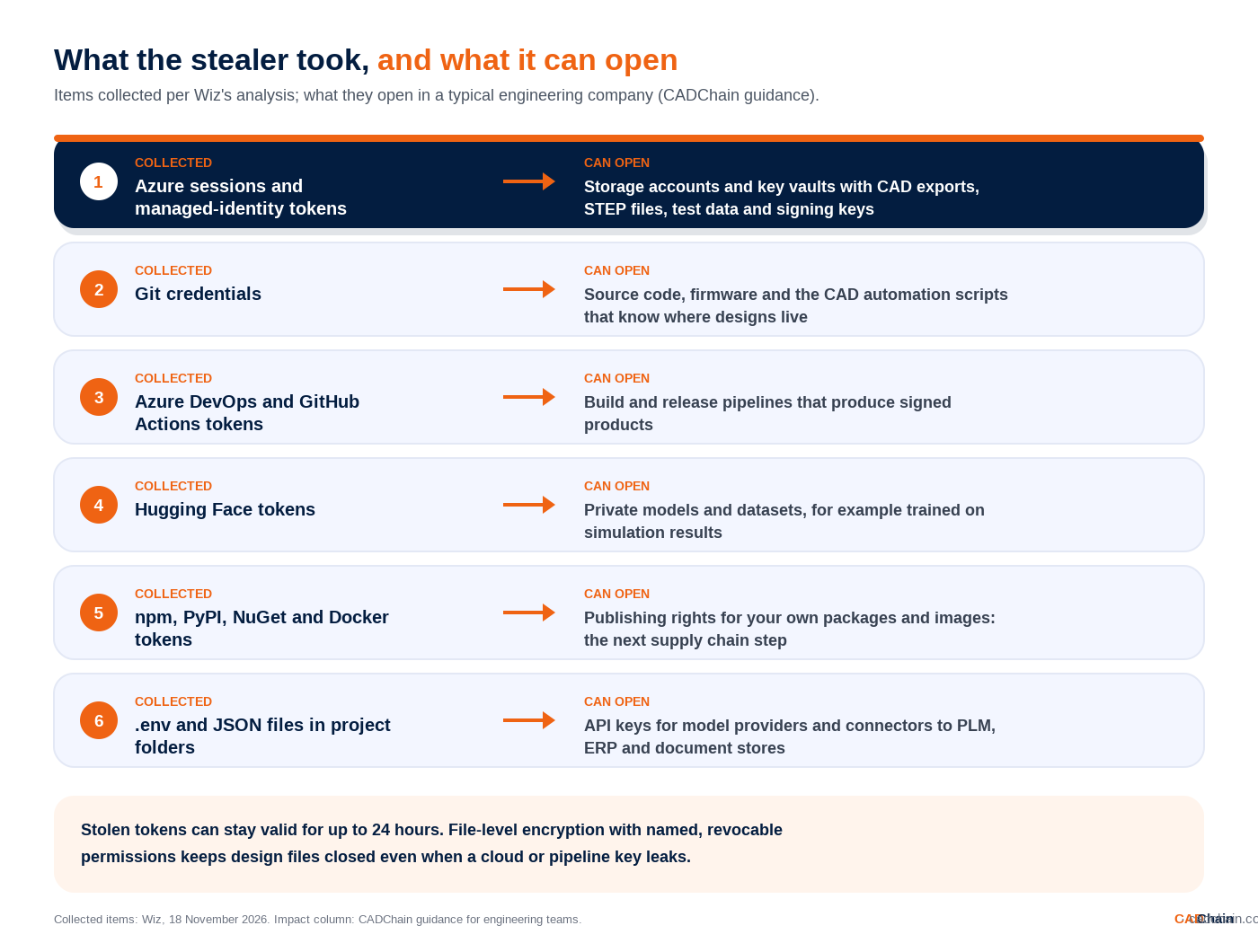
Wiz says stolen managed-identity and pipeline tokens can stay valid for up to 24 hours, which is long enough to copy a storage account, read a key vault or push a change into a build. The attacker used a free account on a public webhook service to receive the data, which capped what it could collect. Wiz saw at most 50 requests: four from the attacker's own machines, 29 from sandboxes, security scanners and tests, and 17 from real systems, which amounted to three unique, successful cases of victim data being stolen. That is a lower bound for the window Wiz could see, not a full victim count.
The table below sums up the three versions an engineering team may find in its environments.
Make stolen tokens less valuable. If a build runner or agent machine is compromised, CADChain-protected CAD files stay encrypted at file level, permissions can be revoked in one step and every open is logged, so a cloud key alone does not hand over your designs.
👉 Protect your CAD files with CADChain
Why should CAD, PLM and hardware teams care about a Python package?
Because the credentials the stealer went after are the same ones that guard engineering data. In a typical deep-tech company, the build server that compiles firmware, the notebook that trains a model on simulation results and the script that exports drawings from a PLM system all run Python, and they often run with broad cloud rights. Our checklist on third-party software vulnerabilities in CAD workflows makes the point that every add-in and library inherits the access of the machine it runs on.
Look at what each stolen item opens. An Azure Storage or Key Vault token can reach the blob containers and secrets where many companies keep CAD exports, STEP files, test data and signing keys. Git credentials open source code, firmware and the automation scripts that know where every design lives. Azure DevOps and GitHub Actions tokens open the build pipelines that produce signed products, which is how one compromised package can become the next supply chain attack. We described that chain in our article on the malicious update planted on Quantum Systems' update server, and the agent-framework case shows the same pattern one level higher, at the package registry.
Secrets left in files make it worse. Apiiro's research on passwords and keys leaked through AI coding tool settings in public GitHub repositories showed how often credentials sit in plain text in developer folders, exactly the .env and configuration files this stealer read. And because AI agents are built to connect to many systems, an agent project folder tends to collect more keys than an ordinary script: model provider keys, vector database credentials and connectors to document stores, ERP or PLM.
Is a signed or official package safe?
Not on its own, and this case shows why. The malicious versions came from the expected project, under the expected publisher, through what appears to be Microsoft's own release service. Version pinning by name alone would not have helped anyone who upgraded during those 55 minutes, and automated dependency updates would have pulled the bad versions in. The PyPI page shows that even the legitimate 1.26.0 was not uploaded with PyPI's Trusted Publishing and carries no provenance attestation, so there was little a consumer could have checked automatically.
It is also not the first time this year. Wiz recalls that another Microsoft Python package, durabletask, was compromised earlier in 2026 after its PyPI token was stolen; Wiz has not linked the two incidents. Together with the Optimizely hack that turned manufacturers' websites into malware distributors a few days ago and the Java4Shell flaw in the Java runtime under Jenkins, Artifactory and Keycloak, the week shows the same lesson three times: the shared software layer under engineering work is now a primary target.
For manufacturers selling into the EU, this is becoming a legal question as well. The Cyber Resilience Act expects manufacturers to manage the risk of third-party components across a product's life, and the first EN 40000 standards published on 18 November frame that as lifecycle risk management. A release pipeline that can be abused to ship malicious code is exactly the kind of risk those standards ask companies to identify, document and reduce.
What should engineering teams do now?
- Search every environment for the bad versions. Check lockfiles, CI logs, virtual environments, developer laptops and container images for agent-framework 1.26.1 or 1.26.2, and pin 1.26.0.
- Look for the hook files. Search site-packages for agent_framework_meta.pth and agent_framework_meta/_telemetry.py (1.26.1) and af_runtime_diag.pth and af_runtime_diag.py (1.26.2). Wiz warns that searching only for the first set misses 1.26.2.
- Check outbound traffic. Search proxy and DNS logs for the webhook.site address in Wiz's list of indicators. Any hit means data from that host left the network.
- Rotate every secret that was on an affected machine. Azure CLI sessions, Azure DevOps personal access tokens and service connections, Git credentials, npm, PyPI, NuGet, Docker and Hugging Face tokens, and every API key in environment variables and .env files.
- Audit cloud identities. Review Azure sign-in and activity logs for managed identities and federated credentials reachable from affected virtual machines, app services, Kubernetes nodes and pipelines, and for GitHub workflows that installed 1.26.2 with identity-token rights.
- Delay and review new versions. Use lockfiles with hashes, a short cooling-off period before automatic updates and an internal package mirror for build systems, so a release that lives for an hour never reaches your runners.
- Separate agent and build machines from design data. Give CI runners and AI agent hosts their own narrow identities, keep CAD vaults and storage out of their default reach and avoid long-lived keys in .env files.
- Protect the files, not only the accounts. Encrypt sensitive CAD files at file level with named, revocable permissions and an access log, so a stolen token does not equal stolen designs. Our guide to CAD encryption at rest, in transit and in use explains where each layer helps.
How does this fit the bigger picture?
Stolen keys, not broken encryption, are the thread running through this week's news across the CADChain network. If you use agents with public models, our comparison of European alternatives to the OpenAI API shows where those model keys and prompts are processed. Our sister sites covered the rest of the week:
- Stolen signing keys in the data centre. Google Threat Intelligence says a suspected China-nexus group exploited a VMware vCenter zero-day and stole the SAML signing key from the directory service to forge logins. BORIS Inventor explains what the vCenter zero-day means for Vault, licence and file servers.
- Updates you cannot skip. SOLIDWORKS 2027 SP0 was released on 20 November with Windows 11 only and new SQL Server and Office requirements. Solidboris.com lists what to check before installing SOLIDWORKS 2027 SP0.
- Who may use your content for AI. Etsy's new terms of use, effective 16 December 2026, add a right to use sellers' content to train AI, and Etsy has said it will revise them. Blended BORIS covers the Etsy AI training clause and what Blender sellers can do.
Conclusion
The agent-framework compromise lasted less than an hour, yet it reached the place where trust is most automatic: an official package from one of the largest software companies, published through its own release pipeline. Microsoft has not yet explained how its credentials were obtained, and the number of victims beyond the three cases Wiz could confirm is unknown. What is clear is what the attacker wanted: cloud sessions, pipeline tokens and registry keys, the credentials that lead from one developer machine to a company's code, models and designs.
Engineering teams cannot audit every release of every library their agents and scripts depend on. They can make sure that a compromised build runner or laptop holds as few keys as possible, that secrets rotate quickly and that the design files themselves stay protected, with access that can be revoked and a record of every open, even when an account or token falls into the wrong hands.
Keep your CAD files closed when a key leaks. CADChain gives every CAD file file-level encryption, granular permissions you can revoke at any time, a blockchain ownership record and a full access log, across CAD systems, suppliers and partners.
👉 Protect your CAD files with CADChain
FAQ: the agent-framework PyPI supply chain attack
Which agent-framework versions were malicious?
Versions 1.26.1 and 1.26.2 of the agent-framework package on PyPI, published on 17 November 2026 at 20:35 UTC and about 21:08 UTC. Both were removed by about 21:30 UTC. Wiz says 1.26.0 is the last safe version.
Was the agent-framework source code on GitHub changed?
The analyses we read describe malicious files added to the published PyPI packages, not changes to the framework code. The releases kept the normal dependency on agent-framework-core 1.26.0, so applications kept working while the stealer ran.
How did the attacker publish the packages?
Wiz says the attacker appears to have compromised a client certificate and private key for Microsoft's Engineering System Release Pipeline (ESRP), which signs and publishes the package. Other researchers suspected compromised GitHub administrator or upload credentials. Microsoft has not published a root cause.
Do I have to have imported agent-framework to be affected?
No. The malicious versions added a .pth file that Python processes at every interpreter start, so any Python process in an environment with 1.26.1 or 1.26.2 installed ran the stealer.
What data did the stealer collect?
Secrets in environment variables, credential files for Azure CLI, Git, npm, pip, Docker, Hugging Face and Azure DevOps agents, .env and JSON files under /app and /workspace, Azure managed-identity tokens for 12 services and, in 1.26.2, GitHub Actions identity tokens.
How many victims were there?
Wiz found three unique, successful cases of victim data being stolen among the requests it could observe. Because the attacker's free webhook account capped what was captured, that is a lower bound, not a full count. The package has close to 200,000 downloads a month.
What should I do if a machine installed a bad version?
Remove it and pin 1.26.0, delete the .pth hook files, check logs for the webhook address, rotate every secret that was on the machine and audit Azure and GitHub identity logs, since stolen tokens can stay valid for up to 24 hours.
How does CADChain help after a credential leak?
CADChain encrypts CAD files at file level, ties access to named people and partners, lets you revoke permissions at once and logs every access, so a leaked cloud or pipeline token does not give an attacker readable design files.