The best European alternative to Zapier in 2027 is n8n from Berlin: it builds AI agents and multi-step workflows, runs in n8n's cloud in Frankfurt or on your own servers, and starts at €20 a month. For no-code data flows with German-only hosting, pick Synesty from Jena; for enterprise integration that can even run air-gapped, Frends from Finland.
This guide compares six European alternatives to Zapier for engineering firms, manufacturers and deep-tech startups that automate quotes, orders, CRM updates, support tickets and, more and more, AI agents that read company data. For each tool we checked, on the vendor's own website on 26 November 2026, which company you sign the contract with, where your workflows and run logs are hosted, whether you can host it yourself, and what it costs. Three popular "European" picks failed that check, and Make, the closest like-for-like Zapier replacement, comes with an important note about its contract.
TL;DR: European alternatives to Zapier
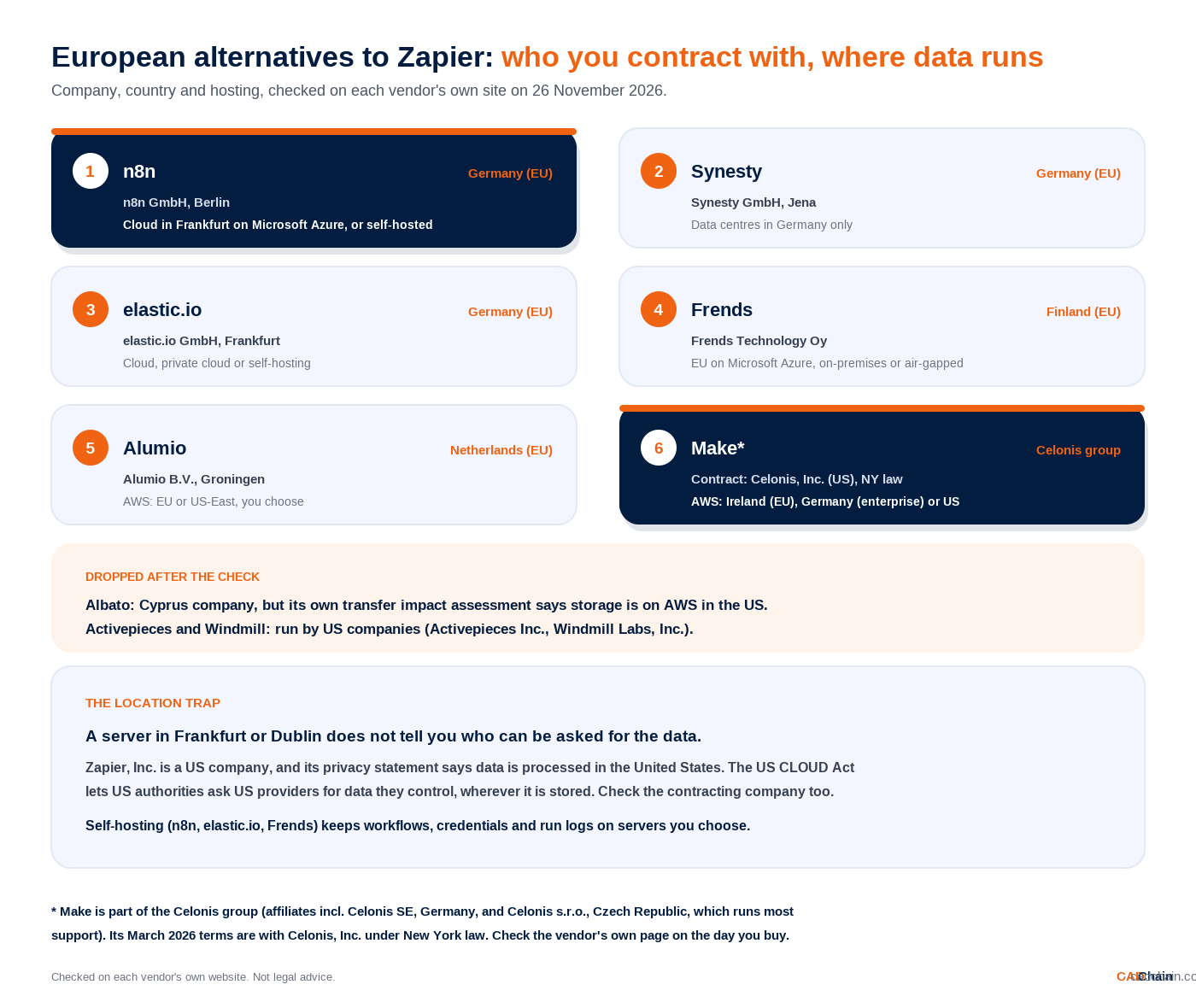
Best overall and for AI agents: n8n (n8n GmbH, Berlin), cloud in Frankfurt from €20 a month billed annually, or free to self-host with the Community Edition. No-code for shops, ERP and marketplaces: Synesty (Jena), data centres only in Germany, from €99 a month paid annually. Hybrid integration and white-label: elastic.io (Frankfurt), from €25 a month, self-hosting on request. Enterprise and regulated sectors: Frends (Finland), EU cloud, on-premises or air-gapped, price on quote. Commerce and ERP data layer: Alumio (Groningen), from €499 a month, EU hosting. Closest Zapier look-alike: Make, part of the Celonis group, with EU hosting in Ireland, but since March 2026 its standard contract is with Celonis, Inc. in the US.
Why are European companies looking for alternatives to Zapier?
The first reason is jurisdiction. Zapier's privacy statement names Zapier, Inc. of San Francisco and says information collected from its sites is transferred to and processed in the United States, and Zapier itself is a US provider. An automation platform is not a passive folder: it holds OAuth tokens and API keys for your CRM, ERP, mailbox and cloud drives, and it copies data between them on every run. Under the US CLOUD Act, US authorities can ask US providers for data they control, wherever it is stored. Our guide to GDPR compliance for CAD and document systems in Europe explains the transfer rules, and the EU Data Act and trade secrets article covers business data you hand to service providers.
The second reason is AI. Every tool in this list now sells AI agents or an MCP server that lets assistants such as Claude or ChatGPT trigger workflows. That is useful and risky at once: an agent with access to your automation platform can reach every system it connects to. The EU AI Act and rogue AI agents, the PyPI supply chain attack on an agent framework and the Cubist AI code theft lawsuit all show why engineering teams want to know where agent logs and credentials live. If you are choosing the model behind those agents too, see our European alternatives to the OpenAI API and European alternatives to ChatGPT.
The third reason is control and cost. Three of the six tools below let you run the engine on your own servers, so workflows, credentials and run history never leave your network, and several bill per workflow execution rather than per step, which matters for long AI workflows.
Zapier alternatives in Europe compared: country, owner, hosting and price
The table uses the same columns as every article in our European alternatives series. All six companies have their home in the EU; the Make row is flagged because its standard contract is with a US company. Prices exclude VAT and appear only where the vendor's own page showed them on 26 November 2026.
Checked on each vendor's own website on 26 November 2026. Make's plan prices did not display when we checked, so we list none.
1. n8n (Germany): the best European alternative to Zapier for AI agents
n8n's imprint names n8n GmbH, Novalisstraße 10 in Berlin, with Jan Oberhauser as managing director. Its pricing FAQ says data on hosted plans is stored in the EU, on servers in Frankfurt, and its security page says n8n cloud runs on Microsoft Azure, with backups replicated to a separate region in the same country. Self-hosted n8n runs wherever you put it.
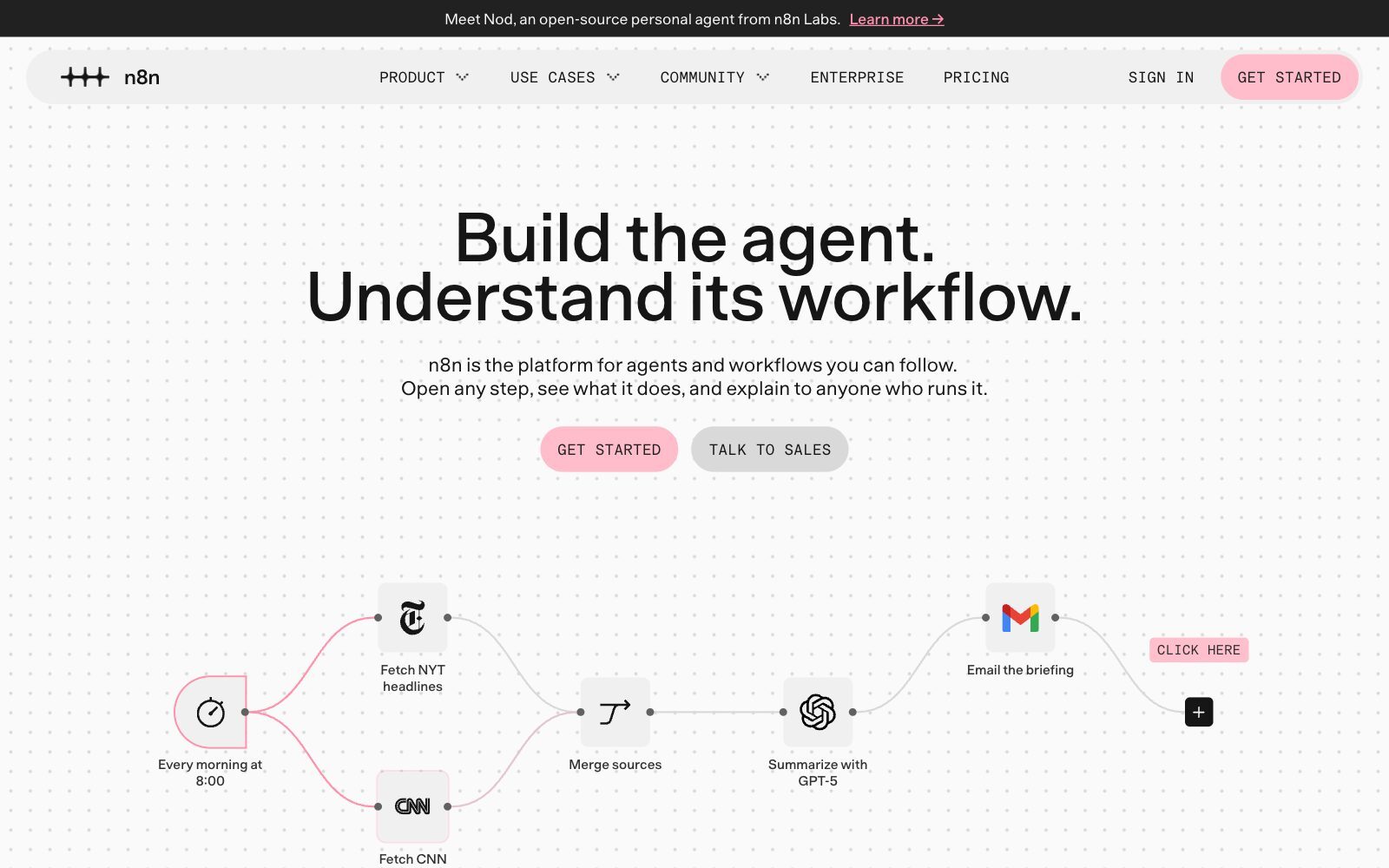
Strengths: a visual editor where AI agents, MCP and AI nodes sit next to ordinary integration steps, human approval for tool calls, and code steps when no-code is not enough. Cloud plans bill per workflow execution with unlimited steps: Starter €20 a month (2,500 executions) and Pro €50 a month (10,000 executions), both billed annually; Business costs €667 a month and is self-hosted only; companies under a size limit can apply for a startup discount on Business. The Community Edition on GitHub is free to self-host. Limits: the licence is fair-code (the Sustainable Use License), not an OSI open-source licence, so read it before you resell workflows; the hosted cloud depends on a US cloud provider, Microsoft. Who it suits: technical teams and startups building AI agents on company data. Migration notes: rebuild each Zap as a workflow, recreate credentials inside n8n, and self-host if your customers ask for on-premises processing.
2. Synesty (Germany): no-code automation with German-only data centres
Synesty's imprint names Synesty GmbH, Leutragraben 1 in Jena, with Christoph Rüger as managing director. Its homepage says it uses only data centres in Germany, and that a data processing agreement can be signed electronically in the backend. Synesty Studio builds API integrations and data pipelines for shops, ERP systems and marketplaces.
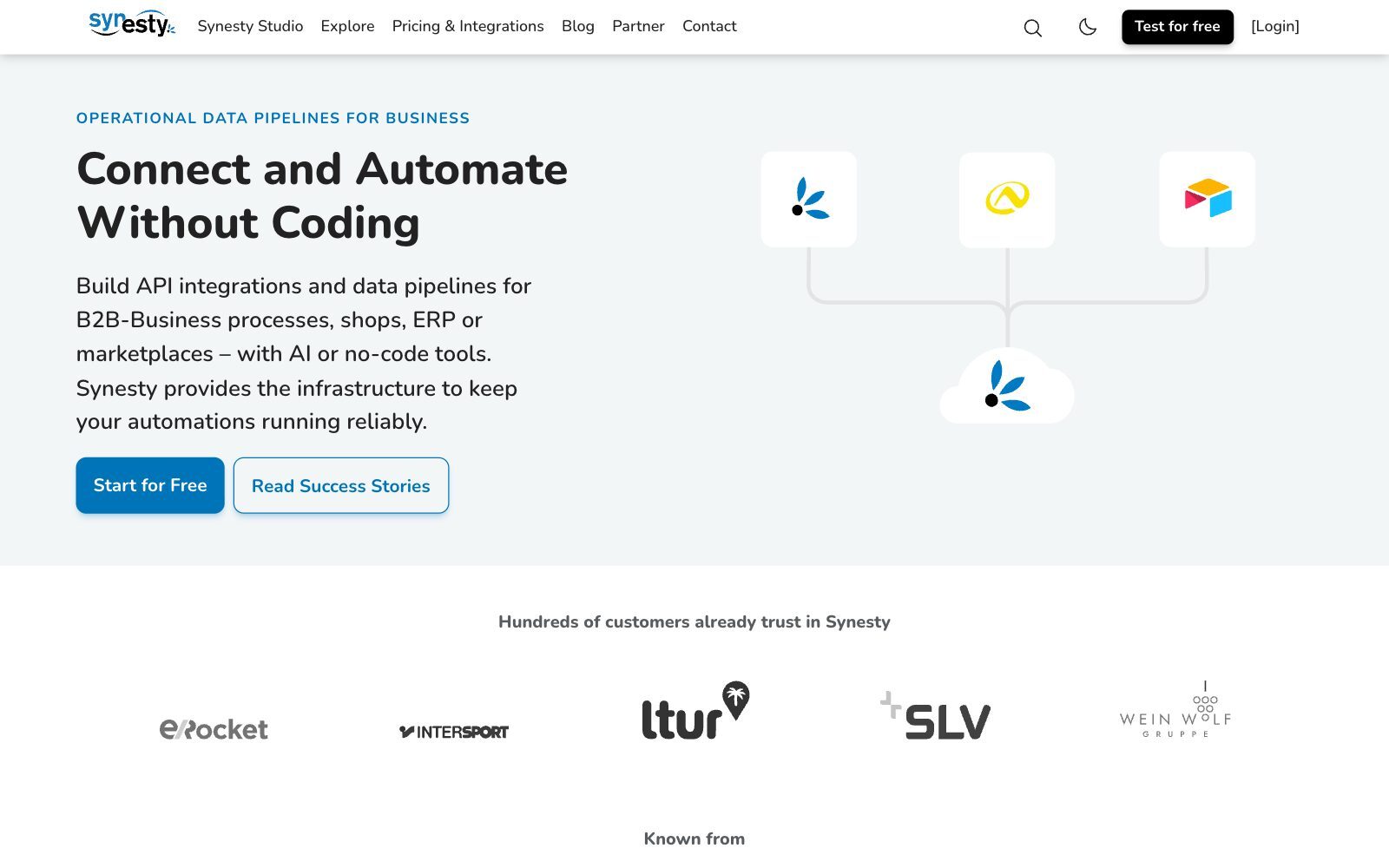
Strengths: more than 200 integrations, versioning of changes, data export and backup, and a Synesty MCP Server so you can design flows from ChatGPT or Claude and review them before they run. Essentials costs €99 a month when paid annually, and Plus features for teams cost €79 a month extra. Limits: the connector catalogue leans towards e-commerce and ERP, so check that your engineering tools are covered; no self-hosted edition. Who it suits: manufacturers and distributors that sync product data, stock and orders between ERP, shop and marketplaces. Migration notes: map Zaps that move product or order data first; they gain most from Synesty's data mapping.
3. elastic.io (Germany): hybrid integration with an on-premises agent
elastic.io's legal disclosure names elastic.io GmbH, c/o Tribes Business Centre, Baseler Straße 10 in Frankfurt, registered at the Bonn district court, with Pascal Lauria as authorised representative. It sells a low-code integration platform, an MCP product, enterprise integration for cloud and on-premises systems, and embedded integration for software vendors.
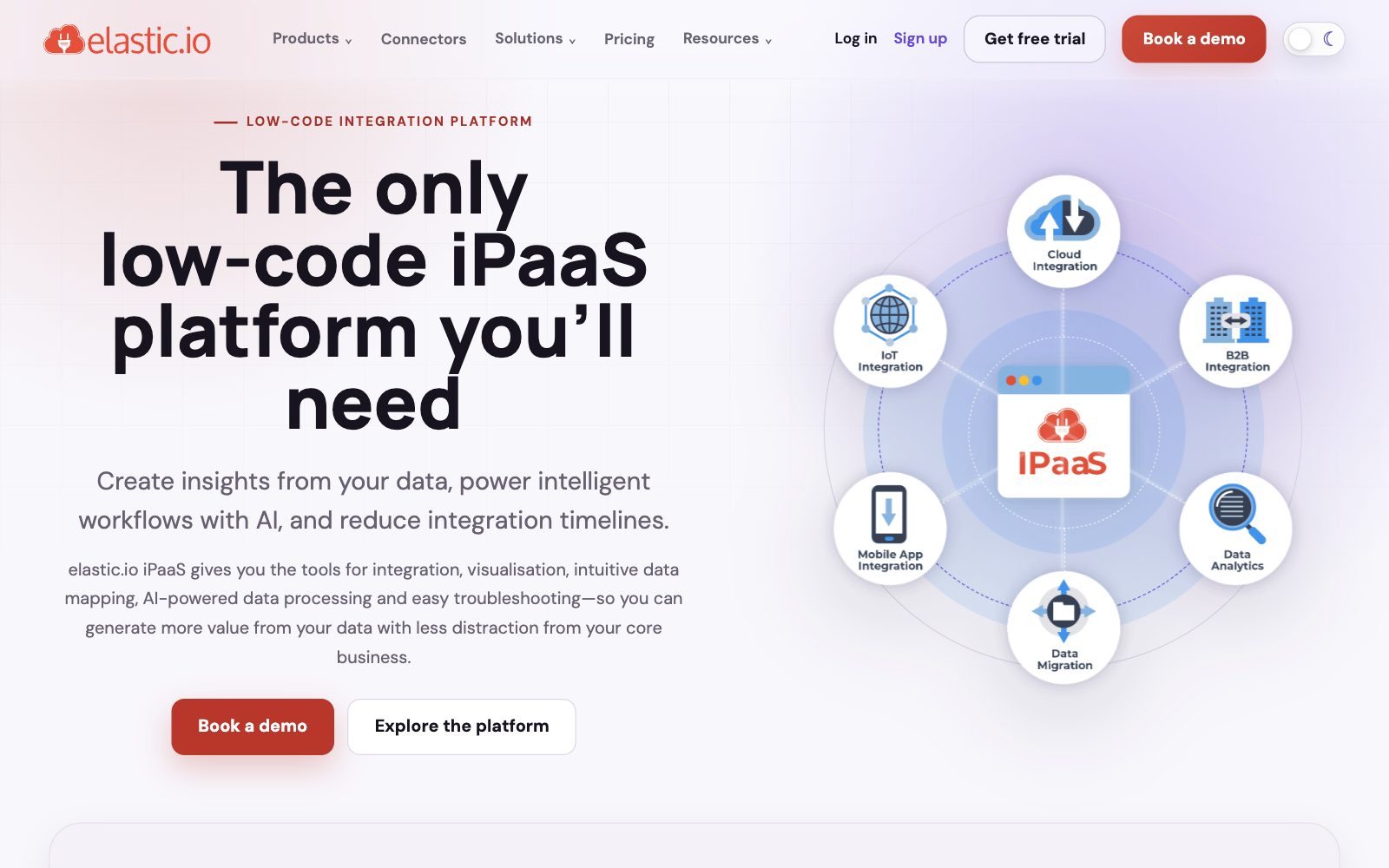
Strengths: an on-premises integration agent that connects systems behind your firewall, SDKs for custom connectors in Node.js and Java, white-label and multi-tenant options, and support during German business hours on Enterprise. Professional costs €25 a month billed monthly for one user, 10 active steps and 60,000 messages; paying annually saves up to 25%, and White-label and Self-hosting are priced on request. Limits: the site does not state which region the shared cloud runs in, so ask for it in the data processing agreement, or choose private cloud or self-hosting. Who it suits: companies connecting an on-premises ERP or PLM to cloud apps, and software vendors embedding integrations. Migration notes: install the on-premises agent before you move Zaps that reach internal systems.
4. Frends (Finland): enterprise iPaaS that can run air-gapped
Frends' terms of service name Frends Technology Oy. Its company history says Frends was founded in Finland in 1988, was acquired by the Swedish company HiQ in 2010 and has worked as a standalone iPaaS since 2022. Its own overview says Frends is headquartered in Finland, operates under EU jurisdiction and hosts Frends Cloud in the EU on Microsoft Azure.
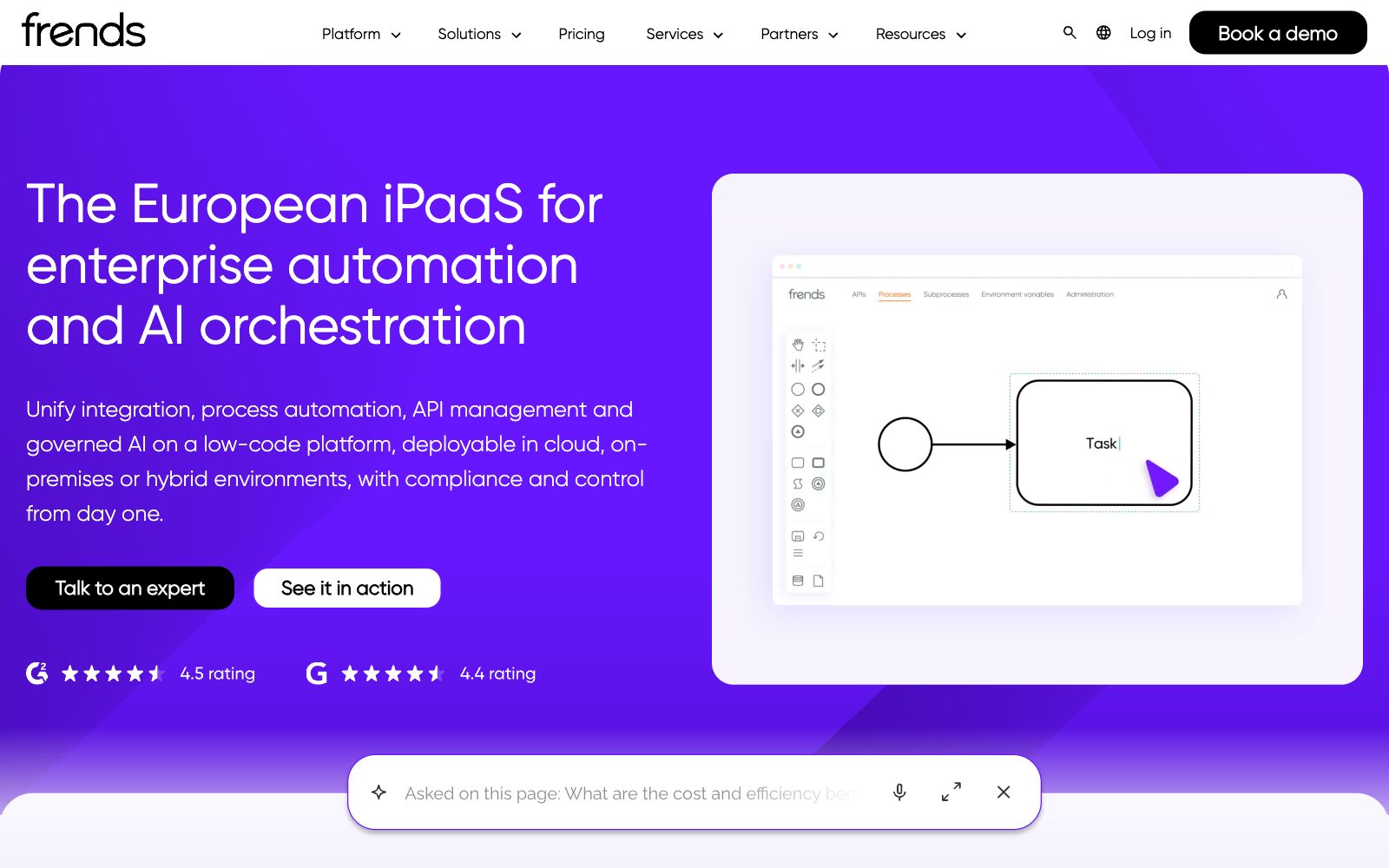
Strengths: processes are drawn in a BPMN 2.0 editor and compile to C# on .NET, with API management, an MCP trigger, AI workflows and, for air-gapped sites, local AI models through Ollama. You can run it as a cloud service, on your own servers, in Kubernetes or hybrid. It holds ISO 27001, ISO 9001 and ISO 14001 certificates. Limits: the Growth, Business and Enterprise tiers are priced on quote, with usage billed in Frends Credits at €10 per 1,000; it is built for IT teams, not for a marketer automating a newsletter. Who it suits: mid-size and large manufacturers, utilities and public bodies that need hybrid or isolated deployments. Migration notes: group Zaps into business processes, and move the ones touching regulated data to on-premises agents first.
5. Alumio (Netherlands): an integration layer for commerce and ERP data
Alumio's privacy policy names Alumio B.V., Laan Corpus den Hoorn 200 in Groningen, registered with the Dutch Chamber of Commerce, and its site lists offices in Hamburg, London and Stockholm. Its pricing page says plans run on EU-hosted, ISO 27001 certified infrastructure, with a shared or dedicated environment on AWS in the EU or US-East.
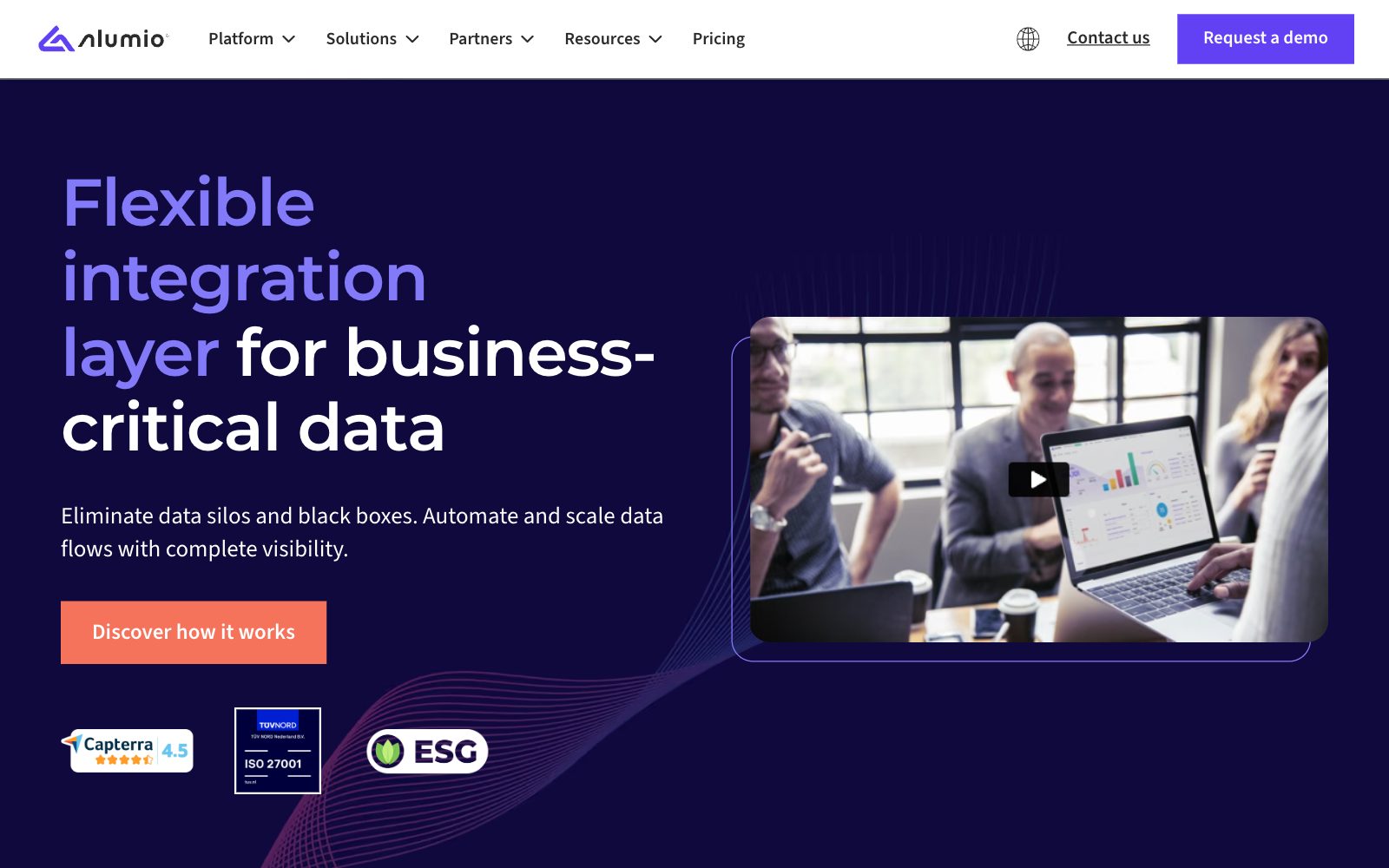
Strengths: connectors for e-commerce, ERP, CRM and PIM, real-time monitoring, logging and alerts, and production and sandbox environments from the first plan, which starts at €499 a month and scales by capacity. Limits: it is an integration platform for business data, not a cheap Zapier swap for small teams, and you must pick the EU region when you sign. Who it suits: manufacturers and wholesalers that sell online and need ERP, PIM and shop data in sync. Migration notes: ask for the EU environment in the order form, then move order and product flows one channel at a time.
6. Make (Celonis group): the closest Zapier look-alike, with a US contract
Make is the tool most lists name as the European Zapier alternative, so we checked it closely. Its sub-processor list names Celonis group companies as affiliates, including Celonis SE in Germany and Celonis s.r.o. in the Czech Republic, which provides most customer support. Customers choose AWS hosting in the US or in the EU: Ireland for self-service plans and Germany for enterprise. But Make's Master Services Agreement (March 2026) is between the customer and Celonis, Inc., a US company, under New York law, and its sub-processor list shows the AI services it uses from OpenAI, Anthropic and Google hosted in the US.
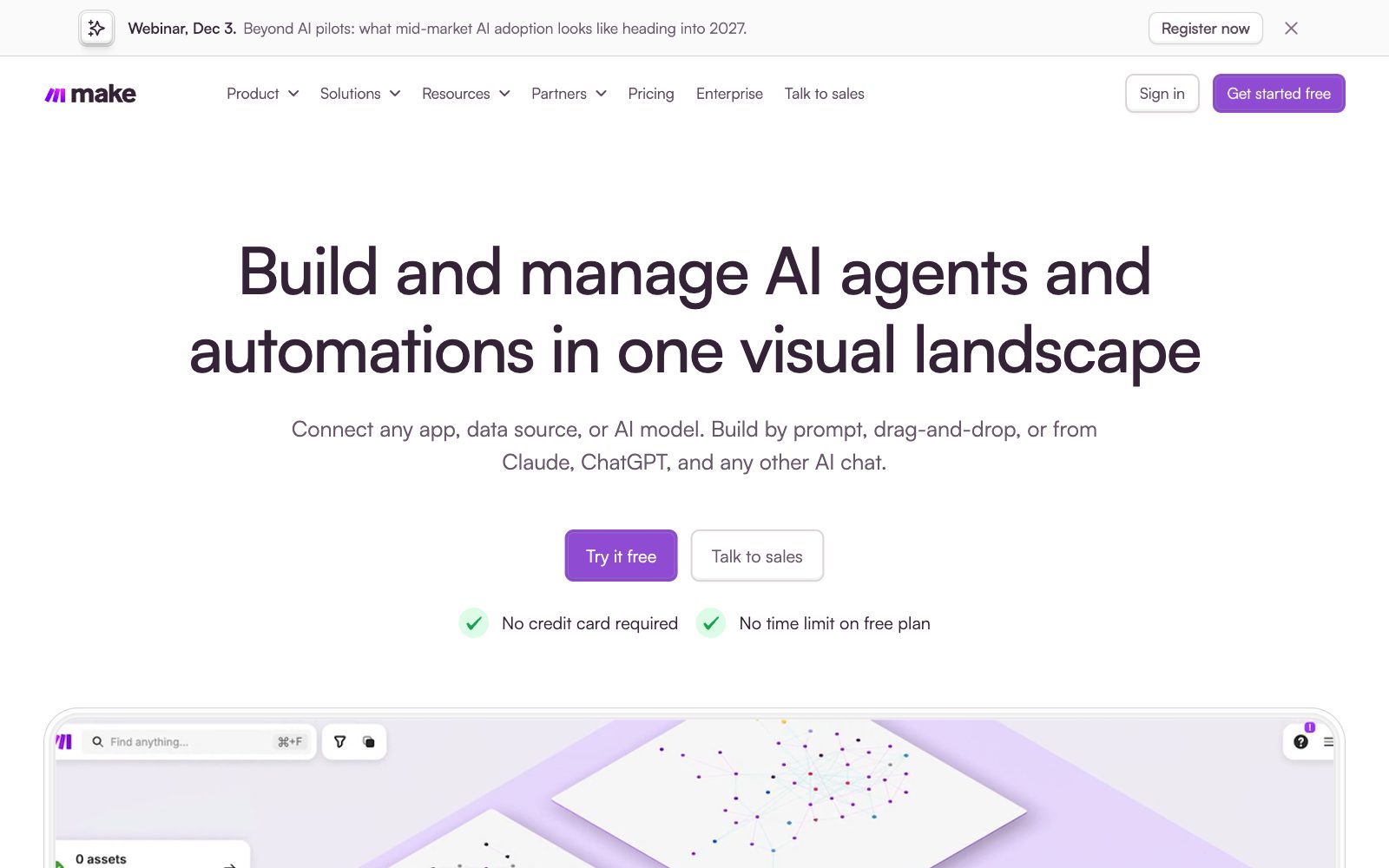
Strengths: the visual scenario builder is the closest match to Zapier, Make AI Agents are available on all plans, and the Make MCP Server is included even on the free plan, which gives 1,000 credits a month. Companies with fewer than 20 employees can apply for 50% off the Business plan. Limits: EU hosting is available, but the contracting company is American, so it does not remove the CLOUD Act route; plan prices did not display when we checked. Who it suits: teams that want a like-for-like Zapier replacement with EU data hosting and accept a US contract party. Migration notes: pick the EU zone when you create the organisation, and turn off AI modules for confidential data.
Zapier alternatives we checked and left out
- Albato: the controller is Albato Ltd in Nicosia, Cyprus, and its footer gives an address in Setúbal, Portugal, but its own transfer impact assessment says Albato is hosted on AWS with the storage location in the US.
- Activepieces: offers a cloud in Frankfurt, but its terms are with Activepieces Inc. of San Francisco under Delaware law.
- Windmill: made in San Francisco and Paris, but the site names Windmill Labs, Inc. with an address in Dover, Delaware.
- Automatisch: a Berlin open-source project by AB Software GmbH, but its site footer still says 2022-2023 and its GitHub repository has had no updates since February 2026, so we could not recommend it for production.
How to choose a European workflow automation tool
- Who builds the workflows? Developers and AI engineers: n8n or Frends. Business users: Synesty or Make. Integration teams and software vendors: elastic.io or Alumio.
- Who must be unable to reach the data? If no outside provider may hold your credentials, self-host n8n, elastic.io or Frends.
- Is EU hosting enough? Check the contracting company as well as the server: Make hosts in Ireland but contracts through Celonis, Inc.
- How are you billed? Per execution (n8n), per message (elastic.io), per credit (Make, Frends) or by capacity (Alumio). Long AI workflows cost far less per execution.
- What do the AI features send out? Check which model provider an AI step calls and where it is hosted, and prefer EU models for confidential data.
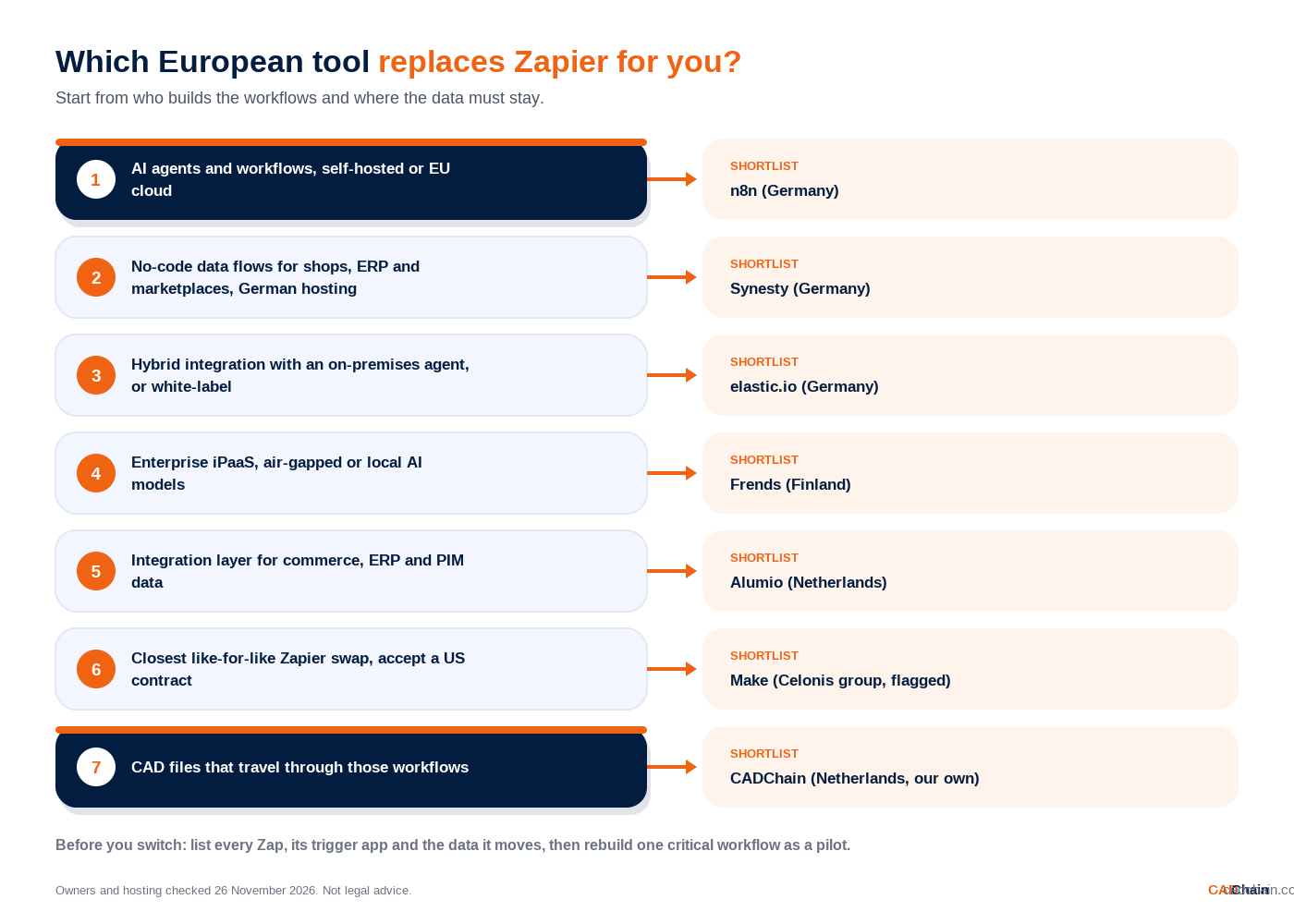
Automations also move files. When a workflow sends drawings to a supplier or a quote portal, the platform's hosting does not protect the model after it arrives. CADChain, our own product from Roermond in the Netherlands, protects CAD files at file level: who may open a model, for how long, and a blockchain record of every access. Read our complete guide to CAD file security, our trade secrets guide for deep-tech startups and the ARTEX AI case of hacking agents reaching OEM design data.
Migration checklist: moving from Zapier to a European tool
- List every Zap. Record its trigger, the apps it touches, the data it moves and who owns it.
- Pick the hosting model first. EU cloud, private cloud or your own servers; set the region before the first workflow.
- Recreate credentials. Create new API keys and OAuth connections in the new tool, then revoke the ones Zapier held.
- Rebuild one critical workflow as a pilot. Compare results and run history for a week before you move the rest.
- Check AI steps. Note which model each AI step calls and where it is hosted; switch to EU models for confidential data.
- Read the data processing agreement. Ask for the contracting company, sub-processors and log retention.
- Switch off Zapier last. Export your Zap list for your records, then cancel the subscription.
Your workflows moved to Europe. Now protect the CAD files they send. CADChain is our own product. It protects CAD files at file level, so control stays with the model whichever automation, cloud or supplier it reaches: you decide who opens it and for how long, revoke access when a project ends and keep a tamper-evident record of every access. See how blockchain compares with traditional DRM for CAD and our cloud storage security guide for CAD files.
👉 See how CADChain protects CAD files
This is the twelfth article in our series on European alternatives to US and other non-European software for engineering and deep-tech companies. Earlier parts cover AutoCAD, Ansys simulation, Xometry and Protolabs, Fusion 360, Microsoft Purview for CAD and IP files, JLCPCB and PCBWay, Revit, DocuSign and Box, Egnyte and ShareFile. For the wider picture, read our benefits of AI and automation for startups and how we connected the Tilda MCP server to Claude Code.
FAQ: European alternatives to Zapier
Is there a European alternative to Zapier?
Yes. n8n from Berlin is the strongest European alternative to Zapier, with AI agents, a cloud in Frankfurt and a free self-hosted edition. Synesty (Germany), elastic.io (Germany), Frends (Finland) and Alumio (Netherlands) are also run by EU companies. All were checked on their own websites on 26 November 2026.
Is Make a European company?
Make belongs to the Celonis group, whose affiliates include Celonis SE in Germany and Celonis s.r.o. in the Czech Republic, and it can host EU customers' data in Ireland or Germany. Since March 2026, however, its standard Master Services Agreement is with Celonis, Inc., a US company, under New York law.
Is n8n GDPR compliant and where is n8n hosted?
n8n GmbH is based in Berlin. n8n says data on its hosted plans is stored in the EU on servers in Frankfurt, on Microsoft Azure, and it offers a pre-signed data processing agreement. If you self-host n8n, the data stays wherever you run it.
Which Zapier alternative can I self-host in Europe?
n8n's Community Edition is free to self-host, elastic.io has a Self-hosting plan on request, and Frends runs on-premises, in Kubernetes or fully air-gapped. Self-hosting keeps credentials, workflows and run logs on your own servers.
Is there a free European alternative to Zapier?
The self-hosted n8n Community Edition is free, and Make's free plan gives 1,000 credits a month. Synesty and elastic.io offer free tests or trials before you pay.
What is the best European alternative to Zapier for AI agents?
n8n, because AI agents, MCP and human approval for tool calls are built into the same editor as ordinary workflows, and you can self-host it. Frends suits enterprises that need local AI models in air-gapped sites.